The Spectrum and Dimensions of Cryptocurrency Investment
TechFlow Selected TechFlow Selected
The Spectrum and Dimensions of Cryptocurrency Investment
Understanding the preferences, needs, and behaviors of the target audience is crucial to the success of the project.
 Navigating Web3 tides with focused insights
Author: Danny @Orthogonal Labs
In discussions about investing in projects, there's a common tendency to categorize them simply as either speculative (lacking fundamentals) or transformationally innovative. At Orthogonal Labs, we believe this binary view fails to fully capture the complexity of projects. Instead, we see the value proposition of investments as existing along a gradient—a spectrum without clear boundaries.
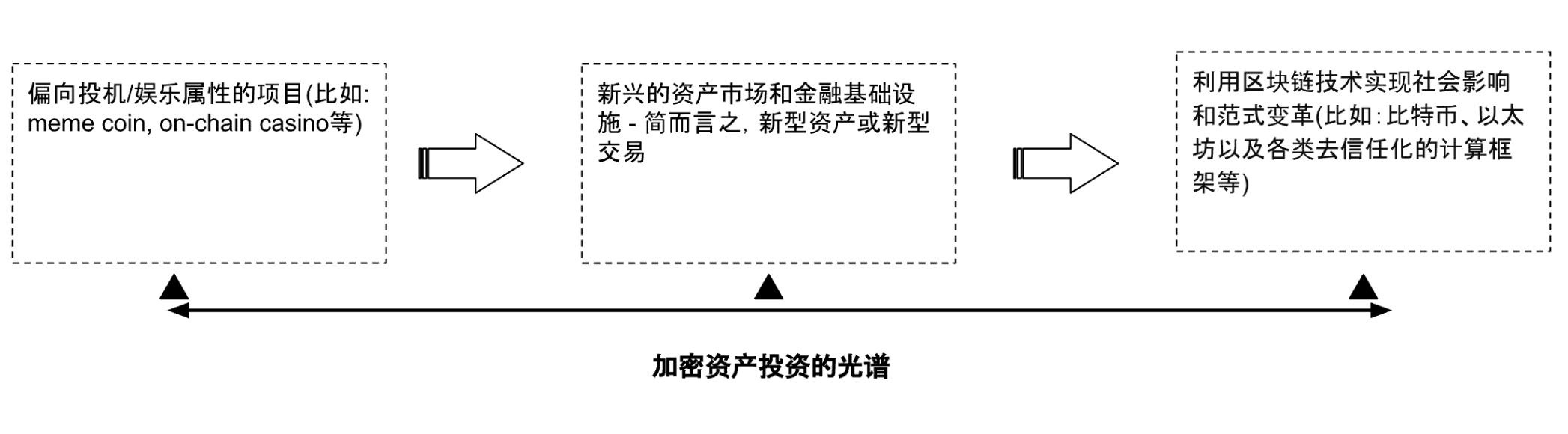
At one end of this spectrum are projects tailored for crypto-native users, offering relatively "entertainment-focused" experiences through speculation, gaming mechanics, or meme coins. We often question their value due to weak fundamentals. Yet, these projects achieve exceptionally high user engagement. Recent examples include the meme coin surge within the Solana ecosystem—$WIF, $SLERF, $BOME—as well as the 2023 Telegram bot frenzy (primarily used for trading meme coins), and similar traits we've observed with $RLB and $SHFL. Community and user participation are vital components of the digital asset space. In this sense, value isn't solely determined by investor perspectives but may depend more on community acceptance. From that standpoint, these projects do hold value—their “existence justifies their being.” That said, their limitation lies in typically failing to attract broader audiences or drive mass adoption of crypto assets.
At the opposite end of the spectrum are projects leveraging technology to create significant impact and transformation—such as Bitcoin, Ethereum, stablecoins, or trustless computing frameworks. These represent breakthrough innovations, akin to an orthogonal vector rising perpendicularly from the existing plane. Unlike the previously mentioned entertainment-driven projects, these are primarily driven by technological innovation and aim to solve foundational problems to enable broader blockchain adoption.
These projects focus on addressing critical challenges like scalability, censorship resistance, security, and usability—bottlenecks that hinder widespread adoption. If these deep-rooted issues can be resolved, such projects have substantial potential to drive meaningful and sustainable growth across the entire crypto ecosystem.
However, they also face their own challenges. While essential for laying the groundwork for mass adoption, these projects are often distant from end-users and real-world applications. This disconnect from immediate user needs can lead to difficulties in practical deployment and adoption (what people refer to as "dead infra"). In practice, many such projects may seem overly abstract, with unclear user positioning, becoming narrative-driven. They might gain short-term market attention, but long-term sustainability suffers due to limited support from broader user and developer communities.
From an investment perspective, while these projects' efforts may appear distant from practical use cases, their pursuit of solving core technical challenges deserves recognition. Market valuations reflect this, making them attractive to long-term investors seeking enduring impact in the crypto space. Unlike purely speculative or entertainment-focused ventures, these projects offer clearer, more stable, and long-term value propositions that could inspire broader technological adoption and transformative change across multiple domains. They represent a crucial area of investment.
Between these two extremes lies an intermediate category: emerging capital markets and financial infrastructure, which serve as vital bridges connecting both ends. These include tokenization of real-world assets, blockchain-based decentralized investment platforms, various decentralized finance protocols (DeFi), and other experimental models. Collectively, they introduce innovative assets and novel trading experiences (which I broadly summarize as “new assets” and “new trading”). While they may not directly bring revolutionary change, they signify major evolution in financial infrastructure. By creating new investment opportunities and fostering ecosystem maturity, they play a key role in shaping the future of finance in the digital age.
One interesting "experiment" in this domain is Friend.tech, which uses crypto to monetize KOLs/influencers’ time and engagement (despite sustainability concerns). Additionally, teams are exploring the convergence of AI agents with crypto—financializing decentralized AI agents could give rise to a new class of micro-assets, better unlocking the value of these agents. These initiatives highlight the potential at the intersection of blockchain, AI, and finance, adding depth to the evolving landscape of digital finance.
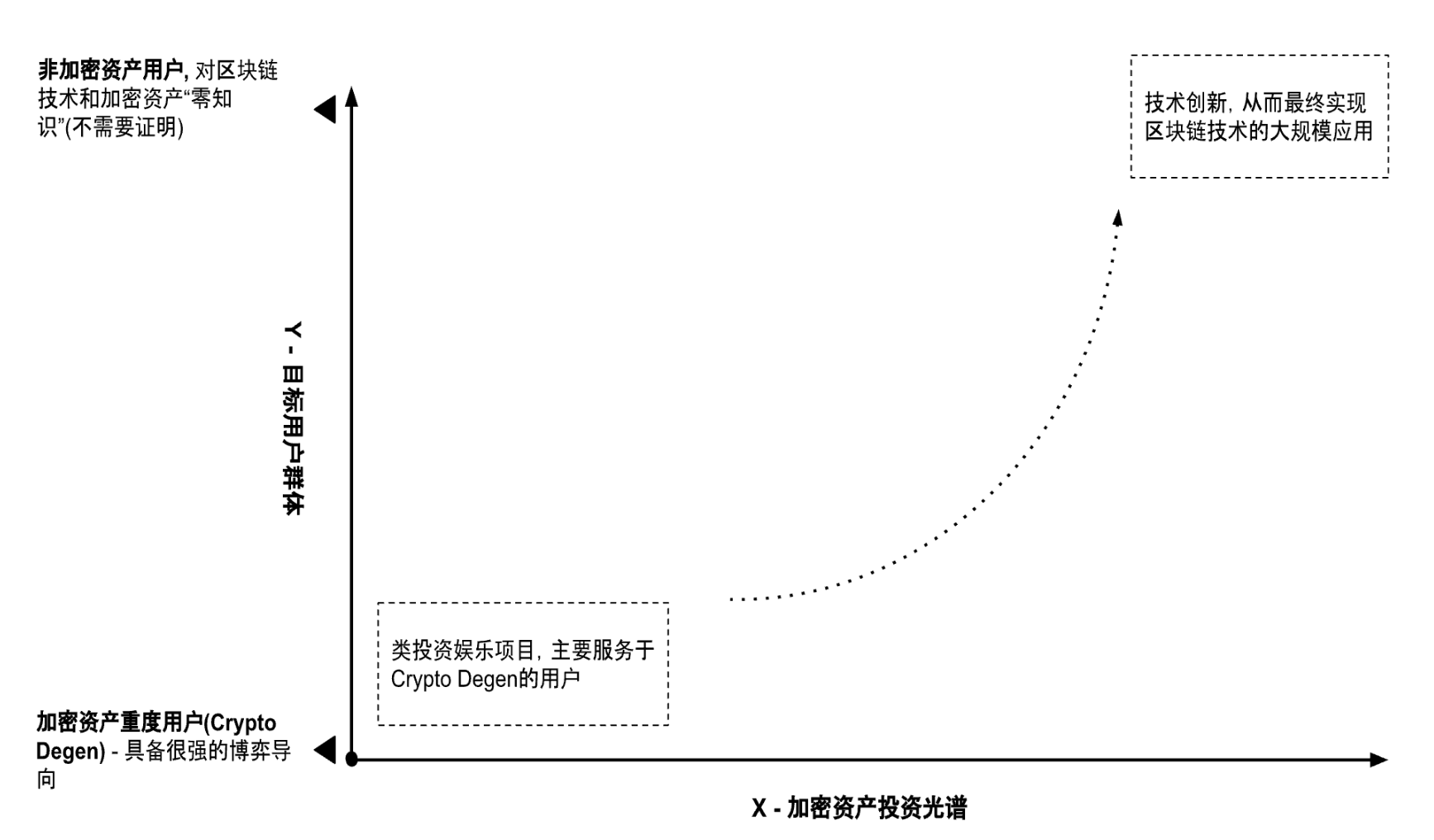
Extending further, we can frame this analysis as a coordinate system: the X-axis represents the spectrum from "entertainment-focused" to transformational projects, while the Y-axis represents user types—from non-crypto users to seasoned crypto enthusiasts. At the top of the Y-axis are new users who haven’t yet entered the crypto world; at the bottom are deeply involved members of the crypto community, often referred to as “Crypto Degens.”
Within the crypto space, people tend to analyze developments from a technical standpoint, focusing on innovation itself while overlooking the users being served. However, understanding the preferences, needs, and behaviors of target audiences is crucial to a project’s success. This underscores the importance of the Y-axis, representing a project’s user base and level of community engagement.
A classic example highlighting the importance of understanding user needs includes niche trading products such as pre-markets, OTC markets, and Points Markets. Although these platforms primarily serve Crypto Degens, teams like Aevo and Whales Markets have precisely captured and addressed user demands, demonstrating deep insight into their target audience.
Conversely, consider the oversimplification of lumping all blockchain games together—whether web2.5 or fully on-chain games. In reality, these cater to different user segments. From a broader crypto adoption perspective, their respective missions differ significantly. Treating them as interchangeable fundamentally ignores nuanced user preferences and behaviors. We’ll explore this distinction in greater detail in a future article.
The combination of the X and Y axes forms a two-dimensional framework. Within this framework, a project’s value increases as it moves from the bottom-left toward the top-right corner—especially if we consider “mass adoption” as the ultimate goal for the crypto community.
Every investor is likely searching for that top-right quadrant project: one that possesses technological innovation while resonating with diverse user types, attracting them and ultimately driving broader adoption and sustained growth across the crypto ecosystem—but this may remain only an “abstract possibility,” an idealized vision :-)
If you have any compelling ideas, feel free to reach out at [email protected]
About Orthogonal Labs
A long-term crypto fund founded by developers, engineers, traders, and investors from the cryptocurrency space. We believe disruptive innovation typically arises independently of existing practices or technologies—analogous to a vector orthogonal to the current dimension, exhibiting zero correlation. Cryptocurrencies embodied this trait from the start. We aim to support mission-driven founders pushing into uncharted dimensions and challenging established paradigms in the crypto space.
Join TechFlow official community to stay tuned
Telegram:https://t.me/TechFlowDaily
X (Twitter):https://x.com/TechFlowPost
X (Twitter) EN:https://x.com/BlockFlow_News
 @0x_danf