








Overview of Bitcoin Layer-2 protocol Side Protocol, the first modular settlement layer in deep collaboration with leading projects such as Babylon and Espresso
TechFlow Selected TechFlow Selected
Overview of Bitcoin Layer-2 protocol Side Protocol, the first modular settlement layer in deep collaboration with leading projects such as Babylon and Espresso
Bitcoin halving approaches, the launch code for SIDE?
 Navigating Web3 tides with focused insights
The future of blockchain technology seems inevitably modular. After Ethereum's Dencun upgrade, Ethereum will adopt EIP-4844 to enhance data availability, demonstrating the world’s largest smart contract platform’s ongoing shift toward a modular tech stack.
Bitcoin, the largest cryptocurrency asset, has recently seen its ecosystem begin to develop more Layer 2 solutions to scale Bitcoin’s capabilities—marking a move toward this modular trend. However, as more L2s emerge, many of the issues already familiar in today’s Ethereum L2 landscape—such as liquidity fragmentation and interoperability challenges—are likely to arise, potentially increasing user barriers and degrading interaction experiences. Moreover, it remains difficult for dApp developers to deploy applications onto their own Bitcoin rollups.
Recently gaining attention, the Bitcoin-side protocol Side Protocol is building a modular framework based on Bitcoin, creating a universal settlement and value exchange layer for Rollups, providing foundational infrastructure for the upcoming explosion in the Bitcoin ecosystem.
How Can a Settlement Layer Transform the Modular Landscape?
Modular blockchains are architectures that divide a blockchain network into distinct layers or modules, each responsible for different functions such as execution, settlement, and data availability. The settlement layer is a key component within this modular architecture, handling the finalization of rollup transactions—enabling high-cost transaction execution to occur off-chain while validity is confirmed on-chain.
However, as rollups grow, fragmentation among them becomes inevitable. This makes the role of a universal settlement layer even more critical—it can offer rollups not only settlement services but also enhanced interoperability, liquidity aggregation, and other valuable utilities.
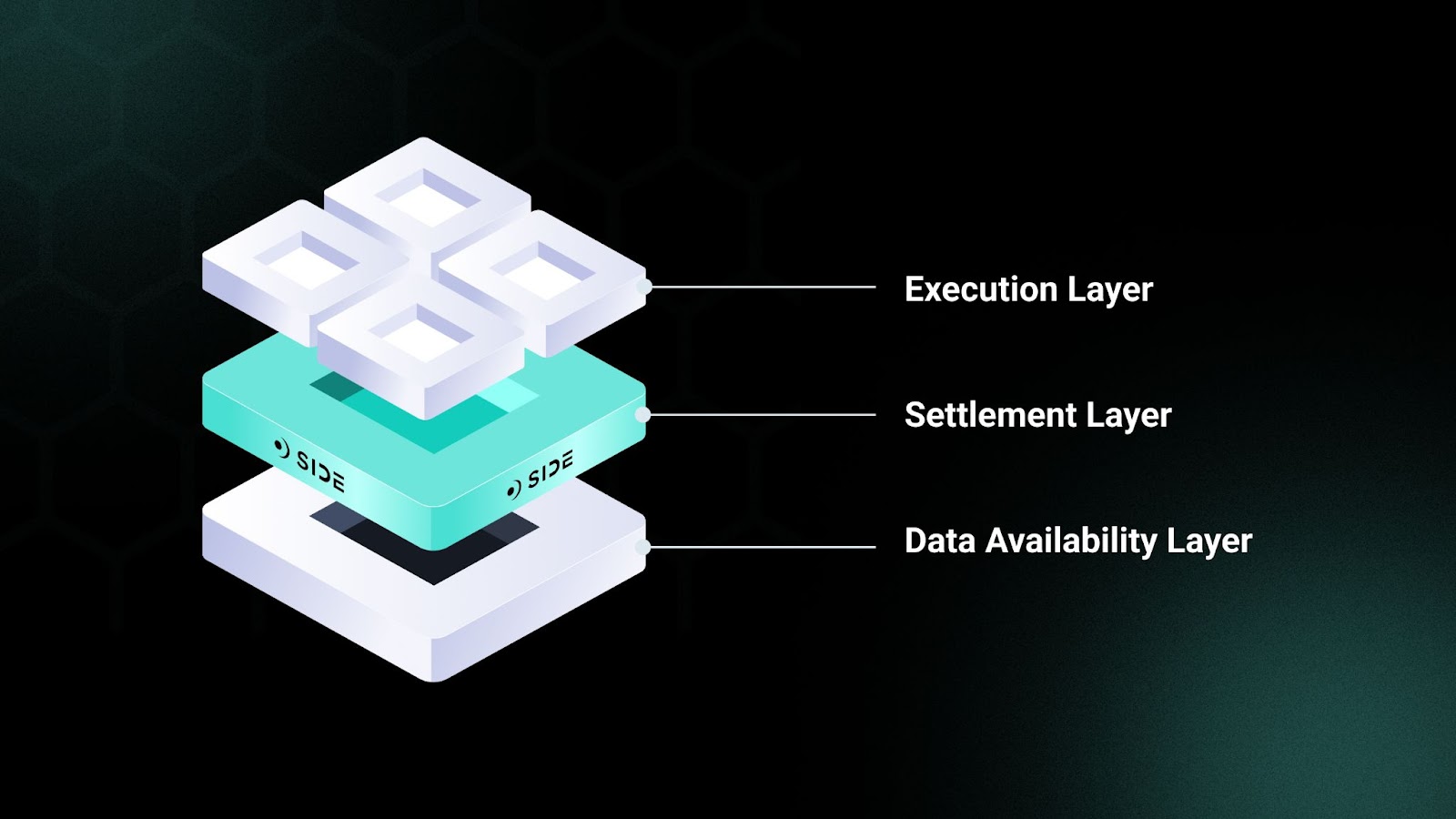
Side Protocol is precisely such a modular settlement layer purpose-built for the Bitcoin ecosystem. With Side Protocol’s developer tools and universal settlement layer, application developers can easily deploy their apps on custom rollups without sharing computing resources on a common smart contract platform. While enhancing rollup interoperability, it delivers a seamless, single-chain-like user experience—allowing the Bitcoin L2 ecosystem to leapfrog past fragmentation and enter the final chapter of scalable solutions.
Looking ahead, if Bitcoin enters the mainstream, we could see hundreds, thousands, or even tens of thousands of rollups. But they shouldn’t all be sovereign rollups. For most developers, it’s sufficient to focus solely on application logic at the execution layer, outsourcing non-core technical aspects like settlement and DA to specialized chains. Of course, every design involves trade-offs. Outsourcing the settlement layer sacrifices some sovereignty, but gains convenience, interoperability, unified liquidity, and more. By building a Bitcoin sidechain as the settlement layer, Side Protocol not only adds Bitcoin-native functionalities to rollups but also acts as a central hub connecting other major ecosystems like Cosmos, Ethereum, and Solana.
Side Protocol: The Ultimate Scaling Solution for Bitcoin?
What is Side Protocol? In one sentence: Side Protocol is a modular protocol for Bitcoin.
More specifically, its goal is to scale Bitcoin through a modular architecture—performing execution off-chain and using zk proofs for settlement on a Bitcoin sidechain. With the introduction of a dedicated settlement layer, developers can use Side Protocol’s toolkits to deploy standardized rollups, all using SIDE Chain as the unified settlement layer. These rollups can then choose from various data availability layers—such as Celestia, Nubit, or Avail—based on their needs and preferences regarding cost and security.
At the execution layer, Side Protocol provides zk-rollup modules like the Side SDK, enabling developers to rapidly launch their own rollups. It uses a zk-VM as the virtual machine environment, allowing rollups to submit state changes along with zero-knowledge validity proofs to the settlement layer. The zk proof system is modular and optional—rollups may outsource proof generation to third parties.
Side Protocol provides a Bitcoin sidechain serving as a universal settlement layer, fulfilling two primary roles. First, as a Bitcoin sidechain, it supports Bitcoin wallet connectivity and transaction signing, integrates with Babylon to leverage Bitcoin staking for enhanced security, and enables cross-chain movement of Bitcoin-native assets—including BTC and inscriptions—into various rollups. Second, as a rollup settlement layer, it handles core functions like transaction validation and settlement, while offering additional services such as atomic cross-rollup interoperability, liquidity aggregation, and asset trading. It also acts as a bridge, enabling assets from other ecosystems—including stablecoins, Ethereum, Solana, and Cosmos—to flow into the Bitcoin ecosystem.
Regarding atomic interoperability, Side Protocol enables Rollup Abstraction—similar in concept to chain abstraction—allowing users to interact across multiple rollups seamlessly without needing to know which specific rollup they're using, delivering a unified, single-chain-like experience. Combined with Side Protocol’s Bitcoin Connect feature, users can operate across all rollups using just one Bitcoin account and wallet.
For liquidity aggregation, Side Protocol employs a Hub-and-Spoke model, meaning all cross-rollup transfers can route through the settlement layer (the sidechain), eliminating the need for numerous point-to-point (P2P) connections.
On the asset trading front, Side Protocol will include a native decentralized exchange (DEX), becoming the liquidity hub of the Bitcoin ecosystem. Multiple trading mechanisms—including AMM and order book models—will be supported. BTC will serve as the primary financial quote asset and function as “modular money” to pay fees for execution, settlement, and data availability.
The services offered by the settlement layer are extensible, maximizing the benefits of modular architecture—making the settlement layer as crucial as the data availability layer. The team has hinted at introducing a cross-chain liquid staking module, allowing users to perform liquid staking across rollups directly from the settlement layer and earn LSD rewards.
With Bitcoin Halving Approaching, Is SIDE the Key to Takeoff?
Side Protocol has publicly announced integrations with leading projects across domains, including Babylon and Espresso. Core contributors include Shane Qiu, former early-stage researcher at Binance Labs, and previously Head of Growth at Nym—a DePIN project backed by a16z. According to public funding information, the team completed a pre-seed round last year led by Hashkey and KR1 (an early investor in Celestia). With the Bitcoin halving upon us, the mainnet launch is expected this year, and the testnet is currently live, with an incentivized testnet soon to follow.
The Bitcoin ecosystem has never been more vibrant with innovation and transformation. As Bitcoin becomes the world’s most dominant asset, Side Protocol is laying the foundational infrastructure for its ecosystem, paving the way for Web2 developers and users to join the Bitcoin revolution. Let’s welcome the convergence of Bitcoin and mass Web3 adoption.
Join TechFlow official community to stay tuned
Telegram:https://t.me/TechFlowDaily
X (Twitter):https://x.com/TechFlowPost
X (Twitter) EN:https://x.com/BlockFlow_News






