Pudgy Penguins Charges Toward the NFT Throne: How Did the "Chubby Penguins" Survive the Bear Market?
TechFlow Selected TechFlow Selected
Pudgy Penguins Charges Toward the NFT Throne: How Did the "Chubby Penguins" Survive the Bear Market?
When managed properly, NFTs will unlock the value of intellectual property.
 Navigating Web3 tides with focused insights
Text: Mu Mu
Editor: Wen Dao
While trading volumes and floor prices of well-known blue-chip NFTs such as BAYC, Moonbirds, and Doodles have declined, Pudgy Penguins has defied the trend, briefly becoming the top-selling NFT on March 9.
Starting in the second half of 2023, Pudgy Penguins’ floor price began a steady climb. In 2024, it repeatedly hit new all-time highs, surpassing 18 ETH by late February—worth approximately $59,000—showcasing strong market performance. According to CryptoSlam data, on March 9, Pudgy Penguins recorded over $4 million in 24-hour sales, outpacing CryptoPunks and BAYC to claim first place on the NFT sales leaderboard.
How did this “chubby penguin” cross the bear market and emerge as a new favorite among blue-chips?
Over the past year, brand building and IP-derived merchandise have been key strategies behind Pudgy Penguins' strong rise. By selling physical toys called Pudgy Toys linked to its NFTs, the project achieved $10 million in sales within less than a year.
The sale of 750,000 Pudgy Toys not only expanded the Pudgy Penguins NFT brand beyond the Web3 space but also attracted substantial offline traffic, fueling further growth in NFT sales. Even Luca Netz, CEO of Pudgy Penguins, acknowledged that widespread adoption of NFTs stems from users’ love for the IP.
The successful operation of Pudgy Penguins reaffirms the viability of converting Web3 IPs into tangible consumer products.
01 Floor Price Up 150% in One Year
In 2024, the NFT project Pudgy Penguins finally entered its spotlight moment. In Chinese-speaking markets, it bears a name fitting its image—"Fat Penguin." Recently, this "chubby penguin" has frequently challenged the throne of top NFT sales, with both floor price and sales volume surpassing two major NFT market leaders: BAYC and CryptoPunks.
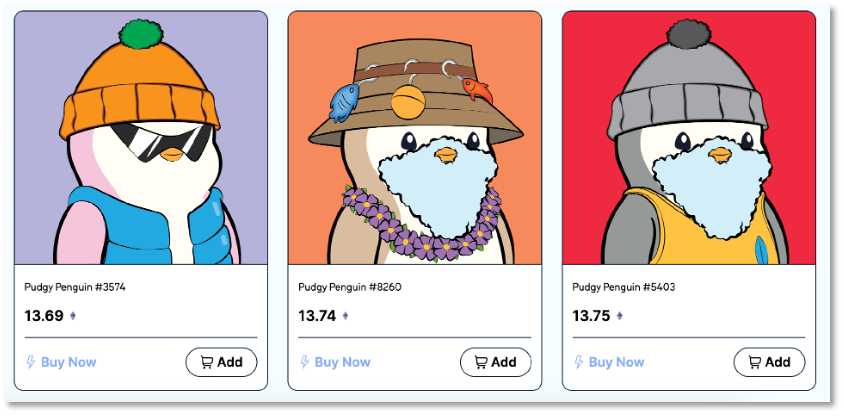
Pudgy Penguins NFT features 8,888 unique penguin images
On March 9, Pudgy Penguins generated over $4 million in 24-hour sales, overtaking CryptoPunks and BAYC.
On February 17, Pudgy Penguins’ floor price surpassed BAYC—the long-standing leader in the PFP NFT category—for the first time. Data from Blur showed that day BAYC’s floor price was 22.15 ETH (around $59,800), while Pudgy Penguins reached 22.54 ETH (about $60,900).
Although the lead was narrow, it marked a milestone reflecting Pudgy Penguins’ consistent upward momentum over recent months.
According to Dune analytics, Pudgy Penguins’ floor price has multiplied over the past 90 days, far outpacing other blue-chip NFT series such as CryptoPunks, BAYC, MAYC, and Moonbirds. In contrast, the "elder statesmen" BAYC and CryptoPunk show signs of stagnation.
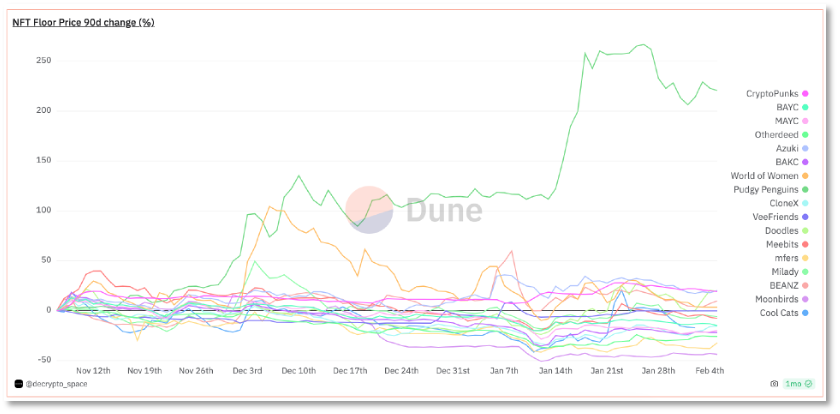
90-day floor price increase of blue-chip NFT projects
In terms of market capitalization, CryptoPunks and BAYC still lead due to their accumulated value during the previous cycle. However, upon closer inspection, BAYC has been on a downward trajectory since peaking in 2022, losing nearly 300% in market cap and now valued at $580 million. In contrast, Pudgy Penguins has steadily climbed, reaching $460 million.
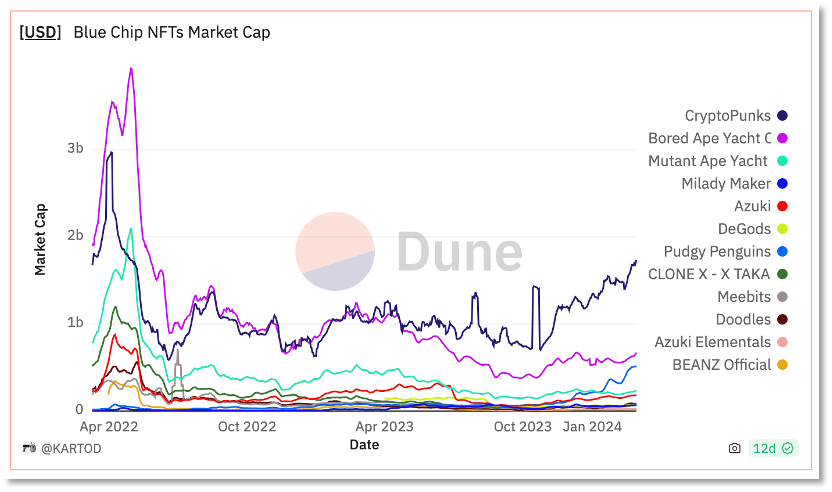
Market cap trends of blue-chip NFT projects
This sustained growth has also placed Pudgy Penguins at the top of NFT trending charts. Over the past 7 and 30 days, the "chubby penguin" ranked first among popular NFT projects, significantly boosting its brand power.
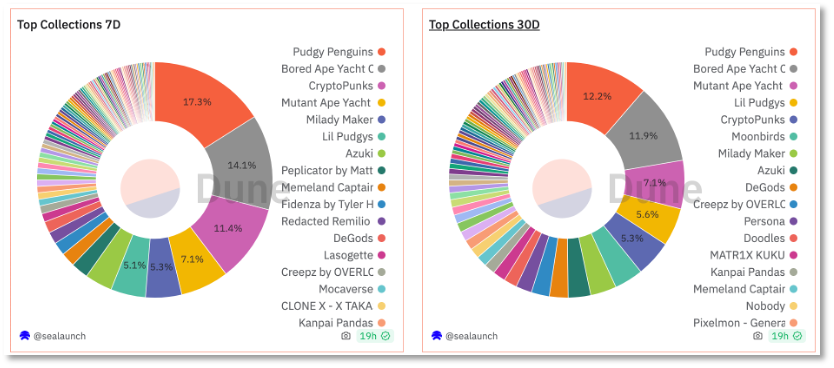
Top NFT Trending Projects – Last 7 Days / Last 30 Days
On March 13, CoinGecko data showed Pudgy Penguins’ floor price at 13.1 ETH (~$52,900), up 22% over the past month and 150% over the past year. Meanwhile, BAYC’s floor price had fallen to 14.55 ETH (~$58,700), down 35.2% over the past month and 78.4% over the past year.
One possible reason for user sell-offs is a recent acquisition by Yuga Labs, BAYC’s parent company. Last month, Yuga Labs acquired PROOF, the parent of Moonbirds, including its team, intellectual property, and art portfolio. However, due to negative sentiment around PROOF, the move sparked community backlash, and BAYC prices began a sharp decline shortly after.
Pudgy Penguins’ strong growth is now challenging established blue-chips like BAYC.
02 The Chubby Penguin’s Rocky Path Through the Bear Market
On Instagram, Pudgy Penguins already boasts over 1.33 million followers—and that number continues to grow. How did it survive the bear market and rise against the odds?
In fact, this IP composed of 8,888 image-based NFTs enjoyed a brief moment of glory during the NFT boom but later faltered due to trust issues, ultimately leading to a change in ownership.
In July 2021, a group of college students launched the Pudgy Penguins project. A month later, it gained fame thanks to an article by New York Times journalist Kevin Roose, pushing its floor price above 3 ETH. NBA superstar Stephen Curry even purchased one penguin for 3.5 ETH; #6873 set a record sale of 225 ETH for the collection.
Unfortunately, the young founding team failed to manage the project responsibly, causing several controversies. Criticism arose over a blind box event deemed insincere, prompting OpenSea to temporarily delist the project. Later, the team's mass selling of NFTs further discouraged community members, and Pudgy Penguins began a prolonged slump.
In April 2022, Pudgy Penguins was sold for $2.5 million to Luca Netz, who had experience running e-commerce businesses and now serves as CEO.
Before taking over, Luca worked across various physical businesses—dropshipping, serving as CEO of a jewelry company, and using marketing strategies to rescue a struggling apparel brand. In 2021, he became Chief Marketing Officer at toy gun company Gel Blaster. After one year there, he acquired Pudgy Penguins.
With extensive marketing experience, Luca prioritized brand-building and charted a clear path: creating sustainable revenue streams.
This approach differs sharply from legacy NFT operations. Yuga Labs succeeded largely by continuously launching derivative projects ("nesting dolls") tied to BAYC, rewarding holders with airdrops to boost engagement and drive demand during bull markets—an effective tactic when crypto markets were surging.
But when Luca took over Pudgy Penguins, the bull market was ending. Launching more derivative NFTs would only dilute the original collection’s value. During this shift from bull to bear, even Yuga Labs recognized this risk and began pivoting BAYC’s IP toward Web3 gaming ecosystems like Otherside to enhance utility. At that time, however, Pudgy Penguins’ IP was already weakened by poor management, and its brand equity had significantly eroded.
Luca decided to rebuild the IP value of the "chubby penguin" using Web2 methods.
After taking control, Luca focused on IP licensing and product development. In May 2023, following a $9 million fundraising round, Pudgy Penguins began selling physical toys called "Pudgy Toys" online.
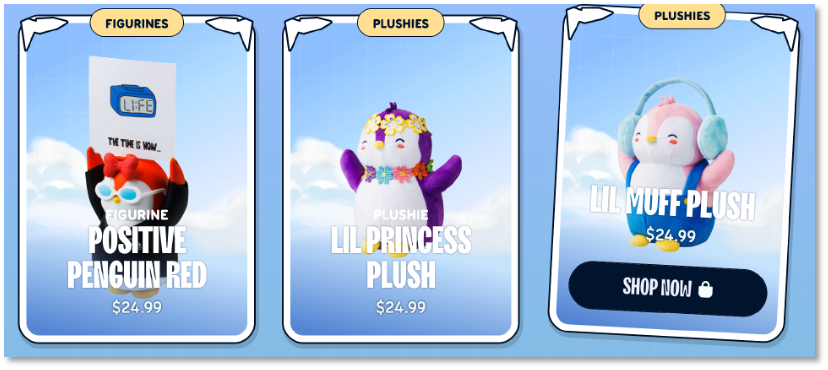
PudgyToys designed based on NFT characters
Pudgy Toys are modeled after the Pudgy Penguins NFTs, and Luca’s prior experience proved crucial—he successfully brought these toys into Walmart, a major retail chain.
By the end of September 2023, Pudgy Toys launched in 2,000 Walmart stores across the U.S., expanding the NFT IP into a vast consumer market.
Luca Netz personally promoted the initiative across social platforms and media: “For just $20 and three minutes, a Pudgy toy can give users their first blockchain wallet and NFT. No other product can onboard users into Web3 as affordably and effectively as ours. This is our Trojan horse.”
Indeed, leveraging IP derivatives to reach Web2 audiences proved highly effective. As reported by Decrypt, the Pudgy Toys line achieved $10 million in sales within less than a year, with over 750,000 units sold.
Beyond physical retail, Pudgy Penguins built a robust social media presence. On Instagram, its million-follower account regularly receives tens of thousands of likes per post. On TikTok, Pudgy Penguins has 250,000 followers, with its pinned video amassing over 13 million views.
With traffic secured, the next step was conversion.
To strengthen ties between NFTs and holders, Pudgy Penguins launched OverpassIP, a licensing platform allowing NFT owners to authorize partnerships with Web2 platforms or physical brands to generate income.
This revitalized the entire Pudgy Penguins NFT series, giving early adopters incentives to engage with real-world brands and amplifying the IP through broader markets.
Recently, Pudgy Penguins has further enriched its ecosystem by preparing to launch its own Web3 game, Pudgy World—a narrative-driven open-world experience for NFT and toy owners. Each physical penguin toy comes with a QR code; scanning it unlocks NFT items in-game or enables customization.
The Pudgy Penguins case reaffirms that NFTs are more than speculative assets in Web3. With proper branding and marketing, NFT IPs can, like any entertainment IP, accumulate lasting value and enable continuous innovation.
Unlike traditional IPs, Web3 NFT IPs benefit from built-in pricing markets. The existence of NFT trading platforms makes IP value transparent—hot properties are immediately visible on OpenSea, Blur, and similar marketplaces. Blockchain technology ensures transparent ownership records, providing the ideal infrastructure for IP circulation.
Looking ahead, Pudgy Penguins’ remarkable comeback suggests that in 2024, NFTs will continue evolving, exploring increasingly diverse use cases.
Join TechFlow official community to stay tuned
Telegram:https://t.me/TechFlowDaily
X (Twitter):https://x.com/TechFlowPost
X (Twitter) EN:https://x.com/BlockFlow_News