Interview with Pudgy Penguins CEO: Major Abstract Developments Coming, Ethereum and Solana Have Different Missions
TechFlow Selected TechFlow Selected
Interview with Pudgy Penguins CEO: Major Abstract Developments Coming, Ethereum and Solana Have Different Missions
"Currently, only these four chains are competitive," "The Ethereum Foundation has never contacted me."
 Navigating Web3 tides with focused insights
Author: Wenser, Odaily Planet Daily
At the beginning of the new year, PENGU token has been live for over a month and the Abstract mainnet has just launched. As the crypto media outlet most closely following Pudgy Penguins, the Abstract ecosystem, and its parent company Igloo.Inc, Odaily Planet Daily conducted an in-depth interview with Pudgy Penguins CEO Luca Netz. The discussion covered topics such as the PENGU token, the Abstract ecosystem, the competitive landscape between L1 and L2 networks, and the Ethereum vs Solana vision debate, aiming to gain deeper insights into the crypto industry from Luca’s perspective.
Below is the full transcript of the interview, with some parts edited or condensed for clarity. Readers may refer accordingly.
Note: Questions were posed by Odaily Planet Daily CEO Mandy and reporter Wenser; answers were provided by Pudgy Penguins CEO Luca Netz. The interview took place on January 31, 2025.
Q1: After launching the PENGU token, has the focus of work at Pudgy Penguins and its parent company Igloo.Inc changed?
Luca:
Yes, changes are happening. Although everyone in crypto—especially those who received the PENGU airdrop—knows about Pudgy Penguins, many still don’t understand our unique significance within the crypto space or what we ultimately aim to achieve.
So our new focus has become: “How do we make a lasting impression on new community members and the broader crypto world, and demonstrate our capabilities?” In other words, we have a lot to do—like helping hundreds of thousands of new community members understand what we’re building and showing them our vision. Of course, people will soon see our next moves.
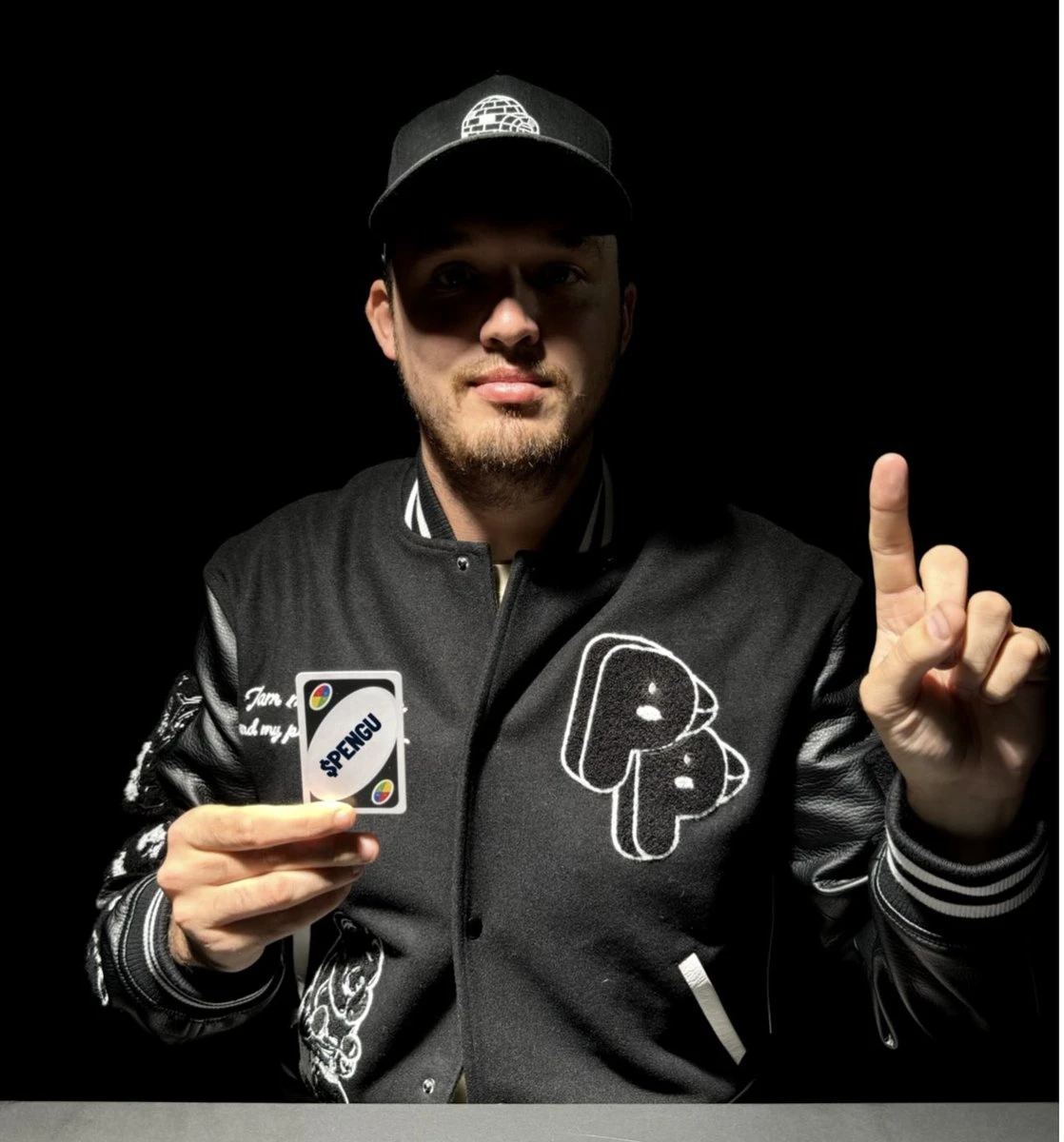
Luca appears during the PENGU token launch
Q2: The Abstract mainnet has just gone live. Are the initial metrics meeting expectations? Can you share future plans for ecosystem development and key initiatives?
Luca:
In short, our goal for the Abstract ecosystem is to make it “the most interesting place in crypto” and “the go-to environment offering a beginner-friendly, zero-to-one crypto experience.” If you log into the Abstract network and try out the current mainnet, we’ve already achieved this milestone to some extent.
The Abstract ecosystem allows third-party integrations and lets users join in their preferred way. Unlike other blockchain ecosystems that require specific processes or rigid entry methods, our user experience is more open and flexible. If users dislike certain fixed procedures, they can simply skip them.
Additionally, in about 3–4 weeks, the Abstract ecosystem will spark widespread discussion across crypto: we have numerous upcoming integrations and plug-ins that will bring significant liquidity, trading volume, and TVL into the ecosystem. Importantly, we aren’t optimizing for technical benchmarks—we’re optimizing for real users, including their families and friends. If they visit abs.xyz, they’ll enjoy a smooth and intuitive experience.
At that point, a highly vibrant and active on-chain ecosystem will be visible to all. Whether competing at the L1 or L2 level, Abstract is confident in standing out.
When others choose to go left, we choose to go right—that’s the story of Pudgy Penguins and Igloo. Once everything unfolds, people will look back and realize: “The Pudgy Penguins team actually had incredible foresight.”
Odaily Planet Daily: Can you reveal any details about the upcoming ‘big event’ in 3–4 weeks?
Luca:
Sure. First, we expect a large number of Web2 livestreamers to enter the Abstract ecosystem. Second, an ecosystem composed of 40–50 active funds will gradually emerge. Finally, I look forward to seeing more users voluntarily connect their MetaMask wallets—or use other preferred methods—to integrate with Abstract and various third-party projects.
Odaily Planet Daily: We noticed that the UI design of the Abstract mainnet feels very Web2-like, with extremely smooth interactions. Was this intentional?
Luca:
Absolutely. If our goal is mass consumer adoption, this approach is essential. Over the past five years, many projects have built their on-chain ecosystems the same way—they chose to go left. We went right. We want to reach people who haven’t entered the on-chain world yet. While this might feel unfamiliar to existing crypto users, imagine telling someone they need hours to piece together fragmented information just to execute a transaction on Ethereum. Now, by logging into abs.xyz, they can master on-chain transactions in under 20 minutes.
We’re using an approach no one else has tried to bring millions of new users into the on-chain world.
Q3: That was also NFTs’ original promise, but NFT market activity has been weak in this cycle. What’s your view on the future direction of the NFT industry? OpenSea recently launched its 2.0 points system, and many anticipate its potential token launch and airdrop. How might this impact the NFT space?
Luca:
I believe the NFT industry won’t recover unless some form of minimum royalty system is adopted.
What truly made NFTs great was the act of “minting.” Right now, top-tier blue-chip NFT projects like Pudgy Penguins, Doodles, BAYC, Azuki, Milady, and CryptoPunks are still active—we’re still at the table, aren’t we? If we had failed, we’d probably be gone by now.
Right now, people are just aligning themselves with tribes or communities and voicing opinions. So if we want an NFT revival, low royalties aren’t enough. Compared to other crypto sectors, the most engaging and competitive aspect of NFTs is minting and revealing. But then the question becomes: if project teams earn nothing after minting, they lose incentive to launch new projects. This is a major reason why many people avoid NFTs. It’s also why so many turn to pump.fun to launch tokens instead. That’s the core of the competition, in my view. We must respect what the majority wants.
Many leading projects have their own ideas about success, but clearly, they haven’t considered broader needs. Still, I respect those who dare to experiment. Over the past few years, many have built protocols and blockchain ecosystems, often starting with an NFT project to grow their community base—not starting with core products like blockchains or exchanges. That’s the path we’ve chosen.
Odaily Planet Daily: Will OpenSea’s token change the NFT industry?
Luca: Without a doubt, no.
Q4: You previously described PENGU as a meme coin. Can you share future plans for PENGU, such as staking, buybacks, burns, or other utilities?
Luca:
To be honest, we’ve kept a lot under wraps regarding PENGU. We labeled it a meme coin because meme coins feel more fun and less burdened by competitive pressure.
In terms of meme coin market cap, PENGU currently ranks 12th (based on data at time of interview. According to CoinGecko, at time of writing, PENGU ranks 9th among meme coins and 117th in overall crypto market cap).
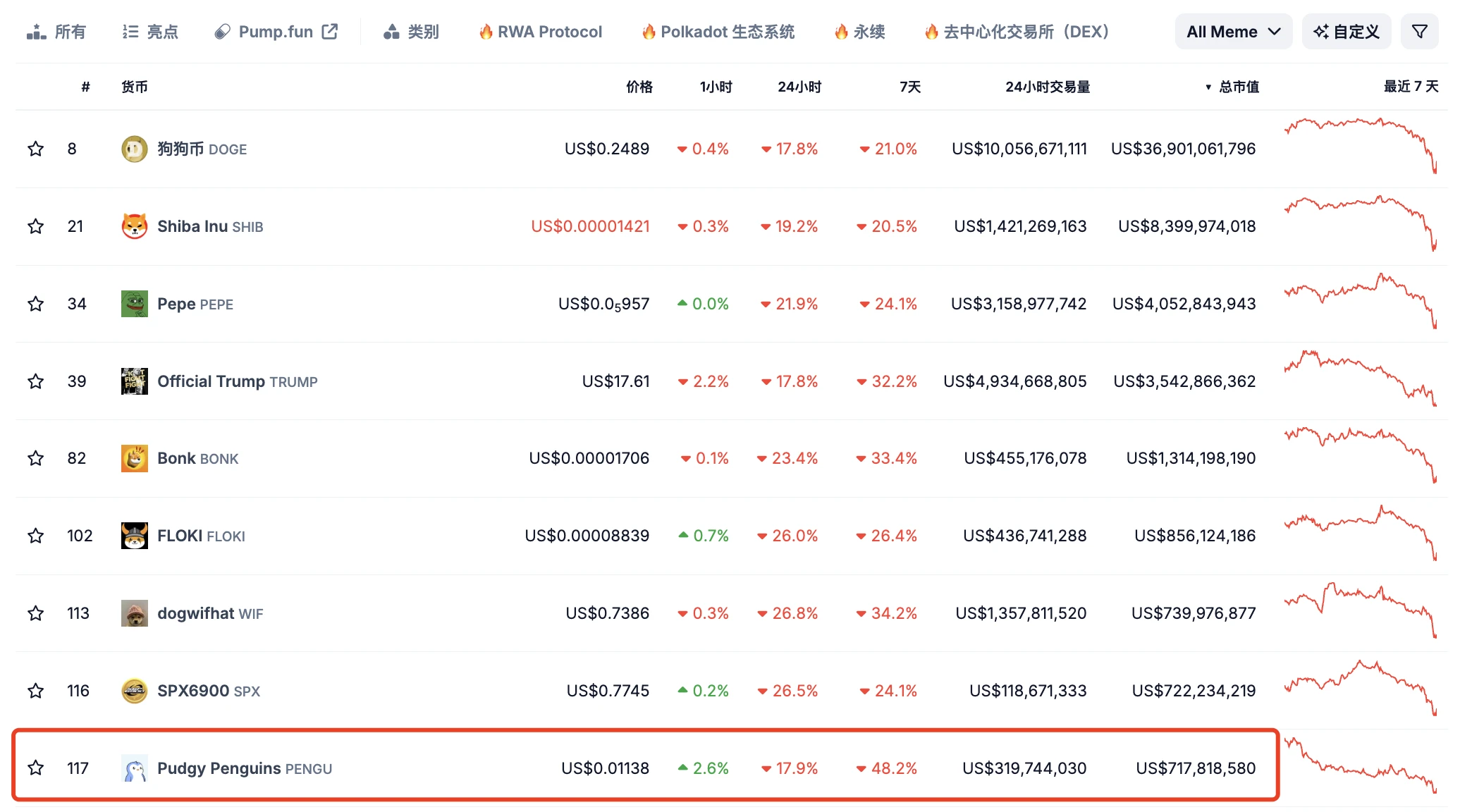
PENGU ranks 9th among meme coins by market cap
Meanwhile, Pudgy Penguins-related memes receive hundreds of millions of views daily. Millions of physical Pudgy Penguins toys have entered homes worldwide—no other meme has achieved this. Pudgy Penguins is arguably the cutest and most widely used crypto-native character in recent years, resonating with people across Asia, North America, Europe, and beyond. It’s a fully original, enduring, and battle-tested meme—an extremely rare phenomenon.
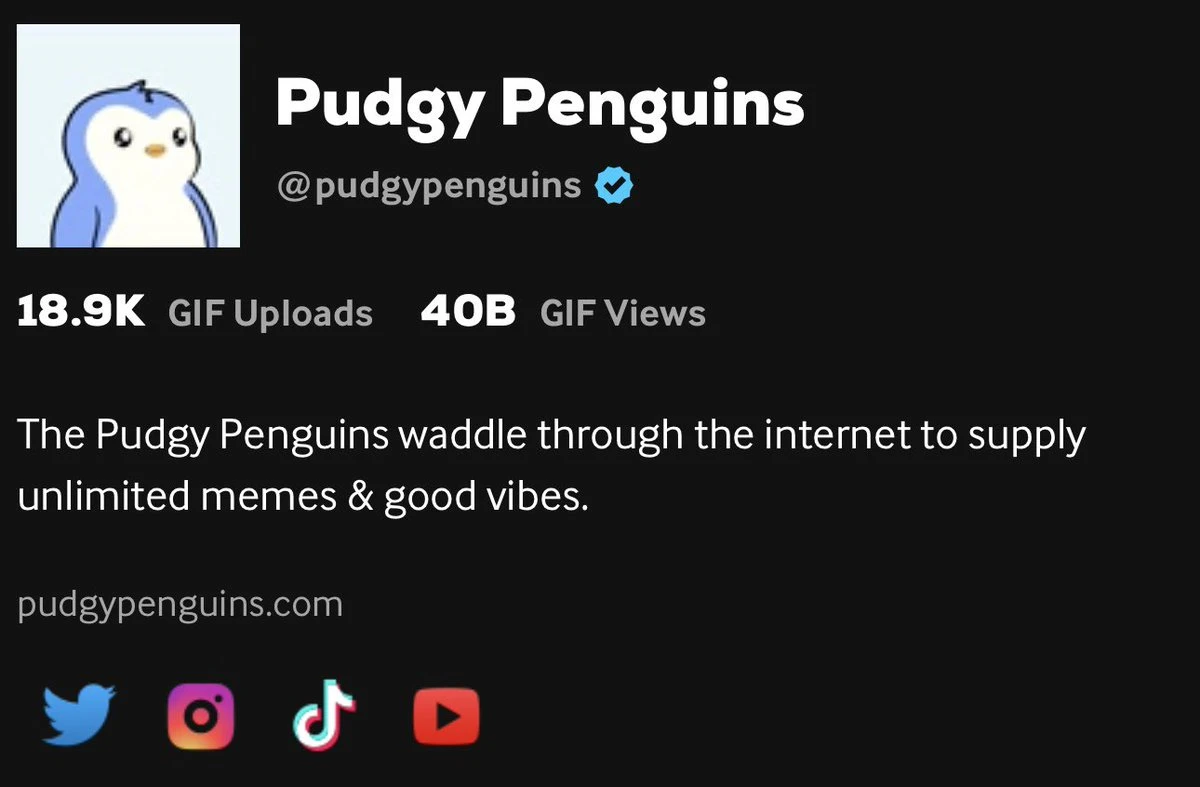
Views on Pudgy Penguins memes have exceeded 40 billion
So overall, in terms of significance and popularity, Pudgy Penguins and PENGU deserve far more than 12th place among meme coins. Personally, I believe they should rank in the top three.
Meme coins that do nothing will eventually fade away. Waiting passively for change is unrealistic. Trump has already changed the game—launching his official meme coin TRUMP—and many will follow. Hot money is flowing in, but expecting victory without action is a huge mistake.
How we view Pudgy Penguins and the PENGU token is crucial. We see it as a “meme coin ++” version.
You must build a brand. You must generate more demand around the IP. You must break barriers and boundaries. You must become more popular, more contagious, more viral. You must become a cultural phenomenon.
How?
Through games, movies, TV shows, content, social media, memes, gifts, toys, statues, collaborations with major brands—embedding yourself into culture. You must do it all. Without this, it’s hard to become a long-term winner.
Second, a continuously deflationary token model and a compelling narrative are essential. As everyone knows, PENGU was issued in the U.S., which is notable. But how do people perceive PENGU’s tokenomics? How do they understand supply, demand, mechanics, and ways to reduce supply?
We have many plans ready and will unveil them gradually over the coming months. Frankly, the operations of BONK and BONKbot inspired me greatly. If some projects aren’t good at this, they should improve quickly—or we’ll replace them.
The days when a successful meme coin could be created with just an animal picture and a supposedly strong community are over. Trump and TRUMP have opened Pandora’s box in an unavoidable way—previous animal-based meme coins cannot withstand the test of time amid waves of hot money and new innovations. You must actively respond weekly, even daily—burn tokens, overcome challenges, stay competitive while advancing the industry. Otherwise, the outcome won’t be good.
That’s why we call PENGU a meme coin: its technical architecture defines it as such; its token symbol features a highly meme-worthy penguin; it’s distributed to countless holders; its elements are embedded in cultural phenomena.
And why “Plus”? Because we plan to promote it in the world’s largest retail chains, advertise it on movie screens, feature it in novels, and release games on AppStore and countless desktop platforms.
We’ll bring unprecedented high-profile partners from the crypto space—we must do this.
Sometimes I ask myself: how can we burn part of the PENGU supply and let it surge ahead in the market?
If we execute all this, a positive “success flywheel” will emerge. That’s our thinking. Ranking 12th among meme coins isn’t satisfactory for us, nor for many others. On the other hand, if PENGU becomes part of films, games, and other content—just as we succeeded in NFTs—we’ll completely transform the meme coin space.
Q5: Will PENGU token have further integration or collaboration with Pudgy Penguins and Abstract? Will Abstract issue its own token in the future?
Luca:
I’ve received feedback indicating many people have misunderstood this recently. I’ve explained extensively to Western community members and tried my best to communicate with partners in the Eastern community.
(Odaily Note: Previously, Pudgy Penguins officially stated that the PENGU token would be linked to Abstract, leading the market to speculate it might become Abstract’s chain token—but in fact, they never intended this.)
We’re doing things for the PENGU community, and more surprises are coming. Not everyone may expect them, but we’re consistently delivering—bringing more community members onboard and creating greater value for PENGU holders.
But our capacity is limited. Much information remains confined within small circles. We might reach 10,000 people, but there are likely 1 million PENGU holders. Often, we fall into an information bubble.
Currently, the consensus is that my job is to integrate resources as much as possible—but doing one integration doesn’t mean that’s all we should do. Over the past few years, we’ve centered everything around Pudgy Penguins and iterated continuously. But we haven’t used multiplier points or soft staking to integrate the Abstract ecosystem and bridge liquidity here. That’s not how it works—the starting and end points are unrelated.
This is built for real-world use cases—a single example, not special rights or perks. We must ensure all information comes from official channels, clear and accurate—even a simple tweet must meet this standard. So announcements around PENGU, Abstract, and related news are just part of our work, not the entirety.
As for an Abstract token, when competition intensifies, I believe it will undoubtedly have its own token. But that will take time.
Regarding how PENGU will integrate with it, I can only say I’m very excited, and the community will be too. There may be astonishing convergence later, but right now, our priority isn’t that—it’s showcasing our extensive brand partnerships to the world.
In the coming weeks, our focus is highlighting Abstract’s competitive edge.
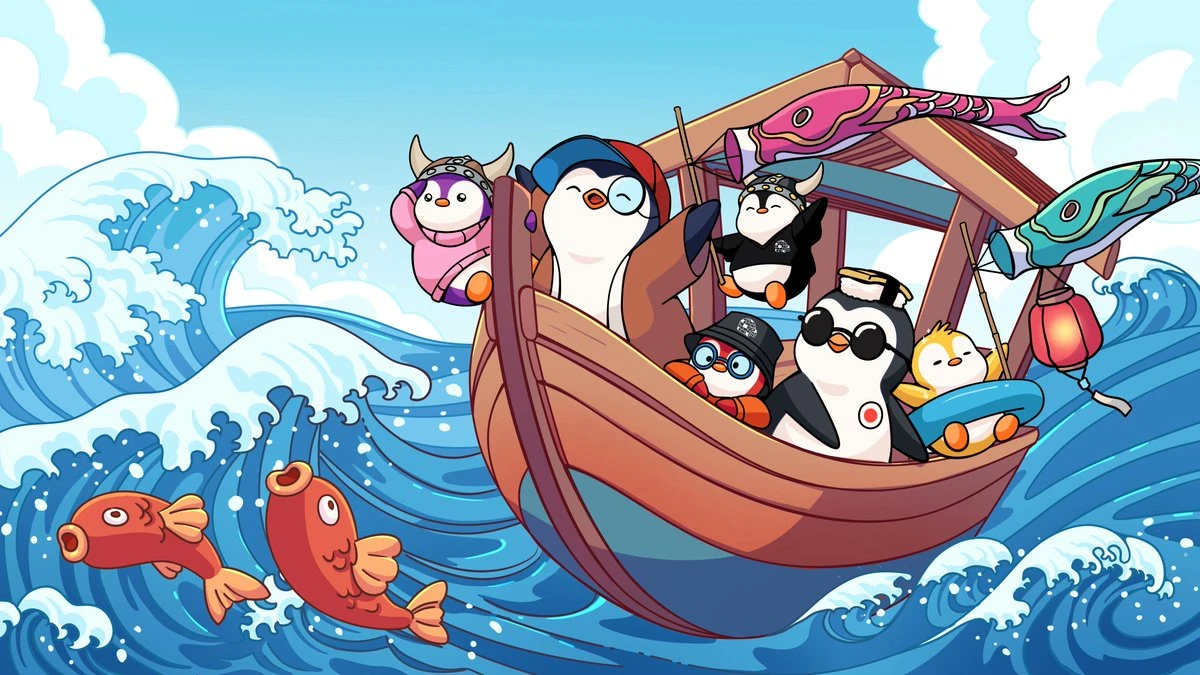
The future of Pudgy Penguins is vast and boundless
Q6: What do you think about Trump’s official meme coin TRUMP launching? Did you personally invest?
Luca: I know the people behind the project well—we’ve known each other for years, even before I entered crypto. But I didn’t get insider info or buy early. I just did a small swing trade. When I first saw TRUMP, its FDV was already $5 billion. So I bought $50,000 worth and sold shortly after.
I could’ve made a big profit, but I didn’t. At the time, I thought it was too expensive—its FDV seemed extremely high, especially considering Trump had backed smaller crypto projects before. My logic was comparing TRUMP to DJT stock, which also has a ~$5B market cap. (Odaily Planet Daily: Even though 80% of TRUMP tokens are locked.) Yes, that comparison was clearly flawed.
Q7: Trump chose Solana to launch his meme coin, intensifying the Ethereum vs Solana debate. You also launched your token on Solana. In a previous interview, you said “Solana has proven itself as a Consumer Chain.” Can you explain the difference between a “consumer chain” and a “financial chain”? Looking back, was this choice aligned with expectations?
Luca:
Yes, choosing Solana as the launch ecosystem for our token was the right decision. Solana leads in onboarding new users—arguably no other ecosystem does it better. We hope Abstract can bring similar achievements to the EVM ecosystem. From our perspective, Solana focuses on user experience, which Ethereum hasn’t prioritized—this reflects fundamentally different goals.
Ethereum aims to become a decentralized digital nation—a vision critical to every individual. Meanwhile, Solana strives to build the best-performing blockchain ecosystem and is aggressively fighting to win.
They have different visions: Ethereum aims to be important, decentralized, censorship-resistant infrastructure; Solana pushes the boundaries of blockchain capability, constantly shipping new innovations. The latter operates with stronger leadership, top-down execution, clear directives, and strict implementation. These are “two cultures, two visions.”
Therefore, comparing them outside the blockchain ecosystem is difficult. To me, they’re indirect competitors, not direct enemies, due to fundamentally different missions.
Mandy: Yes, with PENGU and TRUMP tokens launching, Solana has faced massive traffic pressure but passed each test successfully. Other blockchains would likely have collapsed under similar loads. No other blockchain ecosystem’s DEX has ever reached $30 billion in daily trading volume.
Q8: cygaar, a contributor to Abstract, previously discussed on X with joshrudolf.eth, a member of the Ethereum Foundation team, noting that EF doesn’t engage enough with projects on Ethereum. EF members acknowledged room for improvement. Vitalik previously proposed restructuring EF’s leadership, sparking controversy. What’s your take? How do you view the relationship between L1 and L2? Has the EF team contacted you recently?
Luca:
No, the Ethereum Foundation has never communicated with me.
Personally, I’d be happy to talk with EF. Given Pudgy Penguins’ achievements on Ethereum over the past few years, we’re arguably one of Ethereum’s best projects—but they’ve never reached out.
Honestly, as an entrepreneur, that feels unpleasant. Conversely, in the Solana ecosystem, I can contact co-founders Toly and Raj anytime, anywhere. I’ve discussed this privately with mentors and friends.
The conclusion: Ethereum wasn’t built for this (as mentioned earlier, its mission is a digital nation); Solana was. Ethereum’s mission isn’t to engage builders and nurture them, even though these builders are the primary force behind the ecosystem’s greatness. I personally disagree with this approach, but you know—Ethereum’s mission transcends all. Its goal is a censorship-resistant, resilient blockchain network, even if no one uses it.
It wasn’t designed to cater to me. Still, I believe Ethereum could be even more successful price-wise if it improved here.
Just as the TRUMP meme coin boosted Solana’s ecosystem and SOL’s price, we shouldn’t underestimate how NFT hype drove Ethereum’s price surge years ago—NFT bull markets brought ETH to all-time highs. Today, fewer people trade NFTs on Ethereum because there’s little for ordinary users. That’s why Solana is succeeding now. A month ago, Ethereum still ignored NFT projects built over years. When I placed Pudgy Penguins physical toys on Walmart shelves, I still received no recognition. It feels awful.
I’m contributing value to a network that doesn’t value my contribution. But after talking with my mentors, I realized: there’s no point complaining—Ethereum’s ambitions lie elsewhere.
Communicating with Solana’s top leaders is much smoother. That’s why I believe Solana has risen to the top. Until this changes, Ethereum may continue struggling—not just in NFTs. Even DeFi was severely underestimated by EF in the past. That view is insane—historically, NFTs predate DeFi. I think they’re finally turning a new page, recognizing DeFi and NFT importance.
Of course, EF developers aren’t commercial operators—that’s not their role. I understand them and deeply respect them. They’re foundational to the Ethereum ecosystem.
Q9: How do you view competition among blockchain ecosystems? With so many L1s and L2s today, how do you define and build core competitiveness?
Luca: I believe only four blockchains currently have strong competitiveness, clear vision, and real adoption: ETH, Solana, Base, and SUI (I give SUI more credit than many expect, even if overlooked, it belongs here).
I know meaningful activity is happening on SUI. Honestly, it’s hard to judge and filter. Networks like ZKSync, Arbitrum, and Optimism feel more like superchains, elastic chains, or underlying layers—not true standalone blockchain ecosystems, in my view.
These networks prefer others build L2s/L3s atop their stack rather than becoming central destinations themselves. They don’t prioritize consumer adoption but care about partnering with projects like Azuki or Pudgy Penguins to drive it indirectly.
Simply put, they don’t care about individual users—your family or friends. They only want to be the center of their own ecosystem. That’s a fundamentally different business model.
Among these four, Ethereum stays true to its mission. Solana, Base, and SUI may compete for the next tier, ranking first, second, third. The issue is, Base lacks distinct advantages over Solana and even struggles within the EVM space, while the EVM domain itself is shrinking.
This is where Abstract comes in—competing head-on with Base and others—but our UI and UX offer differentiation. Interface innovation is Abstract’s focus and our path to winning through user experience, branding, and community.
Also, it remains to be seen whether Base can do more than replicate Solana’s general-purpose model. If it follows rather than leads, Base—as an Ethereum scaling solution—will lose the capital race. Ethereum’s capital ≠ Base’s capital. You need something uniquely different.
Of course, Base’s team is exceptional. After spending months building Abstract, I better appreciate their incredible work and constant delivery of impressive products. We’ve learned a lot from them and hope this perspective serves as constructive feedback.
So, what’s the most challenging part of building a blockchain network—especially the unexpected aspects?
So far, ecosystem management has been toughest. On Abstract’s launch day, we could’ve done better. Intuitively, we had ~120 solid apps ready for EVM integration, but due to various reasons, only five were launch-ready. As everyone knows, launching a blockchain involves countless moving parts. But this is solvable—through communication channels, we’re now pushing each one forward step by step. It’s ultimately a management and operational challenge, especially ensuring fair treatment for all builders.
Q10: AI is undoubtedly the hottest topic today. Are you considering integrating AI or exploring other emerging fields? What specific directions are in progress?
Luca:
We have AI-related plans for the PENGU and Pudgy Penguins ecosystems. We’re about to deploy an AI project on Abstract with a seasoned AI expert from Japan—she’s a friend of mine, deeply experienced in Web2 digital avatars, with four years of AI humanoid creation, a pioneer in the field. She’s collaborated with LV and Balenciaga, and her digital avatars have walked runways as supermodels.
She’ll launch a new AI project and corresponding token on Abstract. I believe this will be the hottest token in the Abstract ecosystem to date, and I’m highly anticipating her product. Undoubtedly, our ecosystem is heading toward an AI explosion. Timing isn’t final, but I can reveal the AI’s name: Miria AI. This might be Abstract’s coolest near-term AI project—unlike the AI agents flooding X, it’s more like a luxury brand in AI, akin to LV or Balenciaga.
Q11: What new progress has Pudgy Penguins made toward mass adoption—such as online/offline toy sales, IP collaborations? How do you extend an IP’s lifecycle? How does the Pudgy Penguins team balance traditional IP business with crypto-native operations?
Luca:
Yes, we’ll announce new updates this week, including several offline stores in Korea. A few days ago, we announced a collaboration with Candy Pez, a highly recognizable and respected retail brand (Odaily Planet Daily note: an Austrian company founded in 1927 specializing in candy and manual candy dispensers, also known as Pez). We’re actively pursuing brand partnerships. Last year, Pudgy Penguins toy sales surpassed 2 million units, performing exceptionally well. In December 2024 alone, we sold approximately 400,000 toys—the best monthly record to date.
Regarding business balance, our team has 65 members: 20 in crypto and 45 in IP. Clear division of labor ensures good balance.
Q12: Can you share your outlook for 2025?
Luca:
I believe this year will belong to Igloo. PENGU’s market position won’t remain at 12th among meme coins—it’s poised to break into the top three. Abstract will become the sole competitor driving user adoption, going head-to-head with Base. I believe Pudgy Penguins NFT will become the #1 NFT project by market cap before year-end.
Q13: As a creator, how can one contribute to the Abstract ecosystem and receive corresponding rewards?
Luca:
Yes, the livestreaming mechanism is one of the most exciting parts of the Abstract ecosystem, and I hope everyone participates. For individual content creators, we’ll offer substantial rewards—this category gets high allocation.
I and the Abstract ecosystem deeply respect content creators. Especially livestreamers—for example, sports streamers can earn rewards by broadcasting basketball games, though the amount may not be huge. The key is that users can anchor content around a dedicated Abstract livestreaming app, enhancing engagement, expanding network effects, finding their PMF, and kickstarting growth flywheels. For top streamers, this is a once-in-a-lifetime opportunity.
If a token in the Abstract ecosystem achieves this, the reward will be substantial. But the prerequisite is contributing to ecosystem growth. Streaming sports content on Twitch or other platforms means little to me. But if you stream on an Abstract app and consistently create ecosystem-relevant content, your rewards will be maximized. So your next step is applying as a creator and completing the process. We’ll reveal more details in the coming weeks.
Odaily Planet Daily: Does this mean Abstract could become a competitor to YouTube, TikTok, and other social media platforms?
Luca:
Yes, exactly.
Join TechFlow official community to stay tuned
Telegram:https://t.me/TechFlowDaily
X (Twitter):https://x.com/TechFlowPost
X (Twitter) EN:https://x.com/BlockFlow_News
 Odaily