
Top 12 Layer1 Projects of 2024: Analysis of Features, Advantages, and Investment Potential
TechFlow Selected TechFlow Selected
Top 12 Layer1 Projects of 2024: Analysis of Features, Advantages, and Investment Potential
Before investing in any cryptocurrency asset, thorough research should be conducted.
 Navigating Web3 tides with focused insights
By Kane Pepi
Translation: Baishuo Blockchain
Layer 1 cryptocurrencies play a crucial role in the crypto world by providing the foundational framework for blockchain networks, offering scalability, security, and decentralization.
As we look ahead to 2024, understanding the dynamics of these platforms is essential for investors seeking growth potential within the cryptocurrency industry.
This article highlights the top Layer 1 cryptocurrency projects of 2024, exploring their unique features and advantages.

1. List of Layer 1 Cryptocurrencies
For anyone interested in Layer 1 projects, here is a brief list of Layer 1 blockchains:
Bitcoin (BTC): As the highest market cap and the first and largest cryptocurrency in the world, Bitcoin remains one of the premier Layer 1 projects. With a capped supply of only 21 million tokens, Bitcoin has become an ideal store of value. Bitcoin will undergo its next halving event in April 2024, which could trigger a prolonged bull market. Bitcoin is also expected to receive its first ETF approval from the U.S. Securities and Exchange Commission (SEC).
Ethereum (ETH): Thousands of secondary tokens operate on the Ethereum blockchain, making it the most popular Layer 1 blockchain among developers. Ethereum hosts everything from metaverse and play-to-earn gaming to decentralized finance ecosystems. Despite its massive market cap, many analysts believe its current value represents only a fraction of its future potential.
Solana (SOL): This Layer 1 blockchain offers a compelling alternative to Ethereum in terms of speed, cost-efficiency, and scalability. Solana can handle smart contracts and decentralized applications without compromising security or energy efficiency.
BNB (BNB): Supporting the world’s largest cryptocurrency ecosystem, BNB is Binance's Layer 1 blockchain. Paying transaction fees on the BNB chain is mandatory and provides a 25% discount on Binance trading fees. BNB is a deflationary Layer 1 project; Binance regularly removes tokens from circulation. Investors can purchase BNB at a price 66% lower than its all-time high.
Ripple (XRP): This Layer 1 blockchain facilitates cross-currency transactions between financial institutions. XRP provides real-time liquidity bridging, ensuring solid long-term utility. Ripple is used by some of the world’s largest banks, meaning it may eventually replace the SWIFT network. XRP has risen 60% over the past 12 months but remains 84% below its all-time high.
Cosmos (ATOM): Launched in 2019, Cosmos developed the Inter-Blockchain Communication (IBC) protocol. This allows competing blockchains to communicate and share data without relying on centralized providers. ATOM is the Layer 1 cryptocurrency powering Cosmos. Currently, it trades at 78% below its all-time high. ATOM has a market capitalization exceeding $3.7 billion.
Avalanche (AVAX): A Layer 1 blockchain network claiming infinite scalability, Avalanche offers near-instant transaction confirmation. It also enables ERC-20 projects to bridge onto its network, charging a 0.025% fee on the bridged amount. Its native cryptocurrency AVAX trades at 85% below its 2021 all-time high.
Cronos (CRO): Supporting the Crypto.com exchange platform, Cronos is a highly scalable Layer 1 blockchain with low fees. The Cronos network supports smart contracts and dApps, with transaction fees paid in CRO tokens. Crucially, CRO gives exposure to the Crypto.com platform, which aims to increase its market share during the next bull run.
Stellar (XLM): Launched in 2014, Stellar is a Layer 1 blockchain supporting fast, cheap, and scalable cross-border transactions. It has partnered with IBM, MoneyGram, and other well-known entities. XLM is the project’s native cryptocurrency, with a current market cap of $3.4 billion. Investors today can buy at a discount of up to 86% from its all-time high.
Polkadot (DOT): Another top-tier Layer 1 blockchain advancing interoperability, Polkadot aims to be the “blockchain of blockchains” in the Web3 era. One of the most energy-efficient Layer 1 protocols, Polkadot has a market cap approaching $8 billion. DOT, its native token, is down 90% from its all-time high.
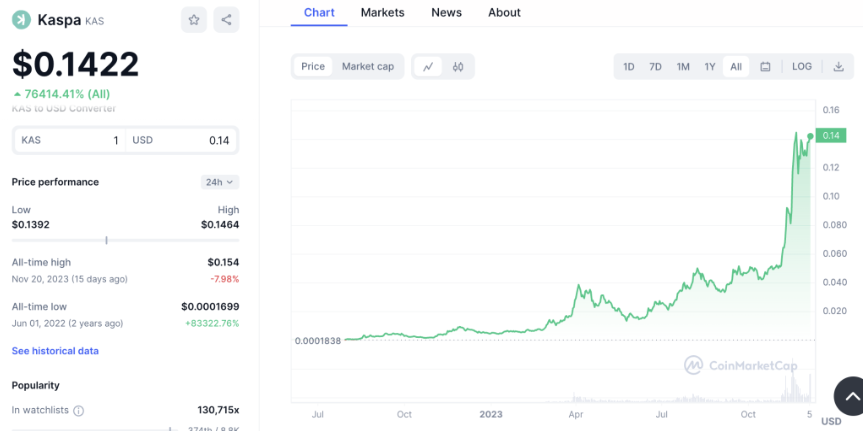
Kaspa (KAS): One of the fastest-growing cryptocurrencies, Kaspa has surged over 7,000% since its launch in July 2022. In the past 12 months alone, this Layer 1 cryptocurrency has grown more than 1,800%. Kaspa uses a proof-of-work model but confirms transactions in seconds.
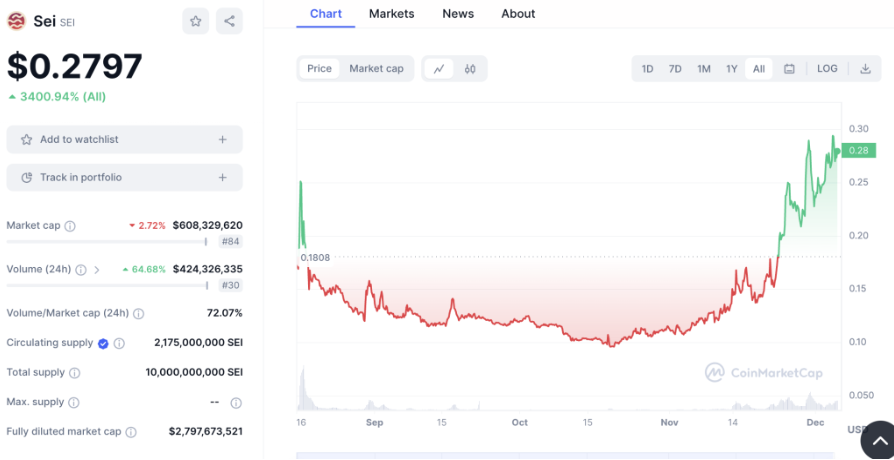
Sei (SEI): A new Layer 1 project launched in August 2023. Since then, Sei has surged over 3,400%, making it one of the best-performing cryptocurrencies this year. The Sei blockchain can process up to 20,000 transactions per second with finality speeds of 380 milliseconds.
2. Top Layer 1 Cryptocurrency Projects – In-Depth Analysis
The following sections will help you understand the long-term potential of each Layer 1 cryptocurrency listed above. Keep reading to discover the best Layer 1 tokens for your investment portfolio.
1) Bitcoin (BTC): Overall Best Layer 1 Blockchain for Long-Term Investors
Although short-term gains may appear modest compared to other cryptocurrencies, we still consider Bitcoin the overall best choice. Launched in 2009, Bitcoin is the original Layer 1 blockchain. It holds the largest market cap of any cryptocurrency, peaking at over $1.4 trillion in value.
This was when Bitcoin traded near $69,000. Last year, Bitcoin dropped below $16,000 but has since recovered to over $61,000.
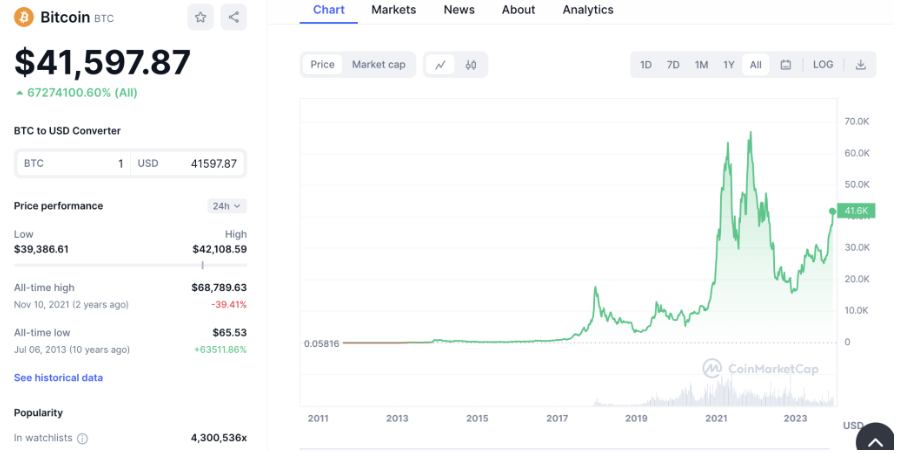
There is currently significant bullish sentiment surrounding Bitcoin. First, analysts predict the SEC will approve the first Bitcoin spot ETF in 2024, potentially triggering massive institutional investment inflows.
Equally notable is Bitcoin’s upcoming halving event, expected in April 2024. This will reduce the 10-minute issuance of new Bitcoin by 50%, down to 3.125 BTC. Ultimately, while some analysts believe Bitcoin could surpass $100,000 next year, this might just be the beginning. Therefore, we are confident that Bitcoin remains one of the top Layer 1 cryptocurrency projects for long-term holders.
2) Ethereum (ETH): Most Popular Layer 1 Blockchain Favored by dApp Developers
Ethereum is the most popular Layer 1 cryptocurrency project, favored by decentralized application (dApp) developers. While most dApps remain inactive, there are hundreds of thousands of secondary tokens on the Ethereum network. Those that are active represent some of the largest market-cap cryptocurrencies, including metaverse projects like Sandbox, Axie Infinity, and Decentraland.
Ethereum also hosts some of the leading decentralized exchanges, including Uniswap and Sushiswap. DeFi platforms such as Aave, Yearn.finance, and Compound also prefer Ethereum. Crucially, every project on the Ethereum network pays transaction fees in ETH, ensuring strong ongoing demand for the world’s second-largest cryptocurrency.
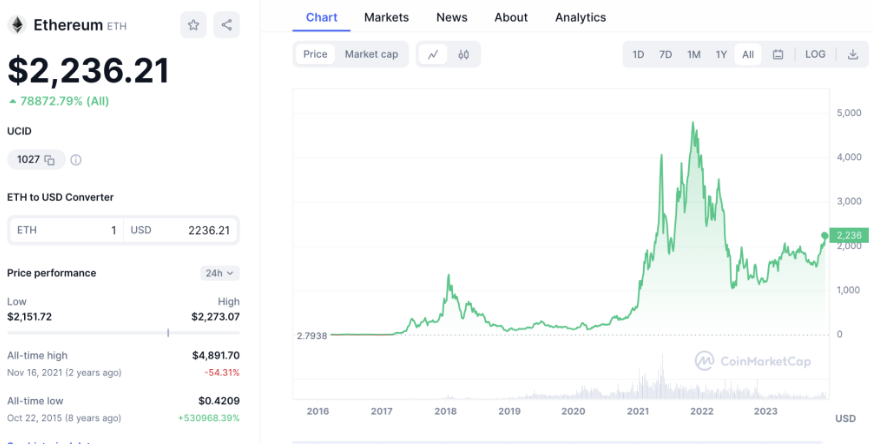
Despite increasing competition from other Layer 1 blockchains, Ethereum still dominates the vast majority of the dApp market. After all, Ethereum was the first to launch a smart contract platform, giving it a significant first-mover advantage. In valuation terms, Ethereum currently has a market cap exceeding $350 billion.
Now trading above $2,900, it is higher than 12 months ago. However, like most top-tier Layer 1 blockchains, Ethereum still trades at an attractive discount. Investors today can buy it at 58% below its nearly $5,000 all-time high. Given that BlackRock recently filed an Ethereum ETF application with the SEC, this could mark the beginning of the next bull market.
3) Solana (SOL): One of the Best Long-Term Investment Layer 1 Blockchains
Solana is one of the most promising Layer 1 cryptocurrency projects for long-term investors. A key question analysts are watching is whether Solana will capture significant market share from Ethereum. According to CoinMarketCap, the Solana ecosystem contains only 218 cryptocurrencies. In contrast, Ethereum hosts thousands.
Moreover, most Solana-based projects are small-cap cryptocurrencies with limited trading volume. Nevertheless, Solana is the superior Layer 1 blockchain in performance—a critical metric, as dApp developers want their projects to run on the fastest and most efficient chains.
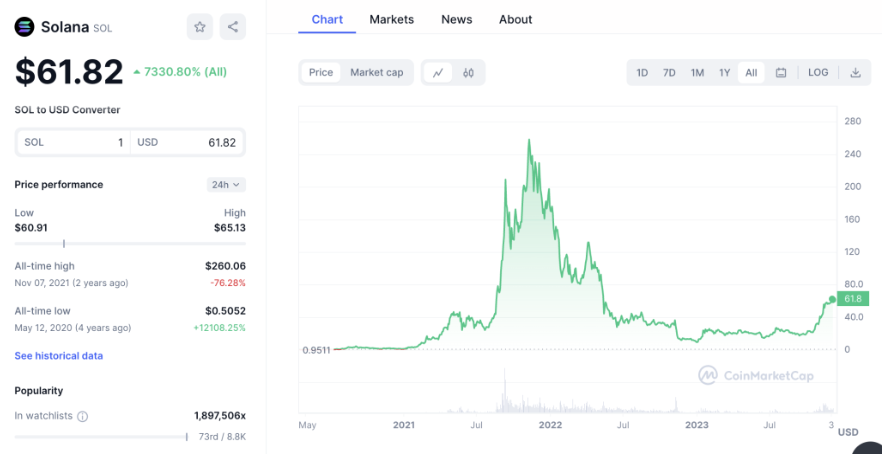
While Ethereum handles around 30 transactions per second, Solana has successfully processed over 65,000 TPS in testing. This makes it far better suited for high-volume transaction throughput. Additionally, Solana’s transaction fees are significantly cheaper than Ethereum’s—averaging just $0.00025 worth of SOL per transaction.
So what is Solana’s upside potential? Currently, Solana is one of the best-performing cryptocurrencies. Over the past 12 months, SOL has increased by more than 360%. Since early 2020, SOL has gained over 7,300%. Yet, you can still enter at a substantial discount—Solana currently trades at $116.25.
4) BNB (BNB): Layer 1 Blockchain Powering the Binance Ecosystem
BNB, the third-largest Layer 1 cryptocurrency by market cap, is also worth considering. This blockchain powers the Binance ecosystem. Like Ethereum and Solana, the BNB chain supports smart contracts and dApps. Thousands of projects, known as BEP-20 tokens, operate on BNB.
BEP-20 projects require BNB as the transaction token when settling fees. BNB also has utility on the Binance exchange, offering a 25% discount on standard trading commissions. BNB is also a deflationary Layer 1 cryptocurrency—Binance regularly burns BNB tokens, removing them from circulation.
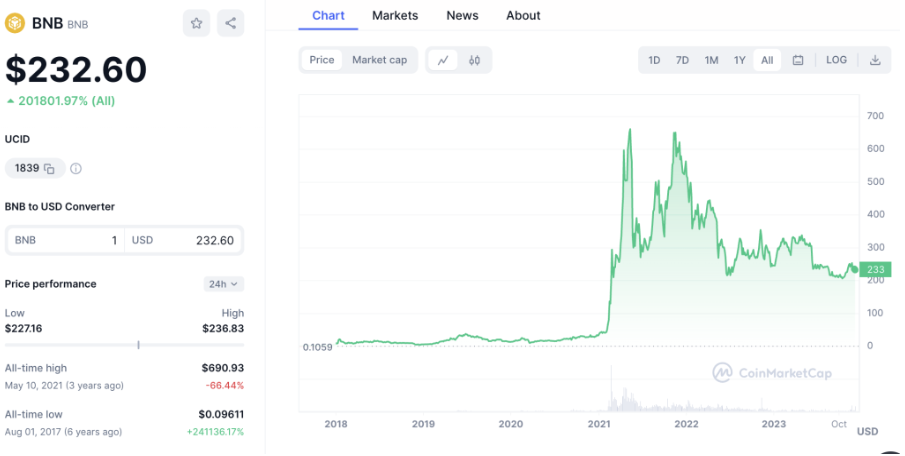
In terms of price performance, BNB has surged over 20,000% since its late-2017 launch. Nonetheless, BNB declined 20% over the past 12 months. Currently priced at $376.90, it trades about 46% below its previous all-time high of approximately $690. Ultimately, Binance is the largest crypto exchange by trading volume, so BNB offers investors exposure to its continued growth.
5) Ripple (XRP): Layer 1 Payment Network for Cross-Currency Transactions
Ripple is one of the earliest Layer 1 blockchains—the network launched in 2012. The technology targets large financial institutions needing international transactions. Ripple streamlines the process, completing cross-border transfers in under five seconds.
Additionally, fees are typically less than one cent, and the network can handle up to 1,500 transactions per second. Ripple is particularly useful for cross-currency transactions, especially when transferring funds into emerging markets. Its native cryptocurrency, XRP, provides real-time liquidity.
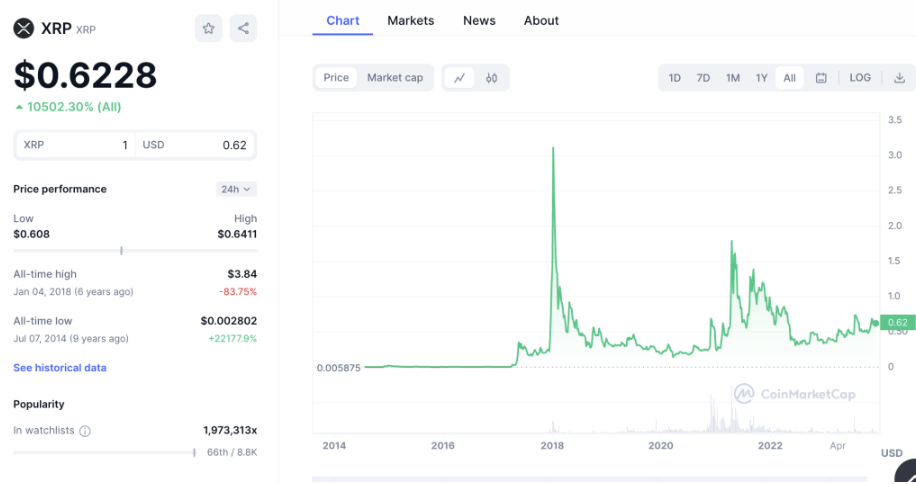
This means financial institutions no longer need to rely on SWIFT, which typically depends on correspondent banking networks. Since some of the world’s largest banks already use Ripple, XRP is one of the best Layer 1 cryptocurrency projects worth considering. In February 2024, XRP traded at $0.5359.
6) Cosmos (ATOM): Enables Layer 1 Networks to Share Data via Inter-Blockchain Communication
Cosmos is a Layer 1 cryptocurrency project that developed the Inter-Blockchain Communication (IBC) protocol. Simply put, this allows two or more blockchain networks to share data without using centralized providers. For example, consider Kava and Cronos, both specialized in decentralized finance and trading services.
These blockchains operate independently, meaning they have their own consensus mechanisms and base code. Normally, Kava and Cronos cannot communicate. However, once the Cosmos IBC protocol is deployed, they can share data in real time. This gives Cosmos extremely broad use cases.
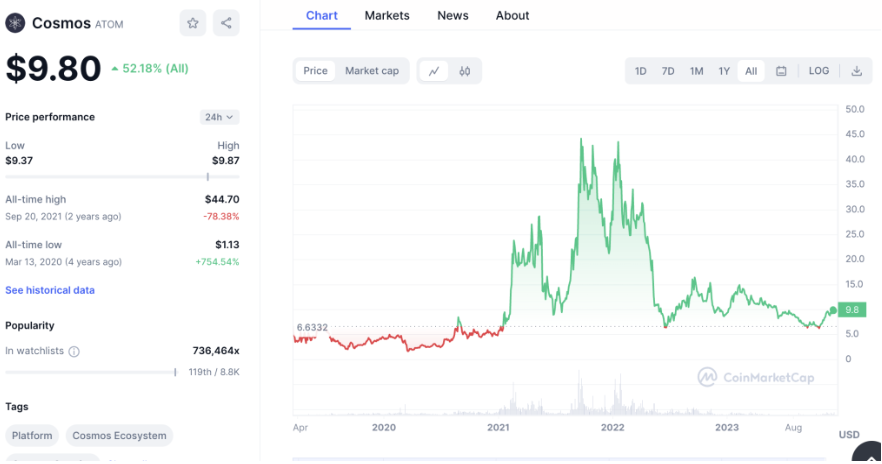
Cosmos has its native Layer 1 cryptocurrency, ATOM, required when using the IBC protocol. ATOM has a market cap exceeding $3.8 billion. Growth has been relatively modest—since 2019, ATOM has risen only 52%. Additionally, ATOM trades nearly 78% below its all-time high of almost $45.
7) Avalanche (AVAX): High-Performance Layer 1 Network with Infinite Scalability
Avalanche is another high-performance blockchain aiming to gradually erode Ethereum’s market share. It claims “infinite scalability,” meaning it can handle unlimited transactions without compromising security. It also offers near-instant transaction finality, ideal for smart contracts and dApps.
Another feature of Avalanche is its ability to support ERC-20 projects. Avalanche charges a 0.025% fee on bridged amounts, with a minimum of $3. According to CoinMarketCap, 282 projects have already bridged to Avalanche, including USDT, Chainlink, DAI, SushiSwap, and Frax.
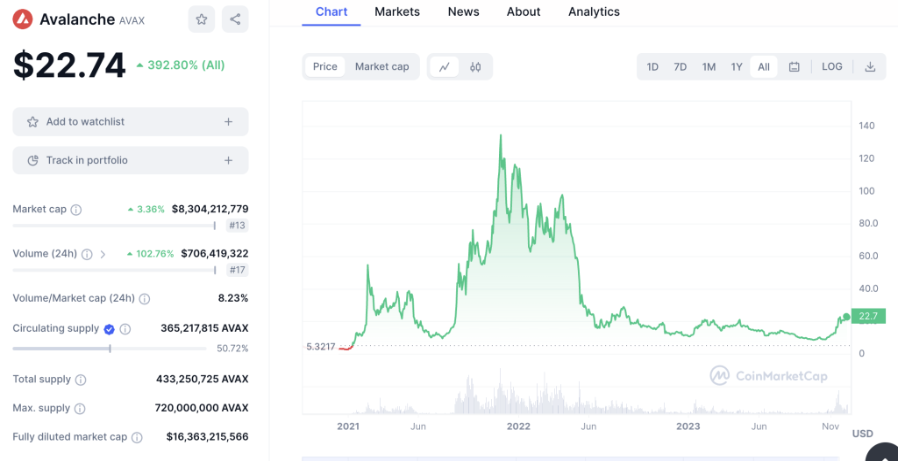
In terms of price performance, Avalanche is up 63%. While this lags behind the broader industry average, Avalanche trades at 85% below its 2021 all-time high. Thus, investors can obtain an attractive discount before the next altcoin season. With a market cap just over $13 billion, Avalanche still has ample room for growth.
8) Cronos (CRO): Crypto.com’s Layer 1 Network Trading at a 90% Discount
Launched in November 2021, Cronos is one of the newer Layer 1 blockchain projects entering the market. It delivers scalability, low transaction fees, and supports smart contracts and dApps. That said, Cronos is best known for its association with Crypto.com. Considered one of the top cryptocurrency exchanges, Crypto.com offers some of the lowest trading fees in the market.
Crypto.com has processed over $1 billion in trading volume—only a fraction of Binance’s $18 billion. However, given Binance’s recent $4 billion fine for money laundering violations, Crypto.com is likely to gain confidence and grow its market share. Therefore, investing in the Cronos blockchain provides exposure to Crypto.com’s growth trajectory.
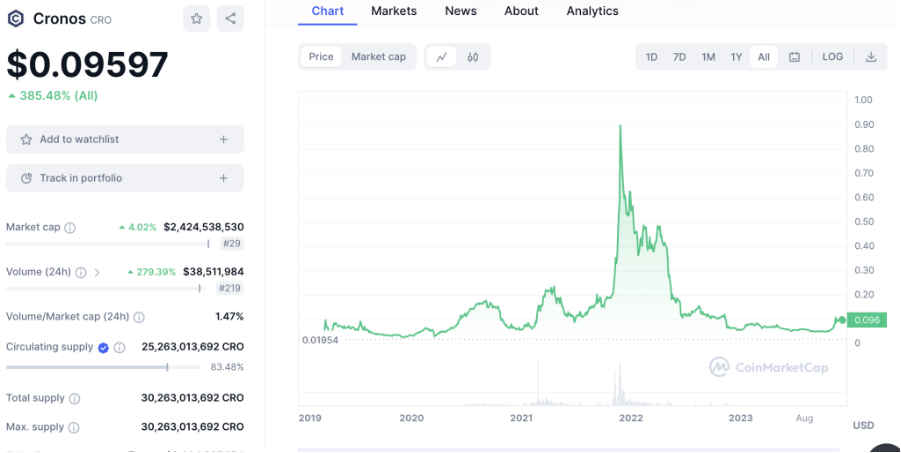
Cronos’ native cryptocurrency, CRO, currently has a market cap of just $2.4 billion—significantly smaller than Binance’s BNB, valued at over $35 billion. Over the past 12 months, CRO has grown 42%. However, it trades at a 90% discount from its all-time high, presenting a substantial opportunity.
9) Stellar (XLM): Cross-Border Payment Network Built for Individuals and Enterprises
Stellar is an open-source Layer 1 blockchain using the proof-of-agreement consensus mechanism. Not only is Stellar highly energy-efficient, but it also offers extremely fast confirmation times—averaging 5–6 seconds. Stellar also features low fees and can scale to 1,500 transactions per second.
Stellar aims to become the de facto payment network for global remittances, thus “banking the unbanked.” That said, it also enables enterprises to conduct low-cost cross-border transactions. To achieve this, it has partnered with IBM, MoneyGram, and other prominent organizations. XLM is the project’s native cryptocurrency, launched in 2014.
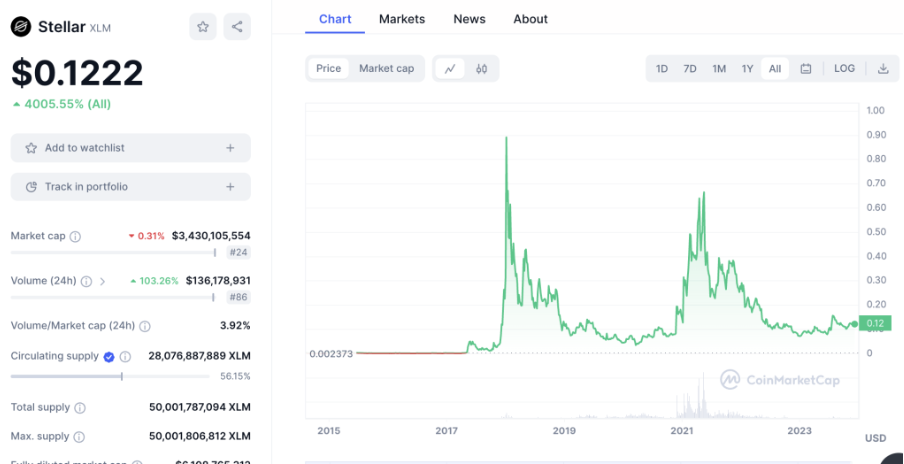
XLM has gone through several bull and bear cycles. Nonetheless, the token has appreciated 4,000% since launch. Compared to its previous all-time high, buyers today enjoy an 86% discount. XLM has a market cap of $3.2 billion.
10) Polkadot (DOT): Leading Interoperability in the Web3 Era
Polkadot is another Layer 1 blockchain focused on interoperability. Its proprietary network aims to connect competing blockchains, adapting to the Web3 era. This enables cross-chain transfers while preserving decentralization—all achieved with high efficiency.
Through its nominated proof-of-stake consensus model, Polkadot consumes as much energy as 6.6 average U.S. households. Polkadot’s native Layer 1 token, DOT, serves three main functions. First, DOT is a governance token, allowing holders to vote on protocol upgrades and fixes. Second, DOT is one of the best staking assets available.
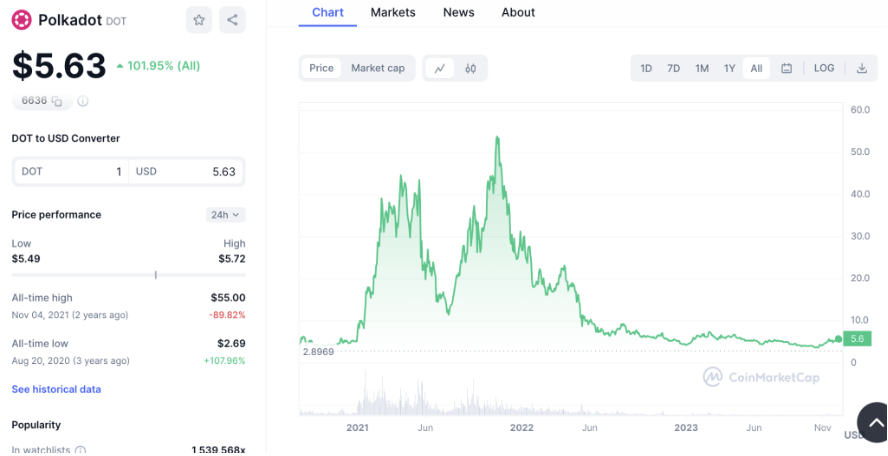
Third, DOT is used for “bonding,” a mechanism facilitating cross-blockchain transactions. According to CoinMarketCap, Polkadot has a market cap exceeding $9.4 billion. Over the past 12 months, DOT saw minimal movement, posting a slight loss of less than 1%. At current prices, DOT trades 90% below its all-time high.
11) Kaspa (KAS): Proof-of-Work Consensus with Sub-Second Confirmation Times
Kaspa is one of the fastest-growing cryptocurrencies in 2024. In the past 12 months, its native token KAS has surged over 1,800%. Since KAS launched in July 2022, the token has gained over 7,600%.
That said, Kaspa’s market cap is only $3 billion, suggesting its upward trajectory may continue into the bull market. Moreover, it currently trades at an 8% discount from its all-time high. In terms of utility, Kaspa is a Layer 1 blockchain using a proof-of-work (PoW) consensus mechanism.
However, unlike other PoW networks like Bitcoin, transaction speeds are extremely fast—typically confirmed within seconds—without sacrificing security. One of Kaspa’s primary goals is improving global scalability. It currently confirms one block per second, a rate expected to increase over time.
12) Sei (SEI): New Layer 1 Cryptocurrency Up 3,400% Since August 2023
Entering 2024, Sei has become one of the hottest cryptocurrencies. Crucially, it is one of the newest Layer 1 blockchains on the market. According to CoinMarketCap, Sei launched its native cryptocurrency SEI in August 2023.
Since launch, SEI has surged over 3,400%. Just last month, SEI rose 137%. Nevertheless, SEI’s market cap is just over $210 million. Compared to other Layer 1 blockchains discussed today, which boast multi-billion-dollar valuations, this presents a strong entry point for new investors.
So why is Sei so popular now? Simply put, this Layer 1 network can handle up to 20,000 transactions per second and finalize transactions in just 380 milliseconds. Additionally, the network has tested over 100 million transactions, demonstrating exceptional efficiency.
3. Fundamentals of Layer 1 Cryptocurrencies
Simply put, Layer 1 cryptocurrencies operate on proprietary blockchain networks. They have unique base code and their own consensus mechanisms. From an investment standpoint, Layer 1 cryptocurrencies are an attractive option.
After all, very few active cryptocurrencies are considered Layer 1. In contrast, the vast majority of tokens operate on secondary networks. For example, over 450,000 tokens were built on the Ethereum blockchain, including Decentraland, DAI, Sandbox, and Tether.
These secondary tokens follow the ERC-20 standard and do not influence how the Ethereum blockchain operates. Therefore, any changes made to Ethereum—positive or negative—will directly impact how ERC-20 tokens function.
Difference Between Layer 1 and Layer 2 Blockchains
Blockchain terminology can be confusing. Here’s a quick overview of the differences between Layer 1 and Layer 2 blockchains:
Layer 1 Blockchains: Layer 1 blockchains are the foundation of decentralized networks. They manage all aspects of the blockchain, including consensus mechanisms, security, and transaction processing. Examples include Bitcoin, Ethereum, Solana, and BNB.
Layer 2 Blockchains: Layer 2 blockchains aim to improve upon Layer 1 limitations, typically enhancing scalability, reducing fees, and speeding up transactions. For example, Polygon is a leading Layer 2 solution for ERC-20 tokens, enabling projects to operate more efficiently. Layer 2 networks can also expand use cases for Layer 1 cryptocurrencies, such as supporting smart contracts and dApps.
Both Layer 1 and Layer 2 blockchains play important roles in the broader cryptocurrency market. However, ultimately, Layer 1 networks are more favored by long-term investors.
4. Conclusion
In conclusion, the importance of Layer 1 cryptocurrencies cannot be overstated—they provide the foundational framework for various applications and digital assets. Our review of the top Layer 1 cryptocurrency projects highlights why they are so popular and underscores their profit potential as investments.
However, it must be noted that the cryptocurrency market is extremely volatile, and thorough research should always be conducted before investing in any crypto asset.
Join TechFlow official community to stay tuned
Telegram:https://t.me/TechFlowDaily
X (Twitter):https://x.com/TechFlowPost
X (Twitter) EN:https://x.com/BlockFlow_News