Explaining BITTENSOR ($TAO): The Leading Force Reshaping the Artificial Intelligence Landscape
TechFlow Selected TechFlow Selected
Explaining BITTENSOR ($TAO): The Leading Force Reshaping the Artificial Intelligence Landscape
AI has immense economic potential, and Bittensor aims to seize this opportunity through a decentralized approach.
 Navigating Web3 tides with focused insights
Author: Greythorn
Project Name: Bittensor
Project Type: Artificial Intelligence (AI)
Token Symbol: $TAO
Cryptocurrency Rank: #30
Market Cap: $3.3 billion
FDV: $3.3 billion
Circulating Supply: 6.23 million (29.69% of total supply)
Max Supply: 21 million
Introduction
The artificial intelligence industry has flourished in recent years, especially with breakthrough technologies like ChatGPT. In 2023 alone, it attracted $25 billion in investments—five times more than in 2022. This massive influx of capital clearly reflects the optimistic expectation that AI will become a trillion-dollar industry.
However, what signs indicate that AI’s future is even brighter? Here are several key points:
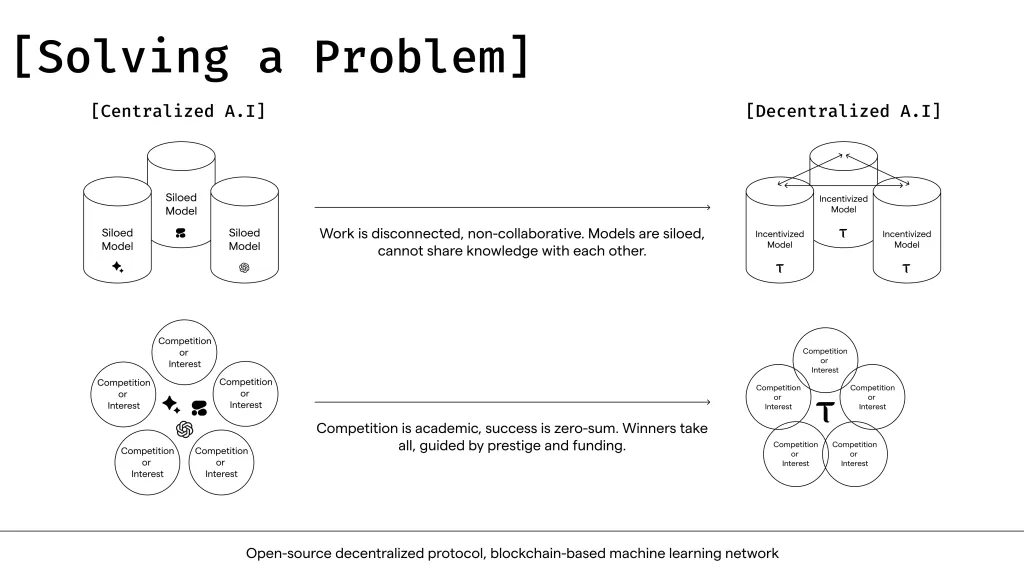
First, the AI field is currently quite fragmented. Different AI models cannot learn from each other, severely limiting their functionality. Additionally, connecting them to other applications or data typically requires special permissions, further increasing complexity.
Second, the barrier to entry for AI is quite high. Training AI models requires significant resources, leading to dominance by large corporations in this space.
Although cryptocurrencies are still in early stages of adoption, they have already shown potential as powerful tools for incentivizing and organizing distributed resource networks. Moreover, by leveraging blockchain technology, AI applications can achieve interoperability, enhancing their ability to work together.
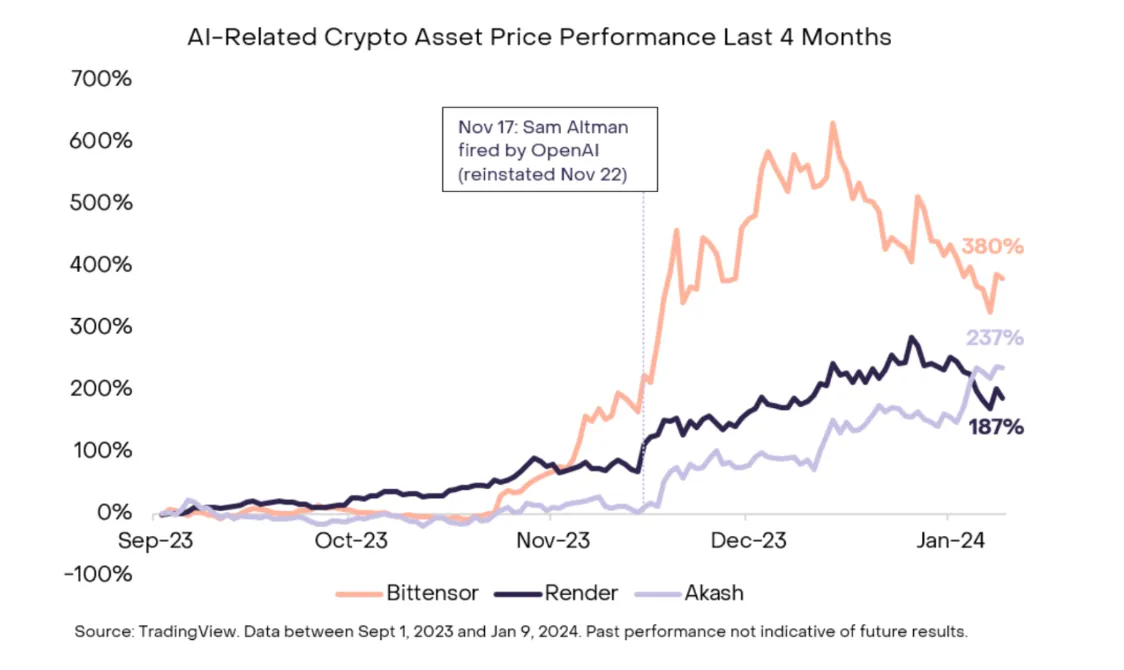
Recently, some exciting success stories have emerged in the AI-crypto space, drawing attention to these opportunities.
Source: GrayScale Research
Therefore, we stand at a crossroads for AI: on one side is a fragmented and resource-intensive AI landscape; on the other lies a clear market opportunity. What we now need is a core solution capable of bridging the two—and this is exactly what Bittensor offers, making it truly worth watching.
Bittensor shifts control of artificial intelligence from big corporations to a broader community, reshaping the development landscape of AI. Its protocol transforms machine learning into a tradable commodity, encouraging rapid knowledge dissemination—an ever-expanding library.
Project Overview
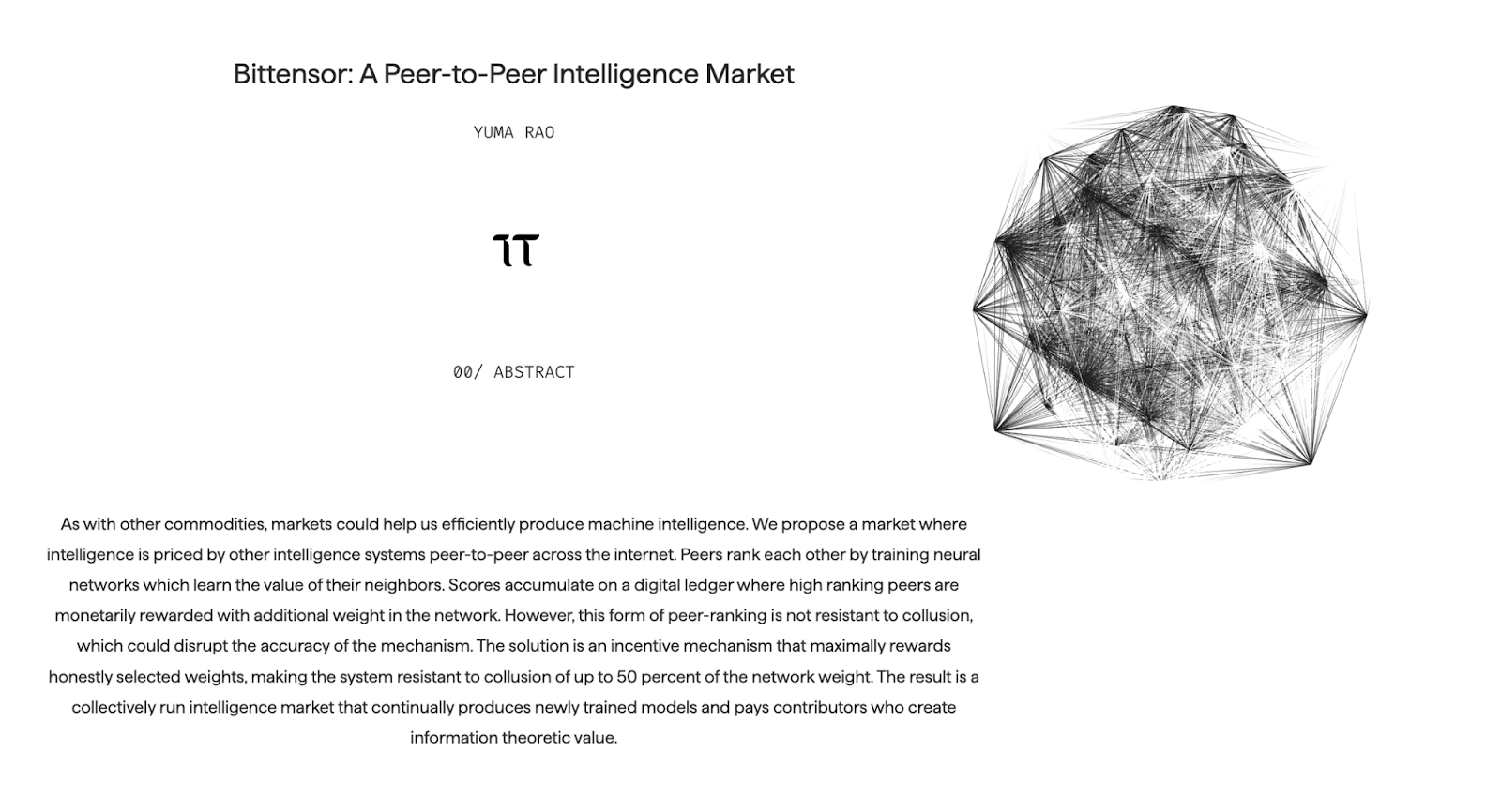
Founded in 2019 by AI researchers Ala Shaabana and Jacob Steeves, Bittensor was initially conceived as a Polkadot parachain. However, in March 2023, it made a strategic shift to develop its own proprietary blockchain, aiming to use cryptocurrency as an incentive mechanism for a global network of machine learning nodes, promoting a decentralized approach to AI development. By enabling these nodes to collaboratively train and learn, Bittensor introduces a new paradigm where incremental contributions enhance the network's collective intelligence, amplifying individual researchers’ and models’ overall impact.
Source: Bittensor Website
Core Structure and Composition
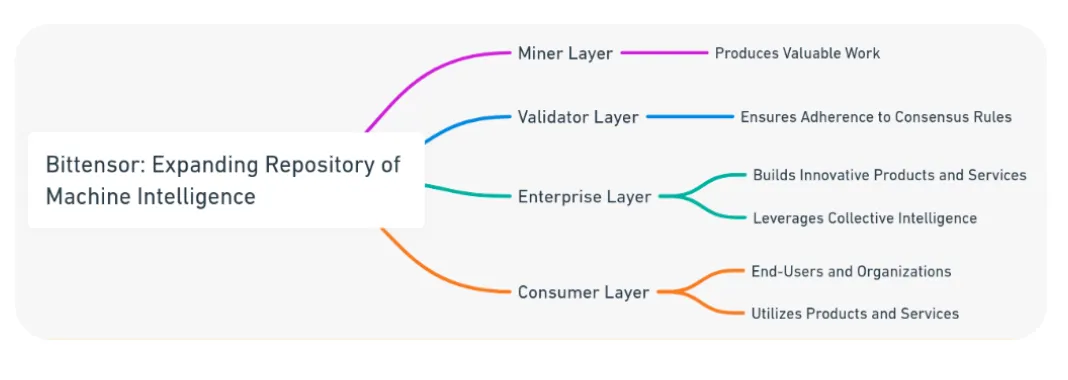
Bittensor’s architecture is designed to support a robust AI ecosystem through a decentralized network:
Miner Layer: This layer forms the core of AI-driven innovation within Bittensor, where miners host and run diverse AI models.
Validator Layer: Validators play a critical role in maintaining blockchain integrity and consensus, ensuring the network operates according to established rules.
Enterprise Layer: Focused on developing cutting-edge applications that leverage the network’s AI capabilities to solve complex problems.
Consumer Layer: The final layer serves end users and organizations, delivering solutions and services generated by the network.
Source: Revelo Intel
Bittensor as an Oracle
Bittensor also functions as an oracle, connecting blockchain systems with external data. This enables integration between AI and blockchain technologies, creating innovative solutions.
Network Dynamics
The Bittensor ecosystem relies on its unique subnet dynamics, with each subnet offering different rewards, ideal for a wide range of AI applications. This setup fosters diversity and the emergence of novel ideas, serving areas potentially overlooked by major AI companies. At the same time, it supports these activities via a unified TAO token economy, giving token holders significant influence over the direction of AI growth within the network.
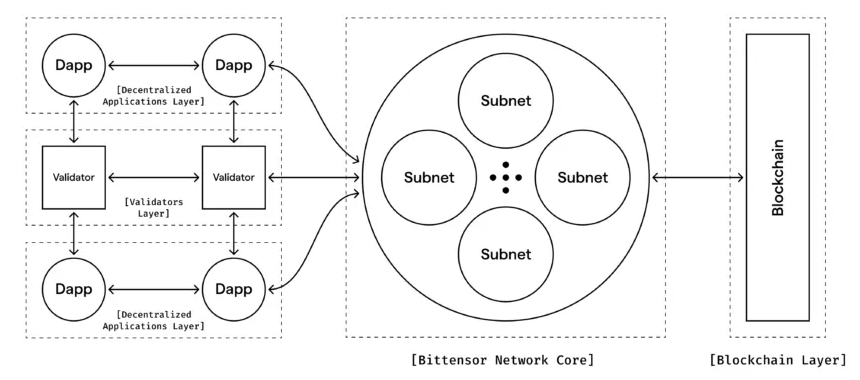
Source: Bittensor
Bittensor Machine Learning Approach and Mechanism
Bittensor connects two key participants within the network:
Validators: Responsible for maintaining blockchain integrity, ensuring transactions and operations comply with network rules.
Off-chain Machine Learning Miners: They provide AI services by hosting and running AI models that perform various tasks—from data analysis to generating insights.
This bridge enables secure and efficient collaboration between blockchain operations and AI services.
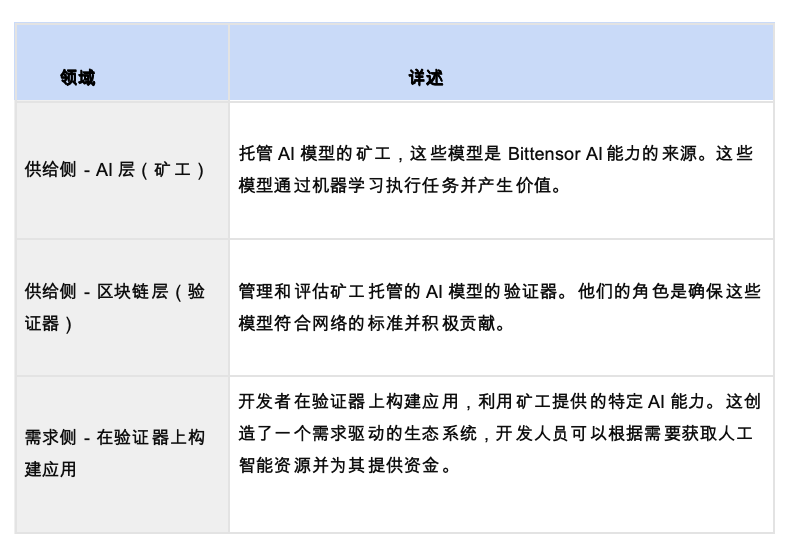
Domain Elaboration
Supply Side - AI Layer (Miners): Miners hosting AI models, which serve as the source of Bittensor’s AI capabilities. These models execute tasks through machine learning and generate value.
Supply Side - Blockchain Layer (Validators): Validators manage and evaluate AI models hosted by miners. Their role is to ensure these models meet network standards and contribute positively.
Demand Side - Building Applications on Validators: Developers build applications atop validators, leveraging specific AI capabilities provided by miners. This creates a demand-driven ecosystem where developers can access and fund AI resources as needed.
Source: Greythorn Internal
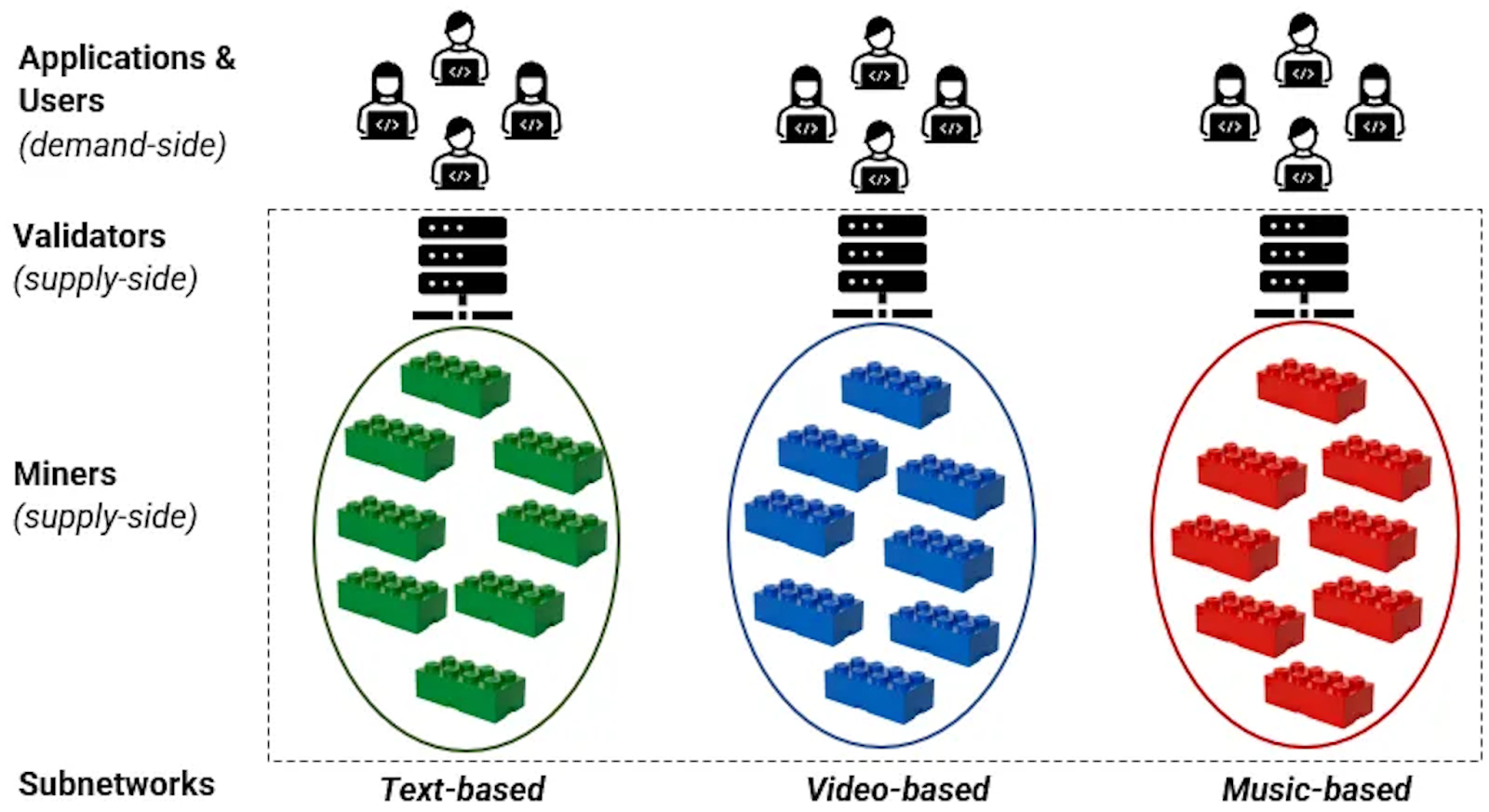
Source: David Atterman
Mixture of Experts (MoE)
Bittensor employs a Mixture of Experts (MoE) model to optimize AI predictions by collaboratively combining multiple specialized AI models, improving both accuracy and efficiency in solving complex problems. This method integrates the unique strengths of each model, producing more precise and comprehensive results compared to traditional single-model approaches. For example, when generating Python code with Spanish annotations, the multilingual model and code expertise model can work together to deliver superior outcomes compared to relying on a single model.
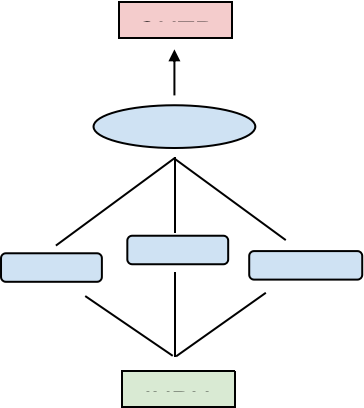
Source: Greythorn Internal
Proof of Intelligence
Proof of Intelligence is the mechanism used by the Bittensor network to reward nodes for contributing useful machine learning models and results. Similar to Proof of Work (PoW) and Proof of Stake (PoS) in blockchain networks, Proof of Intelligence requires nodes to perform machine learning tasks to demonstrate their intelligence level, rather than solving mathematical puzzles. Nodes whose machine learning outputs are accurate and valuable have a higher chance of being selected to add new blocks to the chain and earn TAO tokens as rewards. To receive rewards on the Bittensor network, servers must not only generate valuable knowledge but also gain approval from the majority of validators. Through this consensus mechanism, Bittensor incentivizes valuable contributions, promotes cooperation, and ensures blockchain security.
Ecosystem
The Bittensor ecosystem is powered by the $TAO token, representing an innovative approach to decentralized artificial intelligence. Its unique subnet structure is crucial to the ecosystem’s integrity and performance. Bittensor provides 32 slots for these subnets, fostering a competitive yet dynamic environment that drives innovation. This reflects Bittensor’s commitment to inclusivity and its strategic focus on quality over quantity. Note that subnets in Bittensor are where real value is created through competition and collaboration.
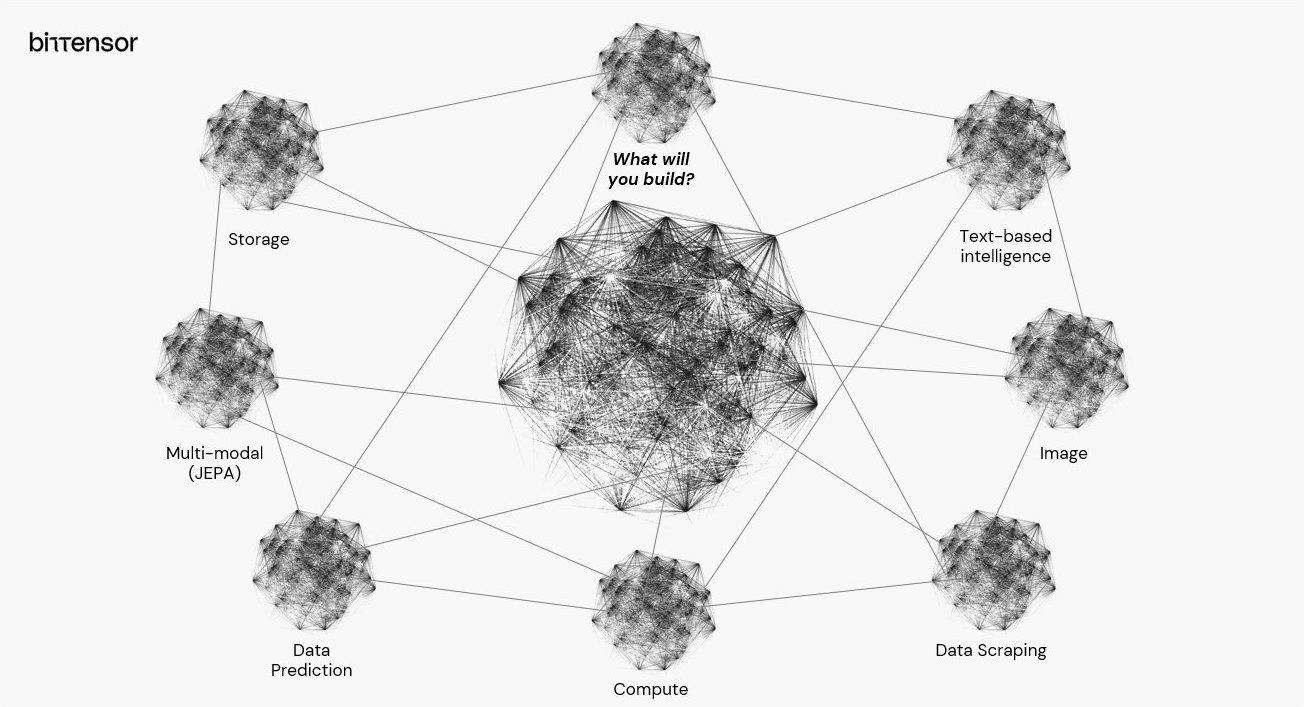
Blockchain technology in this ecosystem ensures transparency and security, while the Bittensor API facilitates participation by providing necessary tools and guidelines.
Participants can engage in building the community as subnet owners, validators, or miners—each role being vital to the ecosystem’s health. The Yuma consensus mechanism is a key feature, promoting consensus by rewarding contributors with TAO tokens.
Strategic partnerships, such as those between OpSec and Tensorage, are essential for advancing decentralized AI technology and delivering seamless data processing and storage solutions.
Integrations like AITProtocol with the Bittensor network highlight its growing influence and the diverse applications of decentralized AI models.
Considering Bittensor’s growth potential, we expect these partnerships and integrations to continue evolving, positioning Bittensor as one of the key players shaping the future of AI.
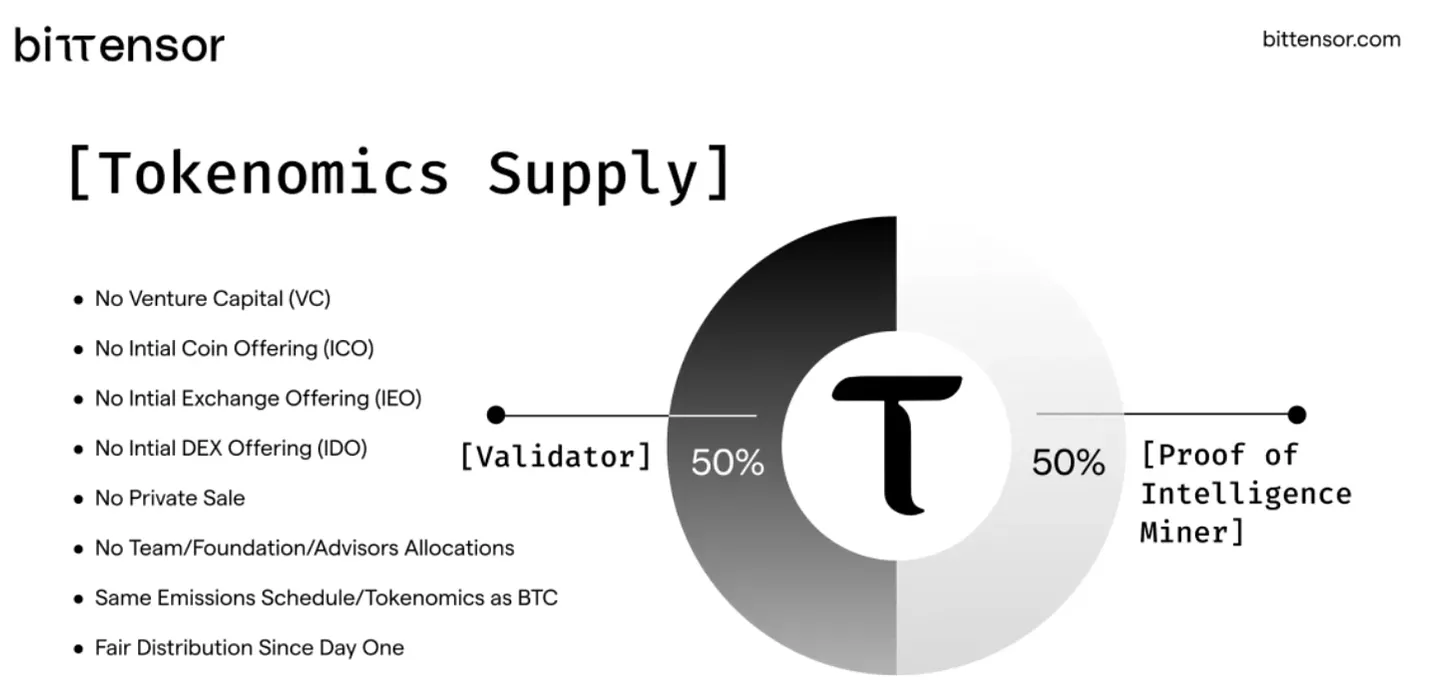
Tokenomics
Overview of TAO Tokenomics
Max Supply: 21 million TAO tokens.
Issuance Schedule: Tokens fully issued over 256 years.
Current Price: $624.97.
Market Cap: $3.92 billion, ranked #27.
Fully Diluted Valuation: $3.9 billion, ranked #49.
Current Circulating Supply: 6.25 million TAO tokens, accounting for 29.75% of max supply.
Total Supply: 6.25 million TAO tokens.
Token Generation and Distribution
TAO tokens are created through mining and network validation activities to promote the development of a decentralized ecosystem.
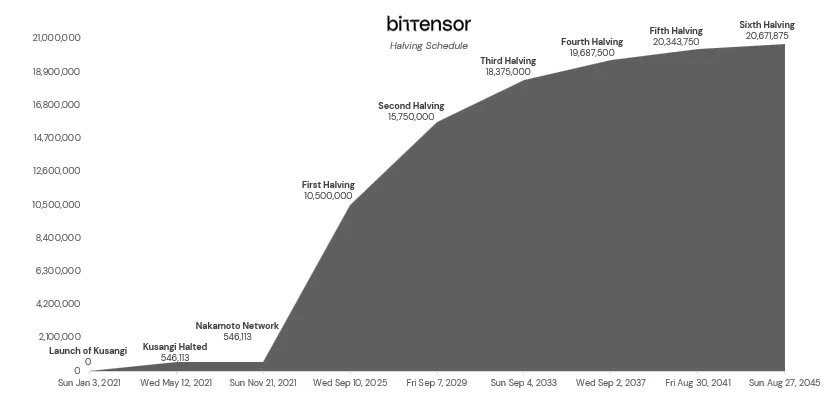
The network undergoes a halving event every 10.5 million blocks, with 64 halvings planned over approximately 45 years.
Rewards are distributed at a rate of 1 TAO per block, roughly every 12 seconds, totaling about 7,200 TAO tokens daily. These rewards are allocated to miners and validators.
Token Utility
Holding TAO tokens grants access to various digital resources on the network, including data and AI-generated core insights. It should be noted that the value of TAO tokens is directly tied to the AI services offered by the Bittensor network. As the importance and utility of these AI services grow, so does the demand for TAO tokens.
Source: Bittensor
Competitors
Artificial intelligence technology has broad applications across the blockchain industry, including machine learning, neural networks, decentralized storage, AI agent training, markets, and data processing.
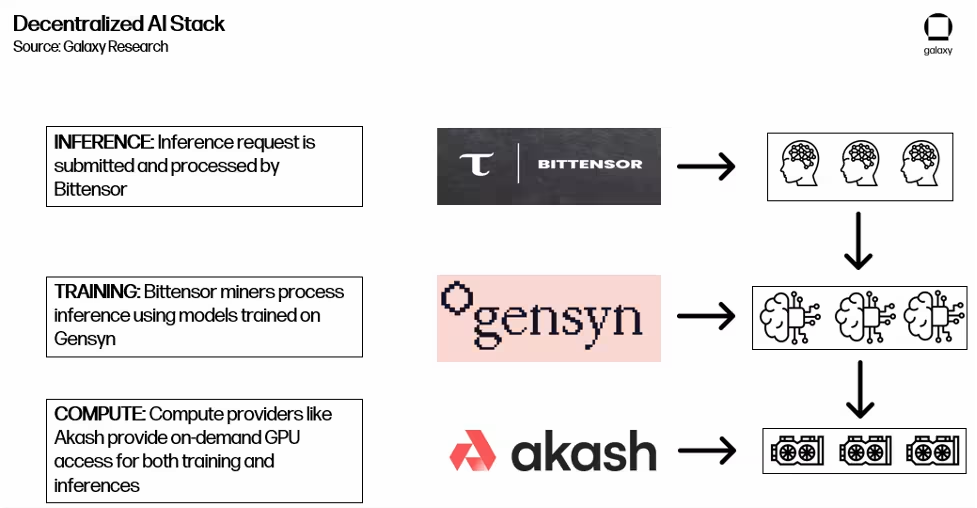
Given this diversity, directly comparing Bittensor to projects like Akash may not be entirely appropriate. Akash offers services similar to cloud computing, whereas Bittensor focuses specifically on areas such as AI model training.
Further research leads us to Gensyn, an emerging project that appears to be a closer competitor to Bittensor. Let’s take a deeper look.
Getting to Know Gensyn
Ben Fielding and Harry Grieve met in early 2020 through the Entrepreneur First accelerator program and began collaborating later that year to create Gensyn, focusing solely on research until Q2 2023. They aim to launch their testnet this year.
In June 2023, Gensyn successfully raised $43 million in Series A funding from investors including a16z, Protocol Labs, CoinFund, Canonical Crypto, Eden Block, and several angel investors.
Gensyn is building a network based on an L1 PoS protocol using the Substrate framework for peer-to-peer communication.
Gensyn aims to create a super-scalable ML network. It offers a globally accessible pool of computing resources. Its goal is to make AI model training possible on any device worldwide—from idle data centers to personal laptops with GPUs—significantly increasing the availability of global ML computing resources.
Differences from Bittensor:
Gensyn differs from typical compute networks through its unique method of verifying computational work. It introduces a new system called "Probabilistic Proof-of-Learning," which leverages data from gradient optimization—a key technique in machine learning. This technology provides a scalable and reliable way to verify work without replication, making machine learning tasks more efficient.
By contrast, Bittensor offers two key advantages:
First, it adopts a Mixture of Experts (MoE) model, enhancing AI predictions by enabling multiple specialized AI models to work together. This collaboration aims to improve the accuracy and reliability of AI outputs.
Second, Bittensor uses a unique machine learning approach known as AI Legos. The concept of AI Legos is to leverage blockchain to make AI development more open, decentralized, accessible, and efficient. Built upon the idea of “Compute Legos,” it emphasizes the versatility of general-purpose computation to foster machine learning innovation. Bittensor’s vision is to establish a global community network of ML nodes capable of tackling specific complex challenges while enhancing the collective intelligence and capabilities of AI models.
But we can also envision a scenario where permissionless blockchains allow various protocols to integrate and strengthen the overall decentralized AI ecosystem. For instance, Akash, Gensyn, and Bittensor might jointly handle inference requests, showcasing synergies among different on-chain AI solutions.
Comparison with Centralized AI Models:
Comparing Bittensor with centralized AI models like OpenAI (recently valued at $29 billion by Microsoft) clearly highlights its potential. Bittensor’s decentralized approach—aimed at compounding AI intelligence and broader integration—could potentially surpass OpenAI’s capabilities and value if successful. This sparks discussions about Bittensor’s immense latent value.
Through its decentralized model, Bittensor allows AI models to share insights and build upon each other’s discoveries, reducing redundant efforts. According to Bittensor:
“The only thing bigger than OpenAI or any other centralized alternative is their combination.”
Source: Bittensor

Source: Bittensor
Bullish Factors
Bittensor’s tokenomics are designed to encourage fair distribution practices, aligning incentives among network participants. As the base of network participants expands, TAO tokens are expected to grow exponentially.
Approximately 89% of all circulating TAO tokens—amounting to 5,561,230𝞃 (out of a current total issuance of 6,254,373𝞃)—are currently staked.
The issuance design of TAO tokens ensures that creation rate decreases over time and stops completely once maximum supply is reached. This strategy will gradually shift miner incentives toward direct task-based payments.
Source: Bittensor
The AI market is projected to reach $1.8 trillion by 2030, demonstrating the vast economic potential of AI technology.
Since OpenAI’s major advancements, AI-related crypto assets have performed exceptionally well, highlighting growing interest and investment in the sector.
Bittensor aims to create a self-sustaining ecosystem for machine learning, promoting the development and application of AI models. This vision lays the foundation for innovation and practical applications in the AI domain.
The Bittensor network hosts over 4,000 AI models, collectively comprising 10 trillion parameters. This scale not only exceeds models like GPT-3 (which has 175 billion parameters) but also underscores Bittensor’s significant size and diversity in AI development.
Bittensor ranks among the top 25 projects and has not yet received any Tier-1 token listing information. While it remains unclear whether this should be seen as a positive factor, its strong position raises intriguing possibilities regarding wider TAO token accessibility in the future.
Bearish Factors
Although Bittensor hasn’t faced widespread criticism, there are still some skeptics. Some question how its relatively simple code justifies its high valuation. Others, like Kyle, founder of Multicoin VC, specifically criticize how TAO validators select top miners, arguing that without broad application context (unlike ChatGPT), validators cannot properly assess quality. He believes stronger links are needed between user interfaces and model updates. We recommend keeping an open mind, considering the diversity of views in the crypto space.
While decentralized AI holds great promise, it remains in its infancy and carries risks. Our past research on AI projects shows many decentralized platforms haven’t undergone sufficient durability testing. They often struggle to attract users and remain heavily dependent on developers to stay operational.
Another major challenge is the high barrier to accessing extensive databases and cutting-edge AI hardware relative to the resources available to large tech companies. This limitation poses a significant risk to the growth and effectiveness of platforms like Bittensor.
Conclusion
VanEck’s latest research refers to Bittensor as the “Bitcoin of machine intelligence.” The report outlines how its network provides economic incentives for AI/ML models, involving a system where “miners” develop AI models and “validators” evaluate model outputs. However, given that developers can build dApps on Bittensor and the network is structured as a mainchain containing numerous smaller subnets focused on specific AI domains, I believe a more fitting comparison would be viewing Bittensor as the Ethereum of decentralized AI.
Artificial intelligence holds enormous economic potential, projected to reach a market value of $1.8 trillion by 2030, and Bittensor aims to capture this opportunity through a decentralized approach.
During the DeFi boom, Cardano’s market cap approached $100 billion. With Bittensor currently valued at $4.2 billion, especially if AI follows a trend similar to DeFi, its growth potential remains an exciting prospect.
At Greythorn, we always advocate caution toward these markets. If you’re interested in this article, we invite you to reach out. You can explore our previous research and visit our website for more information.
Disclaimer
This document is prepared by Greythorn Asset Management Pty Ltd (ABN 96 621 995 659) (“Greythorn”). The information contained herein is for general informational purposes only and does not constitute financial or investment advice. This document is not an offer, solicitation, or advertisement to buy or sell any financial instruments or to participate in any particular trading strategy. Greythorn has not taken into account the investment objectives, financial situation, or particular needs of any recipient in preparing this document. Therefore, recipients should assess their own circumstances and seek professional advice from their accountant, legal counsel, or other advisors before making any investment decisions.
This document contains statements, opinions, forecasts, and forward-looking statements based on certain assumptions. Greythorn assumes no obligation to update such information. These assumptions may or may not prove correct. Greythorn and its directors, employees, agents, and consultants make no representations or warranties regarding the accuracy or achievability of any forward-looking statements or underlying assumptions. Greythorn and its directors, employees, agents, and consultants do not guarantee the accuracy, completeness, or reliability of any information contained herein. To the fullest extent permitted by law, Greythorn and its directors, employees, agents, and consultants shall not be liable for any loss, claim, damage, cost, or expense arising from or related to the use of this document.
This document is the property of Greythorn. Recipients agree to keep its contents confidential and not reproduce, provide, distribute, or disclose any part of this document without Greythorn’s prior written consent.
Join TechFlow official community to stay tuned
Telegram:https://t.me/TechFlowDaily
X (Twitter):https://x.com/TechFlowPost
X (Twitter) EN:https://x.com/BlockFlow_News
 Greythorn