In-Depth Analysis of the Popular BTC Layer 2: B² Network
TechFlow Selected TechFlow Selected
In-Depth Analysis of the Popular BTC Layer 2: B² Network
This article will provide a detailed introduction to B Network's product vision, technical architecture, token economics, participation methods, and application ecosystem.
 Navigating Web3 tides with focused insights
Author: LouisWang, Core Contributor of Biteye
Editor: Crush, Core Contributor of Biteye
Community: @BiteyeCN
*Approximately 4,800 words, estimated reading time: 10 minutes
01 Bitcoin's Ecosystem Holds Immense Potential
As the cornerstone of the entire crypto industry, Bitcoin currently has a market cap of $874.8 billion, yet it is mostly used merely as a "digital gold" store of value.
WBTC, one of the few gateways for Bitcoin to enter the DeFi space, is an ERC20 asset backed 1:1 by BitGo, a centralized custodian. With a current market cap of $7 billion, it represents less than 1% of Bitcoin’s total market cap.
Therefore, a vast amount of Bitcoin's assets remain illiquid, and its native ecosystem holds tremendous latent momentum.
Contrary to popular belief, Bitcoin's network does support smart contracts. For security and simplicity, its scripting language, Script, is not Turing-complete and lacks the power of Ethereum’s Solidity. However, it still supports functionalities like multi-signature transactions, timelocks, and partially signed Bitcoin transactions (PSBT).
The SegWit (Segregated Witness) upgrade separated witness data (signatures unlocking UTXO transactions) into a dedicated 4MB block space, expanding the types of media that can be stored on-chain.
The Taproot upgrade further enhanced transaction privacy and enabled more complex transactions, allowing data storage within Taproot script paths. These improvements paved the way for the Ordinals protocol, enabling novel asset issuance such as BRC20 tokens and reigniting interest in Bitcoin's ecosystem potential.
02 On-Chain Activity Reinforces the Bitcoin Network
Many Bitcoin OGs believe Bitcoin should remain simple and pure, serving solely as a reserve asset. However, lack of on-chain activity poses risks to the network.
Take the upcoming Bitcoin halving as an example: the current block reward of 6.25 BTC will be cut in half, significantly reducing miners’ income. If costs exceed revenue, miner participation may decline, weakening decentralization and increasing network vulnerability.
There are only two ways to prevent this: either Bitcoin’s price increases substantially (even doubling would only maintain current miner revenue levels), or higher on-chain transaction fees from increased BTC usage—something already proven by the Ordinals protocol and BRC20 tokens.
(Source: https://dune.com/cryptokoryo/brc20)
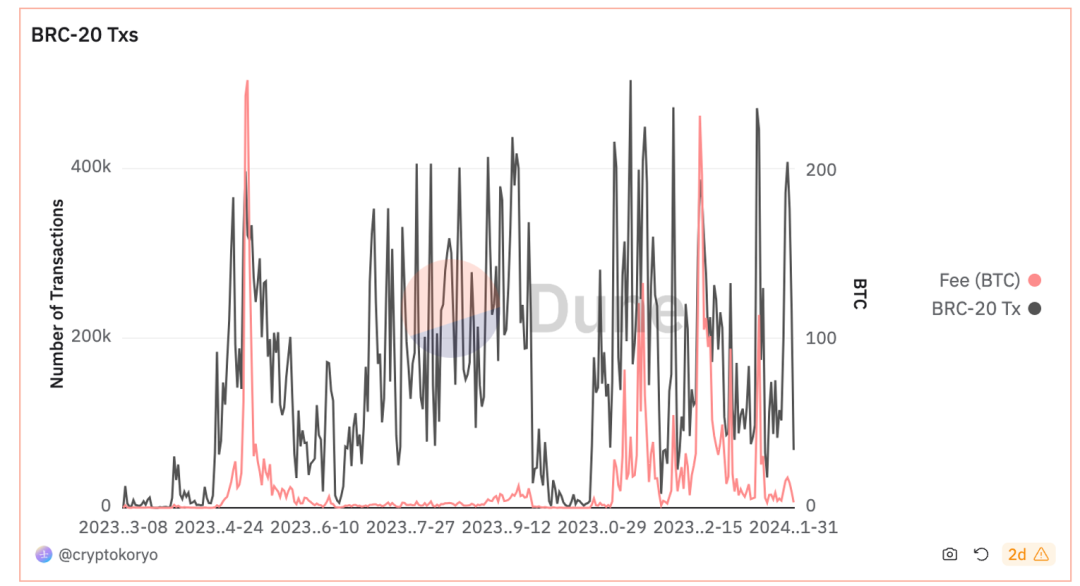
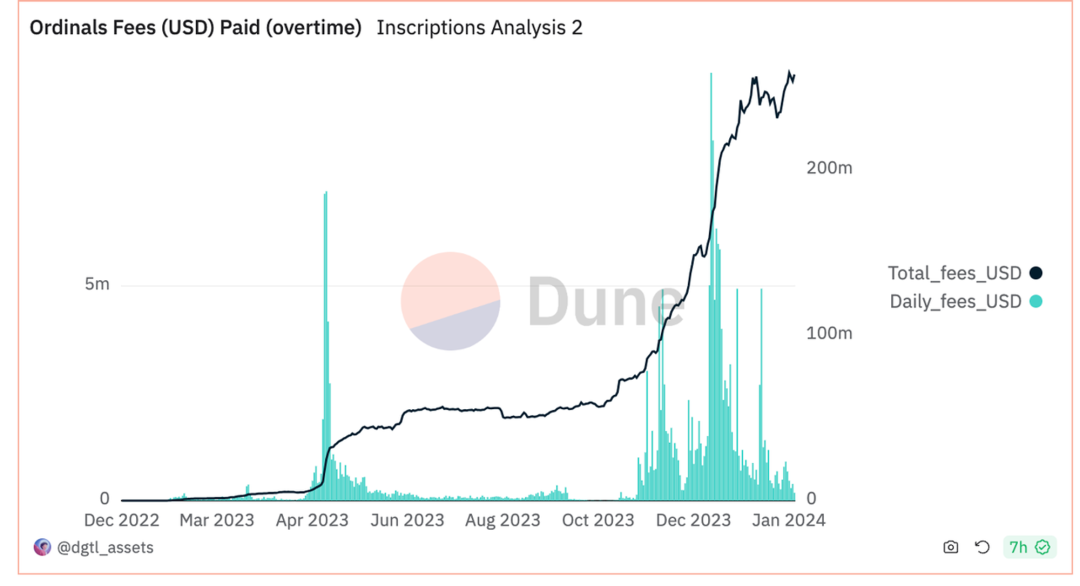
The two major waves of BRC20 activity in May and December significantly boosted BTC miners' income. To date, the Ordinals protocol has generated 5,979.4 BTC (~$257.7 million) in fees for miners—surpassing their coinbase block rewards.
(Source: https://dune.com/dgtl_assets/bitcoin-ordinals-analysis)
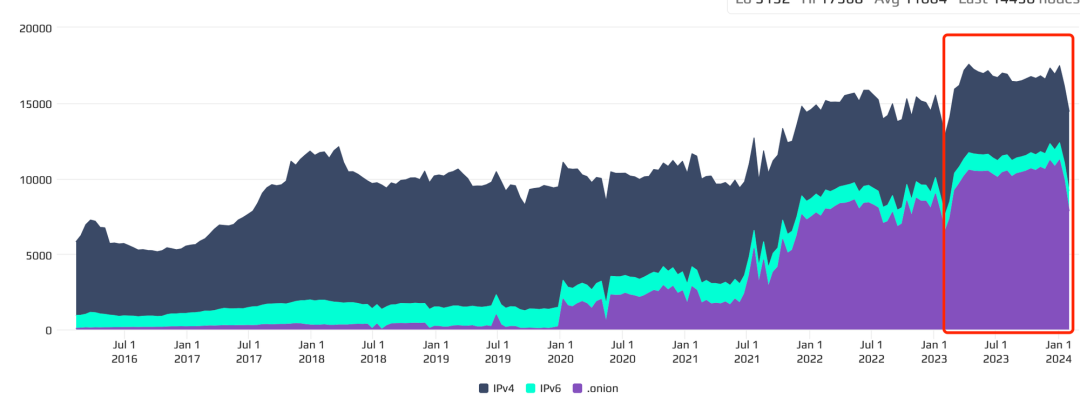
A common metric developers use to assess Bitcoin’s network security is the number of full nodes. To allow personal computers to run full nodes, strict limits are placed on block size and UTXO set size to reduce node operation costs.
Since the emergence of inscriptions, many users now interact with the Bitcoin RPC, leading to a notable increase in the number of full nodes.
(Source: https://bitnodes.io/dashboard/8y/)
Clearly, the BTC network benefits from a thriving ecosystem. Active on-chain usage not only boosts miner revenues—offsetting losses post-halving—but also increases full node count, enhancing network security, and most importantly, brings more people to understand and use BTC.
03 B² Network's Mechanism to Unlock BTC's Potential
Beyond limitations in its smart contract language, Bitcoin is inherently slow and expensive.
In Ethereum, Layer 2 scaling solutions follow a modular blockchain approach—offloading execution to separate layers for greater efficiency while inheriting Ethereum’s security.
The past year has been defined by Ethereum L2 growth, with over 20 Ethereum Layer 2 chains launched, solidifying the concept in users’ minds.
To unlock Bitcoin’s potential, building a Layer 2 network is a natural solution—leveraging fast virtual machines or familiar environments like EVM to overcome BTC’s inherent limitations.
B² Network is a pioneer among Bitcoin Layer 2 projects—an EVM-compatible ZK Rollup secured by zero-knowledge proofs anchored to Bitcoin, bringing Ethereum’s strengths into the Bitcoin ecosystem.
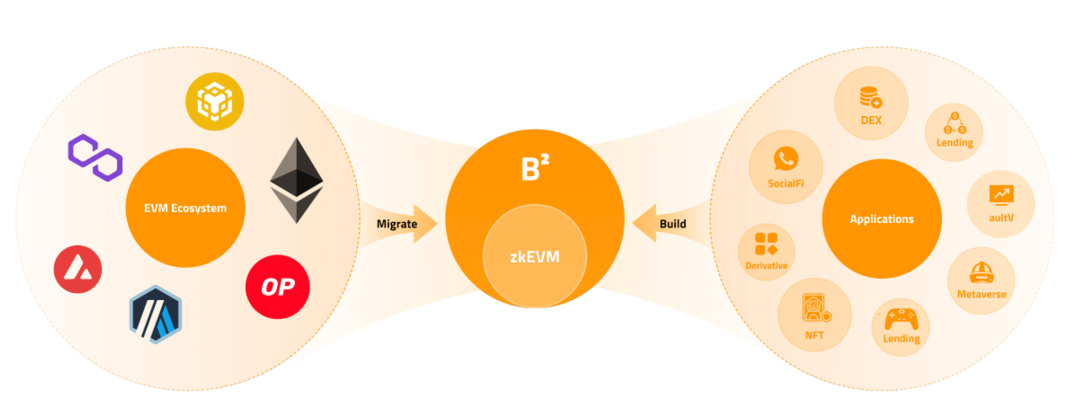
(Source: B² Network LitePaper)
Technical Architecture
B² Network’s architecture consists of two main layers: the Rollup layer and the Data Availability (DA) layer. Simply put, it needs a virtual machine to process user transactions and a secure place to store and verify data.
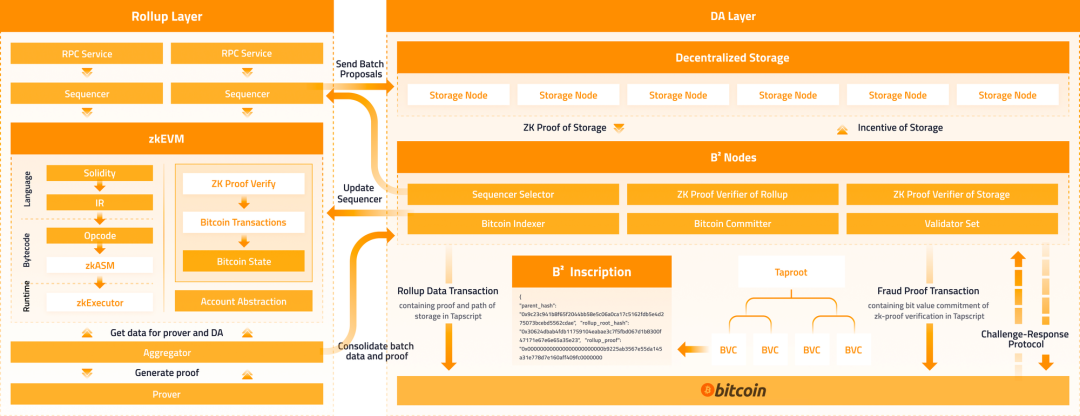
(Source: B² Network LitePaper)
On the Rollup layer, B² adopts zkEVM technology and collaborates with Polygon Labs to extend Polygon CDK to Bitcoin.
Through account abstraction, users can interact using either Ethereum accounts or BTC-native wallets. Familiar tools like Unisat and MetaMask remain compatible, lowering the learning curve.
Main accounts can use the Transaction Bundler service to pay gas fees on behalf of sub-accounts.
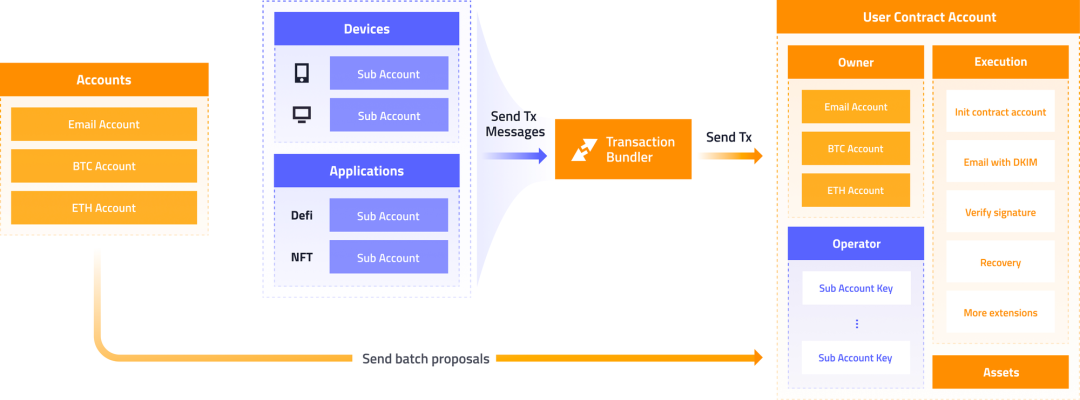
(Source: B² Network LitePaper)
User transactions are submitted and processed on the Rollup layer, where user states are also stored. The network generates corresponding zero-knowledge proofs, which are then batched and sent to the DA layer for storage and verification.
The DA layer includes decentralized storage, B² nodes, and the Bitcoin network itself. It verifies the Rollup’s zero-knowledge proofs, permanently stores copies of Rollup data, and ultimately inscribes the data onto the Bitcoin blockchain via inscriptions.
As shown in the diagram below, after the B² sequencer bundles user transaction data, it stores it via distributed systems to avoid single points of failure and improve reliability.
To ensure data availability, B² writes Tapscript into each block on the Bitcoin network, ensuring temporal continuity of data access.
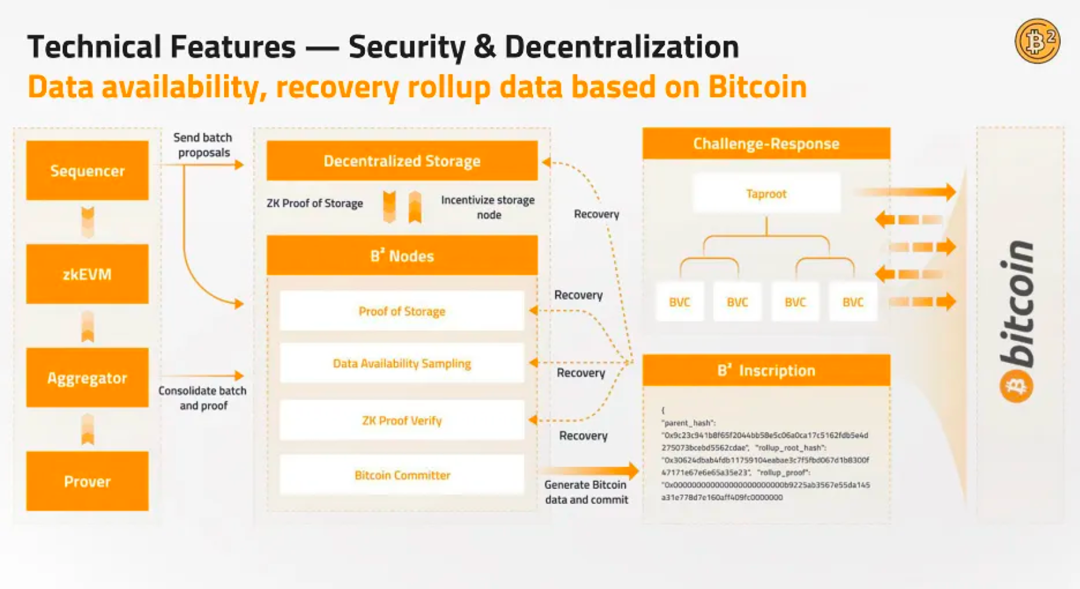
(Source: B² Network LitePaper)
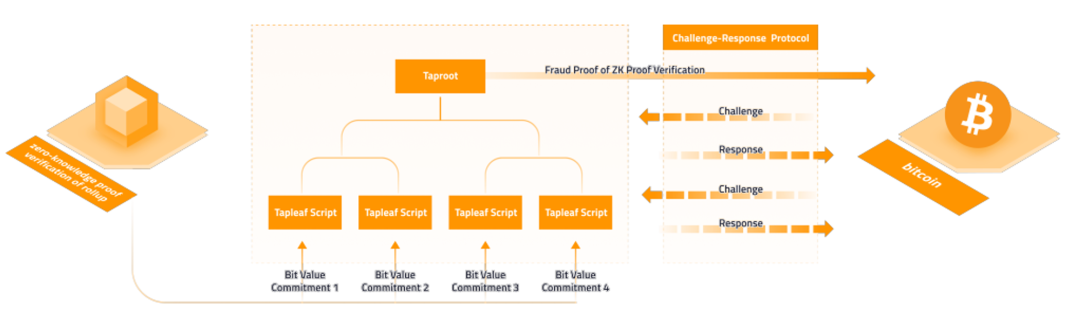
In Ethereum, Rollups submit Layer 2 data to mainnet contracts via calldata for validation and storage. But since Bitcoin lacks smart contract functionality, ZK-Rollups cannot automatically verify proofs on-chain. Instead, B² uses Taproot to write zero-knowledge proofs and aggregated Rollup data onto Bitcoin, anchoring the data immutably.
However, this alone doesn’t guarantee the validity or correctness of transactions within the ZK-Rollup, nor does it leverage Bitcoin’s strong consensus for Layer 2 security.
To address this, B² writes commitments of zero-knowledge proofs to the main chain, allowing challengers to dispute them within a specified period.
If a challenge succeeds, the Rollup state reverts, and the challenger claims the staked assets of the faulty node. If no valid challenge arises during the window, the Rollup achieves final confirmation on Bitcoin.
(Source: B² Network LitePaper)
B² features several clever design choices:
- Account abstraction lowers the barrier to entry, making it easier for users to connect regardless of which wallet or ecosystem they hold assets in.
- EVM compatibility simplifies developer adoption and enables seamless migration from Ethereum’s ecosystem.
- It employs a hybrid model similar to zk+op: using zk proofs for efficient data validation to lower costs, while incorporating optimistic-style challenges to work around Bitcoin’s limited verification capabilities.
B² Network’s vision extends beyond being just a single BTC Layer 2—it aims to become a central hub for Bitcoin L2s, akin to Cosmos Hub or the OP Stack.
In the future, B² Nodes will evolve into B² Hub, providing data availability, state transition verification, and proof systems for all developers and projects building Bitcoin Rollups.
Developers will be able to build their own BTC Rollups using the combination of Polygon CDK and B² Hub.
B² Tokenomics
Multiple components of B² Network require decentralization and thus incorporate token incentives:
-
Sequencer Staking
B² Network operates a decentralized sequencer service via B² nodes. Sequencers must stake tokens to participate in validator elections, with the set updated through a DPoS-like mechanism. Selected sequencers take turns ordering and bundling transactions.
-
B² Hub Revenue
Rollups pay B² tokens when settling to Bitcoin via B² Hub. A portion of this revenue is burned, creating deflationary pressure.
-
Zero-Knowledge Proof Mining
Bitcoin miners can repurpose their hash power for generating zero-knowledge proofs, opening a new revenue stream post-halving.
-
Storage Nodes
Distributed storage nodes in the DA layer preserve copies of Rollup data and ZK proofs, earning token rewards for participation.
-
Governance
Token holders can vote on protocol upgrades and proposals.
-
Staking Rewards
Users who stake B² tokens earn a share of platform gas fee revenues.
04 How to Participate
1. B² Buzz
(Source: https://buzz.bsquared.network/)
B² Buzz is an incentive campaign launched by B² Network. Between early February and three days before mainnet launch, users can deposit assets to earn parts for assembling mining rigs that generate B² native tokens. All funds are securely managed via multisig, and bridged assets can be withdrawn back to their original chains by April 2024.
Supported deposit assets include:
-
BTC: BTC on Bitcoin network, wBTC on Ethereum, BTCB on BNB Chain
-
BRC20 Assets: ORDI, SATS
-
ETH: ETH on Ethereum
-
Stablecoins: USDC and USDT on Ethereum; FDUSD on BNB Chain
-
MATIC: MATIC on Polygon
Group deposits offer higher rewards and unlock premium treasure boxes. Using Biteye’s referral link—https://buzz.bsquared.network/?code=kUClH—grants additional perks:
-
50% bonus on referral points
-
20% discount on MiniBridge monthly pass
-
CryptoHunt monthly pass (currently valued at 0.1 ETH) for deposits over 500 USD equivalent
2. B² Network Odyssey
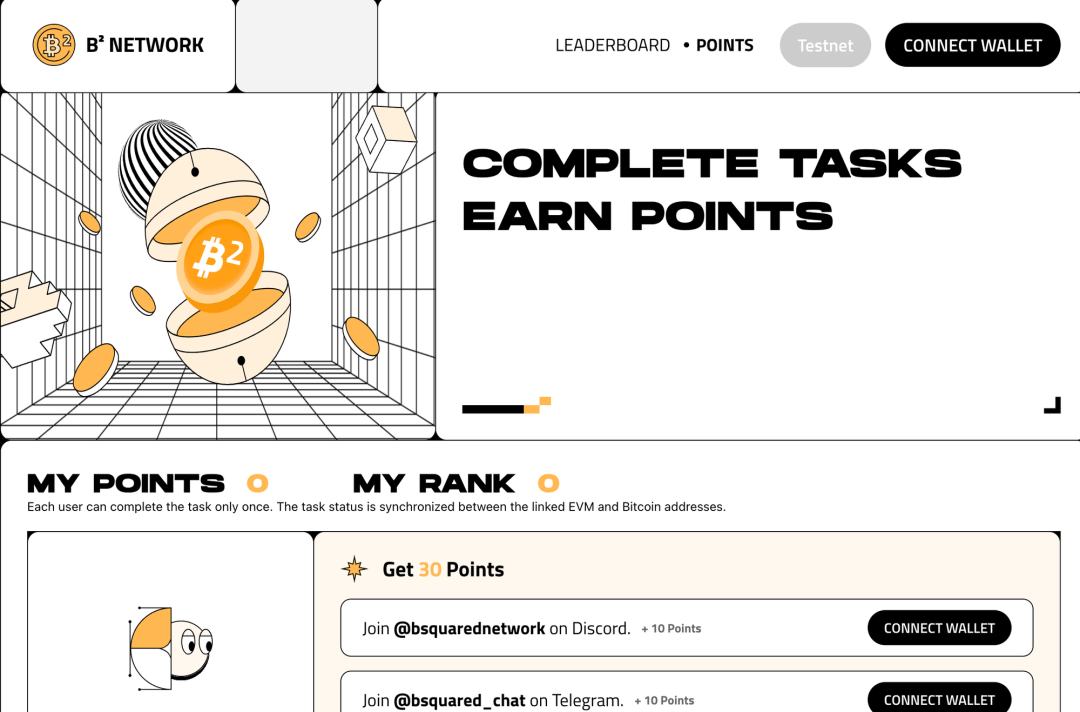
Users can follow and engage with activities on the B² website. Deposited assets before mainnet launch will be bridged to the B² mainnet and circulate within the ecosystem. Users can interact with dApps, complete tasks, earn points, and potentially qualify for future airdrops.
(Source: https://buzz.bsquared.network/)
3. Development
B² has launched a $1 million Grant Program to encourage developers to build on this emerging BTC L2. Six projects have already received grants in the first round:
-
GlowSwap
A native DEX on B² focused on BTC-related assets.
-
Protocol X
An Ordinals-based protocol helping more DApps and games establish their own asset frameworks within the BTC ecosystem.
-
L2scan
A block explorer dedicated to L2 Rollups.
-
PawX
An NFT project where users can plant, breed, trade, and chat with fellow cat enthusiasts in a virtual PawX universe.
-
Mystic Mind
An AI-powered NFT astrology application.
-
Golden Fleet
A cross-chain game powered by zk algorithms.
04 Conclusion
By introducing an EVM-compatible Bitcoin Layer 2, B² Network dramatically expands the scalability of Bitcoin’s ecosystem.
Using zk rollups significantly reduces transaction fees, while its innovative hybrid architecture—combining zk proofs with challenge mechanisms—overcomes Bitcoin’s inability to natively validate smart contracts.
B² partners with top-tier projects: Particle Network for account abstraction, AltLayer for RaaS, and currently collaborating with Polygon Labs to build the first BTC use case based on Polygon CDK.
These strong partnerships position B² as one of the most promising and viable Bitcoin L2 solutions—worth watching and participating in early.
Join TechFlow official community to stay tuned
Telegram:https://t.me/TechFlowDaily
X (Twitter):https://x.com/TechFlowPost
X (Twitter) EN:https://x.com/BlockFlow_News
 @BiteyeCN