








Does Vertex Protocol (VRTX) still have a chance?
TechFlow Selected TechFlow Selected
Does Vertex Protocol (VRTX) still have a chance?
More potential users mean higher fee-sharing revenue, allowing Vertex's flywheel to spin even faster.
 Navigating Web3 tides with focused insights
Author: Sleeping Deeply in the Rain

Currently, $VRTX is nearly down 50% from its all-time high (ATH), returning to roughly its initial launch price. However, according to data, Vertex is currently the largest decentralized derivatives exchange by market share (excluding dYdX).
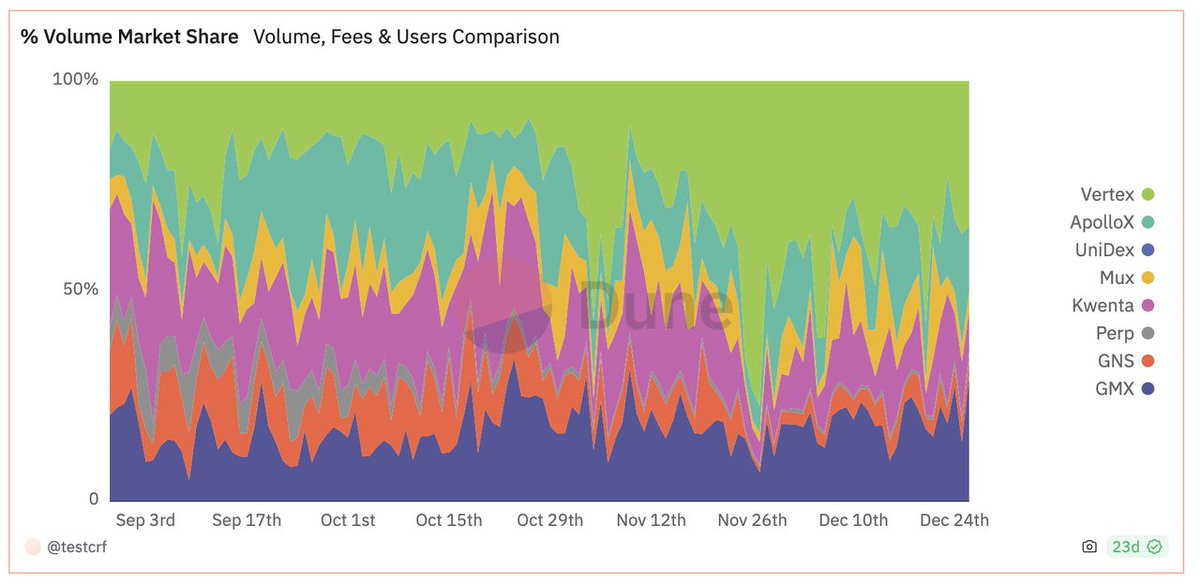
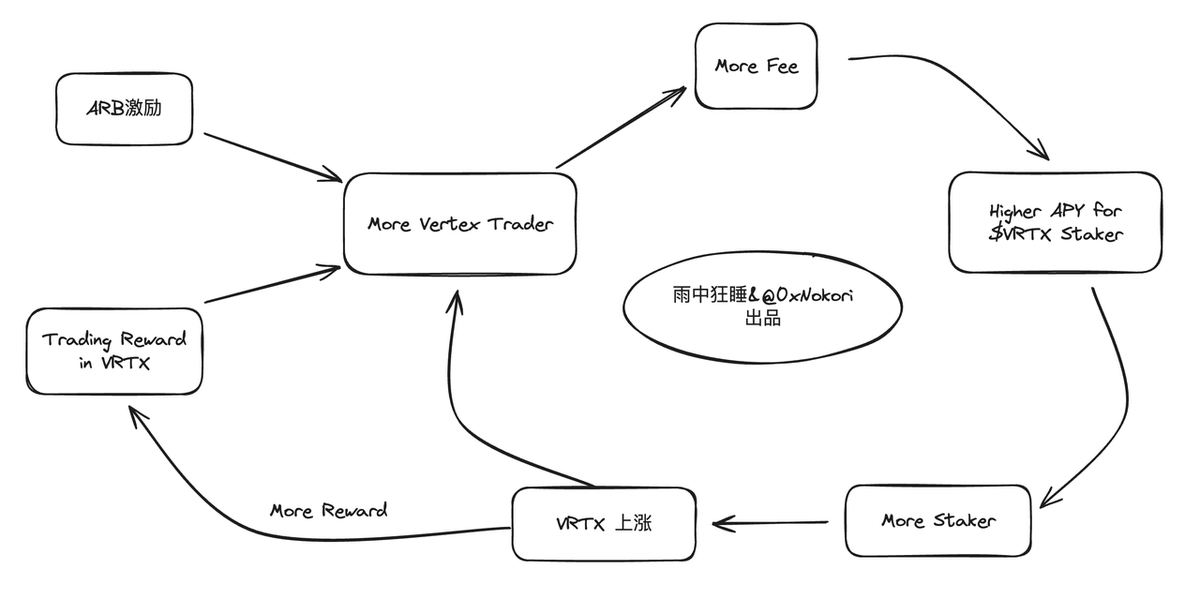
The driving force behind Vertex’s expanding market share lies in its trading mining mechanism. Essentially, Vertex has built a flywheel as illustrated below:
Recently, the most significant update for Vertex is that its v2 version will be launched at the end of January or early February. Therefore, I’d like to briefly discuss whether the release of Vertex v2 contains new opportunities.
What updates will Vertex v2 introduce?
-
List more assets, including more long-tail assets
-
Exotic options
-
Isolated margin
-
Gas fee optimization
Moreover, the most important update in Vertex v2: building a multi-chain product where users across different blockchains can share the same liquidity order book of Vertex.
Essentially, the focus of the v2 upgrade is for the team to expand its real user base by offering more products and expanding to additional blockchains.
For example, listing more long-tail assets allows Vertex to compete with centralized exchanges (CEXs) in terms of asset diversity. When it comes to liquidity and user accessibility & experience, CEXs undoubtedly have the upper hand—but if Vertex can list more long-tail assets not available on CEXs, it will attract more users who demand such assets.
Expanding to other blockchains also aims to acquire more users, while the "shared liquidity order book" addresses the issue of fragmented liquidity in the multi-chain era. Vertex v2 also resolves the problem of frequent cross-chain transactions for users in a multi-chain environment, thereby lowering the barrier to entry.
Additionally, cross-chain deployment mitigates potential security risks associated with cross-chain bridges.
The Vertex v2 update is scheduled for release at the end of January or early February.
Another notable product update (not included in the v2 update) is that Vertex will soon launch a USDC collateral pool. The collateral pool serves as Vertex’s final mechanism for settling traders’ profits. Investors can lock $USDC for a minimum of three weeks to receive the following two benefits:
-
A portion of traders’ liquidated assets
-
Boosted APY rewards for staking $VRTX
However, investors in the USDC collateral pool will also bear the risk of traders making profits.
Overall, as shown in the flywheel diagram, Vertex’s model closely resembles GameFi—using token incentives to reward traders, generating trading fees, and enabling token stakers to earn real revenue from these fees. The v2 update aims to attract more real users by expanding across blockchains, lowering user barriers, and improving user experience—similar to how today’s Web3 gaming seeks to attract genuine gamers through high-quality graphics or gameplay.
More potential users mean higher fee distributions, allowing Vertex’s flywheel to spin even more effectively.
Join TechFlow official community to stay tuned
Telegram:https://t.me/TechFlowDaily
X (Twitter):https://x.com/TechFlowPost
X (Twitter) EN:https://x.com/BlockFlow_News
 雨中狂睡Sleeping in the Rain











