








Deconstructing Anthropic: The Best AI Company—Perhaps Also an Organizational Invention
TechFlow Selected TechFlow Selected
Deconstructing Anthropic: The Best AI Company—Perhaps Also an Organizational Invention
How did Anthropic surge ahead? It boils down to two factors: strategic judgment and organizational culture.
 Navigating Web3 tides with focused insights
Over the past year, Anthropic may well be the most compelling company to study across the entire AI industry. At the start of this year, it achieved the fastest explosive growth in human commercial history: its Annual Recurring Revenue (ARR) surged from $9B to $45B. If compute supply keeps pace, ARR is likely to reach $100B by year-end and $200–300B next year—bringing it directly in line with Meta’s scale. In the secondary market, its valuation has already climbed to $1 trillion, surpassing OpenAI.
We spent considerable time researching how Anthropic managed to overtake its rivals. Ultimately, understanding the company comes down to two core elements: strategic judgment and organizational culture.
Many readers likely have fragmented insights into these topics—but no comprehensive picture exists yet. This article therefore aims to offer a more thorough梳理 and reconstruction. It seeks to explain, from both strategic and organizational perspectives, several questions that outsiders frequently ask, such as:
- Why did Anthropic recognize as early as 2021 that coding might be the most critical direction?
- How did personality differences between Dario Amodei and Sam Altman shape two fundamentally divergent strategic paths for their respective companies?
- Why does Anthropic maintain such an exceptionally low talent attrition rate?
- Why do nearly all Anthropic employees praise its culture? And how has this culture been preserved amid rapid expansion?
The Underappreciated Importance of Focus
Strategically speaking, OpenAI has always resembled a company that wants everything.
In terms of model capabilities, OpenAI pursues math, science, coding, reasoning, multimodality, and architectural innovation simultaneously. On the product side, it advances Codex, browsers, robotics, enterprise platforms, smart hardware, chips, and data centers—all at once. Reports suggest OpenAI internally managed as many as ~300 projects at one point. Anthropic stands in stark contrast: it was the only one among the “Big Three” frontier labs to abandon multimodality early on—and has never discussed architectural innovation, nor emphasized concepts like reasoning models, reinforcement learning (RL), or continual learning. Instead, it focuses exclusively on scaling language models and prioritizes coding above all else—driving through the single most critical capability first.
Today, the market widely understands why coding is so vital—centered on three key points:
- Coding is the gateway to everything. The vast majority of tasks in the digital world can be expressed through code.
- Coding is the capability best suited for model learning. Its outcomes are highly verifiable; feedback loops are short; and user data feeds back more effectively into model training.
- Coding is the core accelerator for AGI research. Top AI labs have now entered an accelerating cycle where a quarter’s model progress outpaces an entire year’s prior advancement.
The outcome confirms coding truly is the most critical direction—the sole masterpiece eclipsing all others. OpenAI didn’t awaken to this reality until March, when it cut off Sora and other side initiatives and elevated coding to its top corporate priority.
How Did Anthropic Identify Coding So Early?
We’ve long wondered: Why did Anthropic pick coding from the outset? Tracing back reveals the answer is half foresight, half luck.
Anthropic struggled significantly with early fundraising. With limited capital, it needed a more efficient path toward AGI. It had to first tell a vertical-story narrative—one demonstrating a viable commercial loop. So the team seriously evaluated: if forced to choose just one direction, coding was likely optimal—train better coding models → deploy them to customers → collect real-world engineering usage data → feed that data back into model training. This could form a self-reinforcing flywheel.
Anthropic’s Head of Growth once mentioned reviewing an internal memo co-authored by company founders titled “Why We Should Focus on Coding.” Crucially, the memo dates to 2021—far earlier than anyone knew the actual market opportunity. Later, however, fundraising improved and resources expanded, causing the coding thread to fade. Instead, Anthropic pivoted to building a more general-purpose model foundation. The decisive shift came after ChatGPT’s explosion. Recognizing that the consumer market had been seized by OpenAI, Anthropic—with regret (yet, in hindsight, extraordinary fortune)—shifted focus entirely to enterprise (toB).
This strategic pivot remained cautious and empiricist—not a bold, all-in gamble.
During Claude 3 training, Anthropic began deliberately strengthening coding capabilities—and achieved strong market validation with Sonnet 3.5. From there, it incrementally doubled down while rigorously testing assumptions. Internally, confidence solidified around coding’s dual potential: commercial value and research acceleration. The team then committed fully to this path—not only abandoning consumer (C-side) efforts entirely but also refusing to divert attention even to multimodal development. Beyond market-directional focus, Anthropic also demonstrated remarkable technical discipline.
Over the past two years, prominent researchers repeatedly claimed scaling laws had hit a wall—pretraining’s marginal returns plateauing. Yet from our conversations with researchers across labs, Anthropic remains the most steadfast believer in scaling laws—and executes pretraining and data work with unmatched rigor, avoiding distraction by novel paradigms. In retrospect, this was correct: much of Claude’s capability leap stems directly from disciplined pretraining investment.
Founder Personality
Yet this raises another question: Why does Anthropic consistently make decisive trade-offs and maintain unwavering focus across critical dimensions?
Resource constraints certainly played a role—Anthropic’s historical funding totals roughly one-third of OpenAI’s. But digging deeper, the strategic divergence also tightly correlates with founder personalities and backgrounds.
Four of Anthropic’s co-founders were core authors of the seminal scaling laws paper. Dario himself served as the central research lead for GPT-3—and had already spent a decade in AI before that, giving him firsthand intuition about technological progress and empowering him to make confident calls. Moreover, Dario is utterly immune to FOMO—even described by some as narcissistic and stubborn—rarely swayed by market consensus. As he stated in 2024, when Anthropic was still far from explosive growth: “The deepest lesson I’ve learned over the past decade is that markets always generate a ‘consensus.’ But after witnessing multiple consensus reversals overnight, I shifted focus to my own bets. I don’t know if we’re always right—but honestly, being right even 50% of the time delivers immense value, since we provide what others don’t.”
This contrasts sharply with Sam Altman. Based on our conversations with people close to him:
- Sam is widely regarded in Silicon Valley as one of the most ambitious founders—wanting everything from day one. His prior role at Y Combinator, investing in startups, ingrained deep familiarity with “planting many seeds, betting in parallel”—explaining OpenAI’s proliferation of side projects.
- Sam lacks a technical background, making his technical judgment less precise than Anthropic’s. He thus relies more heavily on bottom-up team-driven momentum. Sam leverages his strength—resource acquisition—supplying ammunition to each team.
- His VC background makes Sam especially fond of flashy, breakthrough ideas. Hence OpenAI’s culture highly values paradigm-shifting 0-to-1 innovations—but underemphasizes sustained 1-to-10 refinement. Products like Sora, Atlas browser, and Voice Mode lacked continuity—launched and then abandoned.
- Both Sam and Mark Chen (Chief Research Officer) exhibit a “yes-only” personality—never saying no. Side projects receive continued support as long as teams push hard.
As OpenAI’s forces scatter across countless side initiatives, Anthropic gains advantage through “Tian Ji’s horse racing”—concentrating superior strength precisely where it matters most.
The Art of Strategy Lies in “Omission”
Anthropic’s strategic focus offers a powerful insight: the importance of focus is severely underestimated.
I recall a podcast episode last year featuring David Senra, host of Founders Podcast. Over eight years, he dedicated himself almost exclusively to studying one great entrepreneur per week. When asked what single principle would distill all entrepreneurial wisdom gleaned from over 400 founder biographies, he answered: “Focus.”
Great entrepreneurs are rarely well-rounded A-students—they’re extreme obsessives. They identify one or two critical variables—like Costco’s pricing, Apple’s design experience, or ByteDance’s recommendation algorithm and data flywheel—and relentlessly drive them to extremes—even to the point competitors deem absurd.
It’s crucial to clarify: many believe they’re focused, yet fail to grasp focus’s true meaning and cost.
True focus operates on two levels:
First, judgment—the ability to identify what’s most critical and courageously sacrifice everything else.
Second, intensity—the capacity to deploy overwhelming resources to break through that critical element.
The former is a cognitive challenge; the latter, a matter of willpower. Both are indispensable.
Consider Google’s founding. At the time, internet consensus held that the future belonged to “portals.” Yahoo and other search giants cluttered homepages with news, weather, shopping, games, horoscopes—treating every feature as leverage to boost ad revenue. Google believed information would multiply endlessly—and users needed not larger portals, but immediate access to the most relevant answers. While competitors sought longer user dwell times, Google aimed for faster exits. Its homepage was famously sparse—just a search box.
Business-model-wise, Yahoo pursued dozens of monetization avenues. Google concentrated all energy on “search keyword bidding”—for nearly a decade—before seriously launching a second business line. Even today, one of Google’s Ten Things is: “It’s best to do one thing really, really well.” Strategy’s core isn’t deciding what to pursue—it’s deciding what to abandon. Most people simply say “no” too infrequently.
Culture Is the Greatest Secret Sauce
What makes Anthropic truly distinctive may not be strategy—but organizational culture.
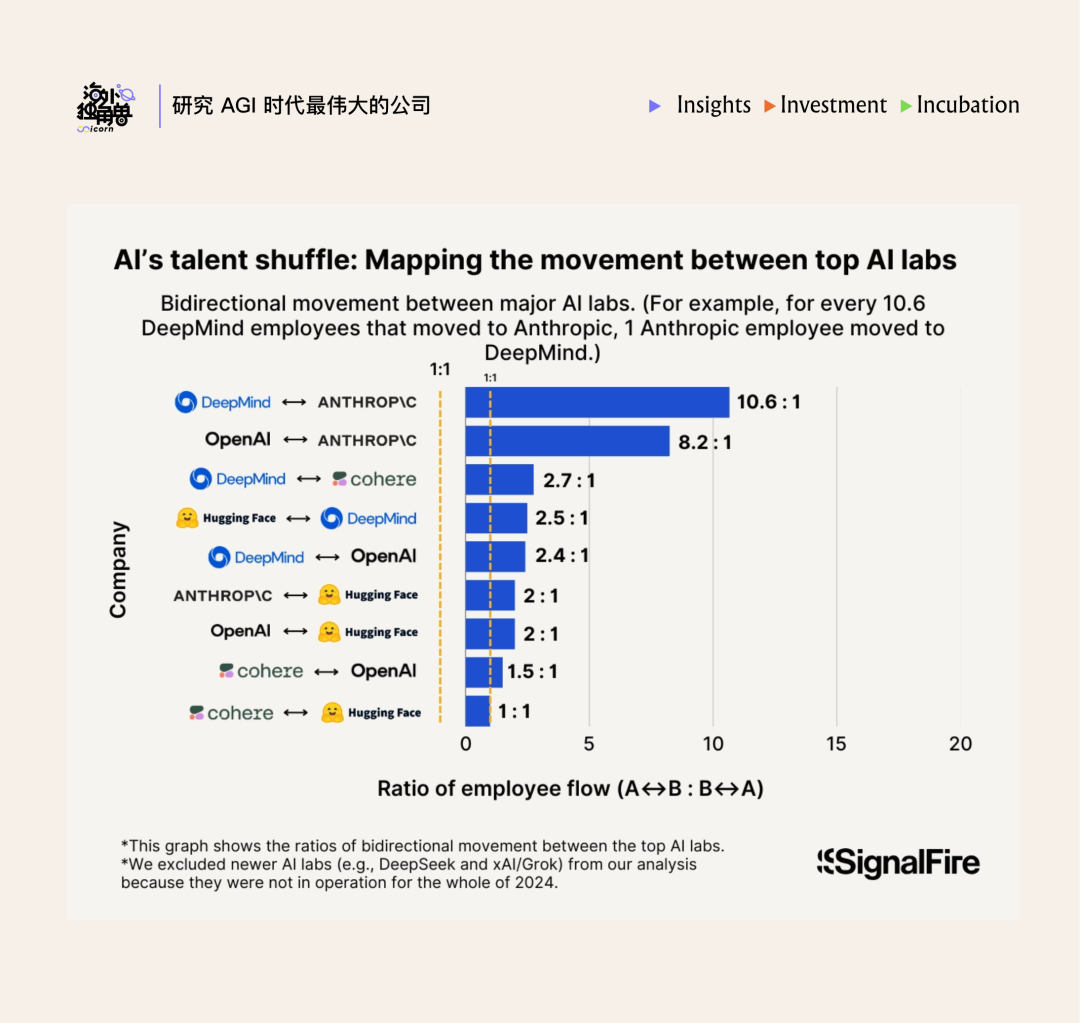
Over the past six months, amid fierce AI talent competition, Anthropic’s attrition rate has remained dramatically lower than other AI labs. The two charts below summarize talent mobility data from 2021–2023.
The first chart shows inter-lab talent flow ratios:
- For every 10.6 people moving from DeepMind to Anthropic, only 1 moves in reverse.
- For every 8.2 people moving from OpenAI to Anthropic, only 1 moves in reverse.
The second chart shows the percentage of employees remaining with the company two years post-hire.
Anthropic’s retention rate stands at 80%—the highest among leading AI labs at the time, slightly exceeding DeepMind’s 78%. Remarkably, Anthropic—a younger, rapidly evolving company—achieved higher retention than the established DeepMind. By comparison, OpenAI registered only 67%.
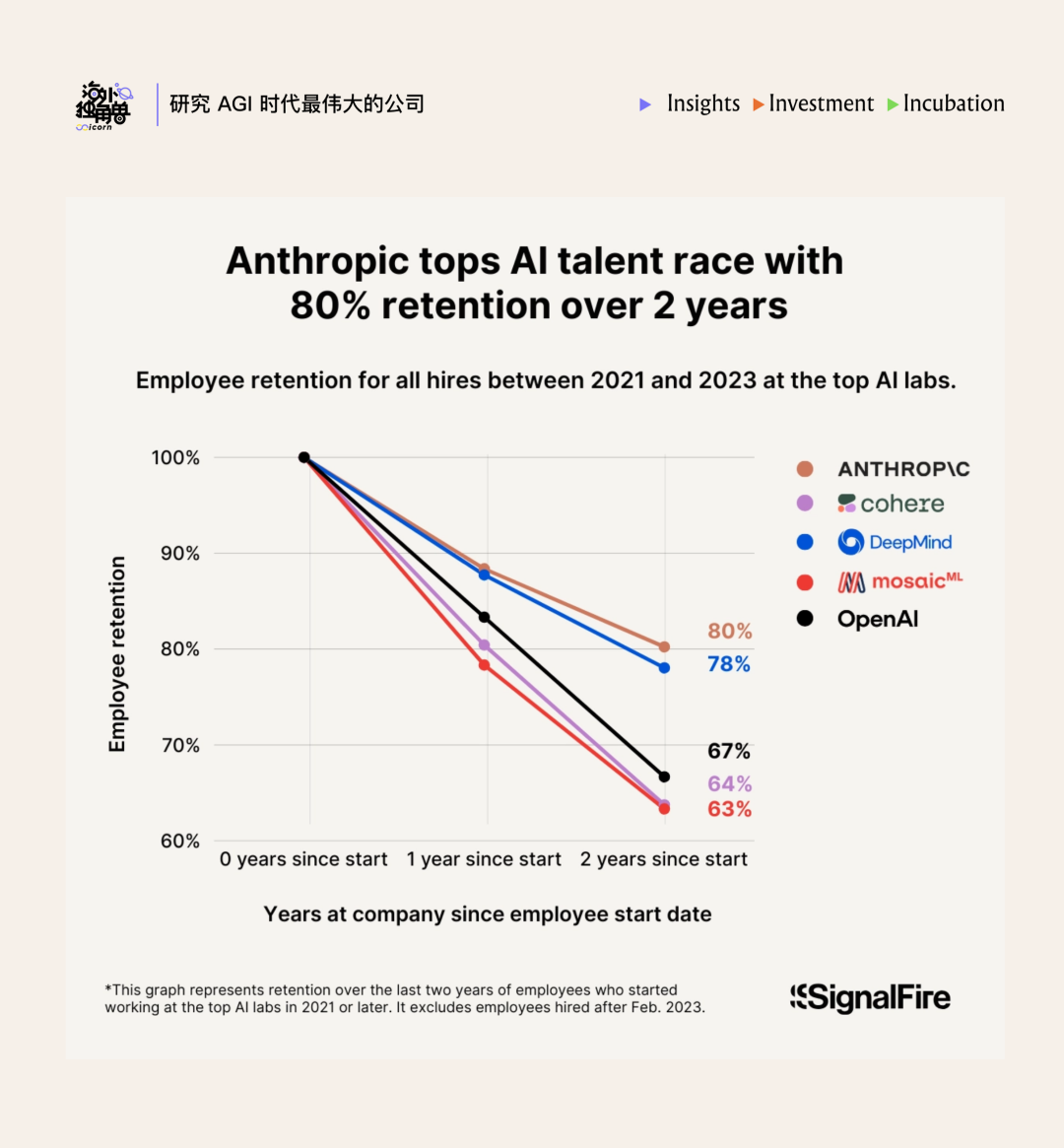
Note that this data predates OpenAI’s meteoric rise—and Anthropic’s emergence into prominence.
Recent headlines further highlight Anthropic’s talent appeal and stability. For instance, a viral Twitter post revealed CTOs from multiple star companies willingly joined Anthropic as ordinary technical staff (MTS—Member of Technical Staff):
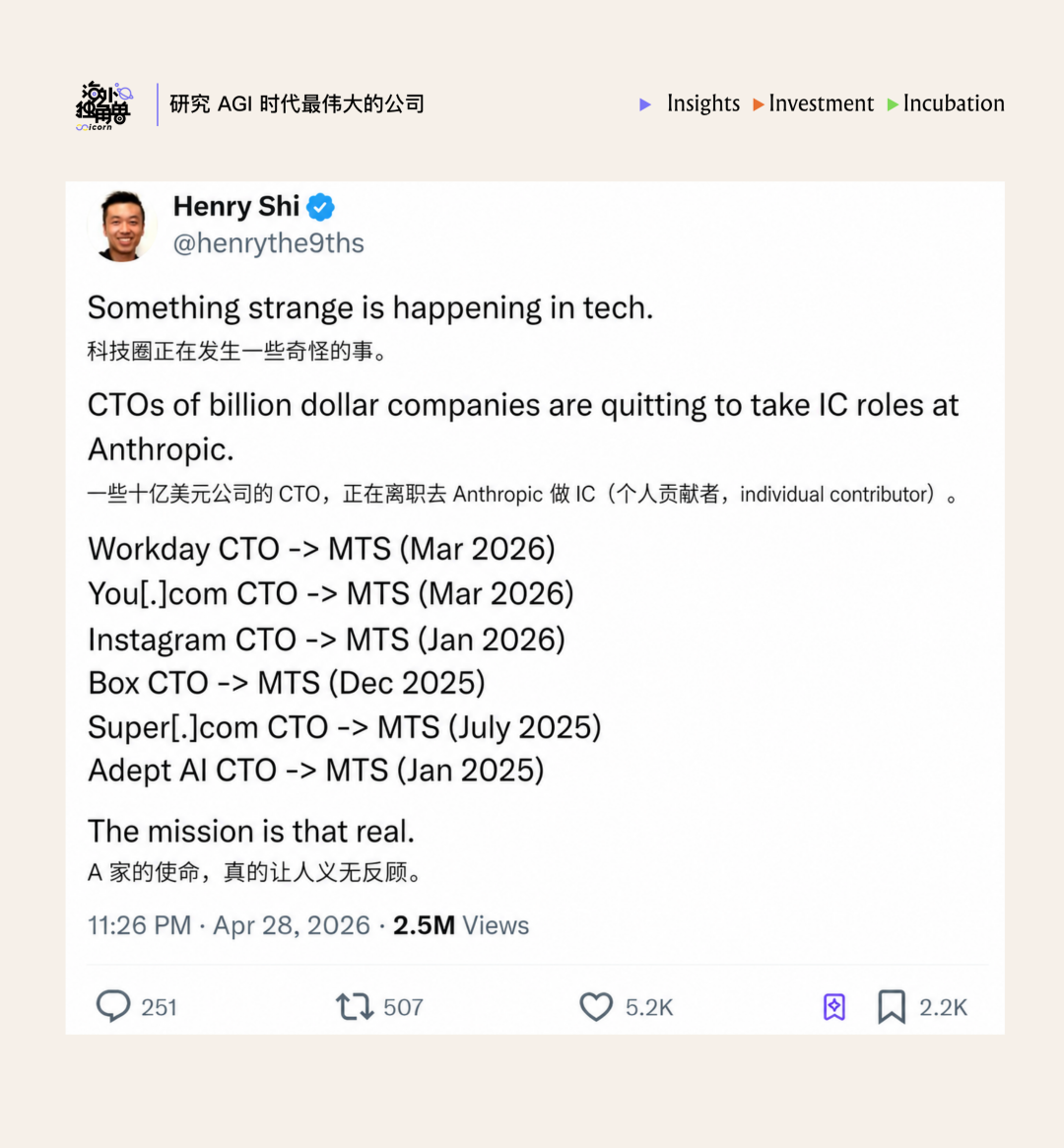
The primary driver behind this phenomenon is widely attributed to Anthropic’s organizational culture.
Listening to Anthropic employees on podcasts, nearly every guest mentions its culture—some even describing this quasi-religious culture as Anthropic’s greatest secret sauce.
“I genuinely believe culture is Anthropic’s secret weapon—the most defensible, irreproducible asset. This doesn’t happen organically; leadership invests heavily here.” — Amol Avasare, Anthropic Head of Growth
Without consciously focusing on this question, it’s easy to overlook—since discussions about culture or values often feel abstract, defaulting to empty slogans. Yet synthesizing all first-hand accounts and public interviews yields profound impact.
Three Distinctive Traits of Anthropic
Specifically, Anthropic differs markedly from other AI labs in three ways:
1. Mission-Oriented
Anthropic’s mission is “ensuring the world navigates the transformative AI transition safely”—placing safety above all else.
Many companies claim mission-driven status, but Anthropic’s commitment borders on religious fervor. It’s a frontier lab imbued with intense moral self-conception: it sincerely believes AGI can save humanity—and equally believes AGI could destroy it—while striving to walk the narrow tightrope between those two extremes.
Boris Cherny, Head of Claude Code, noted: “At Anthropic, ask anyone in the hallway ‘Why are you here?’ and the answer is always safety.” He and Product Manager Cat Wu briefly left for Cursor last year—only to return within two weeks, missing Anthropic’s cultural atmosphere—the shared, pure pursuit of a greater mission.
Some join skeptical—then discover, “Fuck, the internal culture is even more serious than external narratives suggest.”
Early employees have even declared in all-hands meetings: “If Anthropic achieves its mission but the company itself fails—that’s still a good outcome.” This statement explains much about Anthropic.
In most corporate logic, commercial success reigns supreme—mission serves merely as window dressing. Anthropic’s uniqueness lies in having internal members who genuinely prioritize mission over corporate survival.
Anthropic’s actions reflect this alignment: its nonprofit trust governance structure; interpretability research; safety investments; and recent willingness to forfeit a $200M U.S. Department of Defense contract due to values conflicts—all exemplify this principle.
2. High Trust, Low Ego
Conversations with other frontier labs reveal frequent internal politics and factionalism. Anthropic stands alone—without such issues. Instead, collaboration thrives; people readily support colleagues’ success.
The miracle lies in frontier AI’s natural tendency to breed star cultures and resource battles. AI researchers rank among the world’s smartest—and most ego-driven individuals—innately seeking unique solutions, establishing new factions, and seeking fame. Yet resources remain scarce—guaranteeing departmental conflict.
Daniel Freeman, who joined Anthropic from Google, observed: “Other model companies resemble competing feudal states—each operating independently, quietly vying for dominance. I’ve never felt that at Anthropic.”
Rahul Patil, former Stripe CTO, joined Anthropic last autumn—citing cultural shock as his strongest impression. “It’s astonishing how brilliant yet humble these people are,” he remarked. His benchmark: “If the company told you tomorrow your optimal role wasn’t continuing as an executive—but becoming an IC (Individual Contributor), because that best serves the mission—would you accept? I believe 100% of Anthropic’s people would—with zero ego.”
3. A Strong Humanistic Foundation
A New Yorker writer spent months embedded inside Anthropic—leaving two striking impressions:
- Bookish misfits
- A disproportionate number of Anthropic employees seem to be children of novelists or poets.
In essence, Anthropic’s people differ from typical Silicon Valley elites—or stereotypical tech engineers. They’re more literary, nerdy, idealistic—often seeming raised in writers’ or poets’ households. This manifests even in Claude’s naming: Haiku, Sonnet, Opus—referencing concise haiku, Shakespearean sonnets, and classical masterworks. Contrast this with OpenAI’s engineering-style GPT-4 / 4o / o1 or Google’s product-line Gemini Ultra / Pro / Flash—revealing subtle distinctions.
Boris Cherny recounted a telling anecdote on a podcast: At his first Anthropic lunch, he casually referenced an obscure hard sci-fi novel by Greg Egan—so niche he’d never met anyone who’d read it. Mentioning a plot detail, he was stunned when everyone at the table instantly recognized it. This reinforced his conviction: “This is exactly where I belong.” Sci-fi-loving nerds often possess grand humanistic concerns, historical responsibility—and stronger butterfly-effect reasoning. Such reading-based consensus deepened his confidence that Anthropic is the ideal place to push AI boundaries.
How Culture Becomes Institutionalized
Next question: How does such pure, quasi-religious culture persist? Anthropic is no longer a small AI lab—it’s a 3,000-person company expanding at record speed—yet maintains high cultural density.
Dario states plainly: He dedicates one-third to 40% of his time ensuring Anthropic’s culture remains strong—even amid endless demands in technology, product, fundraising, and government relations. He believes his highest-leverage work is cultivating a highly cohesive environment where top talent loves working. Concrete practices include:
- Distinctive Hiring Standards
Anthropic’s hiring philosophy diverges sharply from most AI labs.
First, talent preferences differ. While most firms chase “big names,” Anthropic favors underdogs. Beyond credentials, it prioritizes direct evidence of ability—e.g., independent research, insightful blog posts, substantive open-source contributions. Second, Anthropic applies rigorous cultural screening. Its interview process includes a dedicated Cultural Interview—60 minutes probing 15–20 scenario-based questions.
Publicly leaked questions emphasize three areas:
(1) Do you genuinely prioritize the safety mission? A classic screening question: “If Anthropic decides not to release a model due to safety concerns, would you accept your stock becoming worthless?”
(2) Are you genuinely nice and ego-free? Assessing kindness, empathy, people skills—and willingness to admit ignorance or error.
(3) Can you handle complexity? Anthropic tackles highly complex, dynamic problems. It values systems thinking and second-order effect reasoning—how decisions ripple across interconnected domains.
Anthropic invests heavily in “reverse screening”—and has demonstrably rejected many elite 10x developers. Rahul Patil recalled his pre-Anthropic talks with then-CTO: Rather than persuading him to join, the CTO spent weeks discussing why he shouldn’t—gently discouraging him unless he was deeply aligned culturally and mission-wise.
Thus, Anthropic’s hiring logic isn’t maximizing elite talent intake—but expelling cultural misfits early. “We excel at filtering out those motivated solely by money or fame.” Conversely, OpenAI ceased formal cultural interviews after scaling up—reportedly contributing to management issues.
This contrast surfaced starkly during Meta’s recent hiring spree. Facing Meta’s sky-high offers, OpenAI responded conventionally: counteroffers, retention bonuses, accelerated vesting. Anthropic reacted characteristically: “You joined for the mission—not to inflate your price in external bidding wars. We won’t pay ten times more than peers just because Mark Zuckerberg happened to notice you. That’s unfair. If you leave, go.”
The outcome speaks volumes: OpenAI reportedly lost dozens; Anthropic lost just two—both longtime Meta employees (6 and 11 years).
2. Culture of Context Sharing
Anthropic maintains exceptional internal information transparency.
First, Dario proactively and frequently provides meaning. He hosts all-hands sessions every two weeks—dubbed “Dario Vision Quest” (which he jokes sounds like a mountain retreat followed by enlightenment). He presents for one hour—typically accompanied by a 3–4-page document—covering company direction, product strategy, industry shifts—and answers questions live.
Employees describe his communication as unusually direct and candid: “Dario is the most straightforward person I’ve met—his words aren’t calculated, but raw reflections of his thinking.” Beyond all-hands, he constantly shares unfiltered thoughts on Slack—documenting company developments, worries, and perspectives on employee concerns.
This culture ensures everyone understands decision-making processes and priority-setting—enabling consistent, decentralized decisions amid complexity.
Transparency isn’t one-way indoctrination—it invites challenge. After a Dario all-hands talk, someone disagreeing posted publicly in Dario’s notebook channel: “I disagree with your assessment”—sparking an immediate debate. Challenging leadership openly is encouraged. Further, this writing culture extends beyond Dario—it’s a company-wide thinking mechanism.
Many Anthropic employees maintain personal notebook channels—akin to individual Twitter feeds—chronicling thoughts, work, and progress. Others subscribe, observe, or join discussions. Employees consistently praise this writing culture—Slack functions as a massive knowledge repository. Thus, Anthropic cultivates fertile alignment soil: projects, ideas, and reasoning remain transparent and fluid—even financial data reportedly accessible.
(Conversely, technical confidentiality is extremely tight—some teams reportedly isolate deliberately, even avoiding shared meals. Result: External researchers lament that critical know-how resides scattered across individuals’ minds—impossible to reconstruct by poaching a few people.)
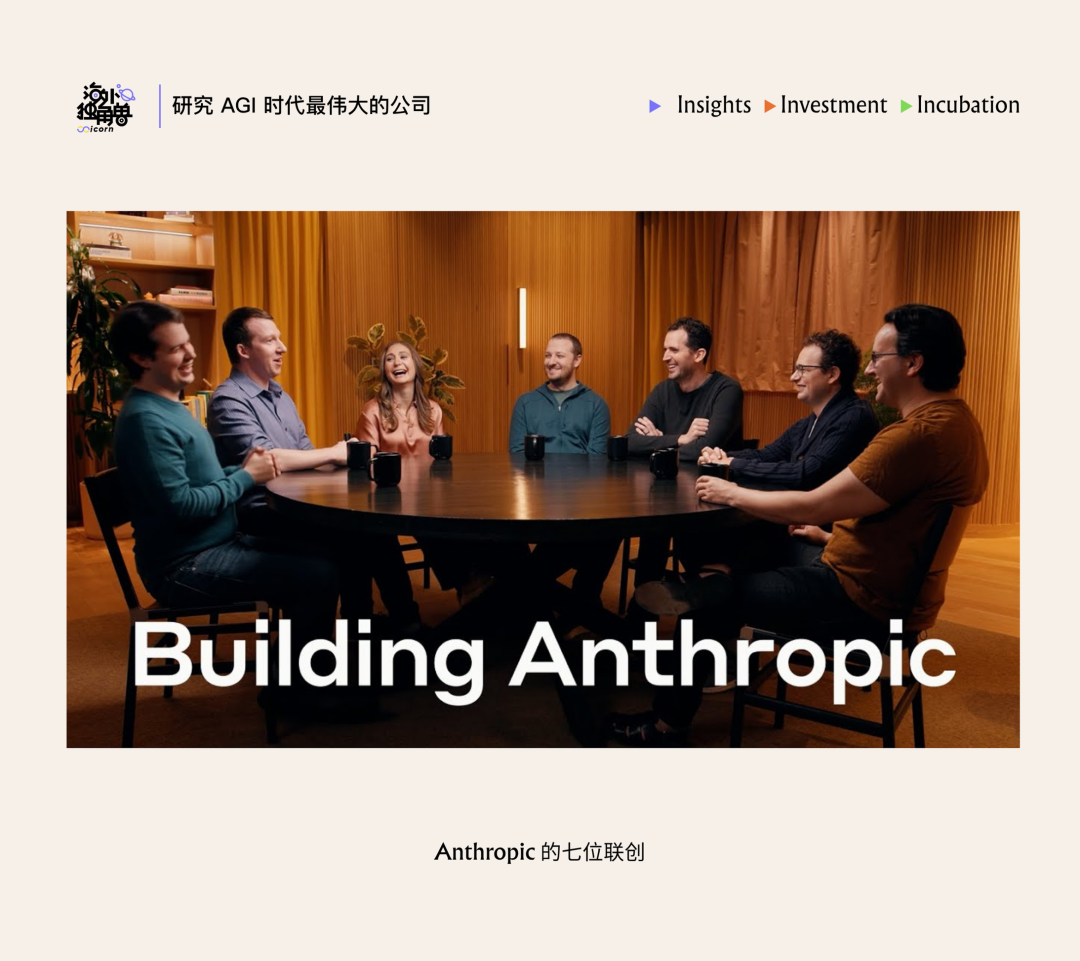
3. Seven Co-Founders with Equal Equity—Founding Structure as Cultural Mechanism
Anthropic’s founding structure defies conventional business wisdom: seven co-founders—and Dario insisted each receive identical equity—not reserving extra for himself.
Everyone advised this would be disastrous—blurring authority, misaligning incentives, risking collapse through infighting. Dario countered: The company orbits the mission—not any single founder—and equal equity serves as irrefutable proof of this principle. Having collaborated for years, the founders trusted each other deeply—equal equity wasn’t governance design but a commitment demonstration—a cultural diffusion mechanism.
Seven co-founders function as seven cultural replication nodes—projecting values across diverse domains. Thus, even amid expansion, core culture resists dilution.
Contrast this with OpenAI’s volatile leadership: 11 founding team members departed sequentially—leaving only Sam Altman, Greg Brockman, and Wojciech Zaremba. New leadership proves even more unstable: Since early 2026, the top product leader took leave; the top marketing leader resigned for health reasons; the communications leader exited; the operations leader was reassigned; the finance leader marginalized...
4. Extreme Emphasis on “One Team”—Preventing Factionalism
Anthropic’s CTO stated on a podcast: Compared to traditional firms, AI labs are inherently bottom-up—a reverse-pyramid structure where power and creativity flow upward.
Most critical work happens at the front lines—where people interact daily with AI’s emergent behaviors. Experiment-running frontline staff possess the most intuitive grasp of model capabilities. Most product ideas originate there—not from executive roadmaps. Yet this decentralization risks fragmentation: teams guard their problem sets and value functions—becoming competing factions.
Anthropic recognized early: If judgment must be distributed, unity must be actively engineered. Dario refuses to let safety teams declare safety paramount while product teams insist product is paramount—kicking conflicts upward. His core management principle: Distribute trade-offs to individuals—granting each a founder’s perspective—participating in one massive, shared trade-off process.
Hence, Anthropic emphasizes “one team” fiercely—and weakens role boundaries via institutional design. Below executive level, titles vanish—everyone is “Member of Technical Staff,” deliberately blurring distinctions like “researcher vs. engineer,” “senior vs. junior,” or “architect vs. implementer.”
This contrasts sharply with OpenAI’s stronger researcher culture—and visible internal “pecking order”: Researcher > Research Engineer > Software Engineer. Consequently, products often yield to research—lacking influence. During conflicts, research teams resist cooperating with product teams.
OpenAI’s product innovation is strongly researcher-driven: Research teams produce breakthroughs—then product teams scramble to find applications.
In Anthropic, product and model teams integrate tightly—product actively shapes and defines model capabilities. This partly explains OpenAI’s weaker product execution versus Anthropic.
Two Origins of Culture
Next question: Why did Anthropic develop this unique culture?
Two perspectives help explain:
I. Business Requirements
I recall a talk two years ago by a top-tier tech firm’s HR head—deeply impactful, prompting my first serious reflection on organizational culture’s true meaning.
Organizational culture’s essence: Employee behavior patterns that critically enable company success. Thus, culture’s first principle is that business nature dictates culture.
Example: ByteDance and Huawei both possess formidable organizational capabilities—but swapping their structures would cause both to collapse quickly. They occupy opposite ends of a spectrum: ByteDance champions “being first”; Huawei champions “being second.” One values innovation; the other efficiency.
This isn’t value judgment—it’s business-nature driven. Building a new product differs radically: Huawei builds base stations and chips—failure recalls risk swallowing annual profits. ByteDance operates short-cycle, short-chain businesses—releasing dozens of versions weekly—fixing errors immediately. Thus, ByteDance encourages innovation and “context, not control”; Huawei cannot. Premature innovation burdens Huawei—its strength lies in dominating markets after PMF emerges, leveraging organizational muscle to crush competitors.
Back to Anthropic.
In AI competition, a core moat is enabling “smart people to do dirty work.” Especially in coding and agentic directions—surface-level model capability competition masks deeper engineering competition. These aren’t solved by genius flashes—but by massive, tedious, granular systems engineering. Data forms the ultimate barrier.
Past chat data was simple text. Coding and agentic data is vastly more complex—encompassing tasks, environment setup, execution traces, and full evaluation/verification systems. All are dirty, labor-intensive jobs—critical yet lacking personal glory (unlike publishing papers or launching products).
From researcher interviews: OpenAI’s core challenge is organizing hundreds of top talents to diligently tackle data and grunt work. OpenAI hires from the top of the pecking order—elite backgrounds, high ambition—naturally preferring their own bets and 0-to-1 breakthroughs—not cleaning up messes or augmenting data.
OpenAI succeeded previously through paradigm-shifting breakthroughs—but as Yao Shunyu recently noted: “The era of individual heroism is over… AI doesn’t require brilliance—it requires reliability and meticulousness.”
Here, Anthropic’s low-ego, cohesive, mission-driven culture shines. Reportedly, co-founder Jared Kaplan personally leads data reviews daily—executing data cleaning with unmatched rigor—unmatched elsewhere.
(This explains a phenomenon: OpenAI excels at contest-level coding challenges—research problems—yet lags Anthropic on daily agentic tasks—engineering problems demanding data, systems, and execution details.)
II. Founder Backgrounds
Company values often mirror founder values—e.g., Jack Ma’s wuxia ethos, Pony Ma’s gentle openness, Steve Jobs’ aesthetic orientation, Ren Zhengfei’s military discipline.
More precisely, founder values stem from two sources: what they originally believed—and what they deeply hated. The former defines who they want to become; the latter defines who they refuse to become.
Anthropic embodies both—yet the latter’s shaping force may exceed the former. Consider Dario’s journey:
Dario first encountered AI at Baidu’s AI Lab—where he observed scaling laws firsthand, becoming its staunchest believer. After Baidu’s breakthrough, internal battles over control and resources erupted—dissolving the team. Dario later joined OpenAI—deeply involved in GPT-series development. OpenAI entrusted him with 50–60% of company-wide compute—leading GPT-3.
But Dario’s strong values and convictions gradually clashed with OpenAI colleagues on organizational philosophy. For example, Greg Brockman proposed selling AGI to nuclear powers in the UN Security Council. Dario nearly quit immediately—viewing this not as a business disagreement but a foundational values breach.
Greg and Dario’s friction grew over years—Sam Altman mediated. Sam’s strength—making each side feel he supported them—worked short-term but eroded trust long-term. Later, reconciling promises revealed Sam told Dario and Greg contradictory things. Gradually, Dario formed a tight-knit alliance—nicknamed “the pandas” by some for his panda affinity. Disagreements with OpenAI leadership over strategy and governance escalated into severe political warfare.
A major confrontation erupted: Sam accused Dario and Daniela (Dario’s sister, later Anthropic co-founder) of orchestrating negative feedback behind his back; they denied it—and summoned Sam’s alleged source. The source denied knowledge—and Sam retracted his accusation.
This shattered trust—ending in a shouting match.
Similar internal dramas abounded. Ultimately, Dario framed these conflicts as moral trust crises—he believed leaders of a company wielding such powerful technology must be authentic and trustworthy. Dishonest leadership, he felt, would accelerate dangerous trajectories.
Thus, Dario departed OpenAI with GPT-3 core colleagues—founding Anthropic.
Therefore, Anthropic’s culture isn’t just Dario’s innate trait—it’s forged through direct experience of political battles at both Baidu and OpenAI. He witnessed how easily ego-driven geniuses fracture over resource battles and value clashes—prompting deliberate countervailing construction:
Having seen trust erosion through balancing acts—he prioritizes authenticity and transparency; having experienced heated political warfare—he encourages surfacing conflict early; having seen ideological splits destroy organizations—he instituted strict cultural screening; having witnessed superstar power struggles—he emphasizes low ego and avoids “big names.”
Anthropic’s culture today reflects powerful reactive forces from Baidu and OpenAI experiences.
Conclusion
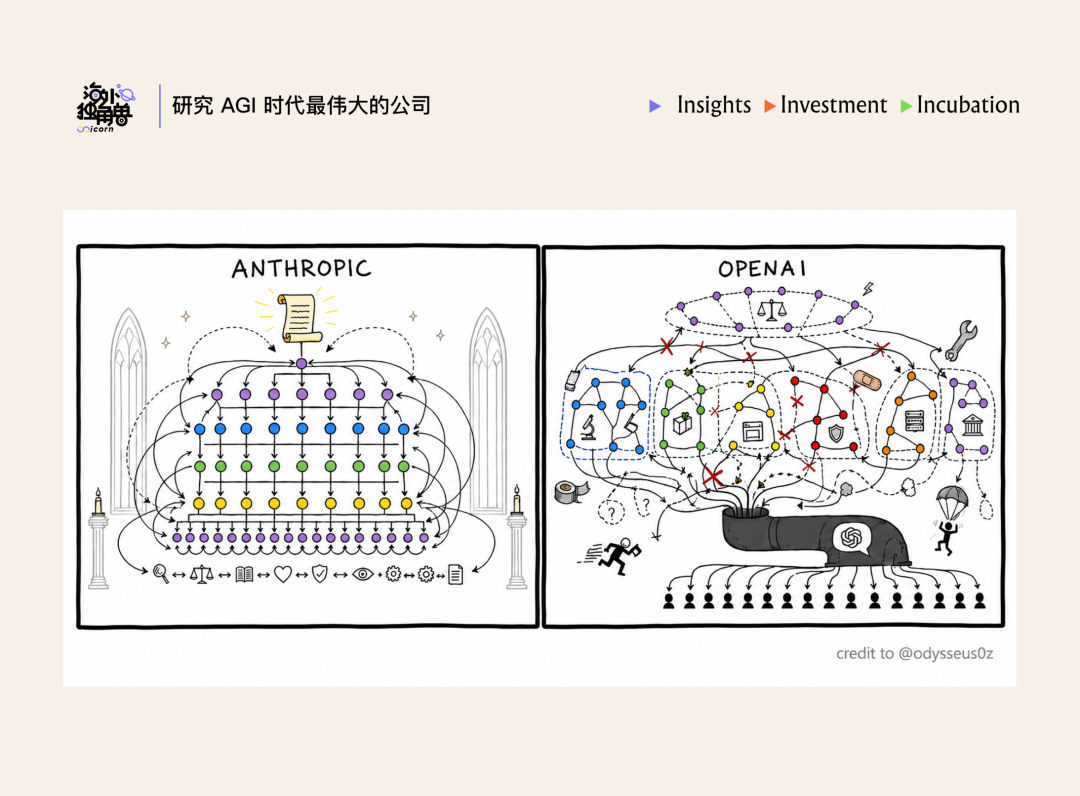
In summary, Anthropic and OpenAI represent fundamentally different companies: the former is an idealistic, mission-clear, highly cohesive “sect-like” organization; the latter, an ambition-driven, multi-pronged, ever-searching super-platform.
To clarify, compare core dimensions side-by-side:
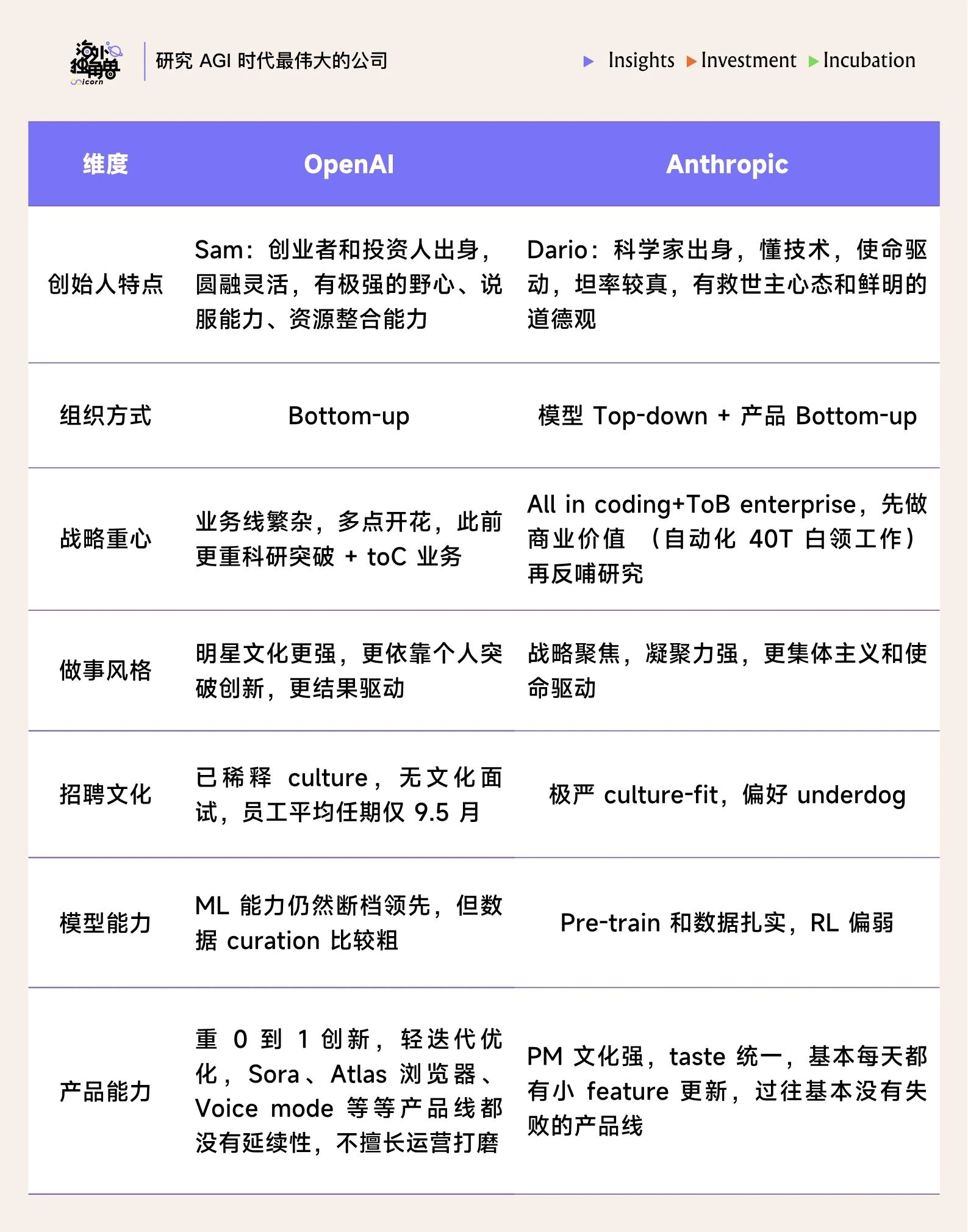
Yet despite highlighting Anthropic’s strengths, we cannot conclude one culture inherently dominates another—or predict the battlefield’s state in three months. AI evolves too rapidly—and OpenAI is currently undervalued by markets, e.g.:
- Coding is now “table stakes”—OpenAI may catch up fast; a clear trend shows developers migrating from Claude Code to Codex;
- Demand explosion exceeds all expectations—compute is becoming the new decisive factor—and OpenAI secured vastly more compute than Anthropic early on;
- OpenAI’s open-exploration culture holds inherent advantages—and it aggressively explores/pursues new paradigms—potentially reversing fortunes with the next leap.
In short: Looking back from 2026, Anthropic leaves the industry a memorable case study—proving that in the AI era, winning doesn’t always require bigger ambition, more exploration, or stronger talent. Sometimes, victory springs from opposites: fewer bets, lower ego, and a seemingly naive mission.
Join TechFlow official community to stay tuned
Telegram:https://t.me/TechFlowDaily
X (Twitter):https://x.com/TechFlowPost
X (Twitter) EN:https://x.com/BlockFlow_News












