Weekly Podcast Recommendation | On the Edge of the Cliff, Facing Infinite Possibilities
TechFlow Selected TechFlow Selected
Weekly Podcast Recommendation | On the Edge of the Cliff, Facing Infinite Possibilities
"Because the edge of the cliff is full of all possibilities." – Tal Wilkenfeld, one of Australia's most outstanding female bassists
 Navigating Web3 tides with focused insights
Compiled by: Sunny, TechFlow
The renowned Japanese entrepreneur Kazuo Inamori once said: "Put yourself in a desperate situation."
"Desperation" refers to a moment when there seems no way out—a dead end. Yet it is precisely such desperation that can unleash extraordinary power, like the superhuman strength seen at fire scenes. In the latest episode of Lex Fridman’s well-known North American podcast, he invited Tal Wilkenfeld. Tal Wilkenfeld is an outstanding Australian bassist, celebrated for her exceptional technical skill and innovative contributions to rhythm and melody in contemporary music.
Tal shares a similar insight about desperation: only when pushed into dire straits, one can unlock unimaginable strength by honestly facing reality and confronting challenges head-on—finding hope amid despair. Poetically, she compares her stage experience to standing on the edge of a cliff, because it is at great heights that human potential is truly unleashed.
Perhaps the awakening of the crypto industry follows a similar path. Vitalik once published a blog post titled “Let Ethereum Rise Here Among the Cypherpunks.” The cypherpunk movement emerged in the late 1980s and gained prominence in the early 1990s, advocating privacy, encryption, and the use of cryptographic tools to enhance individual freedom and resist government surveillance. Cypherpunks were dedicated to empowering individuals through technology and advancing digital-age privacy protection.
It wasn't until the 2008 financial crisis that Satoshi Nakamoto truly brought cryptography and digital privacy into the public spotlight through the invention of Bitcoin. True cypherpunks became the earliest holders and promoters of the blockchain industry—not only committed to carrying forward the encrypted internet movement but also dreaming of optimizing humanity's foundation of trust. Thus, the blockchain and Web3 industries were born.
Fast forward to January 2024, when the U.S. Securities and Exchange Commission (SEC) officially approved Bitcoin spot ETFs. This milestone was not without turbulence: the collapse of Luna in 2022, the FTX implosion in 2023, and the resignation of Binance CEO CZ at year-end all signaled the industry's underlying challenges—insider trading, severe information asymmetry, market manipulation, and lack of regulation. Yet this approval marks a regulatory precedent and paves the way for broader mainstream adoption.
Now, assuming we had ideal regulatory frameworks and environments, what would be the next turning point? For those with innovative ambitions, this is key to seizing the next opportunity; for others, how should they prepare for the market? In the latest episode of Lightspeed, Josh Rosenthal was invited as guest. Josh is a former historian, now a serial entrepreneur and crypto venture capitalist—an innovator who transitioned from AI to crypto. He likens the crypto movement to the financial enlightenment in Florence and the information revolution brought by the printing press. The crypto movement, too, is an enlightenment—a generative technology. In a sense, generative technologies create entirely new value on-chain, not out of thin air.
Today, if we compare major public chain ecosystems to cities, sidechains to archipelagos, scaling solutions to high-speed transit, oracles to the "Snowpiercer" connecting the real world and the on-chain realm, communication protocols to bridges between cities, and zk to capes or shrinking rays... then what exactly is happening in these newly built cities?
Below are TechFlow's curated picks from this week’s podcast resources, highlighting some interesting perspectives and topics currently capturing attention among podcast hosts.
1.Lex Fridman: Music, Guitar, Bass, Jeff Beck, Prince, and Leonard Cohen | Tal Wilkenfeld

"Because the edge of the cliff is full of possibilities." — Musicians express their passion and dedication to art through creation, performance, and personal growth. Tal Wilkenfeld is known for her deep musical passion and profound expression of personal experiences. She emphasizes the importance of emotional connection and personal development in the creative process. At the same time, the music industry is fraught with challenges and hardships, yet finding support and friendship within adversity is crucial. By expressing emotions and exploring inner depths, artists not only showcase the power of music but also create beautiful, healing experiences.
Link: Tal Wilkenfeld: Music, Guitar, Bass, Jeff Beck, Prince, and Leonard Cohen
2.Lightspeed: Why Crypto Matters: Generative Tech Meets New Capital Formation | Josh Rosenthal
The Transformative Potential of Generative Technology – Generative technology holds revolutionary potential, especially in new capital formation based on ledgers. NFT applications transforming buildings into community centers demonstrate how generative tech can drive real change. Historically, the printing press generated new economic models; today, cryptocurrency enables the fulfillment of the internet’s promise—ownership through participation, breaking down traditional barriers. This trend in new capital formation not only creates new markets and collaboration opportunities but also fosters a middle class and drives society’s evolution from scarcity to abundance. Generative technology is more than just innovation—it’s a vital path to solving global crises and freeing ourselves from institutional constraints. Synthesized identities, money, and communication via deep network bridges will be the next compelling unlock in crypto’s social and economic impact. This large-scale unlocking could resolve socioeconomic and financial issues, bringing profound transformation.
Link: Why Crypto Matters: Generative Tech Meets New Capital Formation | Josh Rosenthal
3.Taiki Maeda: Crypto Market Wizards | Qiao Wang

Trends and Predictions in the Cryptocurrency Market – Qiao gains valuable insights from the successes and failures of young traders, learning 50 to 100 lessons annually. He stresses that a growth mindset is essential in crypto, given the space’s constant evolution with new narratives and domains. Comparing upside potential between mainstream and alternative equities, he advocates for a longer-term perspective in crypto investing. Cardano’s community loyalty resembles a cult or religion, and active developer engagement in debates signals strong market “religious” potential. Some project founders show signs akin to religious extremism. Ethereum and Polygon lead the market despite Twitter controversies. Bitcoin’s growth has exceeded expectations, particularly underestimated by Western investors and VCs. Qiao remains confident in Bitcoin’s bottom, even though his predictions came early. He has abandoned the goal of chasing 100x returns, having already achieved much greater gains. Reflecting back, Qiao regrets not quitting his job a decade ago to enter the crypto space, recognizing its immense profit potential.
Link: Qiao Wang - Crypto Market Wizards EP11
4.a16z: Economic and Structural Challenges in Higher Education | Ben Horowitz and Marc Andreessen
The difference between university teaching and research may raise concerns about educational quality, while the economic structure of universities heavily relies on full-tuition-paying international students. The conventional view ties the value of a university degree to job skills, but this is difficult to empirically verify. The student loan crisis is worsening, with graduates burdened by massive debt that grows over time. Many degrees and institutions fail to produce graduates demanded by the market, contributing to both the student debt crisis and societal misdirection.
Social and Political Impact of Higher Education: Elite universities cultivate elites who eventually control many aspects of society, including public policy. The replication crisis in research reveals errors in many published findings, while U.S. university faculty show extreme political polarization, raising questions about their role as advisors in politics. University administrations have become bloated cost centers, with administrative staff outnumbering students at some institutions. Universities depend heavily on diverse funding sources, and disruptions in funding could jeopardize their stability.
Link: Crisis in Higher Ed & Why Universities Still Matter
5.Token Terminal: Manta Network | Kenny Li
Manta Network has taken innovative steps in its methodology and technology. Its new paradigm for L2 yield and economic model provide critical support for its market strategy and future plans. Through a modular approach, Manta Network effectively leverages key technologies, reduces gas fees, and enhances user experience. ZK expansion beyond private transactions opens new possibilities for developers and users. By building universal ZK circuits, Manta enables easier and more efficient development. Its modular design demonstrates significant industry impact in scaling solutions, combining Celestia’s high throughput to achieve competitive advantages in the L2 space. Manta tokens serve multiple roles in the ecosystem—gas fees, governance, and incentives. Improved user experience is evident in significantly reduced gas costs, offering users more swaps and benefits. Additionally, the yield mechanism on L2 introduces exciting changes, reshaping ecosystem growth and funding rules. Universal circuits make decentralized game creation on blockchains possible, while Web3 aims to overcome Web2’s geographic fragmentation, creating a more unified and global platform.
Link: Manta Network – Modular innovation, Celestia DA, ZK apps, New Paradigm, & more
6.Unchained: How Small Bitcoin ETF Issuers Can Compete With Giants Like BlackRock

The launch of spot Bitcoin ETFs marks a major milestone, providing regulatory clarity and attracting a broad audience to Bitcoin for the first time. ETFs have evolved from being called “weapons of mass destruction” to “mother’s milk of investing,” highlighting crypto’s vast potential in finance. Premiums across products have dropped significantly, and two organizations have pledged profits to support Bitcoin core development, treating Bitcoin as a public good. Major financial institutions participating in Bitcoin fund market-making have normalized and legitimized crypto. Next year, major brokerages are expected to launch Bitcoin ETFs, driven by strong ETF performance and low correlation with traditional assets, indicating massive demand. Currently, Bitcoin issuance stands at $1 billion per month, signaling high growth potential. Digital assets are seen as the next revolution in emerging markets. Bitcoin is projected to hit all-time highs in Q4 following contentious elections, with global voter turnout reaching record levels, creating opportunities for transformation and disruption. On competition and business strategy, Bitwise plans to compete with giants like BlackRock and Fidelity through brand advertising, aggressive pricing, and existing market relationships. The appeal of low-cost ETFs lies in serving a broad audience.
Link: How Small Bitcoin ETF Issuers Will Compete With the Likes of BlackRock
7.The Chopping Block: When Will the ETF Hype End?

Jane Street has become an authoritative player in the ETF market, underscoring the importance of authorized participants. Larry Thinkink compares cryptocurrencies to gold, viewing tokenization as the future. The possibility of an Ethereum ETF has increased following the approval of Bitcoin ETFs and the lack of differentiated rejection reasons. The SEC handing jurisdiction of Ethereum futures ETFs to the CFTC may signal Ethereum could be viewed as a non-security, though no official statement has been made. Circle earns high-margin, predictable revenue from USDC, making it an attractive business at a 5% interest rate, especially compared to Coinbase’s volatility. Companies with no revenue can be valued higher than those with substantial revenue, creating an investment paradox. Stablecoins bring practical convenience and improve lives in countries like Turkey, Argentina, and Venezuela. Some crypto platforms are labeled “crypto casinos,” sparking controversy over their legitimacy and stability.
Link: When Will the ETF Hype End? The Chopping Block
8.Epicenter: FHE-powered End-to-End Encrypted Ethereum | Phenix
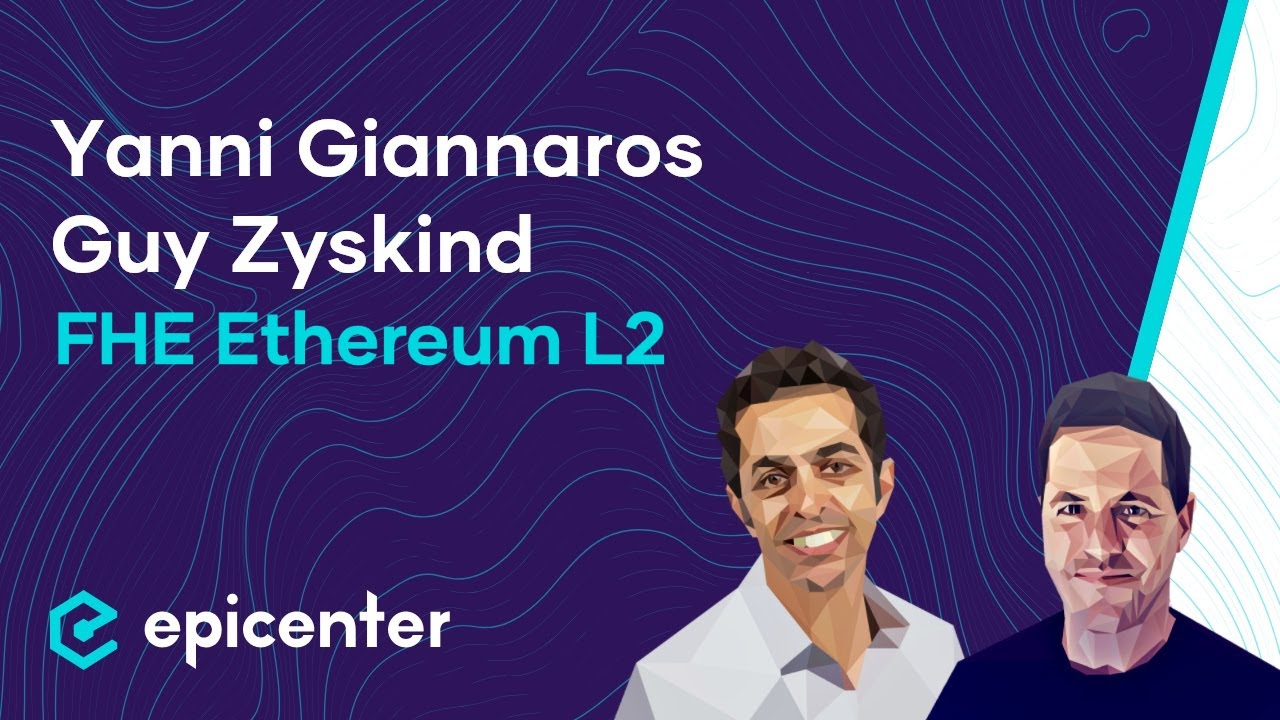
FHE Technology and Applications – Guy Itzhaki leads Intel’s FHE business, focusing on building hardware accelerators for homomorphic encryption. FHE-enabled end-to-end encryption on Ethereum L2 enables secure computation, protecting data privacy in programs and smart contracts. Different encryption schemes like CKKS and BGV suit machine learning and AI computations, showcasing FHE’s versatility. The long-term goal is to build a large-scale compute network to accelerate FHE beyond binary decryption. From engineering and developer perspectives, FHE is being simplified to facilitate collaboration.
In scenarios like poker, secure computation is critical. FHE-based end-to-end encryption allows servers to compute data without knowing its content. Unlike MPC, FHE focuses more on computation than communication, and performance improves with more FHE-dedicated hardware. FHE enables computation on encrypted data, while ZK is used for data verification, offering unique functionality compared to ZK EVM. Ultimately, the FHE decryption key is split across the network; if reconstructed, it could decrypt private keys within contracts.
Link: Guy Itzhaki & Guy Zyskind: Fhenix – FHE-powered End-to-End Encrypted Ethereum L2.
9.Bankless: The State of Ethereum Layer 2

The Layer 2 ecosystem is undergoing remarkable evolution. Long-imagined aggregations and second-layer stacks are now functioning in practice, marking a pivotal moment in Ethereum’s scalability journey. To support an explosion of innovation in the coming years, tools within the L2 ecosystem must be ready and robust. The rise of modular blockchains enables new applications to build and transact meaningfully across chains on Ethereum. Layer 2s are shifting toward more specialized niche use cases, moving away from highly generalized ones, giving rise to differentiated applications. Easy node modification will usher in an unprecedented era of blockchain experimentation. The vision for L2s is exciting—deploying chains wherever needed, enabling a golden age of experimentation and valuable innovation. The future of Ethereum L2s depends on customization and support across different stacks, with the challenge lying in finding the optimal path to scalability.
Scalability, interoperability, and compatibility remain key issues. Superchains and shared sequencers aim to improve user experience and interoperability in DeFi and transfers, offering valuable arbitrage opportunities. Growth in superchains and L2s is notable, focusing on tighter interoperability and optimization, maintaining EVM compatibility, and collaborating with frameworks like Optimism to deliver free, significant performance improvements, leveraging network effects and momentum.
The economic impact of L2 solutions is also evident in the market. A bullish outlook for crypto suggests tens of thousands of rollups will be needed to meet growing demand. Launching their own rollups allows ecosystems to internalize fees and gain better control, driving demand for customization and economic sovereignty. The low cost of rollups is an economically compelling reason, enabling any team to launch one today.
Link: The State Of Ethereum L2s
10. Molly White: The Charges Against Binance

On compliance and misconduct: Binance operated in the U.S. without registration, violating U.S. financial laws, despite its strong appeal to American customers. Internal communications reveal Binance prioritized appearing compliant over actual compliance, failing to file any suspicious activity reports. Binance chose deliberate ignorance and even served clients from sanctioned countries. Loose policies attracted serious criminals, and Binance created a “Tai Chi entity” to evade law enforcement. On leadership and accountability: Binance CEO CZ resigned and pleaded guilty, banned from future involvement in Binance operations. Ultimately, Binance agreed to pay $4.3 billion in fines and restitution—the largest financial penalty ever imposed on the world’s leading crypto exchange.
Join TechFlow official community to stay tuned
Telegram:https://t.me/TechFlowDaily
X (Twitter):https://x.com/TechFlowPost
X (Twitter) EN:https://x.com/BlockFlow_News
 深潮TechFlow