








Helium Mobile: An Epic DePIN Revolution or a Ponzi Scheme?
TechFlow Selected TechFlow Selected
Helium Mobile: An Epic DePIN Revolution or a Ponzi Scheme?
The "dual flywheel token price spiral growth model" combined with the "33 pivot points to ignite the flywheel" has generated great anticipation for its performance in a bull market.
 Navigating Web3 tides with focused insights
Author: KillerWhalesDAO
With the recovery of the Solana ecosystem and the growing popularity of the DePIN sector, $MOBILE—the leading token—surged tenfold by the end of 2023, briefly peaking at $0.008.
Recently, however, as Solana-based tokens corrected, MOBILE has dropped to $0.0027 at the time of writing, marking a maximum drawdown of 68%.
Alongside this price decline, skepticism questioning whether the project is a blockchain scam has increased. So, what is the fundamental state of Helium Mobile?
Yet, there remains a lack of systematic research and analysis on MOBILE within Chinese-speaking communities. Our group, Killer Whales DAO, plans to conduct in-depth, ongoing analysis of this project over the coming period, including real-time tracking of on-chain data.
If you’re interested in MOBILE, the Solana ecosystem, DePIN, or AI+, follow us @KillerWhalesDAO.
To summarize upfront: we believe Helium Mobile’s most compelling aspect lies in its “dual flywheel token price growth model,” combined with what we call the “3x3 leverage points to ignite the flywheel.”
Key risks include regulatory challenges related to 5G infrastructure deployment, geographic limitations to the U.S., potential signal instability issues common to mobile virtual network operators (MVNOs), and other technical hurdles.
Additionally, MOBILE’s token distribution is highly concentrated and it hasn’t launched on major centralized exchanges (CEXs), resulting in significant price volatility.
Moreover, Helium’s previous IoT project, HNT, was not successful—many miners suffered heavy losses, and the token was delisted from Binance, among other setbacks. This history somewhat undermines confidence in Helium launching a new venture.
1. What Is Helium Mobile?
Helium Mobile is a decentralized 5G operator that uses the MOBILE token to incentivize individuals to deploy and operate 5G network hardware, forming a decentralized wireless network (DeWi).
$MOBILE is the governance token for the Helium subDAO, designed to enable separation of governance responsibilities.
As we know, the biggest cost in building 5G networks lies in base station infrastructure. Helium Mobile cleverly leverages token-based economic incentives, encouraging individuals to purchase hotspot devices—similar to routers—and deploy them in various indoor and outdoor environments.
In simple terms, it mobilizes grassroots participation—replacing large base stations with countless small, distributed hotspots—to achieve lower deployment costs, broader coverage, and cheaper telecom plans.
2. The Dual-Flywheel Token Price Spiral Model
First, Helium Mobile is a Proof-of-Work (PoW) mining token, similar to BTC and FIL. Traditional PoW tokens exhibit a “miner hardware–token price” flywheel effect (see Figure 1).
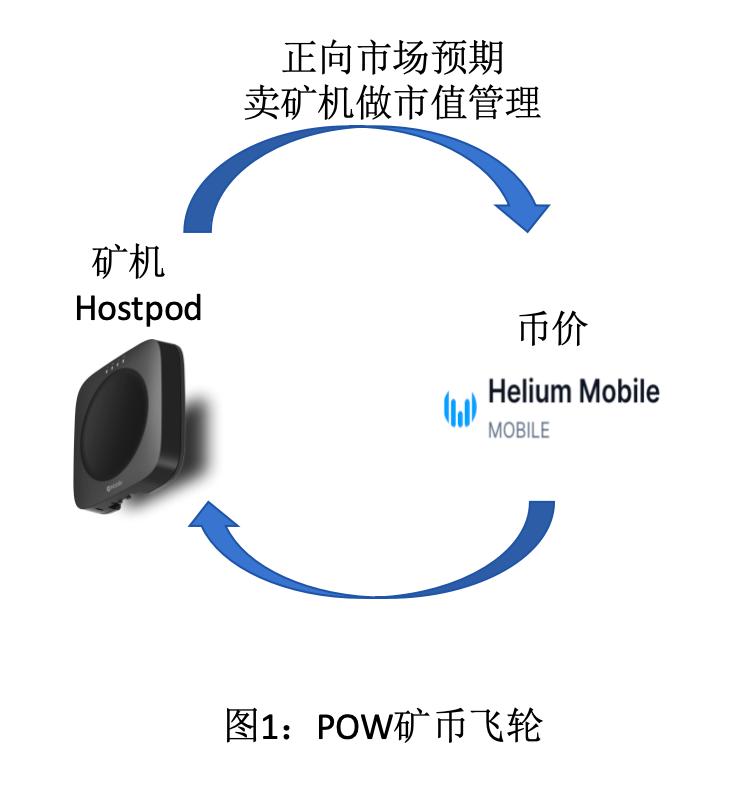
Revenue from selling mining hardware can be used for market cap management, pushing the token price upward.
As the price rises, mining becomes more profitable, attracting more participants to buy and deploy hardware.
This leads to even greater hardware sales, generating more funds for further market support and price pumping.
Once the flywheel gains momentum, retail investors from secondary markets also join in, supporting the rising price.
Thus, the system sustains itself—a self-reinforcing spiral where each cycle fuels the next.
Past mining tokens like BTC, FIL, and HNT were all driven this way.
In 2021, FIL rose tenfold in one quarter, while HNT surged 100x over a year.
However, a flywheel based solely on mining can become an empty bubble. For example, FIL’s decentralized storage network saw massive miner participation but lacked real users. Similarly, HNT had numerous inactive hotspots deployed in China, rendering them unusable.
BTC, while also powered by a mining flywheel, stands in a completely different league because it has genuine use cases—payment and value storage—used widely by individuals and institutions alike for settlements and as digital gold.
What sets Helium Mobile apart from traditional projects like FIL and HNT is that it features not just one, but two flywheels: the standard “hardware–token price” flywheel, plus an additional “hotspot–user” flywheel (see Figure 2).
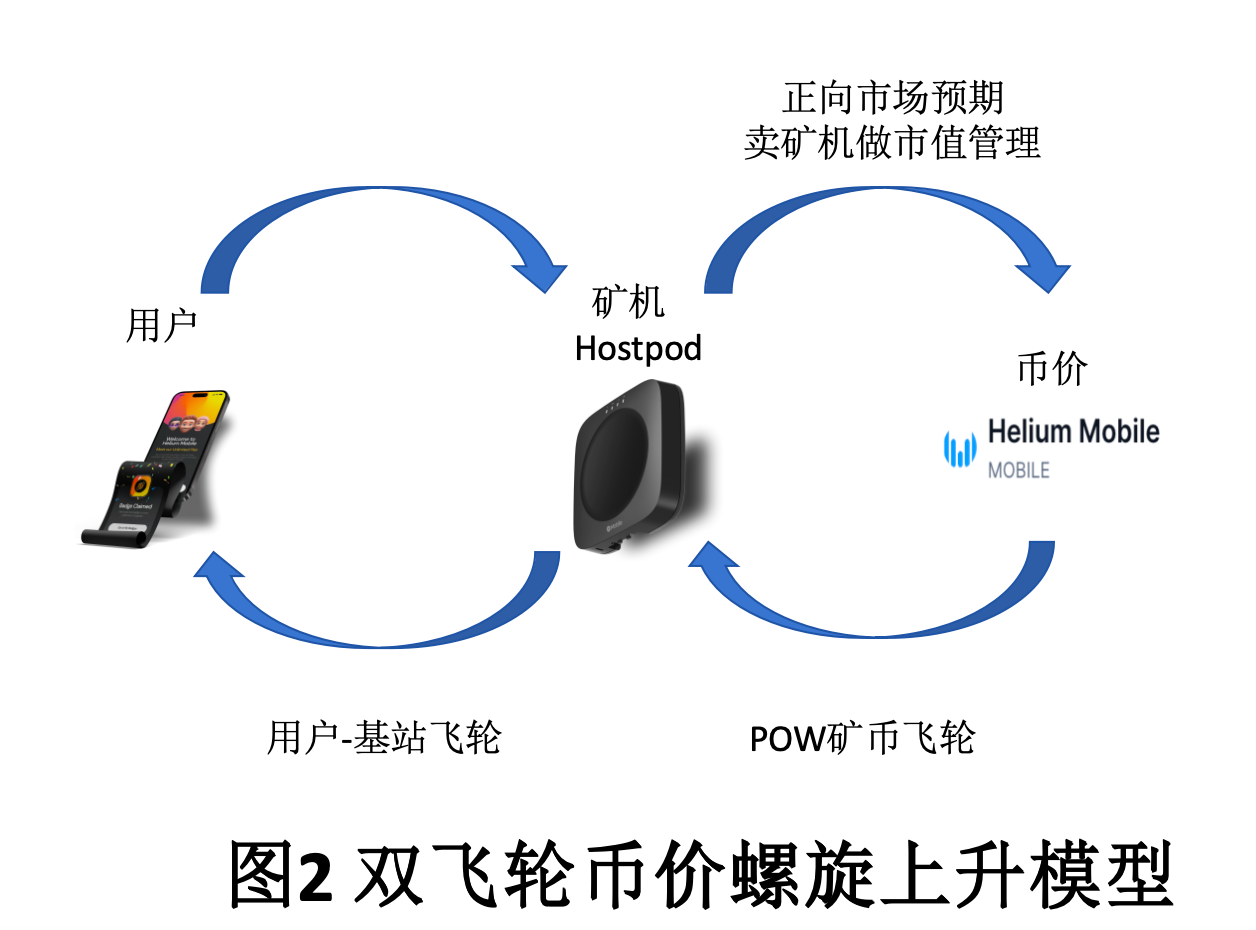
The more hotspots deployed, the better the user experience, and the more users join.
More users increase demand for more hotspots.
A virtuous cycle emerges.
This is the “dual-flywheel token price spiral model.”
To prevent the idle-hardware problem seen in FIL and HNT, Helium Mobile introduced a novel principle: mining rewards are tied directly to actual usage.
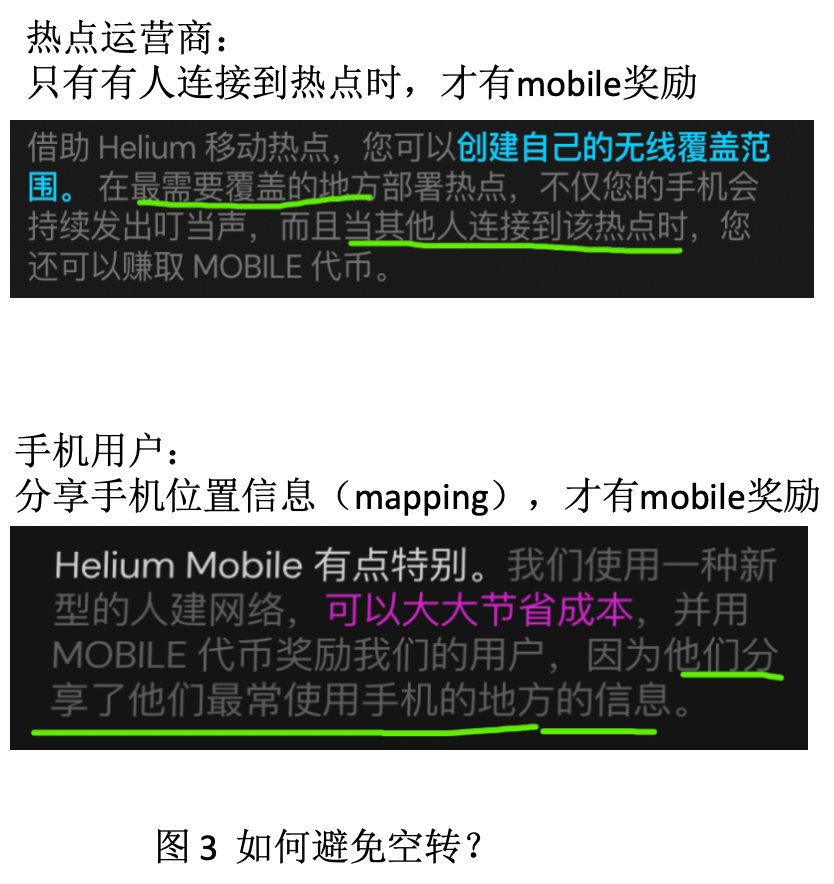
Only when real users connect to a hotspot and generate data traffic will the operator earn MOBILE rewards.
Simply deploying hotspots without real usage yields no rewards.
Furthermore, to scientifically guide hotspot placement, Helium Mobile incentivizes subscribers to share their phone’s location data (mapping), rewarding them with MOBILE tokens.
This provides clear visibility into both user and hotspot distribution (see Figure 4).
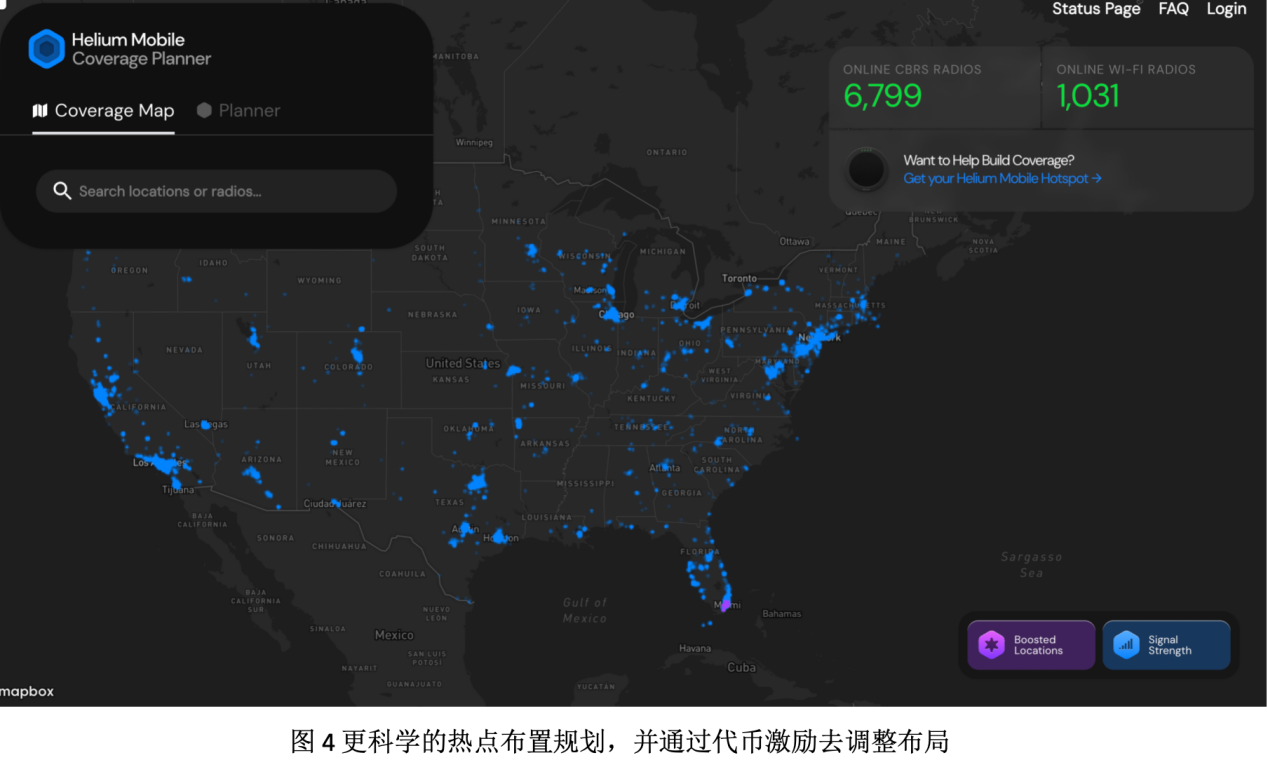
The team can then adjust token reward coefficients to guide hotspot deployment.
Areas with excess hotspots relative to users receive lower rewards.
Areas lacking coverage get higher reward multipliers.
This mechanism not only eliminates idle hardware but also ensures rational, phased expansion of network coverage. It’s clear that Helium has accumulated substantial operational experience since its earlier HNT project.
3. The 3x3 Leverage Points to Ignite the Flywheel
Helium Mobile operates under a dual-flywheel token price spiral model. But to set these flywheels in motion, leverage points are needed.
For the “hotspot–user” flywheel, three key levers drive user adoption: aggressive pricing, seamless integration, and token incentives.
For the “hardware–price” flywheel, another three levers boost token value: Solana and DePIN narrative tailwinds, token deflation, and extreme meme appeal.
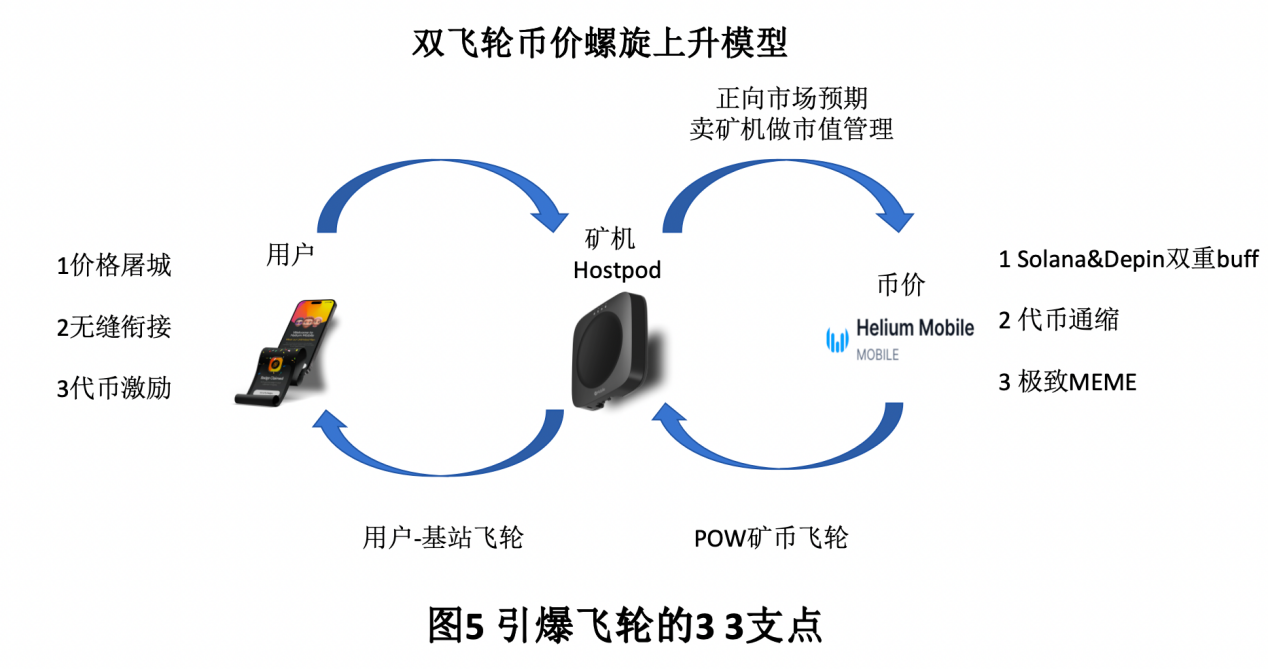
Together, these six factors form the so-called “3x3 leverage points” to ignite the flywheel.
(1) Price Disruption
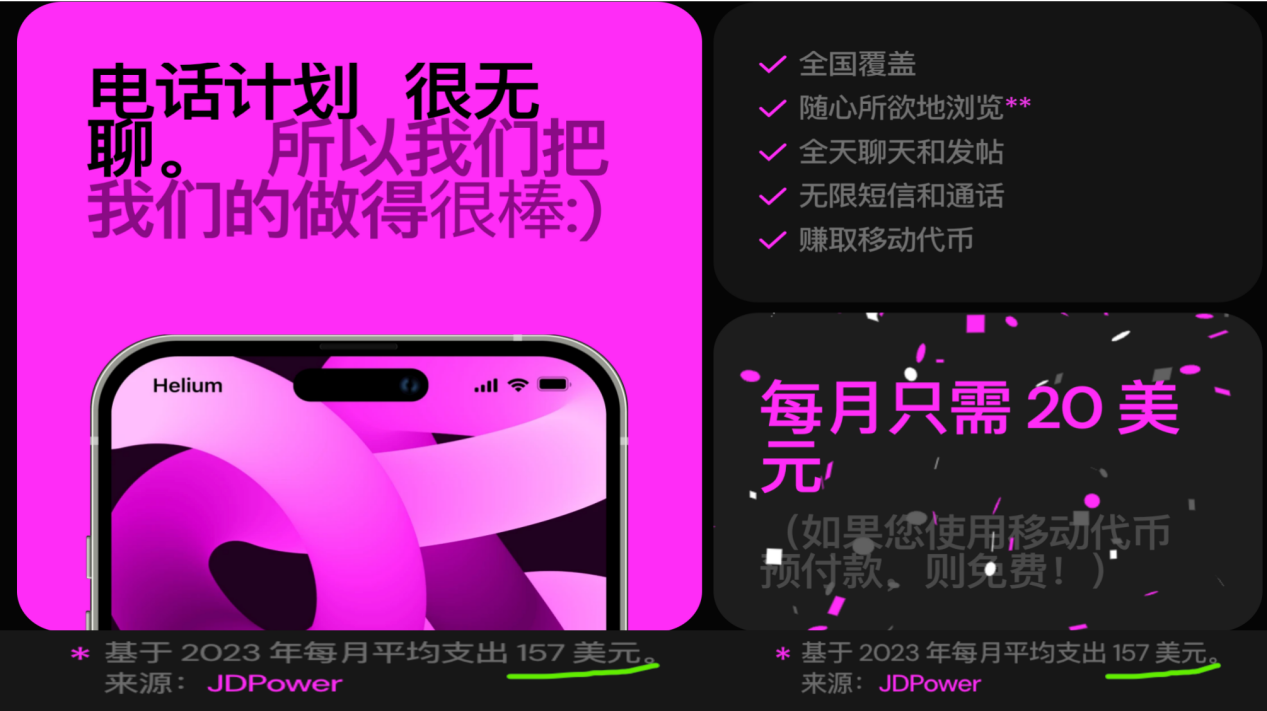
According to J.D. Power, the average American spent $157 per month on telecom plans in 2023.
In contrast, Helium Mobile offers unlimited calls, data, and texts for just $20/month.
It echoes the aggressive subsidy tactics used by Didi and Kuai Di during their ride-hailing battles.
(2) Seamless Integration
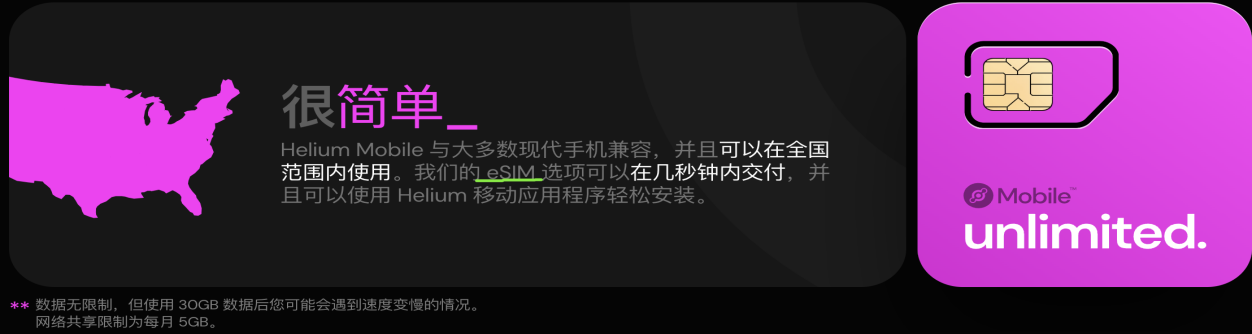
Many in Asia may not realize that North American iPhones come with both a physical SIM slot and an eSIM.
Switching carriers doesn’t require visiting a store, unlike mainland China, where number portability faces numerous obstacles.
Users simply download the Helium Mobile app and configure the eSIM to seamlessly switch to the service.
Another concern: how to handle poor coverage during early network rollout?
Even if your $20 plan is attractive, poor early coverage and weak signals could ruin the user experience.
Helium Mobile anticipated this. It secured a five-year strategic partnership with T-Mobile, one of the four major U.S. telecom operators.
Helium’s 5G network is integrated with T-Mobile’s. When Helium Mobile users enter areas without DeWi coverage, the carrier automatically switches to T-Mobile’s network.
This guarantees a truly seamless transition—no inconvenience, no complex procedures.
(3) Token Incentives
As previously mentioned, Helium Mobile encourages subscribers to share their daily location data to help optimize hotspot deployment.
In return, they are rewarded with MOBILE tokens.
At the peak of MOBILE’s price in late 2023, people exclaimed: “Break even in 2 days, profit in 28!”
By paying $20/month for a plan and simply tapping to share location daily, users received ~$10 worth of MOBILE tokens per day.
After just two days, the plan effectively paid for itself.
Moreover, earned MOBILE tokens can be used to prepay up to three months of future service fees.
This proposition holds strong appeal for Americans struggling with high living costs.
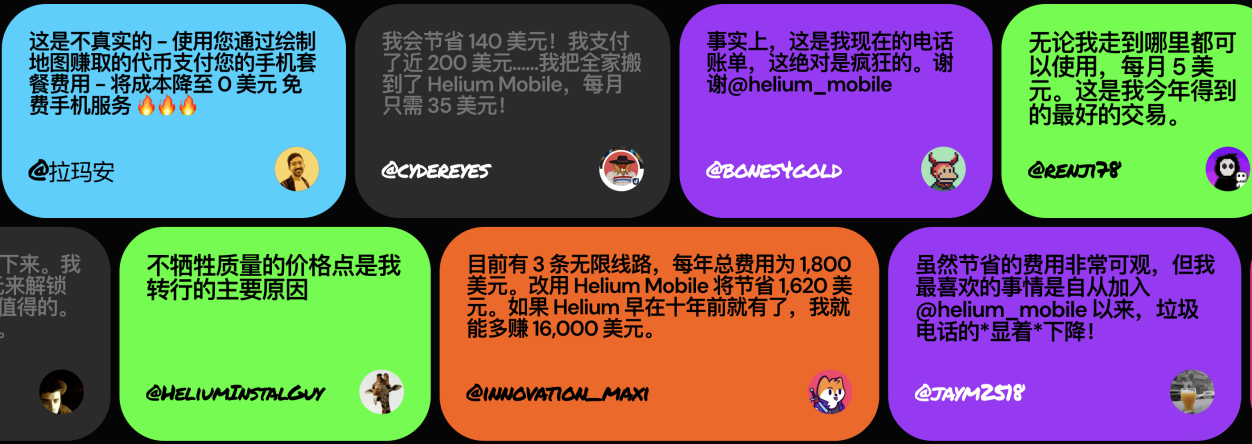
Of course, if you're not satisfied with earning $10/day in MOBILE via your phone and want higher rewards, you can purchase dedicated hotspot hardware. Outdoor models cost $499/unit—highly sought after and often sell out immediately. Indoor versions are available for $249/unit.
These are the three levers driving the “hotspot–user” flywheel: aggressive pricing, seamless integration, and token incentives.
Thanks to these levers, Helium Mobile already has over 50,000 subscribers—and this number grows daily by hundreds to thousands.
From a data standpoint, it’s been barely over a month since the $20/month plan launched, coinciding with the Western holiday season. The cold-start momentum looks solid.
Next, let’s examine the three levers that drive the “hardware–token price” flywheel.
(4) Dual Narrative Boost: Solana Ecosystem + DePIN
In 2023, we witnessed Solana’s resurgence and renewed brilliance. This Wall Street-backed blockchain appears poised for full-scale ecosystem expansion. SOL/ETH has rebounded nearly 5x from its lows.
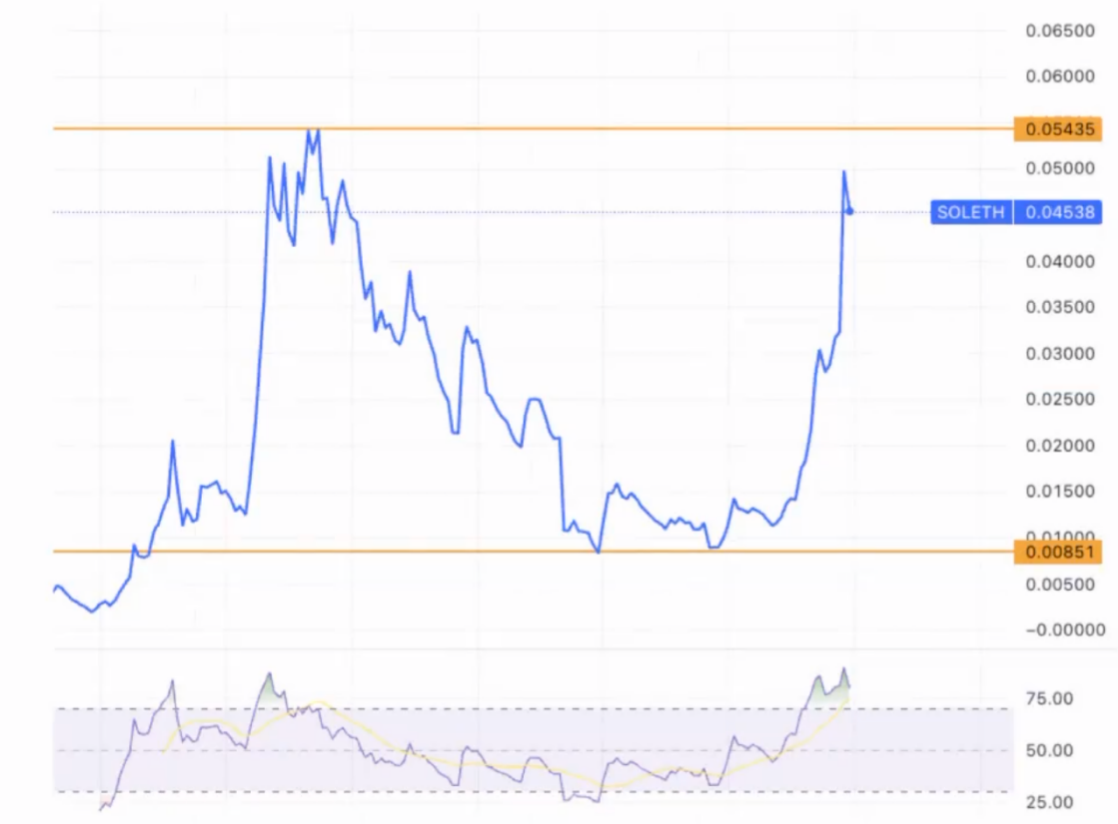
As a flagship DePIN project on Solana and one of its core strategic focuses for 2024, Helium Mobile enjoys strong institutional backing.
CoinEx previously noted that Solana’s ecosystem attention centers on DeFi, Memecoins, and DePIN.
Solana’s main narrative is inherently DePIN—shaped by the founder’s background and vision, not accidental.
Solana founder Toly spent over a decade at Qualcomm developing communication technologies. Even during Solana’s initial fundraising in 2018, he emphasized ambitions in communications and hardware.
At Solana’s Breakpoint 2023 conference in late October, Helium Mobile was repeatedly highlighted as a leading case study. Projects featured prominently at the event—including the founder’s silly outfit—performed strongly in November, either surging in price or announcing airdrops.
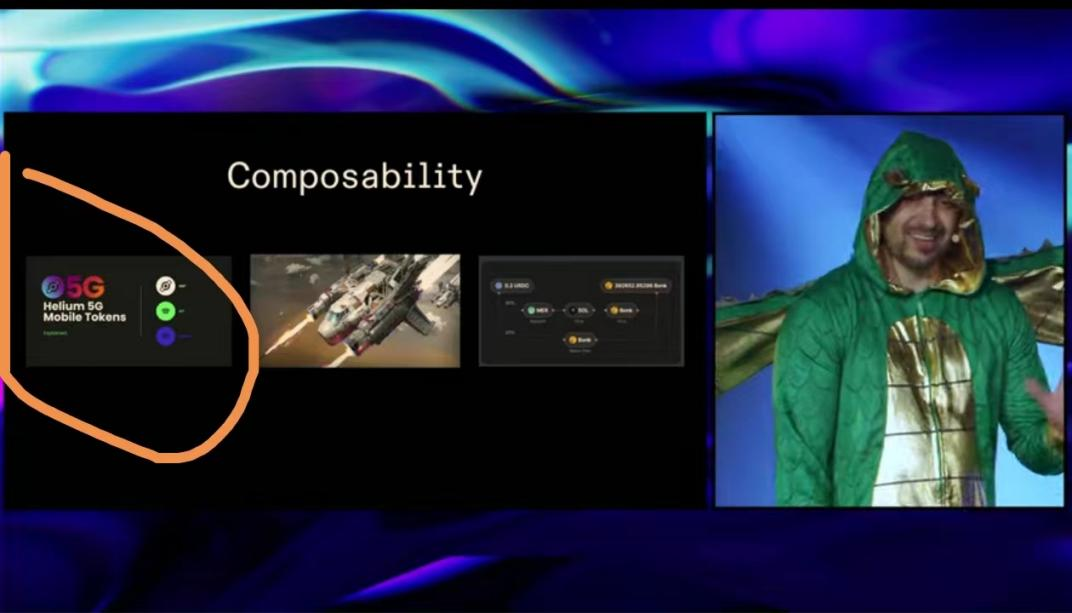
It was essentially an official endorsement.
Even beyond Solana’s favor, DePIN remains one of the dominant narratives of this bull market.
OKX Chinese published a DePIN explainer titled “Why Is DePIN Considered One of the Most Promising Sectors in 2024?”
In that piece, Helium Mobile was used as the primary example.
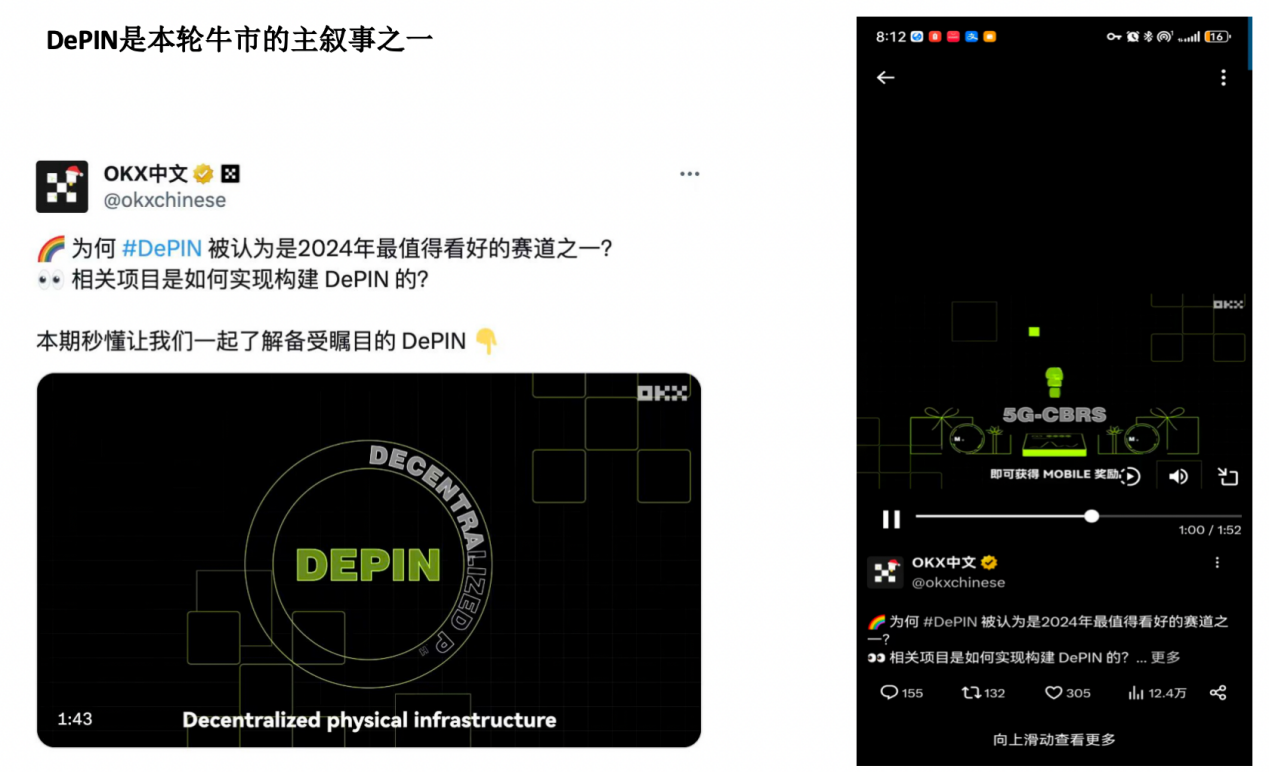
Binance Chinese also hosted a Space discussion titled “How to View the Solana Ecosystem & DePIN New Narrative?” Throughout the conversation, Helium Mobile remained the central topic.

Undoubtedly, DePIN is a core narrative of this bull run, and Helium Mobile firmly occupies the top position.
According to CoinGecko, Helium ranks third in market cap within the DePIN sector. Among the top five projects, three are built on Solana (Render, Helium, and Helium Mobile).
(5) Token Deflation
For experienced GameFi and mining token veterans, token inflation and selling pressure remain persistent challenges.
Hence, many instinctively ask about MOBILE: What happens to inflation as more users and miners join? Are there any token burn mechanisms?
This reflects a misunderstanding of MOBILE’s tokenomics.
Like BTC, MOBILE has a fixed total supply of 250 billion—no inflation.
Annual emissions are predetermined and independent of the number of miners. The emission rate halves every two years.
There was a pre-mine of 50 billion, followed by 66 billion in Year 1, 33 billion in Years 2 and 3, 16.5 billion in Years 4 and 5, and so on.
Similar to BTC, which averages one block every ~10 minutes regardless of mining hardware or participant count, MOBILE’s annual output remains stable and predictable.
More miners mean lower individual rewards. Miners are primarily incentivized by rising token prices.
Just like BTC, there’s no need to create artificial token consumption mechanisms. Whether the flywheel spins depends solely on how much market consensus the narrative can generate.
Further, MOBILE isn’t just fixed-supply—it’s deflationary. Hotspot manufacturers and operators must stake MOBILE tokens (500 million for Hostpot Vendors, 50 million for Hostpot Operators), locking up significant supply.
(6) Extreme Meme Appeal
Helium Mobile embodies all the ingredients of a perfect meme:
Foremost is the $20/month mobile plan—the cheapest in North America—making it instantly compelling.
And anyone, even a grandmother, can understand it: cheap U.S. telecom plans, smartphones that mine tokens, and extra earnings by deploying hotspots. The imagination potential is huge.
Finally, user entry barriers are zero, and 5G itself is an absolute necessity, giving it powerful crossover potential.
ICOs sparked a wave because anyone could issue assets.
DeFi Summer expanded the range of tradable assets.
GameFi became popular because acquiring assets required nothing more than playing games—no blockchain expertise or resources needed.
STEPN became a phenomenon because the barrier dropped further: all you needed was legs to walk.
Helium Mobile pushes this to an unprecedented extreme:
Zero entry barrier. No technical knowledge. No time investment—phone mining just requires sharing location; hotspot mining just needs plugging in an Ethernet cable.
And 5G connectivity is an essential need for everyone.
4. Potential Risks
Despite its sophisticated design and strong operational capabilities, Helium Mobile still faces notable risks in its early stages.
First, the biggest risk stems from regulation. 5G infrastructure is considered strategic in any country, especially in the U.S., where it involves complex regulations across multiple agencies. While Helium Mobile wisely partnered with T-Mobile early on—mitigating short-term risks—scaling up may eventually trigger regulatory scrutiny.
Also due to the strategic nature of 5G, no country would easily allow a foreign company to build critical national infrastructure. Thus, Helium Mobile will likely remain confined to the U.S. for the foreseeable future.
Additionally, Helium Mobile operates as an MVNO under an agreement with T-Mobile. In China, MVNOs once emerged but faded due to issues like unstable signals and poor customer service. These historical problems may resurface as key challenges for Helium Mobile.
Lastly, Helium’s prior IoT project, HNT, failed—many miners incurred heavy losses, and it was delisted from Binance. This track record affects confidence in Helium launching a new venture.
Meanwhile, MOBILE’s FDV has reached $700M, yet token holdings are highly concentrated and it’s not listed on major CEXs, resulting in weak liquidity.
High valuation, concentrated ownership, low liquidity, and a controversial founding team—all suggest MOBILE will experience significant price volatility for the foreseeable future. Investors should carefully manage position sizes and timing.
Conclusion
In summary, Helium Mobile is a fundamentally sound project. Its “dual-flywheel token price spiral model” combined with the “3x3 leverage points to ignite the flywheel” makes it highly promising for this bull market. However, due to regulatory and technical risks, it may ultimately prove to be another epic Ponzi scheme.
Disclaimer
The above does not constitute investment advice. Please make your own judgment. Investing carries risk; invest cautiously.
Join TechFlow official community to stay tuned
Telegram:https://t.me/TechFlowDaily
X (Twitter):https://x.com/TechFlowPost
X (Twitter) EN:https://x.com/BlockFlow_News
 @KillerWhalesDAO






