Understanding Shadow: Decentralized Storage Tied to Solana, Built on Speed
TechFlow Selected TechFlow Selected
Understanding Shadow: Decentralized Storage Tied to Solana, Built on Speed
As one of the earlier projects launched on Solana, GenesysGo's products have undoubtedly contributed to the development of the Solana ecosystem.
 Navigating Web3 tides with focused insights
By TechFlow
Recently, Filecoin has been gaining strong momentum. Arthur Hayes, founder of BitMEX, also voiced support for Filecoin during his speech at Token2049 in Singapore, revealing that he holds FIL.
Meanwhile, within the Solana ecosystem, there is an important yet relatively low-key storage project that remains under the radar — GenesysGo, a blockchain infrastructure provider on Solana specializing in decentralized cloud storage services.
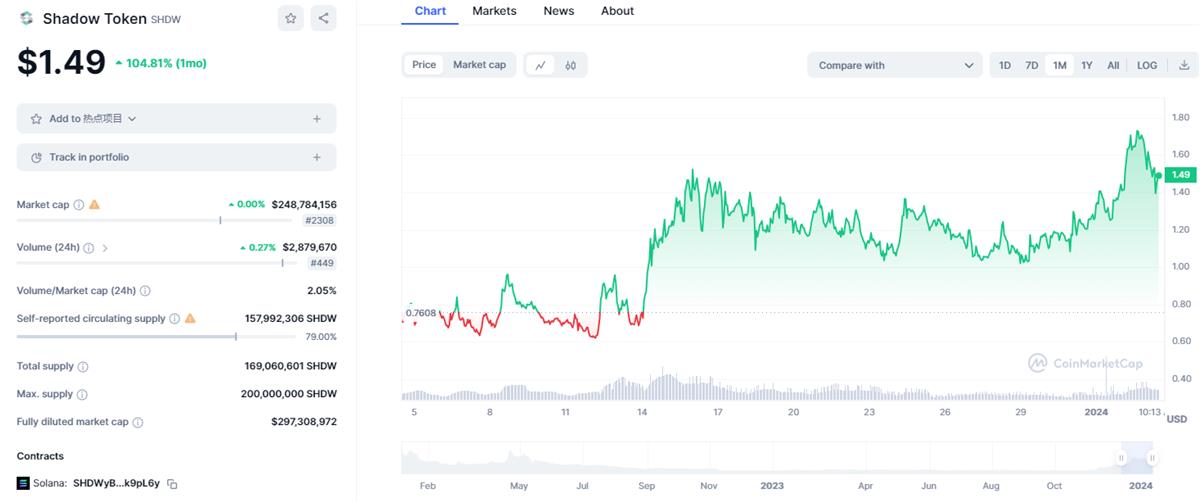
While much of the attention around Solana’s ecosystem has previously focused on memecoins and liquid staking, the Shadow Token ($SHDW), GenesysGo’s native token, has quietly doubled in price over the past month.
The decentralized storage sector is already crowded, with mature projects like IPFS and Arweave dominating the space. What makes GenesysGo different? And can it leverage Solana’s ongoing ecosystem revival to unlock greater growth potential?
To answer these questions, we first need to understand GenesysGo’s three core offerings:
-
Shadow Operators: Decentralized RPC nodes (RPC layer)
-
Shadow Drive: Decentralized data storage layer
-
Shadow Cloud: Decentralized cloud computing platform
We will also analyze its tokenomics and how they compare to other similar projects.
Shadow Drive
Shadow Drive is the decentralized data storage layer and the core of GenesysGo, designed specifically to meet the growing storage demands of the Solana ecosystem.
Previously, NFTs and other data on Solana were often stored using third-party solutions such as Arweave or Filecoin. However, these are independent blockchains incompatible with Solana. They require their own native tokens (not SPL standard) for payments, and sometimes cannot keep up with Solana’s speed. Therefore, a native storage solution built specifically for Solana has become a necessity.
Shadow Drive is a modified open-source version of Ceph, a defined storage program. Ceph provides a unified software-defined solution for block, file, and object storage, and its effectiveness has been widely validated.
The GenesysGo team integrated Ceph’s open-source framework with Solana’s Proof-of-History (PoH) mechanism to create Shadow Drive.
Shadow Drive is powered by the native $SHDW token. Users must pay a small amount of $SHDW to upload data to Shadow Drive.
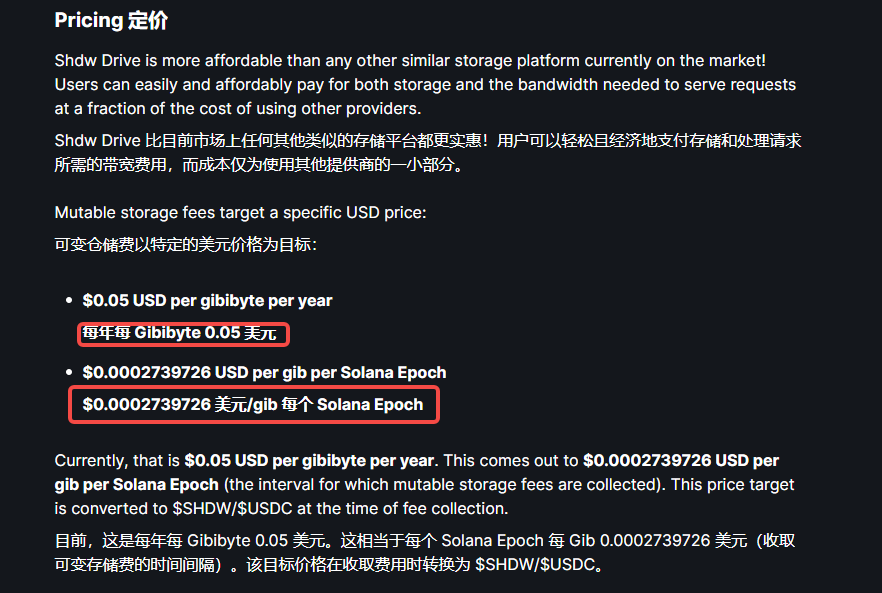
According to the project’s official documentation, Shadow Drive’s storage fees are cheaper than any comparable solution on the market, with a theoretical cost of just 5 cents per GiB per year. (Note: 1GB [Gigabyte] and 1GiB [Gibibyte] are computer storage units representing data size but based on different measurement systems. 1GiB ≈ 1.07GB; here they can be approximately considered equivalent.)
In our hands-on test, creating a 1GB storage account required only 0.25 $SHDW, which equaled approximately 0.42 USD at the time of writing.
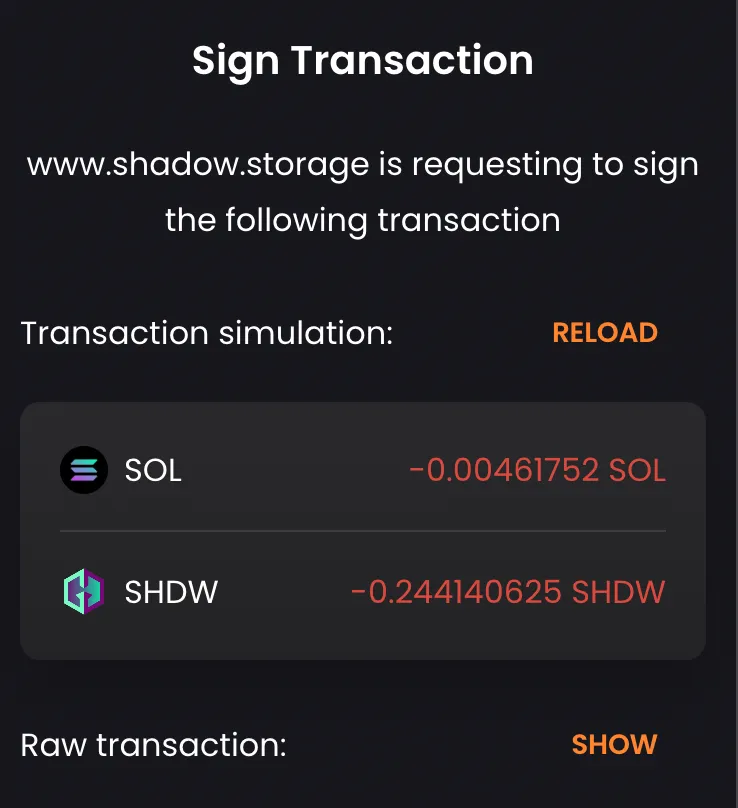
The low cost is partly due to Solana’s inherently low gas fees, and partly because of Shadow Drive’s efficient decomposition, scheduling, and management of storage tasks at the underlying layer.
This leads us to another key topic: the project’s data distribution mechanism — D.A.G.G.E.R.
D.A.G.G.E.R stands for Directed Acyclic Gossip Graph Enabling Replication. While the technical explanation is complex, we can simplify it as the project’s data distribution mechanism and consensus engine, whose purpose is to optimize fast data access and file processing, thereby enhancing storage efficiency.
The D.A.G.G.E.R architecture consists of several core components: Communication Module, Processor Module, Consensus Module, and Controller Module.
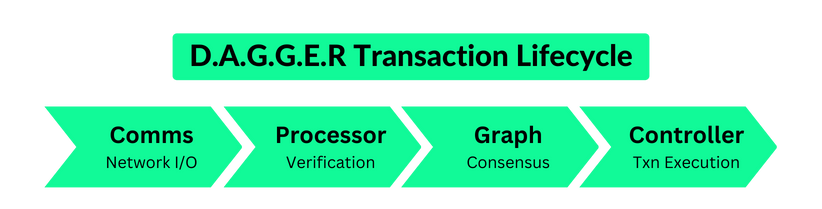
For a transaction, the processing flow in D.A.G.G.E.R follows these simplified steps (details not elaborated further):
-
Communication Module: Handles network-level input/output (transaction transmission)
-
Processor Module: Validates the transaction for correctness and validity
-
Consensus Module: Nodes across the network reach agreement on the transaction
-
Processor Module: The transaction is executed
Overall, it's clear that Shadow has made significant optimizations in how data is stored.
Shadow Operators
Shadow Operators are operators running RPC nodes.
RPC (Remote Procedure Call) is a term used in distributed computing systems. It functions as an API (Application Programming Interface) that allows computer programs to communicate with each other.
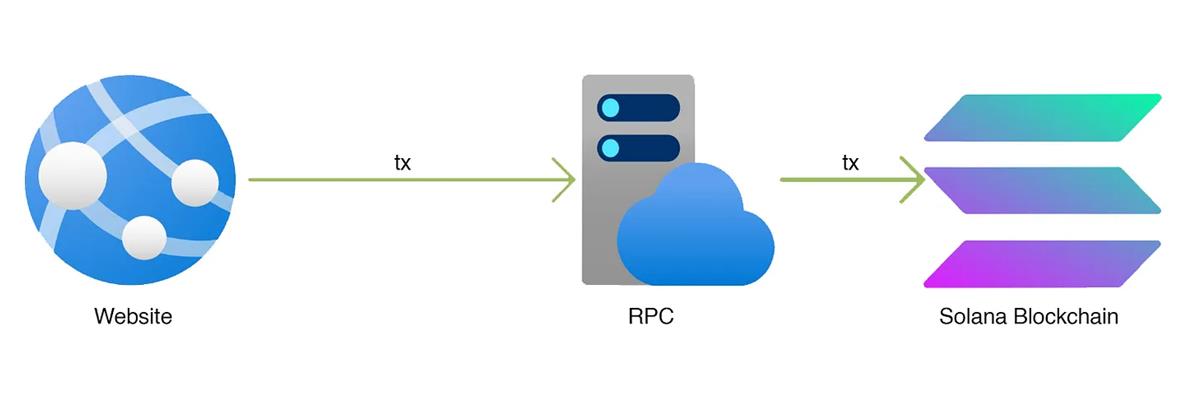
Simplified flowchart of sending a transaction on Solana
Compared to other blockchains, Solana boasts extremely high transaction throughput. As a result, the workload on Solana’s RPC network far exceeds that of other networks. This means existing RPC providers from other blockchains would need to completely redesign their architectures if migrating to Solana.
This presents a unique opportunity for GenesysGo to offer native Solana RPC services.
GenesysGo offers three types of RPC services: one free tier and two paid subscription tiers. Revenue from paid services goes entirely to Shadow Operators. Additionally, Shadow Operators must stake $SHDW tokens to provide services and face penalties in case of service outages.
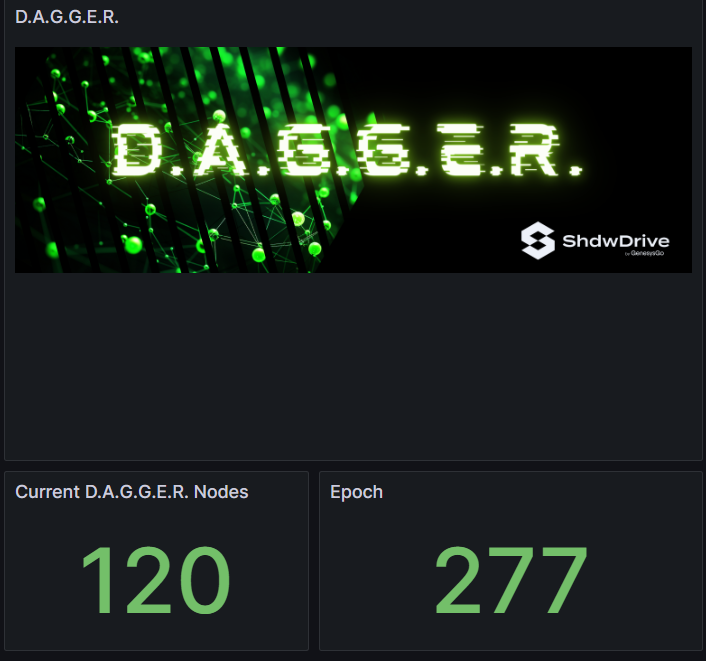
At the time of writing, 120 RPC operators are running on the testnet — about five times more than the 27 operators reported in December 2022.
Shadow Cloud
Shadow Cloud is a decentralized cloud computing platform launched by GenesysGo, also powered by the DAGGER technology.
With established node and storage services, GenesysGo can now leverage these capabilities to offer a decentralized computing platform catering to various application needs.
This platform aims to support decentralized storage, computation, and networking operations, providing broader infrastructure for Web3 and decentralized applications.
However, based on current progress, GenesysGo’s storage and RPC products appear more mature, with comprehensive technical documentation and product design, while the cloud service seems more of a long-term strategic goal — a natural evolution once the first two products reach sufficient scale.
Competitive Landscape: Speed Wins
Overall, both Web2 and Web3 have seen numerous mature examples of decentralized or distributed storage. In Web2, Google’s BigTable leads among distributed storage systems. In Web3, Arweave and Filecoin are the most commonly used third-party storage solutions.
So what sets Shadow Drive apart from competitors? Let’s primarily compare it with Filecoin.
First, as mentioned earlier, Arweave and Filecoin are not fully compatible with Solana. If focusing solely on serving the Solana ecosystem, a dedicated storage infrastructure becomes essential:
-
$AR and $FIL are not SPL-native tokens (SPL being Solana’s token standard)
-
Arweave and Filecoin’s throughput cannot match Solana’s speed, increasing the risk of transaction failures
Second, Shadow Drive’s consensus mechanism enables higher storage efficiency:
Filecoin uses Expected Consensus (EC) and DAGs for consensus, requiring explicit validation and block weighting for finality, which may reduce efficiency.
D.A.G.G.E.R employs a leaderless asynchronous architecture, achieving consensus through DAG-based graph representation, eliminating the need for leader election and enabling immediate transaction processing.
Third, Shadow Drive has optimized data encoding:
D.A.G.G.E.R integrates erasure coding into its architecture to optimize metadata replication and data transactions. Filecoin treats erasure coding as an optional client-side strategy, focusing instead on data replication and periodic proof-of-storage.
Below is a direct comparison of key performance metrics:
Filecoin Performance Metrics:
-
Transaction Speed: ~30 seconds per block
-
Confirmation Time: ~1 hour for high-value transfers (120 blocks)
-
Data Storage: A 1 MiB file takes 5–10 minutes from acceptance to appearing on-chain
-
Sector Sealing: ~1.5 hours for a 32 GB sector on minimum hardware
-
Data Retrieval: Fast retrieval (unsealed copy) in under 2 minutes; unsealing retrieval for a 32 GiB sector may take ~3 hours on minimal hardware
ShadowDrive / DAGGER Performance Metrics:
-
Peak TPS: 50,000 transactions per second on specified machine configurations (ideal network)
-
Surge TPS: ~20,000–38,000 TPS under real-time testnet phase 1 conditions (versions 0.2–0.3, 20–30 node clusters operated independently)
-
Real-world TPS: ~3,000 TPS under real-world stress and churn
-
Data Storage: Uploading a 1MiB file to the DAGGER Hammer Demo takes 2–8 seconds (simulating part of shdwDrive v2 functionality)
-
Erasure Coding Time: 0.018 milliseconds per core per 1 MiB, negligible when scaled horizontally
-
Snapshot Download: 10–50 milliseconds for a 1 MiB file
-
Block Sync Time: Between 30ms and 300ms depending on latency
-
Block Validation Time: Below 500 nanoseconds to 20 milliseconds, indicating minimal latency
-
Finalization Time: 70ms to 650ms, averaging ~273ms (on a 30-node global cluster supporting the DAGGER Hammer demo site)
-
Data Retrieval: Retrieving a 1MiB file via URL on the DAGGER Hammer demo site takes 1–3 seconds
In short, the TL;DR is this: Shadow Drive’s biggest advantage is speed.
These performance comparisons come from the project’s official document D.A.G.G.E.R. Versus Filecoin. Interested readers can refer to it for further details.
Tokenomics
Token Overview
$SHDW is the utility token of the Shadow Protocol ecosystem, primarily used for distributed data storage, allowing users to securely store data across multiple nodes to enhance security and resilience. Its main functions include:
-
Distributed Data Storage: Enables users to securely store data across multiple nodes using $SHDW, improving security and resilience.
-
Access to Distributed Computing Power: By staking $SHDW through Shdw Operators, users support the execution of complex applications and smart contracts.
-
Network Coordination: In the D.A.G.G.E.R.-powered Shadow ecosystem, $SHDW manages data within the distributed network.
Token Distribution
Unlike most projects, GenesysGo adopted a unique listing strategy for Shadow Protocol — distributing tokens via NFTs. The team announced the launch of their NFT collection, SSC (Shadowy Super Coder), in November 2021, with a total supply of 10,000 NFTs at a mint price of 2.5 SOL.
Given that SOL was near its all-time high at the time, and the market was in a bull run, combined with the fact that 50% of the $SHDW supply would go to NFT holders, the SSC collection sold out rapidly.
Additionally, GenesysGo raised funds through an IDO on January 3, 2022. The IDO pool contained 15% of the total supply — 30 million tokens. The starting price was $0.50 per token, rising based on contributions. The team ultimately raised about $52 million, setting the final IDO price at $1.73 per token.
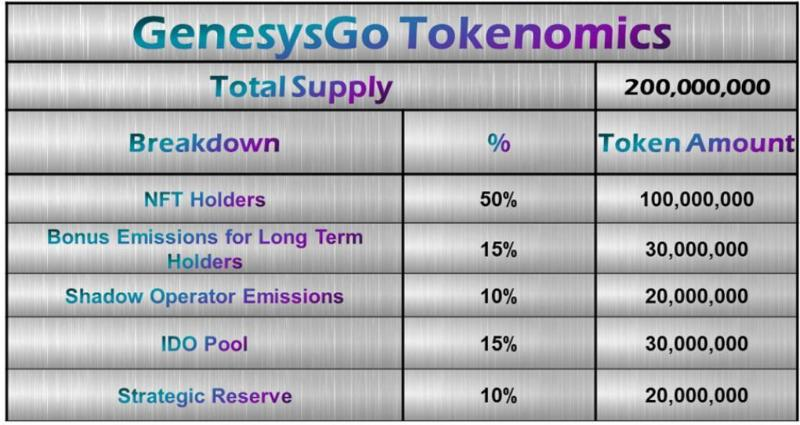
$SHDW has a maximum supply of 200 million tokens. Below is the detailed allocation:
-
NFT Holders: 50%, released daily over 12 months
-
Additional Release: 15% — Each NFT qualifies for an extra 3,000 $SHDW if staked continuously for 12 months
-
Shadow Operator Incentives: 10% — Inflationary rewards to incentivize early-stage Shadow Operators
-
IDO: 15% — Fully released post-IDO
-
Strategic Reserve: 10% — Reserved for team development and future initiatives
Token Performance
At the time of writing, $SHDW is trading at $1.71, with a market cap of approximately $258.6M. Its price performance over recent periods is as follows:
-
7-day: +51.36%
-
30-day: +93.8%
-
1-year: +2615.62%
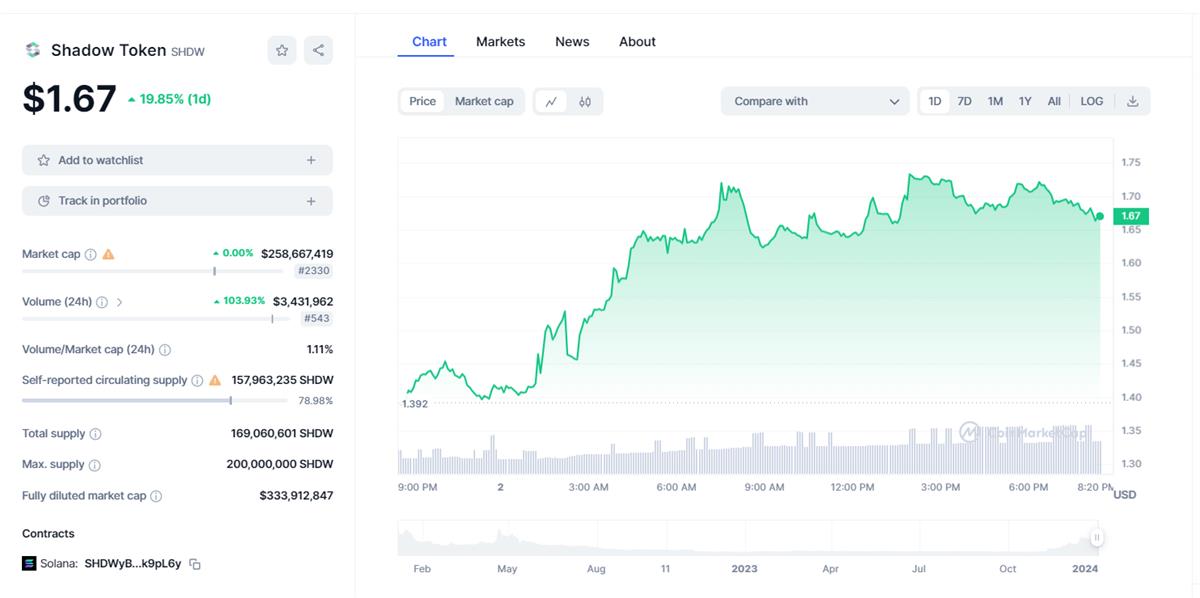
Clearly, alongside the broader market rally, $SHDW has delivered impressive performance — nearly a 26x increase over the past year.
Currently, $SHDW shares a common risk factor with many Solana-based projects — its market maker was Alameda, which still holds related token positions.
Latest Project Developments
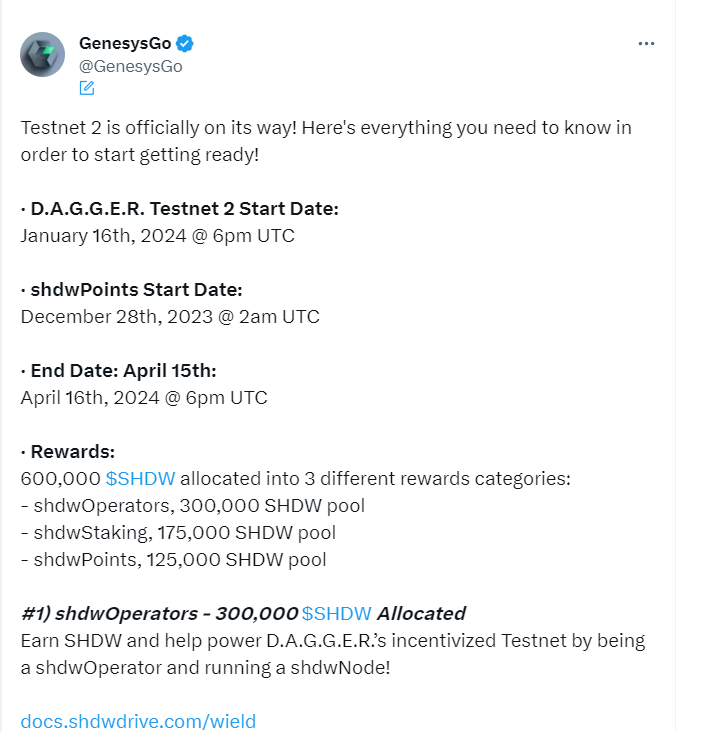
As 2023 came to a close, the project made further progress. On December 29, GenesysGo announced the launch of DAGGER Testnet 2, along with associated incentives.
Starting January 16, 2024, the project began distributing a total reward of 600,000 $SHDW across three categories: shdwOperators, shdwStaking, and shdwPoints, targeting node operators and users respectively.
More exciting news came on January 2, when the team revealed that their top priorities for 2024 are twofold: completing DAGGER and deploying shdwDrive v2 on mainnet in the first half, and in the second half, focusing heavily on "marketing, marketing, marketing!"
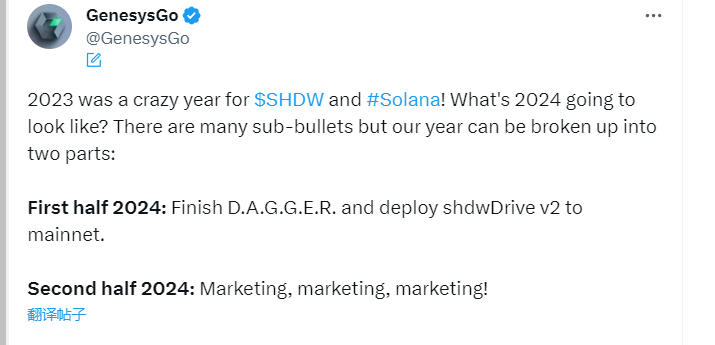
If the bull market continues, this transparent focus on aggressive marketing could spark another strong market performance.
Conclusion
As one of the earlier projects launched on Solana, GenesysGo’s offerings have undoubtedly contributed to the growth of the Solana ecosystem.
Recently, Shadow’s performance has been particularly impressive. It now stores 89TB of data, with 120 active node operators — a significant leap from last year’s figures.
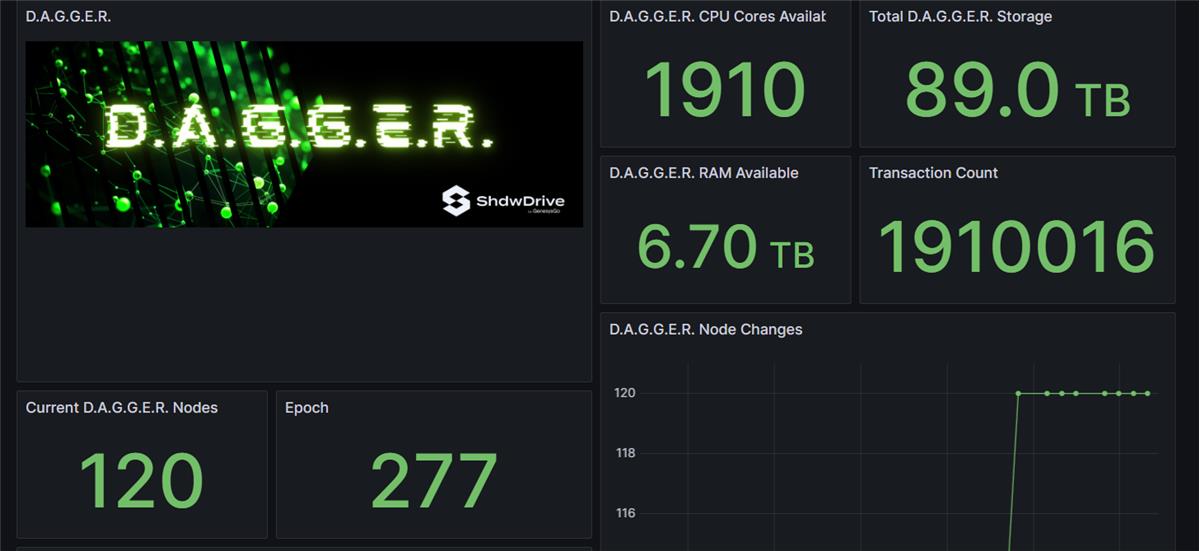
Despite the crowded storage sector, Shadow has carved out a critical niche — providing heterogeneous storage tailored for Solana.
With Solana’s ecosystem thriving and its status as a major L1 undeniable, Shadow, as a natively integrated storage infrastructure, naturally deserves attention.
Much like Neon, the only EVM-compatible chain on Solana, unique infrastructure projects often achieve strong market performance due to their exclusivity.
When Solana thrives, Shadow thrives. Being tightly coupled with a leading blockchain offers inherent advantages in favorable conditions — though conversely, it also exposes the project to shared risks.
Nonetheless, building a solid foundation on Solana and gradually expanding into other Web3 domains could be a promising path forward.
Regardless, in an environment where Web3 infrastructure projects command high valuations, compelling narratives, and rely heavily on resources, a storage solution serving a hot L1 like Solana could deliver notable performance ahead.
Join TechFlow official community to stay tuned
Telegram:https://t.me/TechFlowDaily
X (Twitter):https://x.com/TechFlowPost
X (Twitter) EN:https://x.com/BlockFlow_News
 深潮TechFlow