








Web3's Wild Growth: Cooking a Feast for Crows
TechFlow Selected TechFlow Selected
Web3's Wild Growth: Cooking a Feast for Crows
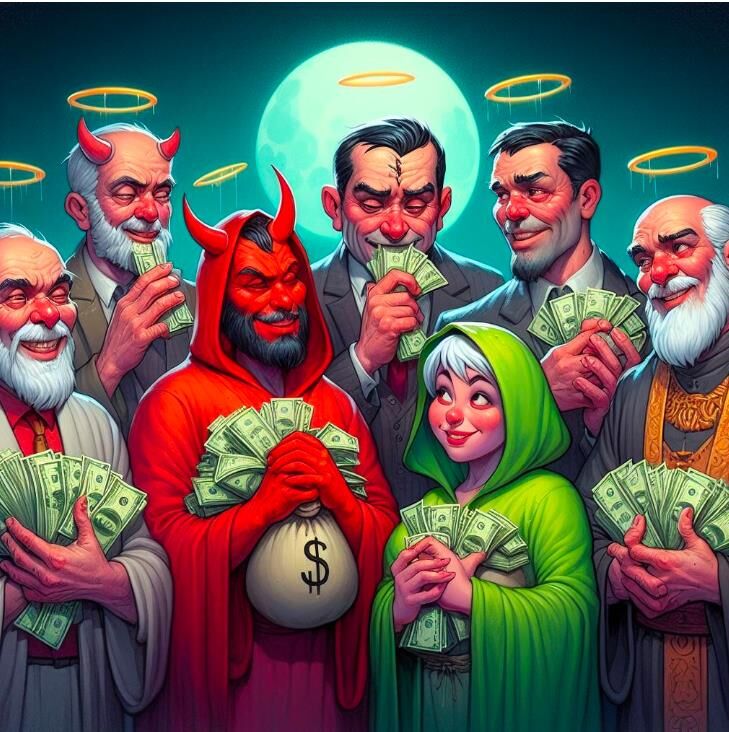
Web3 is like a banquet prepared for crows—flocks attracted by assets, feeding on assets, fighting over assets.
 Navigating Web3 tides with focused insights
Author: Foresight Ventures
I. The Dining Rules
You may have noticed that assets drive the wild growth of Web3, filled with various asset standards for users to trade—so much so that most current Web3 applications are built upon them.
The most common are token standards.
For example, ERC-20 allows people to issue all kinds of tokens, each carrying different narratives and utilities—such as equity-like or debt-like instruments, DeFi usage, DAO governance, etc. These tokens can also be speculatively traded along AMM curves.
Or take ERC-721, which enables the creation of NFTs whose value is underpinned by what we call "consensus," speculation, and yet-to-be-realized utility.
Then there's friend.tech, where every user becomes a Ponzi scheme based on keys, traded via bonding curves. Or the recently popular ordinals ecosystem, BRC-20, various inscriptions, and Web3 gaming engines used for gold-farming games... On the surface, they offer new utilities, but in essence, they're just new asset standards with different carriers.
It’s like someone designing a casino game, setting their own rules. They can open their own casino, or others can replicate the rules to run their own. The creator can release these rules as public goods—for instance, ERC-20 and ERC-721—or extract fees, such as OpenSea taking royalties from NFT series trades, or Uniswap charging protocol fees on transactions and liquidity pools.
We don’t trust people, we trust code
Compared to Web2, Web3’s advantage lies in its permissionless nature: once a model is conceived, it can be rapidly deployed as smart contracts onto the market, validated by real-world feedback. Smart contract transparency allows participants to assess risks themselves. Issuing assets is often just pump-and-dump, but sometimes it's an effective way to quickly bootstrap a product—launch, inflate, bubble, converge—with drastically shortened cycles. Many projects achieve cold starts through controlled supply and compelling models, attracting massive users and liquidity while building infrastructure and networks atop them. Filecoin and Polkadot are classic examples.
Degens are like crows—clever and greedy—drawn to assets, feeding on them, fighting over them. The Web3 world is a banquet prepared for crows, where projects are dishes made from various ingredients. Strong, intelligent crows feast well; slower, weaker ones get outcompeted and starve—or eat poisoned dishes (e.g., rug pulls) and face danger. Project teams play the role of chefs, crafting projects using asset standards to manipulate the crows toward their goals.
II. Narrative/Utility as Cooking Tools
Humans naturally do not understand the world through facts and numbers, but through stories
Narrative refers to stories and information conveyed through language, text, visuals, or other forms. It is a mode of expression used to describe events, experiences, or concepts, aiming to communicate specific messages, perspectives, or values to an audience. Bitcoin presents a highly compelling narrative: decentralized digital gold, alternative payment and transfer method, financial inclusion, a tool to resist the system. Its potential to transform modern finance has immense breadth and depth. AI, BTC ecosystem, modularity—are currently hot narratives in Web3. While we seek opportunities within these popular narratives, we also look for non-consensus narratives, where non-consensus alpha often far exceeds consensus-driven returns.
Narrative is the vessel of value—like a pot—that determines the ceiling of worth. As long as logic remains unrefuted, a sufficiently sexy narrative can theoretically expand the market pie indefinitely. Just like buying incense at temples or hiring shamans to bring good fortune, people pay for unproven visions. Narratives are not only how projects convey vision, values, and goals—they’re also crucial tools to attract and retain community, investors, and user interest. Below, we explore several dimensions illustrating the importance of narrative in asset formation:
1. Influencing Participant Emotions
-
Emotional Drive: In investment schemes, participant emotions are key. A captivating narrative can spark excitement, confidence, or fear, thereby influencing behavior.
-
Story Appeal: Humans love stories. A good narrative makes complex ideas easier to grasp and more engaging—especially important for attracting participants.
2. Facilitating Understanding and Spread
-
Simplifying Complexity: Web3 mechanics and strategies are often complex. An effective narrative distills intricate information into digestible stories, helping participants quickly grasp key points.
-
Enhanced Virality: A compelling story is more memorable and shareable. In the age of social media, the speed and reach of storytelling can greatly impact a scheme’s popularity and appeal.
3. Building Trust and Brand
-
Trust Building: Through narrative, schemes cultivate trust. Historical data, success cases, or visionary leadership portrayed in stories enhance participant confidence.
-
Brand Identity: Stories help schemes build unique brand identities—helping attract participants and stand out in competitive markets.
4. Shaping Market Expectations
-
Market Dynamics: Markets are driven not just by data and facts, but also by expectations. Powerful narratives shape market sentiment, influencing capital flows and prices.
-
Self-Fulfilling Prophecy: In some cases, strong narratives become self-fulfilling—markets act because they believe in the story, thus making it reality.
III. Market as Firewood
When you're standing at the风口, even pigs can fly
Only with sufficient flame can a dish be cooked quickly and deliciously. If the fire is too weak, the food might remain raw—or the feast could end before cooking finishes.
Narrative and market require temporal and spatial alignment. Choosing the right market hinges on fulfilling latent participants’ needs: who’s willing to join, who they are, how much capital exists, how the product meets their needs, and what benefits their participation brings back to the project.
Product-Market Fit (PMF) is key to project success—it not only determines survival but serves as the foundation for sustainable growth:
-
Demand Validation: PMF ensures your product/service addresses actual market demand. Even excellent products fail if misaligned with market needs.
-
User Retention & Word-of-Mouth: When products closely match demand, satisfaction rises, increasing organic word-of-mouth. Satisfied users become the best marketers.
-
Efficient Marketing: With PMF, marketing becomes more efficient—you target consumers most likely to benefit from your product.
-
Growth Foundation: PMF enables sustainable expansion. Only when a product fits the market can teams scale effectively.
-
Resource Optimization: Understanding demand helps allocate resources wisely, avoiding waste on unwanted features.
-
Competitive Edge: In crowded markets, products accurately meeting user needs gain advantage.
-
Risk Reduction: Meeting demand lowers failure risk. PMF implies market acceptance, reducing uncertainty in product launches.
-
Investor Attraction: For startups seeking funding, demonstrating PMF significantly boosts investor interest.
In Web3, a prime example of strong Product-Market Fit is Uniswap:
-
Solving Decentralized Trading Demand: Uniswap created a peer-to-peer crypto exchange without traditional intermediaries like banks or centralized exchanges, enabling permissionless asset issuance.
-
Simplified Trading: Using Automated Market Maker (AMM) models, users trade directly with smart contracts instead of matching buyers/sellers—boosting efficiency.
-
Liquidity Incentives: Users lock assets to provide liquidity and earn trading fee shares. This attracts many liquidity providers, supporting new tokens ("shitcoins").
-
Trustless Environment: Built on blockchain, Uniswap enables secure trades without trusting counterparties or third parties.
-
DeFi Ecosystem Growth: Uniswap catalyzed the entire DeFi space, becoming foundational for other DeFi services.
IV. Desire as Ingredients
Now that we have a pot and fire, it’s time to add our ingredients.
The Seven Deadly Sins—pride, envy, wrath, sloth, greed, gluttony, lust—are a Christian theological concept originating from early Church teachings. First formalized by 4th-century monk Evagrius Ponticus as eight evil thoughts, later refined by Pope Gregory I in the 6th century into seven sins. These vices are considered root causes of moral corruption and occupy central roles in Christian ethics, teaching believers to recognize and overcome them for spiritual health and salvation.
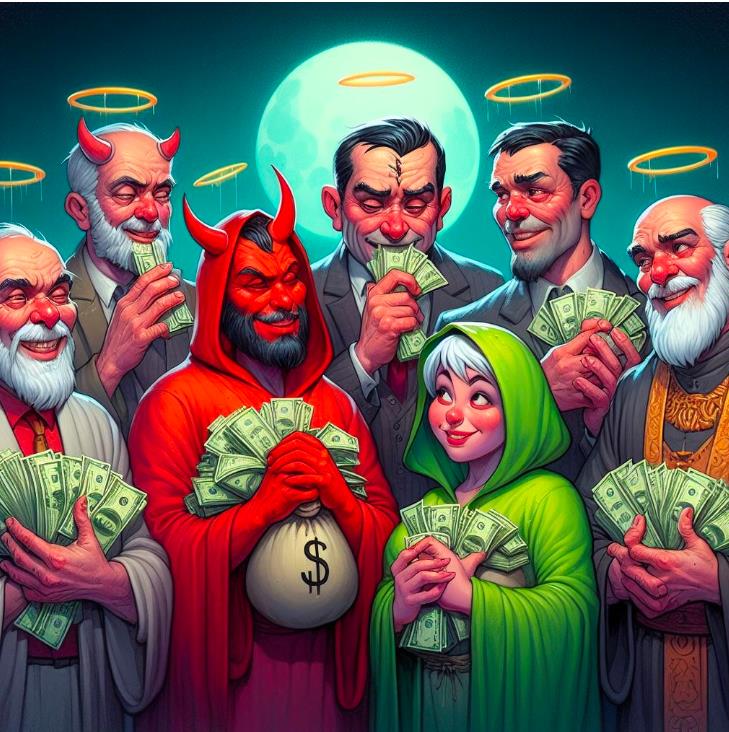
Avoid them? No—we leverage human desires. The wealth code is clearly written in ancient scrolls. Business, at its core, is about discovering or creating demand—and demand lies behind desire. Often, great businesses lead to one or both outcomes: amplifying or satisfying user desires.
Narratives and market trends shift over time, but across millennia of civilization and technological progress, human desires remain unchanged. Smart individuals often manipulate crowds by understanding human nature, fulfilling collective needs, and integrating them into their systems to achieve personal goals. Below are mechanisms (business models) that irresistibly attract the flock of crows—irrespective of Web2 or Web3—acting as appetizing ingredients. Under Web3’s permissionless conditions, composability and deployment efficiency unlock even greater possibilities.
4.1 Providing Trading Markets
Trading implies speculation—potential for buying low and selling high. Uncertainty and high-return potential together create visions of rapid wealth, drawing people toward instant, massive gains. Liquidity and volatility are critical: in a casino, every chip transfer means profit for the house. Why are tokens fundamentally stronger than NFTs? Largely due to better liquidity—tokens can be infinitely divisible, allowing anyone regardless of capital size to participate flexibly. NFTs are mostly traded individually; even if fractionalized, total value corresponds to one unit, raising entry barriers and reducing flexibility. Volatility fuels profit potential, offering thrill and instant gratification.
Successful trades deliver not just financial returns but psychological satisfaction—victory and achievement. Even when luck dominates, successful trades are often perceived as demonstrations of intelligence, analysis, and foresight.
Keywords: Greed, Pride
4.2 Endorsement
Endorsements from top-tier VCs or KOLs ignite followers’ desire to join—but conversely, these figures can exploit their authority to harvest followers’ money. DYOR (Do Your Own Research):
1. Trust and Credibility
-
Brand Trust: Major institutions carry strong reputations and brand recognition, adding credibility to their endorsements.
-
Expert Recognition: Large institutions are seen as market experts—decisions assumed to be well-reasoned and informed.
2. Safety and Risk Reduction
-
Lower Perceived Risk: Followers assume lower risk if a project is backed by reputable institutions.
-
Following Experts: People mimic those perceived as more knowledgeable or experienced.
3. Social Proof and Herd Mentality
-
Social Validation: Institutional investments serve as social proof—"if these successful experts invest, it must be a good opportunity."
-
Group Dynamics: Humans naturally follow the crowd, especially during complex decisions.
4. Market Influence
-
Market Leadership: Institutional moves often set market trends in certain sectors or assets.
-
Demonstration Effect: Their actions trigger imitation, attracting further investors.
Keywords: Sloth
4.3 Market Manipulation (Pump)
"Pumping" refers to manipulating asset prices and volumes through coordinated strategies—news dumps, price pumps/dumps, market-making—all fall under this. Key reasons pumping attracts retail investors:
1. Temptation of Quick Profits
-
Promised High Returns: Pumping creates illusions of fast, substantial gains as prices surge artificially.
-
Greed: Humans are naturally drawn to wealth accumulation—especially when it seems effortless.
2. Fear of Missing Out (FOMO)
-
Herd Behavior: Seeing others profit quickly triggers fear of missing similar opportunities.
-
Social Proof: Others' actions validate investment decisions.
3. Market Sentiment and Group Psychology
-
Market Hype: During bubbles or frenzies, retail investors easily get swept up in prevailing optimism.
-
Herd Mentality: People imitate majority behavior, especially under asymmetric information.
A classic example: pump-and-dump schemes.
-
Pump (Hype):
-
Create Hype: Investors or groups artificially promote low-liquidity assets via news, statements, social media, or community calls, fabricating upward momentum—or enrich early adopters to generate wealth effect and lure newcomers.
-
Price Surge: This hype draws attention and buying interest. Rising demand pushes prices higher.
-
-
Dump (Sell-off):
-
Sell at Peak: Once prices reach highs, initial promoters sell off holdings at premium prices.
-
Price Collapse: Massive sell-offs cause sharp price drops. Latecomers suffer losses—especially those buying at peaks.
-
Whether aiming to profit from exit, gain visibility, attract liquidity, or build infrastructure, market manipulation is an effective method to achieve goals via user behavior.
Keywords: Greed, Pride
4.4 Incentives
Incentives are the most direct way to attract users: airdrops, referral rebates, yield generation, mining rewards, volume-based discounts—all low-risk with visible returns. These incentives offer clear value propositions, letting users see tangible benefits. They boost engagement, fuel platform growth, and expand user bases. As more users join, the platform appreciates in value, attracting even more users. At its core, it's a mismatch between present action and future reward.
These incentives are tightly linked to user activity and may include penalty mechanisms upon exit to increase sunk costs, binding users to the project.
Tip: Immediate, short-term, low-effort incentives are highly addictive—what we call "tittytainment."
1. Airdrops
-
Low Risk: Users typically need no investment or only holding specific assets to qualify for free tokens.
-
Direct Reward: Airdrops provide immediate financial gain—users receive valuable tokens instantly.
2. Referral Rebates
-
Network Effects: Existing users earn rewards for inviting new ones—leveraging network effects to promote adoption.
-
Win-Win: Both referrer and invitee benefit, creating mutual incentive.
3. Yield Generation
-
Passive Income: Staking or investing assets generates passive income (interest, etc.).
-
Relatively Low Risk: Compared to trading, yield strategies are generally seen as lower risk.
4. Volume-Based Discounts
-
Encourage Active Trading: Offering discounts after hitting volume thresholds motivates frequent trading.
-
Increase Stickiness: Discounts keep users transacting on the same platform, boosting loyalty.
5. Mining Rewards
-
Accelerate Buildout: Whether liquidity mining or node mining, token incentives accelerate liquidity and network node construction.
-
Value Alignment: Mining often includes staking and slashing—aligning node interests with network value. Node exit or malicious acts incur economic loss, ensuring network security. Bitcoin’s 51% attack cost and Optimistic Rollup’s fraud proofs exemplify this: the cost of malice far exceeds any gain.
Recent Blast airdrop attracted massive liquidity—over $800 million within weeks—through a brutally simple logic: throw money at users. Invite points create a Ponzi-style flywheel effect. Despite increased risk exposure from cross-chain L1 interactions, participants care only whether the model profits them—security concerns shrink in front of cash flow. Participants keep pouring in.
Keywords: Gluttony
4.5 Leverage
Leverage amplifies gambling instincts—significantly increasing both risk and potential return, intensifying gambling-like psychology and behaviors:
1. Increased Potential Returns
-
Amplified Gains: Leverage lets small capital control large positions—magnifying potential profits.
-
Attractiveness: This magnification appeals to those chasing quick, large returns—akin to gambling’s jackpot chase.
2. Increased Risk
-
Amplified Losses: Leverage magnifies losses too—even minor adverse moves cause major drawdowns.
-
Pressure & Impulsive Decisions: Facing higher stakes, investors may feel stress and make irrational, impulsive choices.
3. Psychological Impact
-
Overconfidence: Leverage use breeds overconfidence—false belief in controlling market risk.
-
Chasing Losses: After losses, investors may increase leverage trying to recover quickly.
4. Invisible “Bets”
-
Intangible Funds: Unlike physical casinos, crypto funds are digital and intangible—making investors underestimate actual capital and risk exposure.
5. Accessibility and Convenience
-
Easy Access: Many Web3 products make leverage extremely easy to use—mirroring gambling’s accessibility.
Perpetual contracts with 100x leverage, Rollbit with 1000x, Rari Capital’s DeFi lending stacks—all attract massive users through high-leverage thrills, becoming core attractions.
Keywords: Greed
4.6 Lottery Mechanics
Lottery mechanisms similarly amplify gambling tendencies—exploiting humans’ strong response to random rewards, akin to temple incense purchases or paying for wishes:
1. Uncertainty and Incentive
-
Incentive Power: Uncertainty drives powerful motivation. Randomness and big prizes generate excitement and anticipation.
-
Dopamine Release: Anticipating possible wins triggers dopamine release—linked to pleasure and reward.
2. Imbalanced Risk vs. Reward
-
Allure of Big Wins: Despite low odds, huge potential rewards draw participation—overshadowing real risks.
-
Underestimated Costs: Participants often underestimate cumulative long-term costs of small bets.
3. Chasing Losses
-
Chasing Jackpots: Participants keep investing hoping to finally win—mirroring gambling’s “loss chasing.”
-
Sunk Cost Fallacy: Longtime players continue due to prior time/money invested, hoping to break even or profit.
4. Illusion of Control
-
Misplaced Control: Players falsely believe strategies or intuition improve winning odds.
-
Pattern Seeking: Humans tend to find patterns in randomness—even when none exist.
PoolTogether is a well-known Web3 lottery project. Users deposit funds into a shared pool earning interest. This interest is then distributed as prizes via periodic raffles. Principal remains safe—non-winners lose nothing. This blends savings safety with lottery thrill, offering risk-free chance for extra returns.
Keywords: Greed
4.7 Flywheel (3,3)
Our familiar Ponzi—simple logic: later entrants fund early participants’ returns, with network-multiplied effects.
Projects like Olympus DAO and Anchor Protocol attracted massive participation despite being labeled Ponzi-like, thanks to innovative financial designs, high-yield promises, and broad DeFi enthusiasm. Key attraction factors:
1. High-Yield Promises
-
Appeal: Offer returns far exceeding traditional finance—highly attractive to yield-chasing investors.
-
Yield Farming: Users earn seemingly high interest or token rewards via staking, lending, etc.
2. Innovative Financial Mechanisms
-
Novel Models: Operate via unique, complex mechanisms—algorithmic stablecoins, liquidity mining, bonds—attracting innovation-focused users.
-
Tech Appeal: Interest in blockchain and DeFi tech itself draws participants.
Keywords: Greed
4.8 Agency
Crypto is like a gold mine—full of treasures waiting to be unearthed, but complex mechanics make extraction difficult.
Human laziness creates demand for shovels. The market offers wooden, iron, stainless steel shovels, excavators—varying in efficiency, cost, and use case. Users want minimal cost: either maximize returns at given risk, or minimize risk at expected return. Each dig is a bet—the shovel earns via rake or revenue share. Two agency models: one provides betting strategies for users to choose per preference (e.g., copy trading, yield aggregator); the other fully manages user resources.
Take Clore.ai, recently popular—a convenient mechanism for miners: automatically finds highest-yield mining tasks. When compute demand exists, it assigns tasks; otherwise, mines the most profitable crypto. GPU miners simply plug in machines—profits auto-maximized.
Trading bots, ERC-4337, intent-centric apps, AI agents—all function as such shovels. They save users tedious steps, achieving goals faster, cheaper, better—this is key to enhanced UX.
Given a gold mine, would you prefer receiving just the mine, or the mine plus a shovel, sales channels, and an automated production line?
Keywords: Sloth
4.9 Arbitrage
Though arbitrage sounds speculative, it often ensures systemic health. Cross-market arbitrage stabilizes asset prices—lowering user risk by aligning purchase costs closer to fair value. Or if a project wants to peg an asset, spread arbitrage works well—perpetual futures and Luna/UST being examples:
Perpetual Futures
When perpetual price > spot (overvalued), longs pay funding rate to shorts; vice versa. Funding rates adjust periodically (e.g., every 8 hours), reflecting market sentiment. This incentivizes traders to push perpetual prices toward spot levels—enabling self-regulation and preventing prolonged divergence.
Luna/UST
Basic Concepts
-
UST: TerraUSD (UST) is an algorithmic stablecoin designed to maintain 1:1 parity with USD.
-
Luna: Native token of Terra ecosystem, used for governance and stability maintenance.
Peg Mechanism
-
Algorithmic Adjustment: When UST deviates from $1, system rebalances algorithmically.
-
Bidirectional Conversion: Users freely convert UST and Luna at fixed $1 value.
Price Stability Operations
-
When UST > $1:
-
Mechanism: Users mint UST using $1 worth of Luna—profitable since UST trades above $1.
-
Result: Increases UST supply, lowering market price.
-
-
When UST < $1:
-
Mechanism: Buy UST below $1 and redeem for $1 worth of Luna.
-
Result: Reduces UST circulation, pushing price up.
-
Arbitrageurs unknowingly become project tools—maximizing risk-free gains while paradoxically maintaining market stability. MEV is another fascinating case in crypto.
Keywords: Greed
4.10 Competition and Game Theory
Let users compete, inflate prices, and let the scheme grow organically.
Commonly known as "involution"—rankings, tiers, leaderboards pit people against each other in the same arena. Top players fight to stay; bottom players strive to overthrow. Unknowingly, they fulfill the rule-maker’s objectives.
Web2 examples abound: many games feature ranked ladders or tiers, driving players to spend heavily or
Join TechFlow official community to stay tuned
Telegram:https://t.me/TechFlowDaily
X (Twitter):https://x.com/TechFlowPost
X (Twitter) EN:https://x.com/BlockFlow_News
 Foresight Ventures






