








A Concise ETF Investment Guide: How to Choose the Right Category for You?
TechFlow Selected TechFlow Selected
A Concise ETF Investment Guide: How to Choose the Right Category for You?
With ETFs, ordinary investors can "invest in multiple assets with one click," enjoying low trading costs and high liquidity.
 Navigating Web3 tides with focused insights
Author: RockFlow
Key Points
① ETF is a special type of fund. It can track any underlying asset—such as a market index, industry index, commodity price, or even a specific investment strategy.
② With ETFs, ordinary investors can "invest in one click" across multiple assets, with low transaction costs and high liquidity.
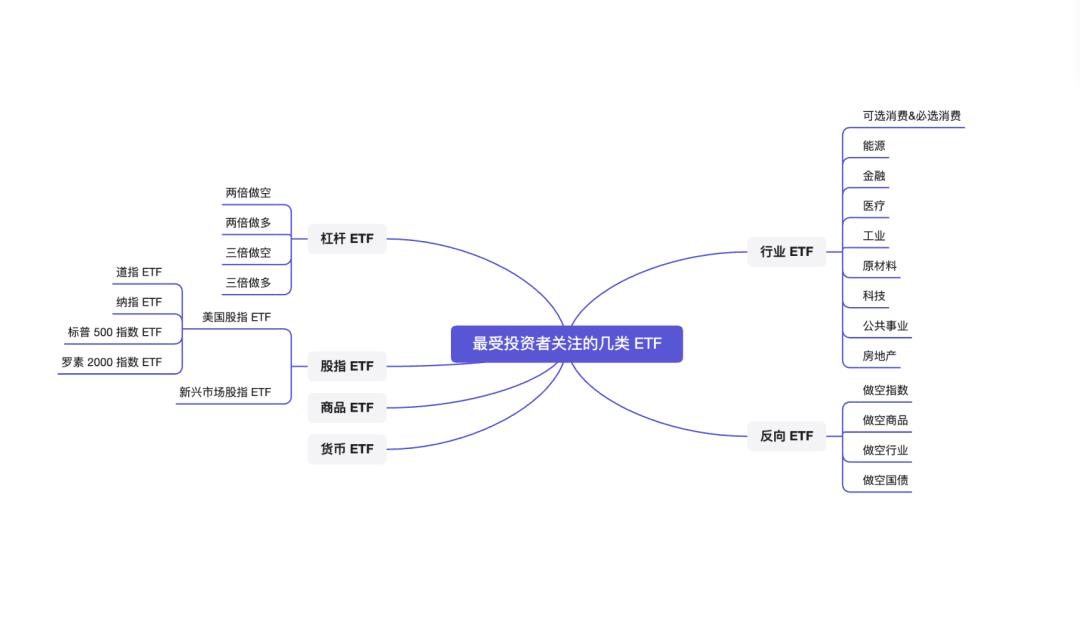
③ There are four important categories of ETFs: sector ETFs, inverse ETFs, leveraged ETFs, and index ETFs. Sector ETFs invest in a specific industry; inverse ETFs move opposite to their underlying (when the underlying falls, the ETF rises, and vice versa); leveraged ETFs amplify movements—when the underlying moves by 1%, the ETF may move several times that amount; index ETFs track a stock market index.
The 1987 U.S. stock market crash delivered a profound lesson for investors—but also gave birth to a groundbreaking financial innovation: the ETF.
On October 19 that year, the Dow Jones Index plunged 22.6%, recording the largest single-day drop in history. In response, authorities quickly introduced trading restrictions, but failed to address the core issue of insufficient market liquidity. The market urgently needed a simple, reliable mechanism to effectively hedge portfolio risk—the idea of a "basket of stocks" was thus born.
After years of development, in 1993, the American Stock Exchange launched SPDR, the first true ETF tracking the S&P 500 Index. To this day, SPDR remains the world’s largest and most popular ETF product.
Over the past three decades, ETF varieties have expanded dramatically. The U.S. market has successively introduced cross-border, sector-specific, commodity, leveraged, inverse, actively managed, and rotational FOF ETFs. By mid-2023, global ETF assets under management reached a staggering $10 trillion (with U.S. equity ETFs accounting for nearly 70%).
Why are ETFs suitable for ordinary investors? What exactly are they? And how do you choose the right type for yourself? Over the next few articles, the RockFlow research team will answer these questions one by one.
1. What Is an ETF?
ETF stands for Exchange Traded Fund—a fund traded on exchanges. It provides investors with a relatively low-cost way to invest in a broad range of assets and indices.
Think of it this way: an issuer buys all the stocks included in a certain index, pools them together into a new fund, and then divides it into small, tradable shares—this becomes a typical ETF. When you buy such an ETF, you're essentially buying all the stocks in that index.
The key advantage of ETFs is that individual investors can “one-click” invest in diversified assets at low cost and with high liquidity.
As a result, ETFs have grown rapidly in North America and come in many forms: some track major market indices, others track sector indices or foreign stock markets… Some even follow bonds, gold, oil, currencies, and agricultural commodities. An ETF's structure allows it to track virtually any underlying—from the price of a single commodity to a highly diversified basket of securities, or even a specific investment strategy.
Today, more and more investors are trading ETFs. Statistics show that over half of daily trading volume on the three major U.S. stock exchanges now comes from ETFs.
Moreover, ETFs are especially well-suited for medium- to long-term investors. These investors care most about macro trends, lack the time to analyze individual company performance, and want to avoid wild swings in their portfolios caused by unexpected events (a common problem when holding individual stocks). Such investors can select a few highly liquid ETFs, buy them at favorable prices, and sell only when trends reverse. With limited trades per year and lower overall risk, they can rest easy.
2. Types of ETFs
Investors can choose from various types of ETFs, classified by different criteria: passive & active ETFs, bond & equity & commodity & currency ETFs, long & inverse ETFs, etc.
Passive ETFs replicate the performance of a securities index (e.g., S&P 500, Nasdaq) to achieve returns closely matching that index—or target a specific sector. Actively managed ETFs, on the other hand, are overseen by fund managers who make active investment decisions—like handing your money to a professional trader. For example, ARK Innovation ETF, managed by Cathie Wood ("female Buffett"), depends entirely on the manager’s skill for its returns. These funds typically charge higher fees than passive ETFs but offer broader investment scope and potentially much higher returns.
By underlying asset: equity ETFs are the most common and include many subcategories; currency ETFs track exchange rate movements; bond ETFs focus on the bond market, with returns tied to underlying bond performance—they tend to offer stable, albeit lower, returns compared to other ETFs; commodity ETFs cover assets like oil, gold, and silver.
By direction: long ETFs, such as the S&P 500 ETF (SPY), track the rise and fall of the S&P 500 index—so if the index gains 1%, the ETF theoretically gains 1%. Inverse ETFs, such as the short S&P 500 (SH), also track the S&P 500 index but in the opposite direction: when the index rises 1%, the ETF falls 1%; when the index drops 1%, the ETF gains 1%.
Below, we dive deeper into four ETF types attracting the most investor interest: sector ETFs, inverse ETFs, leveraged ETFs, and index ETFs.
2.1) Sector ETFs
A sector ETF is a fund that invests in a specific industry. If you’re bullish on a particular sector, you can invest in an ETF tracking that industry, bypassing the need to pick individual stocks and capturing the sector’s overall return.
In recent years, popular (or currently hot) sectors have included consumer goods, internet, and AI. If you have deep insights into a sector and can anticipate its growth cycles, you might consider making a significant bet here.
Clearly, sector ETFs suit investors with strong analytical skills. Their main advantage is the potential to outperform the broader market if your sector call is correct. But the downside is equally apparent: because you're concentrating on one sector, entering at a peak or during a downturn could lead to significant opportunity cost and lost time.
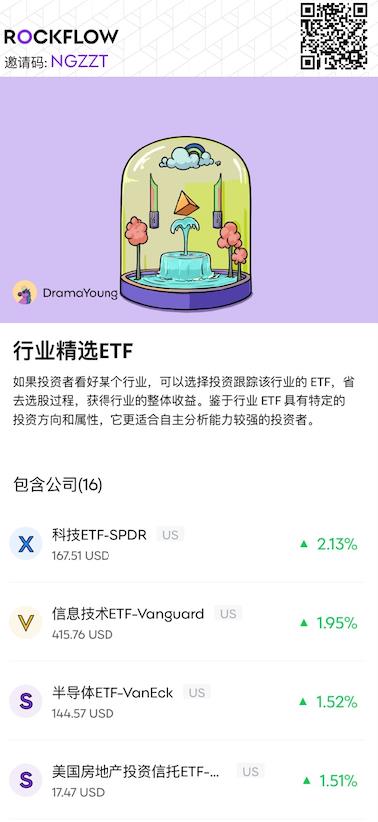
Currently, the 10 major U.S. equity sectors are discretionary consumption, staples, energy, financials, healthcare, industrials, materials, technology, utilities, and real estate—all based on components of the Dow Jones and S&P indices. The RockFlow Research Team has recently launched a "Sector Select ETF" list, curating high-quality sector ETFs combining strong liquidity and representativeness (for visual clarity, only part is shown below):
2.2) Inverse ETFs
We all know that while major U.S. indices trend upward over the long term, they still face short-term sharp corrections or extended periods of stagnation. During bear markets, investors don’t have to just endure volatility and unrealized losses—they can actively respond, even profit. One of the most commonly used tools for this is the inverse exchange-traded fund, or inverse ETF.
Also known as short ETFs, these use derivatives to generate profits when the underlying asset or market index declines. They are direct opposites of the correlated asset: if the asset drops X%, the ETF gains X%; conversely, if the asset rises X%, the ETF falls X%. Compared to short selling or buying put options, inverse ETFs are simpler and easier to use, making them more appealing to many investors.
It’s important to note: inverse ETFs are benchmarked against the daily percentage change of the underlying index—not cumulative returns over time. Therefore, they are suitable only for intraday trading and not for long-term holding, which could result in unintended losses due to compounding effects.
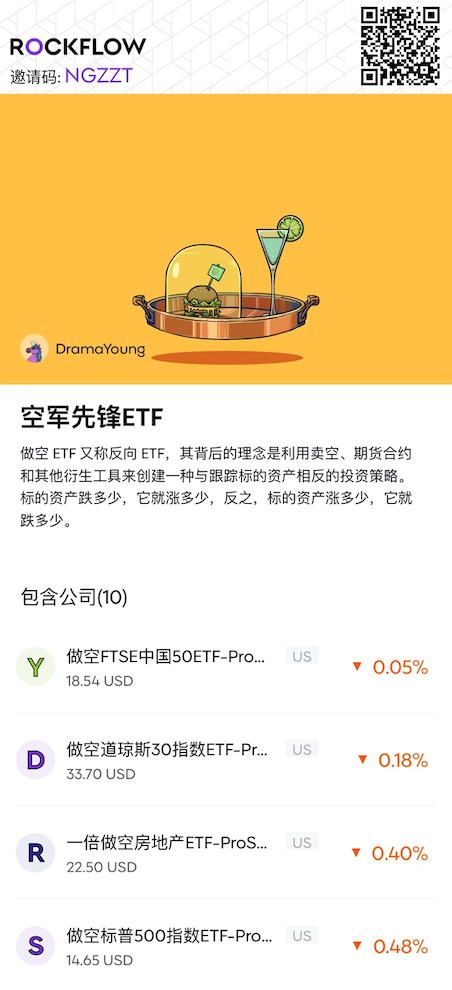
The RockFlow Research Team has recently launched an "Air Force Vanguard ETF" list, selecting highly liquid inverse ETFs targeting major U.S. indices, as well as financials, real estate, and Chinese indices (only partially shown below for visual clarity):
2.3) Leveraged ETFs
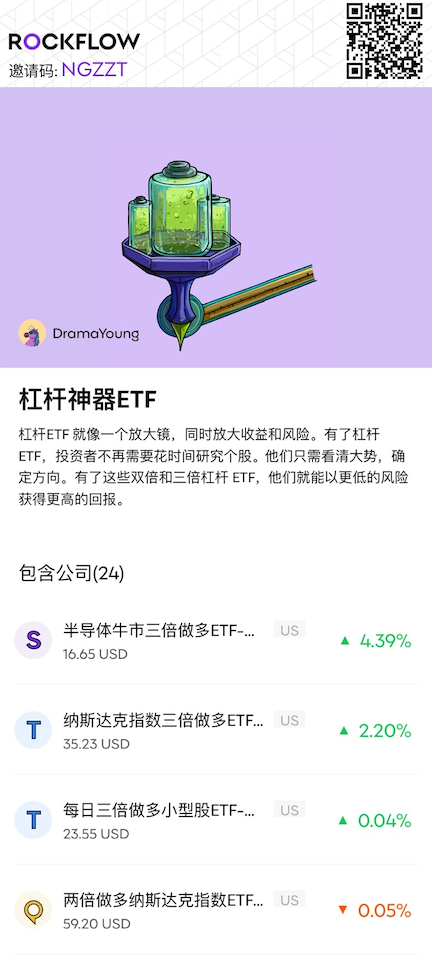
Many investors prefer individual stock trading and dislike ETFs, finding them low-return and unexciting. However, in the U.S. market, there are leveraged ETFs offering 2x or 3x returns, which can fully satisfy investors seeking relatively high returns with manageable risk. Also called multiplier ETFs, they use baskets of derivative instruments to amplify index movements—like a magnifying glass, boosting both gains and risks.
Compared to aggressive leverage tools like index futures or margin trading, leveraged ETFs have lower barriers to entry—both in terms of capital requirements and expertise. They have no position limits, require no margin deposits, and carry lower operational risk. For investors seeking leveraged exposure, they are more efficient and convenient.
Recently, the RockFlow Research Team aggregated high-liquidity leveraged ETFs across major U.S. indices and popular sectors (such as semiconductors) into a high-quality "Leverage Powerhouse ETF" list for interested investors. With these leveraged ETFs, you can use a small amount of capital to generate substantial returns (only partially shown below for visual clarity):
2.4) Index ETFs
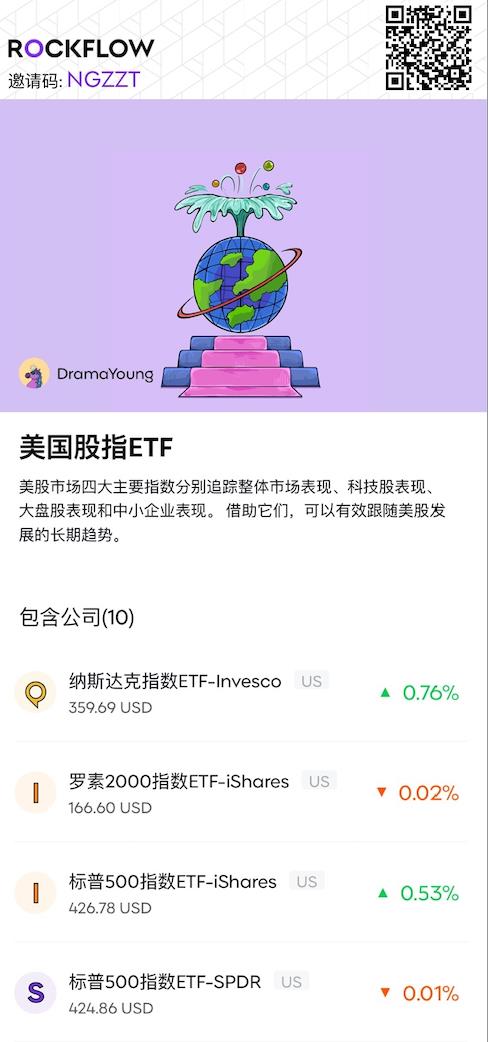
An index ETF tracks a specific stock market index. In the U.S. market, the four main indices are the Dow Jones Industrial Average (DJIA), the Nasdaq-100, the S&P 500, and the Russell 2000—each reflecting the performance of the overall market, tech stocks, large-cap stocks, and small-cap companies, respectively.
How do they work?
The Dow Jones Index is one of the oldest U.S. indices, comprising 30 of the largest and most well-known American public companies;
The Nasdaq-100 includes 100 leading U.S. tech stocks, known for their high growth potential;
The S&P 500 measures the overall performance of 500 leading U.S. public companies and serves as a barometer of the U.S. economy;
The Russell 2000 consists of the smallest 2,000 stocks within the Russell 3000 Index, widely regarded as a bellwether for small-cap enterprises.
The RockFlow Research Team’s latest offering—U.S. Index ETF List—includes highly liquid ETFs tracking these four major U.S. indices, helping investors easily select the ones they believe in for stable, strategic investing.
Of course, index ETFs aren’t just for going long—they can also be used to short the market. Take DSQ as an example: it is one of the most mainstream ETFs for shorting the Nasdaq-100 Index (only partially shown below for visual clarity):
Beyond these four types, there are also commodity ETFs and currency ETFs.
Commodity ETFs invest in physical commodities such as crude oil or gold. They help diversify portfolios and provide a buffer during economic downturns (e.g., commodity ETFs often hold up when stock markets crash). Plus, owning a commodity ETF is cheaper than holding the physical asset, as it avoids insurance, storage, and logistics costs—making it far more convenient.
Currency ETFs track the performance of currency pairs composed of domestic and foreign currencies. They serve multiple purposes—for instance, investors can speculate on exchange rates based on a country’s political and economic outlook, while importers/exporters can use them to diversify portfolios or hedge against forex volatility.
This concludes our introduction to “What ETFs are,” “Why they suit ordinary investors,” and “How they are categorized and their respective features.” In the next article, we’ll analyze how to choose the right ETF—and at this moment in November 2023, which types are most worth holding for the long term.
Join TechFlow official community to stay tuned
Telegram:https://t.me/TechFlowDaily
X (Twitter):https://x.com/TechFlowPost
X (Twitter) EN:https://x.com/BlockFlow_News






