








Defining New GameFi Gameplay: Analyzing the Innovative Dual-Token Economic Model
TechFlow Selected TechFlow Selected
Defining New GameFi Gameplay: Analyzing the Innovative Dual-Token Economic Model
This article takes Space Alpaca as a starting point to analyze the value of its dual-token economic model, as well as the entire new ecosystem and its future vision.
 Navigating Web3 tides with focused insights
GameFi refers to the emerging trend in the blockchain space that combines gaming elements with financial mechanisms, allowing players to earn tokens or other rewards by playing games—commonly known as the Play-to-Earn (P2E) model. An ideal GameFi ecosystem enables players to earn real returns while leveraging blockchain’s composability to democratize game finance.
While the concept of play-to-earn games is promising, many recent GameFi projects have ultimately failed, leading to growing skepticism toward P2E models. These games often suffer from inherent issues such as excessive speculation, security vulnerabilities, and unsustainable in-game economies. Dual-token systems, in particular, may face imbalances between tokens and liquidity problems.
Space Alpaca is a new strategic Play-to-Earn card-based GameFi game that integrates farming and combat mechanics, divided into farm management and battle components. Gameplay includes farm operations, player versus player battles, and dungeon challenges. Players can develop and refine strategies, experiment with optimal team compositions and management tactics, and leverage multiple gameplay modes to maximize earnings.
Space Alpaca has conducted an in-depth analysis of past GameFi projects and introduced a novel dual-token economic model designed to overcome common flaws found in previous blockchain games’ dual-token structures. The following sections will explain, starting with Space Alpaca, the value of its dual-token economy, along with the entire new ecosystem and its future vision.
Limited Game Lifespan, Flaws of Traditional Dual-Token Models: How StepN and Axie Infinity Declined
The dual-token economic model has become a common structure in recent blockchain games. As the name suggests, a dual-token system involves two types of tokens: one primarily used for governance and security, and another serving as a stable token for transactions and value storage. This structure appears flawless at first glance—offering speculative potential through one token while maintaining stability via the other. However, it often comes with significant drawbacks.
Popular blockchain games like StepN and Axie Infinity encountered numerous challenges due to their adoption of dual-token economic models, especially since token prices are closely tied to the game's lifecycle. Yet no game lasts forever. Over time, issues such as token imbalance, insufficient liquidity, and unsustainable in-game economies inevitably emerge.
Take StepN as an example: its economic model heavily relied on continuous inflows of new capital. During peak popularity, token prices rose steadily and governance tokens remained stable—seemingly validating the dual-token mechanism. However, once the hype faded, the utility of the reward token proved too limited. Its price plateaued, rendering the fixed-supply governance token meaningless and effectively worthless. Similarly, Axie Infinity adopted a dual-token model that initially attracted widespread attention. But as massive numbers of players joined, the in-game SLP token became devalued. As SLP prices dropped, Axie pets lost their value, leaving players' efforts unrewarded.
What Are the New Dual-Token Economics? SPAL and Space Shard Tokens Explained
Space Alpaca utilizes two tokens: SPAL and Space Shard (SS).
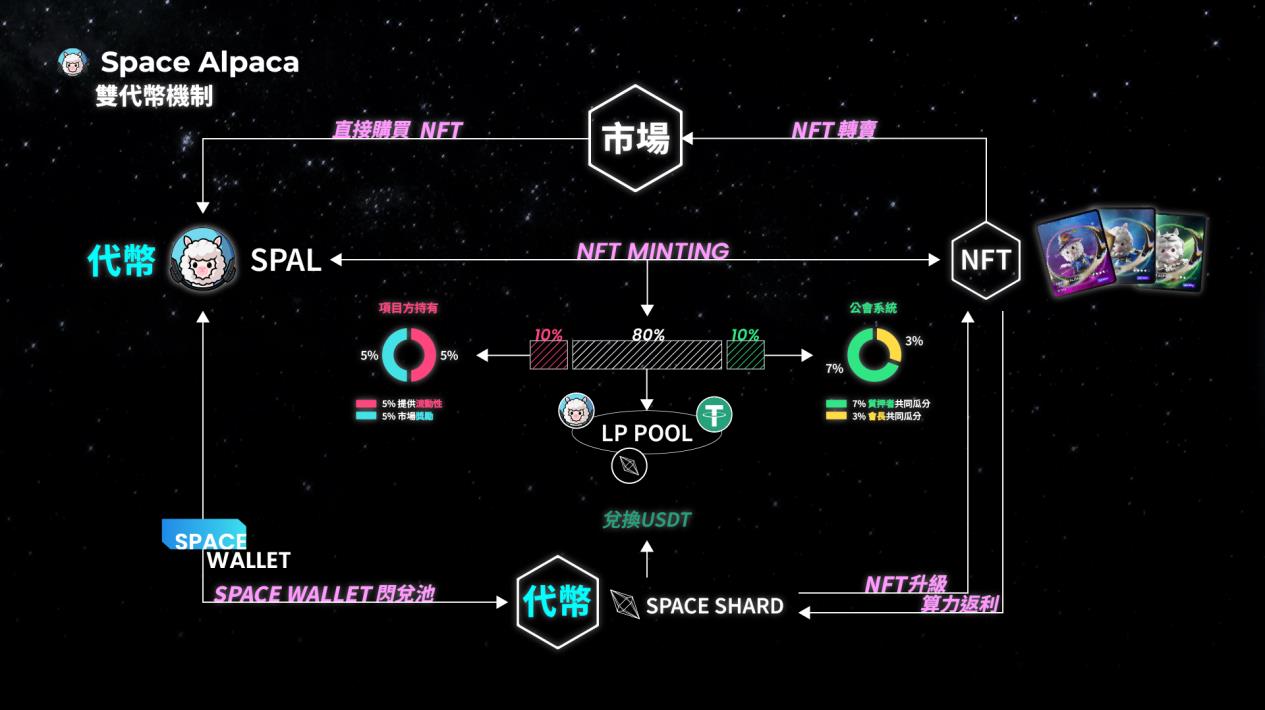
SPAL is the governance token of Space Alpaca. Users can obtain it through early presales and airdrops, purchase it on centralized exchanges, or earn it as rewards from guild staking and guild competitions. SPAL can be used to open NFT mystery boxes, buy NFTs from secondary markets, join or stake in guilds, and instantly swap for Space Shard within the Space Wallet.
Space Shard, on the other hand, is the in-game reward token. It is generated through NFT computing power rebates and can be used to expand land, upgrade weapons and armor, instantly swap for SPAL via Space Wallet, or exchange for USDT on PancakeSwap.
The project implements a burn mechanism to ensure stability and control token circulation. For instance, after each SPAL-powered blind box draw, 80% of the spent value is transferred to the Space Shard liquidity pool to boost liquidity. A well-designed burn mechanism helps maintain a deflationary state for the reward token, minimizing price volatility and securing user returns.
Adding Infinite Circulation Value to Finite-Lived Games: Focusing on Future Project Development
Space Alpaca recognizes the finite lifespan of games and the critical importance of liquidity, placing these insights at the core of its innovative design. Unlike previous projects, the reward token Space Shard isn’t confined solely to use within Space Alpaca—it will be universally applicable across all future games developed by the team, and even throughout the broader ecosystem.
In the next quarter, Space Alpaca plans to launch a series of new blockchain games and expand its supporting ecosystem—including wallets, public chains, and NFT marketplaces—all powered by Space Shard as the primary currency. By standardizing Space Shard across platforms, players can seamlessly transfer assets between different games and communities, enabling true cross-game interoperability.
The Space Shard system adds infinite circulation value to otherwise time-limited games. Even when the popularity of one game fades, new ecosystem projects will continue to emerge, ensuring long-term growth and sustained player engagement—and crucially, preventing the decline of Space Shard’s value.
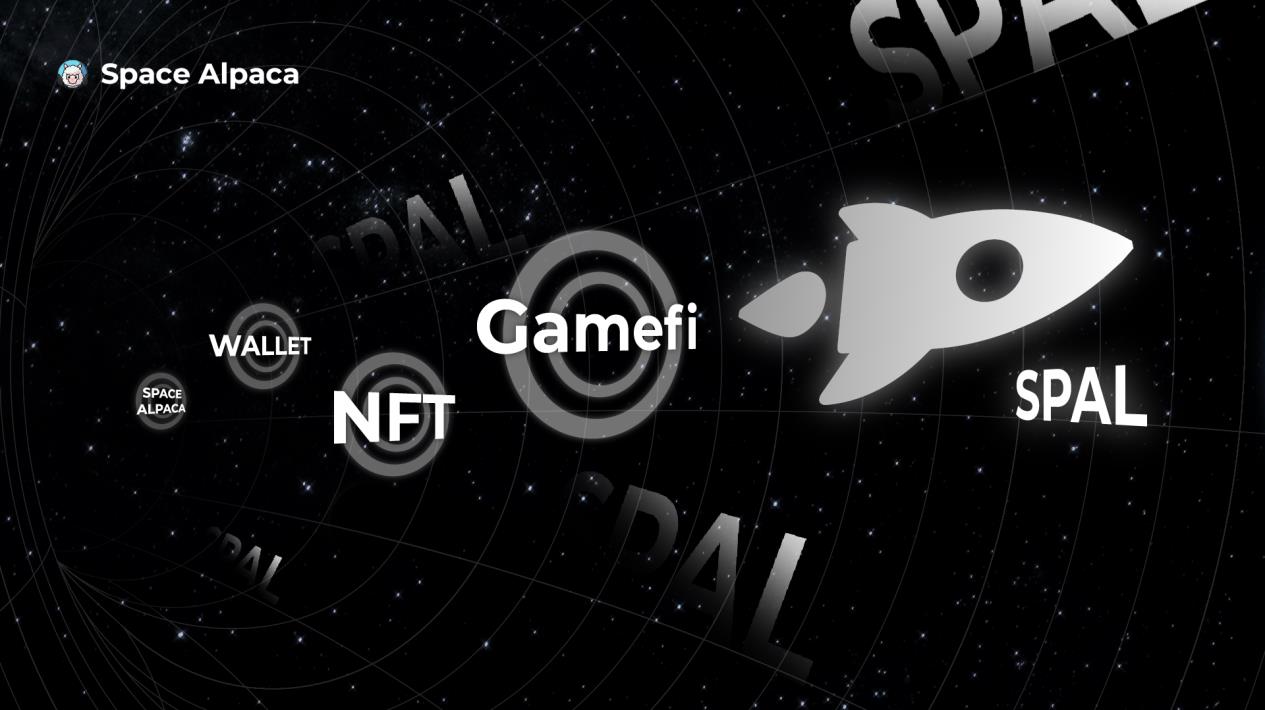
Vision of Space Alpaca
Past GameFi projects like Axie Infinity and StepN, mentioned earlier, once enjoyed immense popularity. A skyrocketing launch may seem predictable for new GameFi ventures, but what truly matters is building a sustainable system.
As a new entrant in the GameFi space, Space Alpaca addresses past shortcomings by fundamentally rethinking game economics. Its strategy focuses not only on short-term economic balance but also on long-term sustainability and player value. Beyond refining economic models, Space Alpaca aims to redefine the direction of the entire GameFi sector. By reshaping the concept of GameFi, it offers players a uniquely rewarding experience.
Join the SPAL Presale and Galxe Campaign Early
Space Alpaca is scheduled to officially launch in December. The team recently announced it has passed a security audit by Certik, achieving a high safety score of 91.5 for its smart contract code. Additional reviews from industry-leading code security firms are currently underway to further ensure the integrity of the project’s smart contracts.
Although the game hasn't launched yet, the team has already begun promotional campaigns to build momentum. Users can now participate in the SPAL token presale or engage in Galxe activities to qualify for airdrops.
Galxe Campaign:
https://galxe.com/SpaceAlpaca/campaign/GCCMFUHfH5
Galxe Campaign Guide:
https://medium.com/@_Space_Alpaca/5m-spal-and-in-game-nfts-airdrops-on-galxe-2fa3d6bee510
Purchase SPAL:
SPAL Purchase Tutorial:
https://medium.com/@_Space_Alpaca/beginners-guide-spal-purchase-tutorial-e53ff2c23d2f
Join TechFlow official community to stay tuned
Telegram:https://t.me/TechFlowDaily
X (Twitter):https://x.com/TechFlowPost
X (Twitter) EN:https://x.com/BlockFlow_News
 @_Space_Alpaca






