TechFlow
TechFlow Selected TechFlow Selected
TechFlow
The Lens Protocol stands out in the competition thanks to its inherent technical advantages, rooted in a steadfast commitment to decentralization.
 Navigating Web3 tides with focused insights
By: Larissa
Following the Ethereum community conference (ETHCC), Lens Protocol made headlines with the announcement of its latest upgrade, Lens V2. This highly anticipated release includes two revolutionary upgrades. The first is "Open Actions," introducing a groundbreaking feature that enables users and developers to seamlessly integrate external smart contract actions into Lens publications. The second enhancement is a major integration with ERC6551, transforming identity management by allowing NFTs to serve as unique identities, binding all account activities within the Lens ecosystem. Users can now link multiple wallet addresses through a single NFT, streamlining the user experience.
Lens and Its Competitors
Lens Protocol has established itself as the leading SocialFi platform on Ethereum. Compared to competitors, Lens excels in growth and user engagement. Fracaster, another social protocol with a similar social graph concept, currently has 17,286 active accounts, while Lens Protocol boasts an impressive 119,241 active accounts—significantly outperforming its rivals.
Although another competitor, CyberConnect, has over 296,342 accounts, Lens Protocol implements access control measures, making direct comparisons less meaningful. Despite CyberConnect's larger user base, Lens Protocol outperforms it in total transaction volume, recording 21,931,943 transactions compared to CyberConnect’s 16,249,274.
The Lens Protocol ecosystem not only attracts a larger user base but also demonstrates higher levels of user activity compared to other social contract platforms, reflecting Lens Protocol’s effectiveness in building a vibrant and thriving community within its decentralized ecosystem. Nevertheless, Lens Protocol is not resting on its achievements and continues advancing to the next stage.
Lens Protocol’s Ambitious Moves
1) Momoka: Lens’ L3

In April, Lens launched MOMOKA, an innovative Optimistic L3 scaling solution designed to process Polygon transactions off-chain, achieving unparalleled scalability while reducing transaction costs. Unlike traditional rollups where L2 sends transactions to L1, Momoka takes a different approach. It creates transactions and obtains signatures from wallets, but instead of broadcasting these transactions directly onto the blockchain, it generates data availability (DA) metadata using transaction signatures and typed data, treating this metadata as the transaction itself. This metadata is then sent to a dedicated DA layer.
Additionally, Momoka provides indexing support, enabling node operators to seamlessly stream and index Lens data without relying on third-party infrastructure. With Momoka, users have the option to selectively store data on Polygon, and publications that do not require a strong trustless execution layer can choose not to use EVM state. As a result, Momoka offers users flexibility in customizing their transaction methods based on specific needs within the Lens ecosystem. The launch of Momoka opens the possibility for users to reduce reliance on Polygon services to some extent, potentially paving the way for Lens to transition toward a Layer 1 chain and become part of a modular blockchain architecture.
2) Integration with ERC6551
ERC6551 allows NFTs to create Token Bound Accounts (TBAs), meaning NFTs can function as wallet addresses or on-chain accounts, effectively turning NFTs into wallets. Furthermore, ERC-6551 supports creating smart contract wallet accounts for existing ERC-721 NFTs, using the NFT as an on-chain identity wallet. Under this NFT account, multiple wallet addresses, owned NFTs, and ERC-20 tokens can be included, making the NFT a true representative of an on-chain identity.
From Lens’s perspective, integrating with ERC-6551 and establishing rules for Lens-based NFTs is a strategic move. Currently, Lens requires users to own a Lens NFT to access its services, and transferring a Lens NFT results in losing all associated account activities and transaction history. By implementing ERC-6551, Lens simplifies the use of its NFTs and adds an identity dimension, fostering a stronger sense of ownership and belonging among users.
Lens believes that the current integration with ERC-6551 not only simplifies NFT usage but also introduces the concept of identity, enhancing the overall user experience. This innovative approach of embedding identity into NFTs creates a deeper connection between users and the platform.
During Lens’s closed beta, users have already created and accumulated over 3.4 million NFTs—not just simple profile pictures or digital assets. Now, these NFTs have the potential to unlock new utility in the realm of identity, offering a fresh and exciting perspective that could generate market interest.
Star Projects in the Lens Ecosystem
Currently, more than 134 verified and showcased applications are thriving within the Lens ecosystem. This diverse range of successful apps has generated significant interest and support from various communities and developers, fueling high expectations for Lens Protocol’s future.
1) Orb
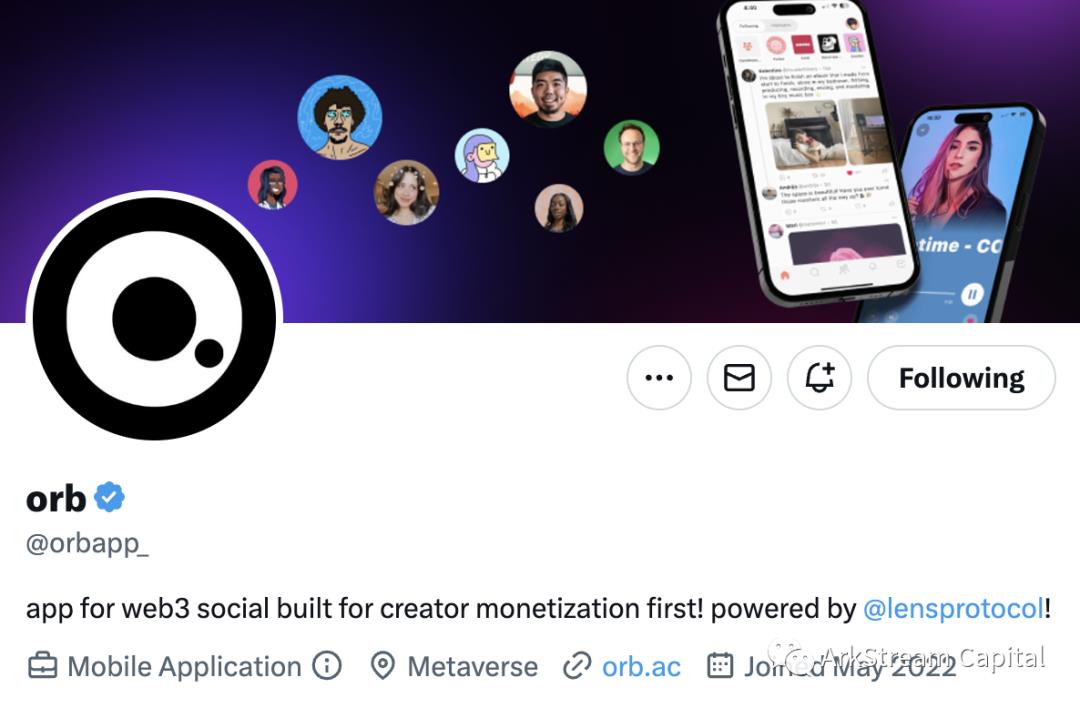
Orb is a decentralized social media platform supporting both mobile and desktop devices. Among all applications, we believe in Orb. Orb stands out as a decentralized social app on Lens, excelling not only in UI/UX but also in emphasizing community focus. We believe that an engaging and distinctive community will be the most unique characteristic of Web3 social apps and will help attract Web2 users from platforms like Twitter. Orb is not only focused on attracting diverse communities from Web3 but is also actively working to create a unique user experience.
2) Lenster

Lenster is an innovative and pioneering decentralized social media application firmly rooted in the principle of permissionless interaction. Backed by the powerful Lens Protocol, Lenster redefines the digital social landscape by introducing a completely new paradigm of user engagement. On this innovative platform, users gain unprecedented ability to create and reward posts that deeply resonate with the broader community.
3) Phaver

Phaver is a pioneer in the decentralized social media space, leveraging cutting-edge capabilities of Lens technology. As an early adopter of this revolutionary paradigm, Phaver not only redefines how users interact with digital communities but also introduces an innovative incentive dimension through its unique token reward system.
Limitations of Lens Protocol
Submitters are responsible for validating transaction data and constructing data to be submitted to Arweave, similar to an L2 sequencer. However, this process is not decentralized—the decision-making power rests solely with the official Lens team.
Rather than following traditional L2 solutions, Lens rolls up and sends data to a DA layer. This decision stems from the fact that as a large-scale application, Lens data will continue to grow in volume and complexity—unlike financial data, which only requires final settlement results. Sending data to a DA layer handled by Arweave serves as a temporary solution, not a long-term scaling strategy.
Despite being considered one of the most mature protocols, with a thriving ecosystem and a dedicated team committed to improving user experience, Lens currently primarily attracts blockchain-native users. It struggles to onboard new users. In contrast, some non-blockchain social protocols have successfully attracted large numbers of new users through low entry barriers and smooth user experiences.
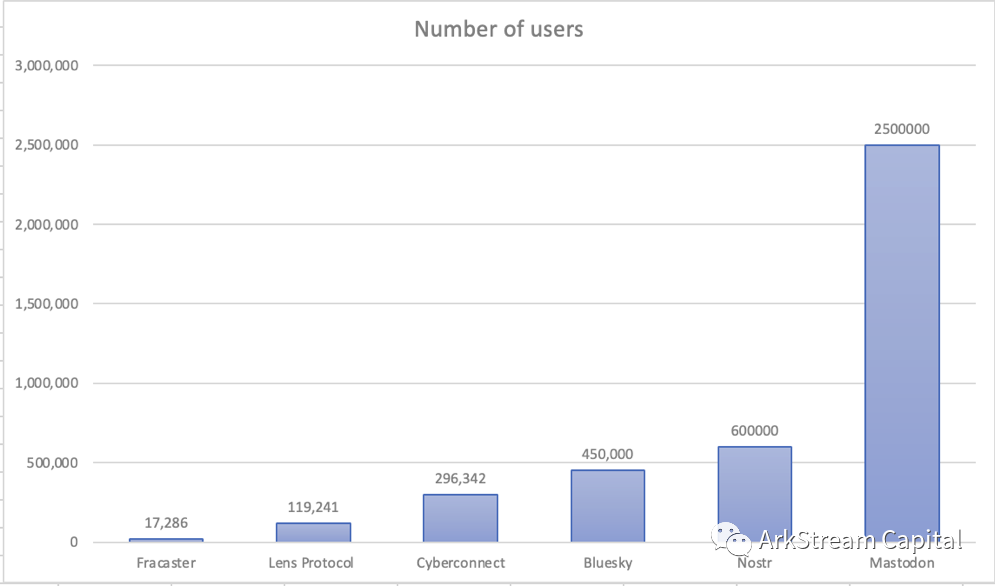
In summary, Lens Protocol distinguishes itself from competitors through inherent technical advantages rooted in its steadfast commitment to decentralization. While well-known social protocols such as Nostr and Mastodon have amassed large user bases without relying on blockchain technology, Lens Protocol's uniqueness lies in its authentic support for decentralization. The case of Nostr highlights the importance of decentralized architecture, eliminating the need for users to grapple with complex blockchain concepts. Nostr’s elegant system, comprising clients and relays, provides an environment where users can easily manage private and public keys, enabling expansion and the creation of diverse applications.
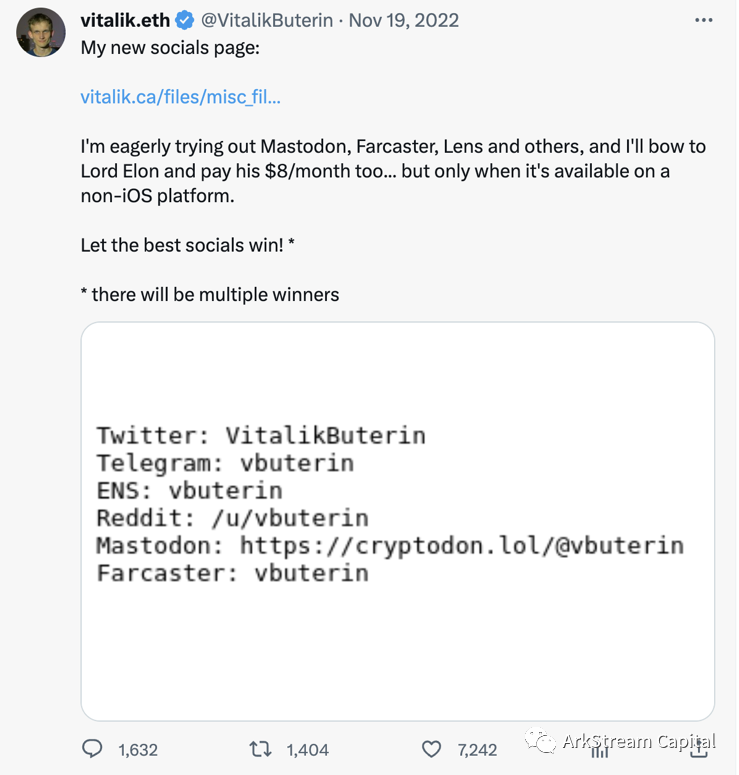
However, recent innovation waves sparked by visionary leaders like Vitalik and Elon on Twitter may realign preferences among native Web3 users, prompting them to explore alternative promising social protocols. In this evolving landscape, Lens Protocol faces the challenge of maintaining its relevance and appeal in a fiercely competitive environment.
We look forward to witnessing Lens standing out in the highly competitive social赛道!
Join TechFlow official community to stay tuned
Telegram:https://t.me/TechFlowDaily
X (Twitter):https://x.com/TechFlowPost
X (Twitter) EN:https://x.com/BlockFlow_News
 Arkstream Capital


![In-depth Analysis of Trade[XYZ]: How Were 92 Markets and 98% HIP-3 Trading Volume Established?](https://upload.techflowpost.com/upload/images/20260716/20260716061117965147.jpeg?x-oss-process=image/resize,p_50/quality,q_80)