Binance Research: Innovative Utilities, Ecosystem Landscape, and Future Outlook of Web3 Social
TechFlow Selected TechFlow Selected
Binance Research: Innovative Utilities, Ecosystem Landscape, and Future Outlook of Web3 Social
Web3 social cannot directly compete with Web2 social in terms of user experience; to succeed, it needs to deliver unique and innovative utility.
 Navigating Web3 tides with focused insights
Author: Binance Research
Translation: Lynn, MarsBit
Key Takeaways
Compared to Web2, Web3 social centers on delivering three key unique utilities:
-
First, asset creation and shared ownership. Web3 social applications can use blockchains to create a shared ownership structure with their users.
-
Second, open data and identity: Data and credentials accumulated on-chain are shared across the ecosystem.
-
Third, composable ecosystems: dApps built on smart contract blockchains like Ethereum are inherently composable, allowing developers to build on top of existing applications in a permissionless manner.
The Web3 social ecosystem can be divided into the following components: infrastructure, middleware, applications, and tools.
-
Infrastructure: Projects are attempting to provide customized infrastructure tailored to the needs of social applications.
-
Middleware: Most recent innovations in Web3 are built upon existing ecosystems. Middleware protocols bridge these infrastructures by querying, organizing, and presenting data to application developers, acting as intermediaries between blockchains and applications.
-
Applications: Web3 social apps represent a diverse portfolio of products suitable for different scenarios. Prominent forms include social media, community-based apps, and instant messaging products.
-
Tools: Unlike applications, tools are a set of products that leverage Web3 interoperability, designed to be "portable" across different platforms and blockchains.
Currently, Web3 social cannot directly compete with Web2 social in terms of user experience. To succeed, it must offer unique and innovative utility. We are monitoring innovation in the following areas:
-
Mobile Applications: A significant portion of social activity occurs on mobile devices, and we anticipate more innovation on this platform.
-
Crypto-Native Innovation: Many current Web3 social products are replicas of Web2 counterparts. We believe truly adopted social products will emerge only from those leveraging blockchain primitives to deliver transformative experiences for users.
-
Integration with Web3 Scenarios: Successful Web3 products may also arise from solving native Web3 use cases, such as on-chain community management.
Introduction
Today, over 4.65 billion people worldwide use social media, accounting for 58.7% of the global population. Web2 social media companies have enabled easy connections with friends and family while gaining access to massive user bases, resulting in remarkable profitability. For instance, Meta, the global leader in social media, boasts nearly 3 billion users and reported net income of $39.3 billion in 2021, with a net profit margin of approximately 33.38%.
However, Web2 social media platforms suffer from several drawbacks:
-
Unfair profit distribution: Users form the primary group of content creators on social media, yet they do not receive compensation for the value they generate. Platforms profit from user-generated content by controlling distribution algorithms and attention flows without sharing revenue with users.
-
Lost data and identity: Once users establish their social relationships within an application, switching to another app becomes costly. Consequently, innovation in the space is naturally suppressed, and users face fragmented identities and experiences across different applications.
-
Closed ecosystems: Major Web2 platforms initially benefited from vibrant developer ecosystems, but once they gained sufficient traction, they closed off their ecosystems to prevent others from stealing their data and users. A notable event in social media history was Twitter shutting down its developer API due to concerns about data sharing.
Leveraging blockchain technology, Web3 social applications offer the following three value propositions to address these issues:
-
Asset creation and ownership: Web3 social applications do not need to rely on indirect monetization (i.e., advertising) and can use blockchains to create shared ownership structures with their users. This can be achieved through issuing fungible tokens or non-fungible tokens (NFTs) to foster community and/or ownership awareness.
-
Open data and identity: Public-private key pairs serve not only as a method to protect assets but also create sovereign, consistent identifiers across different platforms. Data and credentials accumulated on-chain are naturally interoperable with every application built atop blockchains.
-
Composable ecosystems: Blockchains like Ethereum are not just ledgers for asset transfers but also open, transparent, and trustless software development platforms. dApps themselves are composable and can serve as building blocks for other applications.
Web3 applications and protocols have conducted meaningful exploration along these three directions. Based on technical architecture and customer focus, we categorize these projects into the following groups:
- Infrastructure
- Middleware
- Applications
- Tools
We will analyze these sectors in the remainder of this report using some prominent projects.
Infrastructure
Most Web3 social applications are built on public Layer-1 (L1) blockchains like Ethereum, but there are notable attempts to provide customized infrastructure tailored to the needs of social applications. Compared to other dApps, social applications require faster transaction speeds, greater bandwidth, and cheaper media storage—features that may be difficult to achieve on general-purpose L1s. As a result, some social-specific L1s stand out due to their high transaction throughput and cost-effective on-chain storage, although decentralization is somewhat sacrificed.
DeSo
DeSo is an L1 blockchain designed specifically for social media platforms. Its vision is to deliver all three social value propositions of Web3 simultaneously. DeSo claims that with its own version of Proof-of-Stake, it will eventually achieve over 1,000 transactions per second (TPS) and support up to around 30 million users. With built-in NFT and social token functionalities, users can easily create token-based communities and monetize them. The blockchain itself serves as a shared data ledger and composable developer platform.
However, building a custom L1 is a double-edged sword. While it enables fast transactions and low-cost content storage, it loses valuable connections with existing dApps and identity ecosystems on chains like Ethereum. Since launching its token in June 2021, no widely popular consumer applications have emerged based on the DeSo ecosystem.
Crossbell
Crossbell is a new social L1 developed by the team behind RSS3. In contrast to DeSo, it takes a different approach, focusing on providing a shared content storage platform. As an Ethereum sidechain, Crossbell is currently free to use and has already established a content feed and user profile system.
Interview Highlights with Crossbell
Vision — Joshua Meteora, founder of RSS3 and Crossbell, believes the core spirit of Web3 is decentralization, which should not be sacrificed for user experience. Custom L1s remove efficiency limitations of existing blockchains and deliver better user experiences through sufficiently decentralized tech stacks. Moreover, interoperability between Crossbell and the Ethereum ecosystem allows it to benefit from rich content and identity systems, while the sidechain architecture enables efficient execution and cheap storage.
Middleware
Middleware refers to protocols built on existing infrastructure, aiming to act as intermediaries between blockchains and applications by querying, organizing, and presenting data to application developers.
In this section, we introduce four well-known social middleware protocols. While all aim to build a better social application system, each adopts a distinct approach. The table above captures differences in their technical architectures.
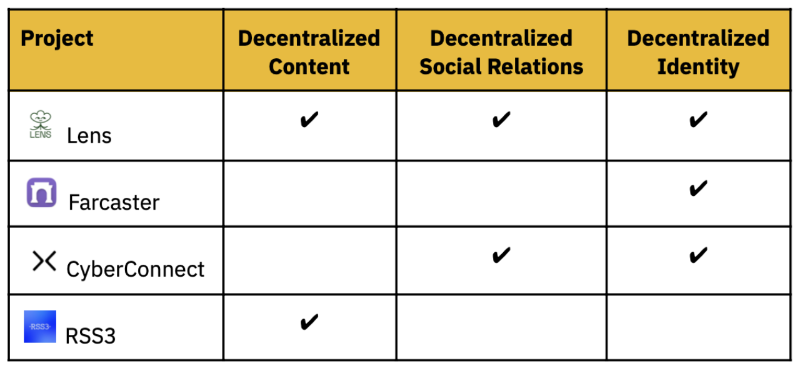
Lens Protocol
Developed by the team behind Aave (Ethereum’s largest lending platform), Lens Protocol is one of the most recognized social protocols. Similar to DeSo, all content, interactions, and user profiles are stored on-chain, but Lens is built on Polygon, enabling interaction with the existing Ethereum ecosystem. It features:
- Non-fungibility — User profiles, posts, and even follows are represented as NFTs.
The first benefit is effective monetization: Social media influencers can sell their posts or entire profiles with a single click.
Additionally, since NFT standards are interoperable and widely accepted by numerous markets and applications, relationships and content on Lens can be easily accessed and displayed on other platforms without additional technical integration.
- Built-in composability — Lens Protocol is a flexible software development kit (SDK) that allows application developers to build on it in various ways. For example, developers can modify the “follow” module so users pay a specific price to follow someone, or add voting mechanisms for account followers.
Currently, over 50 applications are built on Lens Protocol, with approximately 60,000 Lens handle holders.
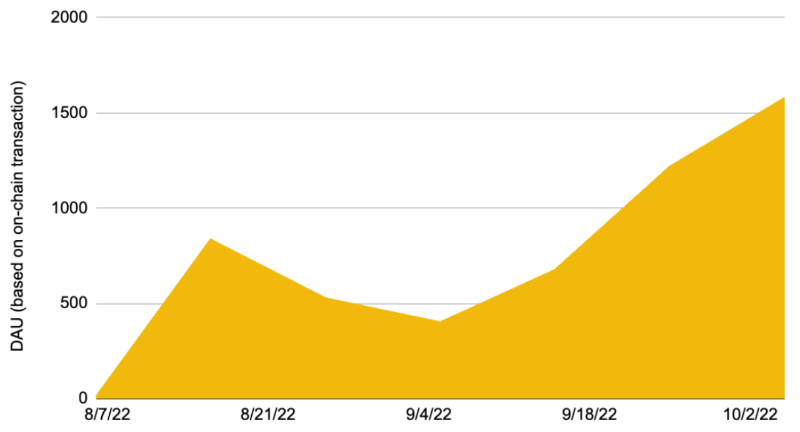
Figure 1: Daily Active Users of Lens from August to October 2022
However, this on-chain architecture requires frequent wallet signatures, disrupting user experience. Currently, the volume of content and social relationships on Lens Protocol cannot compare to Web2 social media. According to on-chain analysis, Lens ecosystem's daily active users numbered in the thousands over the past few months.
Farcaster
If Lens adopts a technology-first approach, Farcaster prioritizes user experience. While everything on Lens—including user identity, content, and social relationships—is stored on-chain, in the Farcaster ecosystem, content and social relationships are stored on centralized servers (or "hubs"), so users don’t need to worry about paying gas fees or signing transactions.
How then are applications on Farcaster different from Web2 apps? Farcaster gives each user a sovereign, on-chain identity. Based on full decentralization principles, even if centralized server operators attempt to block specific users, others can still locate and contact them via their on-chain identity. Farcaster provides templates for self-hosted Hubs for such users.
The main application on Farcaster is the Farcaster app, a Twitter-like application with native crypto features such as on-chain activity tracking, NFT profiles, and NFT gallery collections. To maintain a healthy community atmosphere, the Farcaster team strictly controls user onboarding. There are currently several hundred active users. It will be interesting to observe whether community quality and user experience can be maintained as the ecosystem grows.
CyberConnect
As a social graph protocol, CyberConnect aims to provide one-stop data solutions for developers of Web3 social applications. While Web2 social media platforms store all social relationships on their servers, CyberConnect aims to become a public database for different applications, enabling greater interoperability between apps. For example, users transitioning from App A to App B will find their friends, followers, and other synchronized social data seamlessly transferred along with their ID to the new app. CyberConnect is also incubating its own consumer applications. It recently launched link3, a Web3 version of Linktree with event curation functionality.
Currently, CyberConnect has an ecosystem of over 70 projects, including not only social media apps but also DID, communication protocols, and community management applications. According to recent updates, the total number of users registered with CyberConnect identity is 1.49 million, with 22.22 million API calls.
RSS3
RSS is a Web1 standard that allows people to subscribe to any feed on the internet without relying on centralized servers. Although RSS’s success has been overshadowed by Web2 content platforms, RSS3 aims to support efficient and decentralized information publishing in Web3 by leveraging the best features of RSS. Essentially, RSS3 is a protocol that aggregates on-chain and off-chain content sources in a decentralized manner.
Currently, RSS3’s main product is its data API, which queries all content-related data on Web3 and returns it to developers. Monthly requests have exceeded 200 million. On the client side, RSS3 has also built a search engine and subscription service allowing users to subscribe to content-related updates, such as mirror articles or posts on other decentralized social media platforms.
Conclusion
In terms of scale and valuation, social middleware is one of the most influential segments in the Web3 social space. The reason is simple: it likely exhibits the strongest network effects. Without isolated social data locking in users, applications must continuously compete for user attention, whereas protocols, serving as developer tools, have higher migration costs.
However, protocols are useless without applications. For example, projects like CyberConnect and RSS3 have large volumes of API calls, but they have yet to convert this developer activity into consumer adoption. Therefore, all the above protocols are actively cultivating application ecosystems, with most building their own applications. In the next section, we explore existing Web3 social applications.
Applications
The previous section clarified projects taking an infrastructure-first approach. In this section, we examine projects adopting a product-first strategy. A fundamental argument of these product-first protocols is that social behaviors are closely tied to their respective contexts, requiring a frontend to explore product-market fit rather than building infrastructure blindly. Ideally, product iterations inform the design specifications of their social protocols, enabling other developers to build more dApps on top, ultimately forming an ecosystem.
Social Media
An interesting observation is that many middleware projects are building their own native social applications. Farcaster, discussed in the previous section, iterates both its protocol and a Twitter-like social media app simultaneously. Most of Farcaster’s features are not built at the protocol level, allowing it to better understand user preferences through experimentation and improve features at a faster pace. A functioning product also helps onboard early adopters and demonstrate the underlying protocol’s capabilities to potential external developers. The Farcaster app is currently in invite-only beta mode.
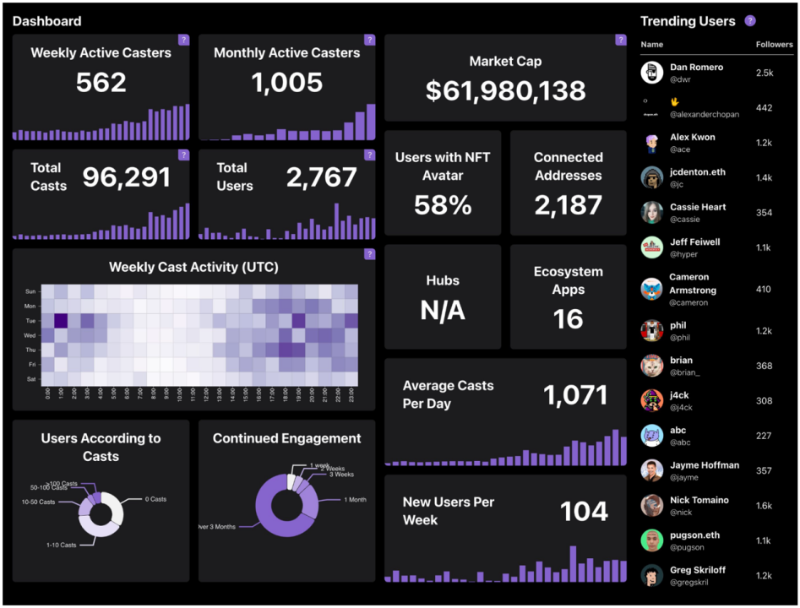
Figure 2: Sample Dashboard of Farcaster
Early productization may carry the risk of protocol inflexibility. Given differing target users and use cases, the underlying user logic behind each major social app varies significantly. ** If the ultimate vision is a protocol-based ecosystem, there exists an inherent dilemma between greater flexibility in middleware and greater specificity in products. ** It is important to distinguish between ecosystems of standalone products and ecosystems of additional components.
The Web3 tech stack introduces novel implementations of trust and verifiability, potentially transforming social profiles from mere displays into actual proofs of identity. This field is still in its infancy, but we expect more emerging innovations that offer solid added value to users. Besides Farcaster, we identified several other projects based on research and public information:
- Context: A platform to observe wallets of friends, influencers, DAOs, and celebrities.
- Lenster: A permissionless social media network application built on Lens Protocol.
- Light: A browser for curating and discovering social interactions around NFTs, DAOs, POAPs, and DeFi.
- Orb: A professional social media application built on Lens Protocol.
Communities
Beyond social media applications, other projects tap into private traffic spaces by catering to online communities. Their central argument is that in Web2, needs for close-knit networks and creator-fan engagement remain unmet. Today’s consumers prefer spending time “passively” scrolling short videos on TikTok rather than “actively” engaging with friends on Instagram or Facebook. Additionally, the business model of short-content recommendations prioritizes ad revenue over fan royalties, leading to inefficient implementation of fan economies.
While many large fanbases (musicians, brands, sports clubs, etc.) are gradually entering Web3 through NFT issuance, there is currently a lack of comprehensive toolchains to both migrate users en masse to Web3 and seamlessly integrate Web3 utilities into existing Web2 applications. One of the early-stage projects we interviewed, Niche, aims to solve this by building an application where tokens serve as gateways to community ownership.
Interview Highlights with Niche
- Vision — Pioneering a new era of ecocentric ownership. By focusing on ownership models via DAOs, Niche can add value for content creators, neighborhood groups, small businesses, and more.
- Product Features — Token prices fluctuate based on market demand to join specific communities. The ultimate goal is to incentivize active participation, enabling users to converse within intimate circles and form genuine connections.
Besides Niche, we identified several other projects based on research and public information:
- Bonfire: A community home equipped with social token gated airdrops, events, content, merchandise, and participation rewards.
- CrowdPad: A platform capable of launching social tokens with built-in community feedback and chat functions.
- RareCircles: A no-code tool for creating NFTs and customized experiences for brands, creators, events, and entertainment.
- Superlocal: A local social network allowing users to earn NFTs and share their experiences wherever they go.
Although token gating is no longer a novel concept, given the growing popularity of NFTs and DAOs, its potential in addressing Web2 inefficiencies remains relatively underexplored. We identify several pain points waiting to be transformed into opportunities:
- Barriers to Adoption: Migrating to a new application with new mechanisms represents a significant commitment for existing communities. From discovery to engagement and monetization, there must be a smooth and practical user journey.
- Unclear Moats: A simple way to quantify an application’s value is the difference between new and old experiences minus user switching costs. Many projects adopt Web2-like UIs to reduce switching costs but overlook the first part of the equation.
- User Education: There remains a long way to go in helping users understand the concept of community ownership. Since Web2 communities are often partially moderated by platforms behind the scenes, users may need time to familiarize themselves with new mechanisms.
Instant Messaging
Onboarding Web2 users into Web3 is not the sole objective of decentralized social applications. Some projects begin by exploring native Web3 social scenarios: online discussions around tokens, transactions, and portfolios, which currently occur primarily on Discord and Telegram.
- BlockscanChat — A platform created by the team behind Etherscan that enables users to send messages between wallets.
- gm.xyz — A Reddit-like platform for community management and building a user-owned social network.
- Nansen Connect — A messaging platform aiming to facilitate more effective cryptocurrency-related conversations by leveraging data and labels generated by Nansen.
- Wallet Connect Chat — A direct messaging protocol allowing users to conduct 1-on-1 messaging with other wallet users in the WalletConnect network.
Among these projects, we interviewed Nansen Connect for deeper insights into this vertical and its product.
Interview Highlights with Nansen Connect
- Vision — Nansen Connect aims to become the go-to platform for cryptocurrency communities to discuss alpha and trading opportunities, while avoiding spam and noise prevalent in Discord channels. Connect is currently in closed testing, open to select communities, and the team plans to integrate more Nansen features.
- Product Features — Key features include automatic token gating for channels and user analytics based on Nansen tags, ensuring safety when users engage in transaction-related online conversations with other accounts.
- What’s Next? — Connect is currently in closed beta, available to select communities, and the team plans to introduce more Nansen features.
One of the biggest challenges for any Web3 messaging application is switching cost. For average users, Discord may be noisy but remains convenient. On the other hand, for project and community managers, scams and hackers are serious headaches, as a compromised channel could easily damage a project’s overall reputation. **The Web3 tech stack introduces new implementations of verifiable identity, which could transform online conversations—especially financial activities like buying, trading, and investing.** This field is still in its early stages, but we anticipate more emerging innovations offering solid added value to users.
Tools
We differentiate between applications and tools to highlight social projects that leverage Web3 interoperability and design their products to be "portable" across different platforms and blockchains.
Engagement, Identity, and Reputation
Tokenization is a common approach. For example, Rally enables developers to mint social tokens for integration into applications and helps communities design their own economies. The RLY token has a maximum supply of 15 billion, entirely minted during a token generation event in 2020. RLY is used as a reserve currency for social tokens launched within the ecosystem, leveraging the protocol’s token bonding curve smart contract.
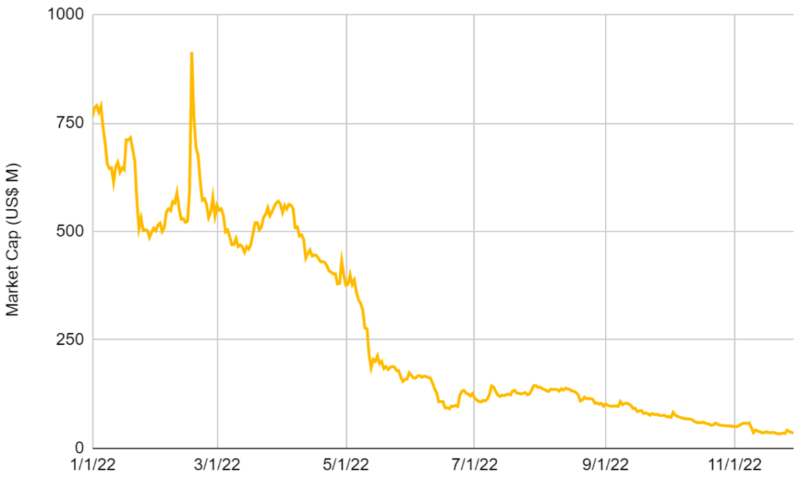
Figure 3: RLY Market Cap Year-to-Date
Following similar logic, Roll allows users to mint their social tokens using the ERC20 standard, with a maximum supply of 10 million. These tokens are designed with a vesting period to ensure long-term alignment between issuers and holders. Roll profits by holding 1% of the maximum supply of issued social tokens.
Rally and Roll are among the top players in the social token vertical, which remains in a very early stage. Numerous other projects have emerged aiming to help communities issue tokens or badges for various causes. For example, the Proof of Attendance Protocol (POAP) enables users to distribute and receive free POAP badges as a way to record online and offline experiences, particularly event attendance. Galxe helps projects automatically issue on-chain credentials as NFTs to incentivize and reward certain user behaviors. In the backend, data curators are rewarded when credentials are used within Galxe’s application modules, oracle engine, or API.
Although tokenization of social activity and identity is no longer a new concept in the Web3 social space, there remains a long road ahead before mass adoption. We identify several pain points awaiting transformation into opportunities:
- Unclear Utility: It remains unclear whether tokenization incentivizes genuine engagement or merely speculative behavior aimed at securing whitelist spots for airdrops.
- Fragmented User Experience: While monetization is a focus for tokenized projects, the user journey begins before monetization and continues after. Tokens should embrace interoperability not only in underlying tech stacks but also across end-to-end user experiences.
- Longevity: Unlike subscription models, tokens can be held indefinitely without viable exit strategies, especially when tied to certain utilities or benefits. After all, designing a functional economy is much harder than simply issuing tokens.
Community Tools
Unlike standalone applications, community-focused tools can operate in the background, managing a community’s presence across various applications. For example, Guild is an automated membership management tool enabling platform-agnostic DAOs, creators, and influencers to manage community access and provide exclusive rewards or incentives.
Interview Highlights with Guild
- Product Features — Community managers can use Guild to specify access requirements based on off-chain (Twitter follows, GitHub contributions, etc.) and on-chain (NFTs, tokens, etc.) data. They can assign roles and distribute rewards in the form of permissions or capabilities to qualified individuals. Given the diverse target users of Guild, the team focuses on supporting more integrations and potential use cases, with the ultimate vision of becoming a universal middleware layer for community management.
- Usage — In September 2022, Guild had approximately 200,000 registered users.
A notable vertical in community tooling is collective investment. Ian Lee, co-founder of Syndicate, believes collaborative investing will be one of the first areas to see mass adoption of Web3 social applications. Compared to Web2, Web3 social applications have the potential to make asset management more collaborative, transparent, and seamless.
Interview Highlights with Syndicate
- Vision — By combining decentralized identity (DID) and NFTs with investment DAOs, Syndicate aims to transform the investment industry just as YouTube and TikTok revolutionized content creation: lowering barriers for users to start co-investing and ultimately unlocking new paradigms of relationship-based investing.
- Product Update — In September 2022, Syndicate launched “Collectives,” a social networking and community-building primitive built on ERC-721M (“M” for “modular”), transforming ERC-721 into an on-chain social network and community platform. The product prioritizes composability and capital-centric networks, which from the team’s perspective are Web3’s two most unique value propositions.
- Usage — By the end of September, over 900 collectives had been formed (university groups, angel investors, etc.), attracting over 80,000 users in closed and public testing. By October 2022, cumulative investments on Syndicate reached nearly 4,000 ETH.
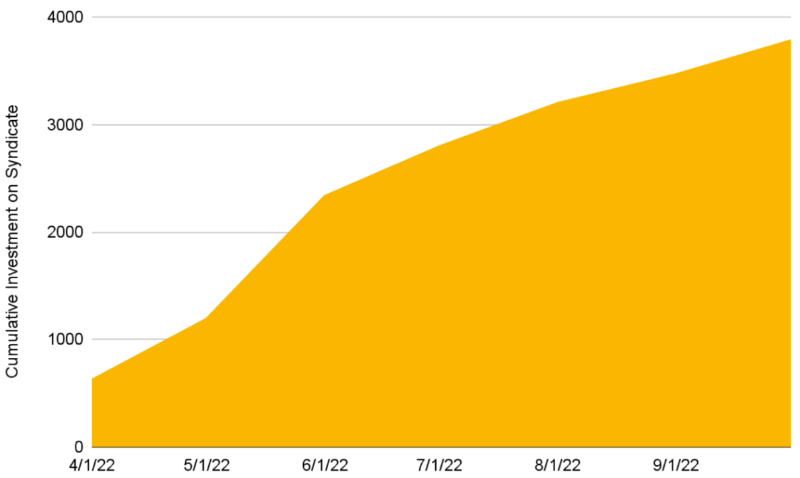
Figure 4: Cumulative Investment on Syndicate (ETH)
Besides Guild and Syndicate, we identified several other community tool projects based on research and public information:
- Boomerang — A CRM for communities to track and manage members across platforms.
- Coinvise — A tool to create personal or community tokens, facilitate airdrops, and enable community members to monetize.
- Highlight — A no-code tool for minting NFTs, building membership communities, and engaging with fans.
Instant Messaging
Although messaging in Web2 typically occurs within specific platforms, Web3’s composability opens new opportunities for platform-agnostic communication.
Interview Highlights with Convospace
- Protocol Description — Convospace is a decentralized conversation protocol enabling users to comment and chat with each other across different dApps.
- Vision — Analogous to Uniswap but in social contexts, Convospace aims to aggregate liquidity of cross-platform conversations to enable richer Web3 social experiences.
- Usage — The protocol had approximately 185,000 unique users in September 2022.
Besides Convospace, we identified several other projects based on research and public information:
- XMTP — A secure messaging protocol and decentralized communication network.
- Dialect — A dynamic, composable protocol for dApp notifications and wallet-to-wallet chat.
- ECHO — A permissionless tool for collecting, preserving, and displaying comments.
Concluding Thoughts
In our research on the Web3 social landscape, we observe promising innovations along these directions—many offering concrete utilities unachievable through Web2. However, we have yet to see the emergence of a killer application, and the path to mass adoption remains unclear.
Currently, the Web3 social landscape faces significant limitations:
-
Limited scenarios where Web3 social delivers user experiences surpassing Web2.
-
Limited on-chain social data or content available to enrich the DID/social media ecosystem.
Our view is that Web3 social currently cannot directly compete with Web2 social in user experience. Rather than competing head-on with Web2 apps, it would be wiser to leverage its unique ecosystem in DeFi, NFTs, and other verticals to offer users distinctive, innovative utilities.
Currently, Web3 social cannot directly compete with Web2 social in user experience; to succeed, it must provide unique and innovative utility.
Join TechFlow official community to stay tuned Telegram:https://t.me/TechFlowDaily X (Twitter):https://x.com/TechFlowPost X (Twitter) EN:https://x.com/BlockFlow_News