








Stanford Blockchain Club: How Lens Protocol Builds an Open On-Chain Social Graph?
TechFlow Selected TechFlow Selected
Stanford Blockchain Club: How Lens Protocol Builds an Open On-Chain Social Graph?
In the long term, the significance of Lens Protocol as a project lies in its paradigm shift in how we design and operate social networks.
 Navigating Web3 tides with focused insights
Authors: STANFORD BLOCKCHAIN CLUB (Stani Kulechov, Jay Yu)
Translated by: TechFlow
Note: This article is from the Stanford Blockchain Review. TechFlow is an official partner of the Stanford Blockchain Review and has been exclusively authorized to translate and republish this content.
Introduction
Social media touches everyone’s life—despite numerous issues with today’s most popular platforms (such as data harvesting, misinformation, and censorship), we seem “addicted” to platforms like Twitter, Instagram, and TikTok.
So why are we so drawn to these platforms? Perhaps the root cause is simple: for better or worse, social media giants have monopolized our “social graphs,” capturing, controlling, and monetizing how, when, and with whom we connect. To truly address systemic design flaws in social media, we need a paradigm shift: making the “social graph” open and decentralized rather than closed and monopolized. This is precisely the vision of “decentralized social” that Lens Protocol aims to pioneer.
Social Apps and Social Graphs
Lens Protocol is not a “familiar” social media startup like Snapchat, Clubhouse, or BeReal—that is, it does not build a new platform for friends, contacts, and communities from scratch. Lens has no user interface; it’s known as the social layer for Web3. Developed by Aave Companies, Lens reimagines social networks using blockchain, smart contracts, decentralized storage, and NFTs, allowing users to own and control their profiles, content, and relationships—in short, their social graph or social capital—and move freely across different social applications. Lens also features built-in monetization and an open data layer.
So what exactly is the concept of a “social graph,” and how does it relate to actual social media platforms like Twitter or Instagram? As the name suggests, a “social graph” is a diagram where individual users (or accounts) are nodes, and their relationships, interactions, and social behaviors form various types of connections between them.
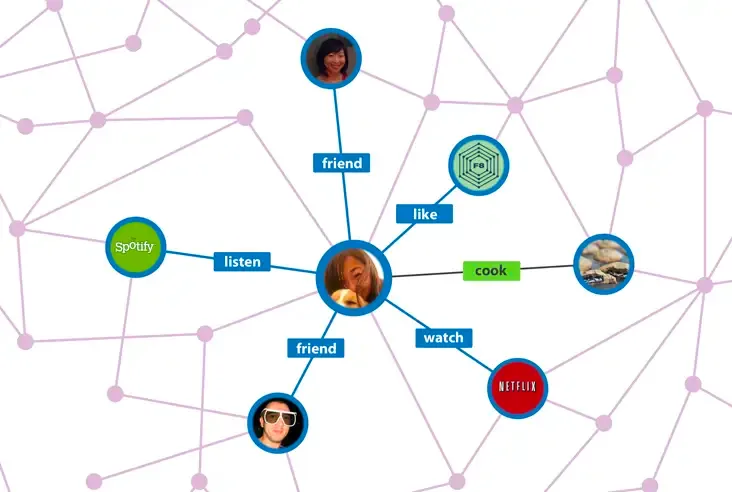
Though conceptually simple, these social graphs provide a powerful way to quantify and model our relationships with others, how we prefer to spend our time, and the kinds of things we generally like or dislike. In short, they represent models of us as users.
There is an important symbiotic relationship between social media platforms (like Facebook or Twitter) and these underlying social graphs: whenever users interact with a social app, that data is recorded into the social graph, which then powers recommendations for content, posts, and friends. Because the quality of the social graph directly determines the quality of recommendations and user experience, it forms the core competitive “moat” for social media giants like Facebook and Twitter.
The recent surge of Instagram’s Threads illustrates how existing platforms can leverage their established “social graphs” to rapidly build entirely new online communities. Indeed, by controlling both the closed application and its underlying social graph, incumbent tech giants make it extremely difficult for any newcomer to disrupt the lucrative business of human connections.

However, there is one interesting exception to the monopoly on social graphs—the phone contact book. Unlike proprietary social graphs from Facebook or Twitter, everyone’s phone contact list is manually curated, distributed across individual devices, and reflects who you actually communicate with. In other words, it is the original “open social graph.”
Most modern social platforms—especially instant messaging apps like WhatsApp and Telegram—leverage phone contacts as an “open social graph” to recommend connections and bootstrap your network on the platform. However, relying solely on phone contacts to launch a social network has a major drawback: compared to the proprietary graphs of Facebook and Twitter, your phonebook is not a richly annotated dataset.
While phone contacts are indeed “open” and “decentralized,” they form an unweighted graph where a bike mechanic is treated with the same social weight as your closest friend. This is why contact suggestions derived purely from your phonebook often fall short—they’re more likely to suggest acquaintances or distant contacts (like the bike mechanic) rather than true friends or people with shared interests.
The Lens Protocol Ecosystem
In contrast, Lens Protocol aims to create a richly annotated, open, and decentralized social graph—one that combines the depth of annotation found in Twitter and Facebook’s graphs with the openness and self-ownership of the phonebook. A key insight of the Lens tech stack is that certain social interactions are common across applications. The Lens SDK abstracts these into on-chain operations: “posts,” “comments,” and “mirrors” (i.e., shares, reposts, or retweets). Whether on Facebook, Twitter, or Instagram, all core social actions can be expressed through combinations of these fundamental interactions, forming a rich social graph that captures how users engage with one another.
For developers, storing this rich social graph in an open, decentralized, and app-agnostic way allows them to tap into existing network effects without building a new social network from scratch. For users, once they mint an NFT profile (e.g., stani.lens), they can use it across different Lens-powered apps (much like Google Login), enabling a seamless onboarding process. Moreover, because their social interactions are publicly stored on-chain, they don’t have to worry about losing all their connections and data when switching to another social app.
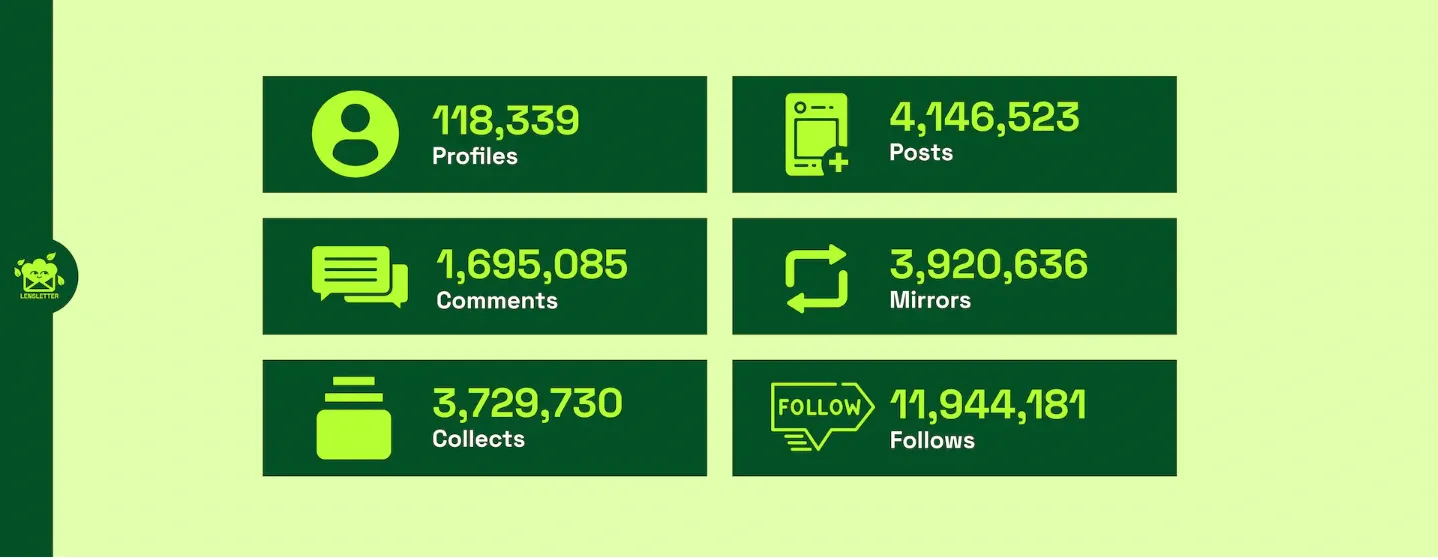
Currently, the Lens Protocol ecosystem hosts over 100 applications, ranging from familiar Facebook- and Twitter-inspired apps like Lenster and Buttrfly, to mainstream social apps with novel incentive models like Phaver’s “earn while you share,” to niche tools such as Ensō, a “digital wardrobe” app enabling communities to co-create fashion products. This diverse suite of apps demonstrates the advantages of implementing an open social graph beyond a single social media app, empowering users so their profiles and relationships are no longer just digits on a privately hosted server but assets they personally own—highlighting growing interest in Lens, especially when contrasted with the story of Clubhouse.
Although Clubhouse launched in 2021 with near-textbook product-market fit—racking up over 9.2 million downloads in just one month in February—the once-iconic audio-based social platform is now undergoing mass layoffs and appears to be in crisis. Undoubtedly, Clubhouse built an incredibly successful and valuable social graph during its initial phase. Yet, once the hype faded and user interest waned, Clubhouse could not leverage its social graph because that trove of data was locked within a dying application.
Had a Clubhouse-like app been built atop an open social graph like Lens, even if the app itself eventually disappeared, Lens’s modular architecture would allow for transformation—or enable ecosystem developers to experiment with new ideas benefiting the entire social graph. Thus, Lens’s core strength lies in offering top-layer apps a blank canvas and expansive design space, empowering entrepreneurs to experiment and create any experience they envision—a design decision firmly rooted in Web3’s principles of decentralization and openness.
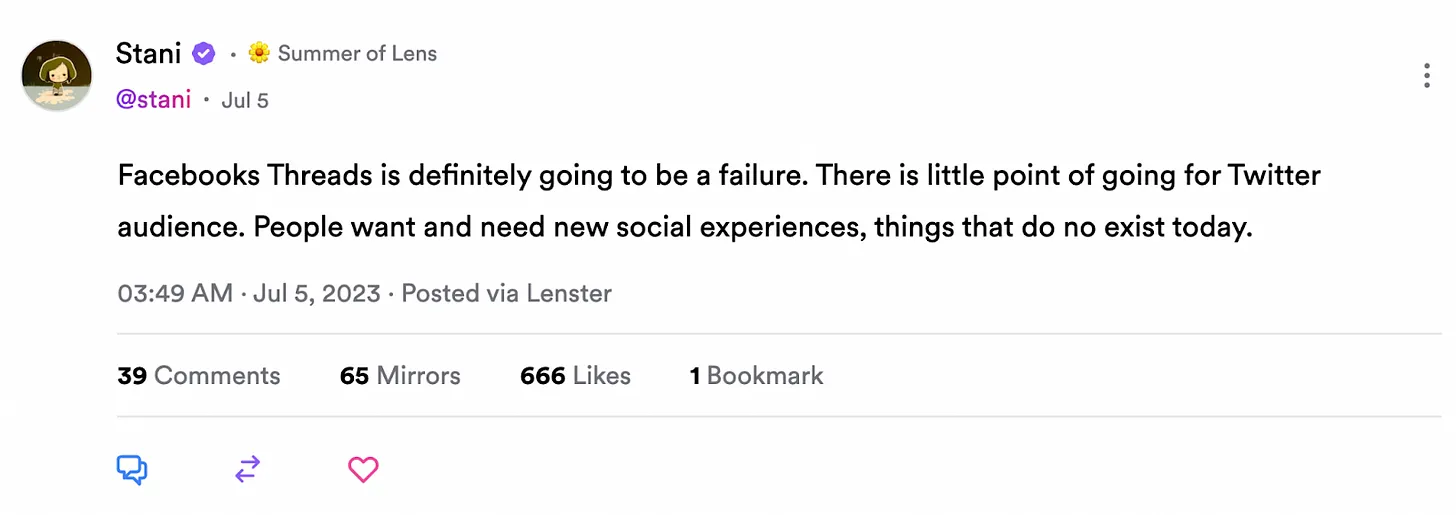
However, for Lens Protocol to scale beyond Web3’s core user base, broader adoption is required. For Lens founder Stani Kulechov, scaling hinges on mainstream awareness of Web3 social benefits while ensuring the technology remains appealing and accessible to current Web2 users.
Kulechov believes that, long-term, Web3 is inherently more transparent and user-beneficial—an essential draw for users. Currently, the protocol focuses on being increasingly open and composable, while introducing features that are both novel and familiar to Web2 users. Lens provides foundational technology, giving consumer app developers and integrators the design space to create new experiences.
As time progresses and these technologies mature, user experience will increasingly resemble that of “familiar” social networks, with simple one-click solutions integrated with email and phone numbers laying the foundation for true mass adoption. Once social apps built on Lens and other decentralized technologies seamlessly integrate into our daily lives, they will evolve from being labeled “Web3 social” to simply “social.”
The Future of Decentralization and Content Moderation
As social media apps become increasingly central to daily life, debates around content moderation grow more intense. If managed too loosely, platforms are accused of enabling misinformation, bias, and hate speech online. If managed too strictly, they face backlash for censorship and infringing on free speech. Not to mention, as a platform, your incentives are aligned toward maximizing ad revenue without provoking user revolt.
For social media giants like Facebook, Twitter, and TikTok, this creates a delicate balancing act among users, platforms, and regulators—all trying to find the right point for content moderation. The root cause of this ongoing struggle is that regardless of what a social media platform does, users rarely switch to competitors due to high switching costs. Essentially, as users, you’d rather live in a New York apartment full of cobwebs and broken pipes than move to a fully functional villa in the middle of the Sahara Desert.
Lens Protocol and similar decentralized systems revolutionize content moderation. By clearly separating social applications from the social layer, launching new social apps becomes significantly easier. This levels the playing field and challenges the dominance of giants like Facebook and Twitter.
By treating the decentralized social graph as a public good, Lens Protocol introduces fiercer competition at the social app layer, incentivizing apps to carefully consider their moderation policies and prioritize user-centric experiences over ad-driven ones. Effectively, decentralization makes it easier for users to “vote with their feet.” This idea of decentralized content moderation echoes Reddit’s model, where each community has its own moderators and rules—a new paradigm distinct from the “one-size-fits-all” approach dominant on most current social platforms.
Conclusion
In the long run, the significance of Lens Protocol lies in the paradigm shift it offers in how we design and operate social networks. As discussed, the core idea of separating the “social application layer” from the “social graph layer” grants users and creators greater flexibility in choosing when, where, and how they interact, while introducing profile portability impossible under today’s mainstream social media.
Just as Uniswap, Aave, and other DeFi projects demonstrated paradigm shifts in how we think about finance—without traditional third-party intermediaries like exchanges and brokers—Lens and other decentralized social projects show how social media can be reimagined in a similarly transformative way. Decentralized social doesn’t need to replace existing social media apps; rather, it gives us a way to reimagine the status quo and offer users real choice.
Join TechFlow official community to stay tuned
Telegram:https://t.me/TechFlowDaily
X (Twitter):https://x.com/TechFlowPost
X (Twitter) EN:https://x.com/BlockFlow_News
 Stanford Blockchain Club






