Looking Beyond the Current Stablecoin Landscape: Opportunities and Challenges for Newcomers Beyond USDT and USDC
TechFlow Selected TechFlow Selected
Looking Beyond the Current Stablecoin Landscape: Opportunities and Challenges for Newcomers Beyond USDT and USDC
Can users purchase stablecoins instead of just borrowing them?
 Navigating Web3 tides with focused insights
Written by: Caesar
Translated by: TechFlow

Stablecoins remain a central topic of discussion within the ecosystem due to their strong alignment with market demand. As such, developers and enthusiasts are actively exploring ways to create stablecoins that could have a lasting impact on the ecosystem. However, progress in this effort has been relatively limited thus far.
I believe the inherent limitations of crypto-backed stablecoins have not received sufficient discussion. As we will explore in this article, current projects fail to attract users because crypto-backed stablecoins face limitations compared to fiat-backed stablecoins in terms of capital efficiency, liquidation risk, limited use cases, and liquidity.
In this article, I will present some statistics about the current state of the stablecoin market and share my thoughts on them. Then, I will introduce the concept of “stablecoin utility” to help explain the reasons behind the current market conditions. Finally, I will focus on crypto-backed stablecoins and discuss their challenges.
Current Stablecoin Market Statistics
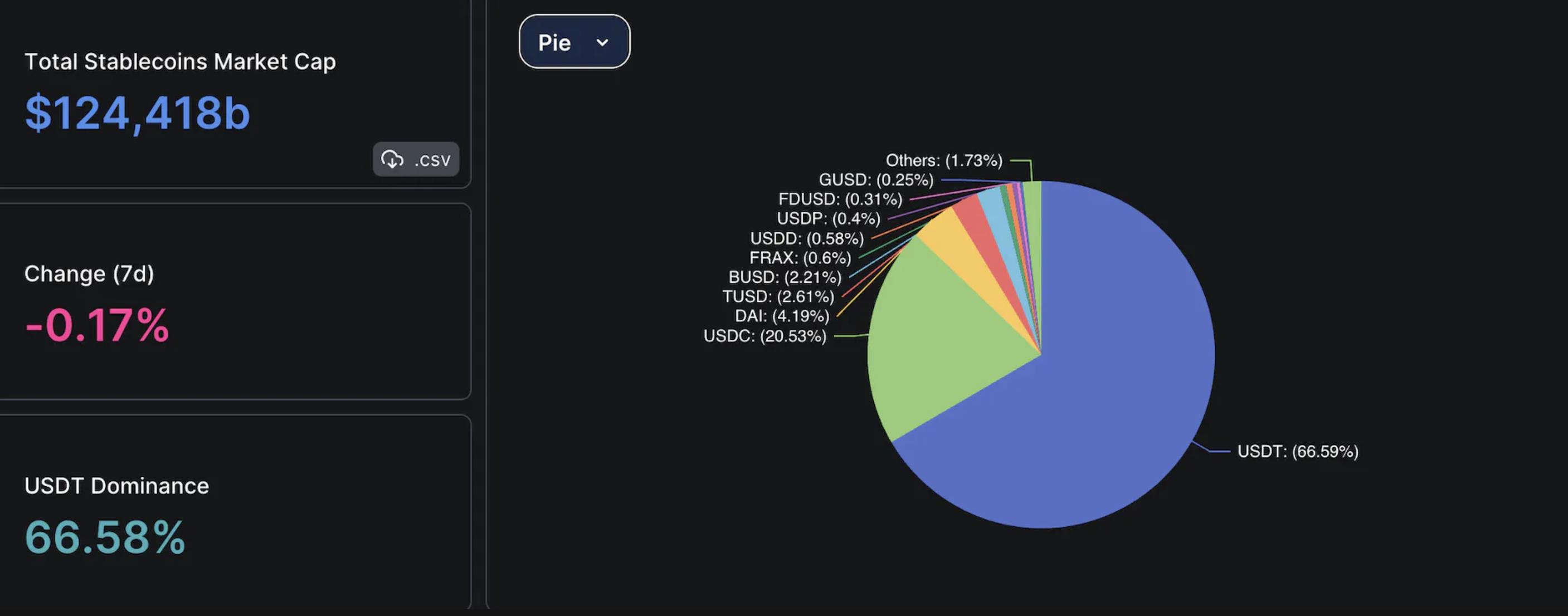
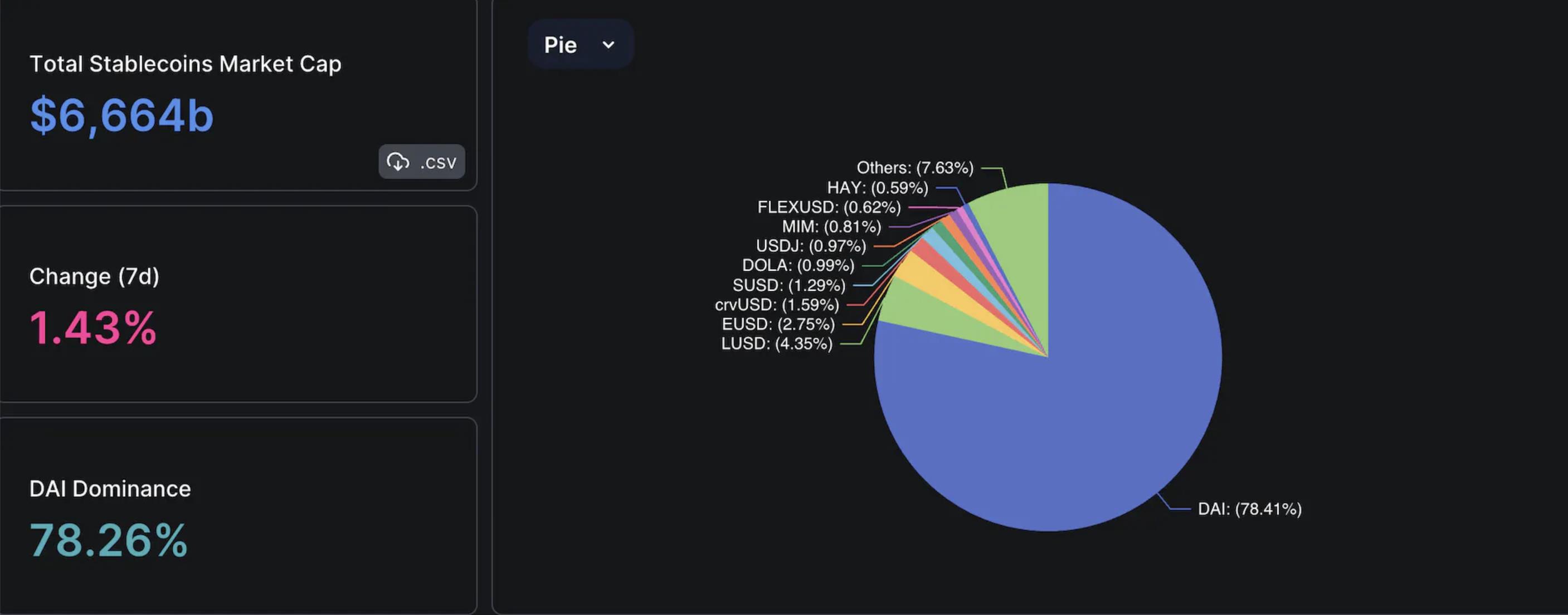
The following data is sourced from DeFiLlama:
-
The total market capitalization of stablecoins is approximately $125 billion, with nearly 87% dominated by USDT and USDC.
-
Fiat-backed stablecoins hold about 92% of the market share, totaling approximately $116 billion.
-
Only about $7 billion is held by crypto-backed stablecoins, with DAI accounting for around $5 billion.
-
Algorithmic stablecoins have a total market cap of approximately $2 billion, with FRAX and USDD capturing 75% of this segment.
These figures offer several insights into the market landscape:
-
USDT and USDC are projects that have achieved product-market fit and align well with market and user needs.
-
Despite the growing number of projects in the crypto-backed stablecoin category, the dominant market share of USDT and USDC indicates there is currently no significant demand for alternatives.
-
Although the increase in DAI’s savings rate temporarily helped it gain market share, DAI has failed to maintain its dollar-denominated market cap over the past year, despite remaining the undisputed leader among crypto-backed stablecoins.
-
DAI’s shift toward including real-world assets like U.S. Treasuries highlights the lack of a scalable stablecoin that can resist censorship and counterparty risk.
-
The limited adoption of other crypto-backed stablecoins beyond DAI suggests their success and potential may be overestimated.
-
The viability of algorithmic stablecoins remains uncertain, especially as FRAX itself moves away from purely algorithmic mechanisms.
-
Unless a major event undermines the credibility of USDT and USDC or a breakthrough project emerges, the stablecoin market landscape is unlikely to change significantly.
Why Do Users Prefer USDT and USDC?
Cryptocurrency began as a movement defined by belief in freedom, decentralization, and skepticism toward centralized entities. Yet, the current state of the stablecoin market contradicts this ethos. Clearly, as ecosystem adoption grows and more people enter the space, the purity of the ecosystem diminishes—most newcomers are not motivated by decentralization or censorship resistance.
The most centralized—and arguably least transparent—projects have become market leaders. This phenomenon can be explained by a new concept I propose called “stablecoin utility”:
Stablecoin utility is a new framework for understanding key issues in the stablecoin space:
-
Market dynamics between users and stablecoin projects;
-
Why certain stablecoins gain adoption while others do not;
-
The vision developers should have when building stablecoin projects.
I argue that stablecoins should be viewed as digital versions of their off-chain pegged assets. Thus, in our case, USD-pegged stablecoins must replicate the functions of the U.S. dollar. These functions can be integrated into stablecoins, including:
-
Medium of exchange: A stablecoin should be seen by users as a tool for exchanging cryptocurrencies or transacting with others. It must be available on major platforms (such as centralized exchanges and established DeFi protocols like Uniswap, Balancer, Curve, etc.) and support essential trading pairs.
-
Store of value / Peg stability: A stablecoin must demonstrate a track record of maintaining its peg; even a 1% deviation can be perceived as failure from a user perspective.
-
Capital efficiency: If a stablecoin requires over-collateralization or carries liquidation risk, it lacks capital efficiency—this limits user adoption, as most users understandably prefer assets without these risks or constraints.
-
Fiat on/off ramps: Without accessible fiat conversion solutions, using a stablecoin becomes more difficult, as the lengthy process of converting crypto assets into cash dollars makes the entire experience expensive and cumbersome.
-
Censorship resistance: A stablecoin should protect users from arbitrary actions by centralized actors by serving as a private, self-custodied safe haven, independent of centralized institutions like banks.
Understandably, $USDT and $USDC possess most of these features—medium of exchange, store of value, capital efficiency, and fiat on/off ramp solutions—but both are centralized and therefore lack censorship resistance. Although neither $USDT nor $USDC fully succeeds under the stablecoin utility framework, they are the most successful within it, achieving clear product-market fit. Furthermore, their early-mover advantage and brand recognition have led to widespread user adoption.
Thus, any stablecoin project aiming to challenge the dominance of $USDT and $USDC must fulfill these five core requirements and build strong brand awareness within the community.
However, we must consider whether it's possible under the current models and technological developments of crypto-backed stablecoins to challenge $USDT and $USDC. Let us now examine some existing stablecoin projects that could potentially be considered challengers.
Crypto-Collateralized Stablecoins
In this section, I will focus on several stablecoins I believe merit analysis, as they represent all critical aspects relevant to crypto-collateralized stablecoins.
Before diving into each individual stablecoin, I want to emphasize that I see the limitations of the Collateralized Debt Position (CDP) model as a fundamental issue faced by every crypto-collateralized stablecoin. The CDP model requires users to lock up crypto assets in an over-collateralized loan with liquidation risk, inherently limiting scalability.
The lending relationship between users and protocols poses several problems and is ill-suited for fulfilling stablecoin utility:
-
Medium of exchange: Since users create debt positions through minting, they typically only use these stablecoins for leveraged yield farming or leveraged trading—not general transactions. Therefore, crypto-collateralized stablecoins are not regarded as mediums of exchange.
-
Capital efficiency: Because CDPs require over-collateralization and carry liquidation risk, they are not capital-efficient from the user’s standpoint—there are more efficient alternatives available.
Therefore, we can conclude that crypto-collateralized stablecoins do not meet product-market demand. Nevertheless, analyzing these stablecoins individually helps us better understand their limitations and weaknesses—and also identify opportunities.
$DAI
$DAI is an over-collateralized CDP stablecoin issued by MakerDAO and one of the largest crypto-collateralized stablecoins, attracting billions in funding and enjoying solid adoption across the DeFi ecosystem. However, with the launch of new crypto-backed stablecoins and episodes of $DAI decoupling from $USDC, the stablecoin lost part of its market share. Nonetheless, the introduction of the enhanced DAI Savings Rate gave the protocol renewed momentum, although debates about sustainability persist.
While the protocol benefits from treasury bill holdings—one of the most profitable businesses in the ecosystem—its future raises questions: Why should I use $DAI instead of $USDC?
As far as I can tell, $DAI faces several challenges:
-
Lack of innovation: $DAI is minted via over-collateralized CDPs, giving it no significant technical edge over competitors. The need to introduce an enhanced savings rate also suggests difficulty in attracting users organically.
-
Reliance on centralized actors: $DAI is not a fully decentralized stablecoin, as its reserve assets are primarily $USDC and real-world assets (RWA), with income generated through treasury bills—meaning custody relies on centralized parties.
-
No clear value proposition: The primary value proposition of crypto-collateralized stablecoins is decentralization and censorship resistance. As a trade-off, these protocols implement CDP models requiring over-collateralization and carrying liquidation risk. However, despite retaining these drawbacks, $DAI fails to deliver meaningful decentralization. Thus, it combines the worst aspects of both fiat-backed and crypto-backed stablecoins.
On the other hand, $DAI also presents opportunities:
-
High adoption: $DAI is one of the most recognized and widely adopted stablecoins in the ecosystem. It exists across most mature DeFi protocols with strong liquidity. Given that launching liquidity is one of the hardest parts for any stablecoin project, $DAI is in a highly advantageous position.
-
Medium of exchange: Many view $DAI as a medium of exchange, evidenced by its frequent use in trading and buying/selling crypto assets, along with deep liquidity across various protocols.
-
Store of value: By distributing treasury bill income to DAI holders via the enhanced DAI Savings Rate, $DAI can serve as a secure and reliable source of yield and value storage, boosting adoption.
$FRAX
$FRAX started as an algorithmic stablecoin backed by an algorithmic mechanism and under-collateralized crypto reserves. However, the collapse of $UST led to a loss of trust in algorithmic stablecoins, prompting the FRAX team to pivot. They decided to back $FRAX with $USDC at a 100% collateral ratio. Yet, as $FRAX became known as the “poor man’s $USDC,” this model drew criticism.
With the upcoming release of FRAX v3, this model will change again. While not all details are public, rumors suggest they will abandon reliance on $USDC, and the FRAX ecosystem—including its stablecoin $FRAX—will instead be backed by U.S. Treasuries.
$FRAX faces several challenges:
-
Dependence on centralized actors: One common critique is $FRAX’s reliance on $USDC—if $FRAX is backed by $USDC reserves, what’s the rationale for holding it? Even though they’re changing the model, dependence on centralized actors will continue, as they’ll partner with other centralized entities for FED master account transactions.
-
Unstable leadership: Whether this critique holds weight is debatable, but the FRAX leadership team has indeed focused on too many initiatives in a short time and frequently changed its roadmap.
-
Lack of $FRAX holders/users: According to Etherscan data, $FRAX has around 8,000 holders with a market cap of ~$800 million. Its value proposition isn’t centered on being a medium of exchange, limiting its ability to challenge $USDT and $USDC. Frax is not widely used across the ecosystem. Beyond products built on Frax, it’s mainly used only on Curve—thanks to incentives paid to $FRAX pools, driven by Frax’s participation in the Curve Wars. Curve’s long-term sustainability is thus a critical factor for $FRAX.
On the other hand, $FRAX also offers opportunities:
-
Capital efficiency: Currently, users can deposit 1 $USDC and receive 1 $FRAX—an efficient process. Assuming this efficiency continues under the new model, it represents a competitive advantage for $FRAX.
-
Established FRAX ecosystem drives use cases: Most stablecoins struggle with use case scarcity—few places exist to utilize the underlying stablecoin. However, $FRAX can be effectively used across the broader FRAX ecosystem, including Fraxswap, Fraxlend, and Fraxferry, and possibly in the future on Fraxchain.
$LUSD
$LUSD is one of the most forked stablecoin projects in the ecosystem, offering a unique solution for a censorship-resistant stablecoin. Backed by $ETH, users can borrow against their $ETH holdings at a minimum collateral ratio of 110%.
Key features that make $LUSD competitive:
-
Immutable smart contracts;
-
No governance;
-
No interest charged;
-
High-quality collateral.
Moreover, according to recent announcements from Liquity Protocol, with Liquity v2, they plan to develop a new model using a risk-free approach to maintain collateral value. This will be a new stablecoin separate from existing offerings.
$LUSD faces several challenges:
-
Limited scalability: Although $LUSD is one of the most inspiring projects in the ecosystem, it is also among the least scalable due to its requirement for over-collateralization, liquidation risk, and acceptance of only $ETH as collateral.
-
Lack of $LUSD holders/users: Due to poor scalability, the stablecoin has only about 8,000 holders and a market cap of ~$300 million, per Etherscan data.
-
Lack of use cases: Due to insufficient scalability, $LUSD lacks adequate liquidity on major protocols, hindering adoption.
-
Poor capital efficiency: Requiring over-collateralization with liquidation risk makes it a suboptimal choice in terms of capital efficiency, limiting $LUSD’s ability to function as a medium of exchange.
On the other hand, $LUSD also presents opportunities:
-
Censorship resistance: $LUSD’s most distinctive feature is that it excels in decentralization and censorship resistance. I believe there is no competition in this regard.
-
Strong brand: $LUSD’s long-term success in decentralization and peg stability, combined with the team’s ability to earn community trust, has made the $LUSD brand powerful—one the team can leverage.
-
Liquity v2: The Liquity team recognizes the protocol’s scalability limitations and aims to scale without compromise. Developing a risk-free model using primary protection methods against volatility-induced losses could partially solve the scalability issue.
$eUSD
$eUSD is a stablecoin backed by staked $ETH as collateral. Holding $eUSD provides a steady yield stream, with an annual yield of approximately 8%. It is a CDP stablecoin requiring over-collateralization and carrying liquidation risk.
In my view, $eUSD faces several challenges:
-
Poor capital efficiency: The over-collateralization model means $eUSD is constrained in capital efficiency, as users must deposit more than they receive while bearing liquidation risk.
-
Limited use cases: Due to insufficient stablecoin demand to support multiple pools, $eUSD has limited use cases, restricting its scalability.
-
Limited growth potential: For emerging stablecoins to grow, they need a unique value proposition. Despite leveraging LSD products as a potential expansion path, intense market competition limits its upside.
-
Not a medium of exchange: $eUSD is a yield-bearing stablecoin, and the protocol does not prioritize its use as a transactional medium. While this is a valuable proposition, it limits growth potential.
-
Peg stability: eUSD holders are eligible for rewards from staked $ETH. Due to this, demand for eUSD exceeds supply, causing it to trade above its $1.00 peg. Unless the system changes, eUSD cannot maintain its peg.
On the other hand, $eUSD also offers opportunities:
-
Yield-generating asset: Since $eUSD generates yield for holders, there will certainly be demand for it as a store of value. If users trust its peg stability, it can serve as an excellent way to earn $ETH yield.
-
Access to LSD products: LSDfi is a growing market that has already achieved product-market fit. Leveraging LSD to mint stablecoins is a profitable venture for both the protocol and users.
$crvUSD
$crvUSD is a CDP stablecoin project requiring over-collateralization and carrying liquidation risk. What sets $crvUSD apart is its LLAMMA-based liquidation mechanism. Instead of instantly selling all collateral at a set liquidation price, LLAMMA gradually sells portions of collateral across different price ranges. As collateral prices fall, parts of the collateral are auctioned off for $crvUSD.
So far, the stablecoin has achieved steady market cap growth without major de-pegging events. However, despite having around $100 million in liquidity, it has only about 600 holders—a concerning sign for scalability.
To me, $crvUSD faces several challenges:
-
Poor capital efficiency: Since $crvUSD involves over-collateralized CDP positions with liquidation risk, it offers no capital efficiency advantage over competitors, limiting its scalability.
-
Limited utility: Due to low liquidity and poor scalability, use cases for $crvUSD are limited. While several $crvUSD staking pools exist, they aren't particularly attractive given the trade-offs involved.
-
Insufficient holders: As previously noted, $crvUSD has only about 600 holders, reflecting weak demand for CDP stablecoins. Despite offering a superior liquidation mechanism, $crvUSD will struggle to attract new users.
On the other hand, $crvUSD also presents opportunities:
-
Unique liquidation mechanism: $crvUSD’s soft liquidation model is a major innovation that competitors will likely adopt, as it improves CDP stablecoin scalability by avoiding harsh liquidations.
-
Curve support: Curve is a mature stablecoin exchange platform with deep liquidity and a long-standing presence in the ecosystem. $crvUSD can leverage this infrastructure to enhance its scalability.
Conclusion
Although this article is long, there is one simple thing you should remember.
The future of crypto-collateralized stablecoins hinges on a single question:
“Can users buy stablecoins rather than just borrowing them?”
Current models do not provide a compelling solution for achieving stablecoin utility. Therefore, $USDT and $USDC will likely continue to dominate this space.
Yet, they also have limitations—especially regarding decentralization, censorship resistance, and self-custody. I believe new models can emerge to address these issues and fulfill stablecoin utility. But I am certain that current models are fundamentally flawed and unlikely to succeed.
Join TechFlow official community to stay tuned
Telegram:https://t.me/TechFlowDaily
X (Twitter):https://x.com/TechFlowPost
X (Twitter) EN:https://x.com/BlockFlow_News
 @CaesarJulius0