Data Reveals the Battle for New Public Chains: Who Can Surpass Ethereum?
TechFlow Selected TechFlow Selected
Data Reveals the Battle for New Public Chains: Who Can Surpass Ethereum?
Among current new L1s, Solana is the most promising contender to surpass Ethereum.
 Navigating Web3 tides with focused insights
Written by: STEVEN SHI
Compiled by: TechFlow
Since the advent of Ethereum, Layer 1 ("L1") blockchains have been among the most popular investment areas in cryptocurrency. More than half of the top 20 cryptocurrencies by market capitalization are native tokens of L1 blockchains. In fact, the concept of "alternative L1s" (alt L1s) was one of the key narratives during the adoption cycles of 2017 and 2021. Due to massive demand for Ethereum block space, many investors and users flocked to new L1s offering higher capacity and lower fees.
However, several years after the alt L1 concept peaked in 2021, Ethereum remains the de facto dominant L1 blockchain. Many other L1s resemble ghost towns, with user growth stagnating or declining.
Nonetheless, new L1s continue to emerge. Aptos and Sui are two major L1s launched over the past year, currently valued at over $12 billion combined. Additionally, several more projects are upcoming, some reaching nine- or even ten-digit valuations in private funding rounds. Moreover, some existing L1s still maintain strong communities who believe they can grow and compete with Ethereum.
The debate around alt L1s persists. Therefore, we aim to address a frequently asked question from our readers: Is there any Layer 1 blockchain capable of surpassing Ethereum?
Overview of L1s
To answer this question, we revisit the history of L1s and Ethereum's leading position. In this report, we define L1s broadly as permissionless smart contract blockchains—commonly referred to as "ETH killers."
The rise of L1s can be traced back to Bitcoin’s limitations. Bitcoin was initially designed to function effectively as a trustless peer-to-peer electronic cash system. As Bitcoin itself gained recognition as legitimate money, developers began experimenting with building decentralized applications on it, such as alternative digital currencies. However, due to Bitcoin’s limited scripting language and social layer resistance to adding complex functionalities, Bitcoin proved unsuitable for supporting broader application development. Multiple prior attempts to build applications on Bitcoin stalled.
Ethereum filled this gap. It was the first widely recognized blockchain featuring a Turing-complete programming language, greatly expanding the design space for decentralized blockchains.
Like Bitcoin, Ethereum's core culture prioritizes decentralization over scalability. Thus, when Ethereum adoption surged—such as during the 2017 ICO boom or the 2020–2021 DeFi Summer—the network quickly hit throughput limits. The network could become congested for hours, gas fees would spike, and many users found transactions unaffordable. At times, a simple token transfer might cost $150 in transaction fees. Developers were reluctant to increase throughput limits due to concerns about protocol "centralization creep."
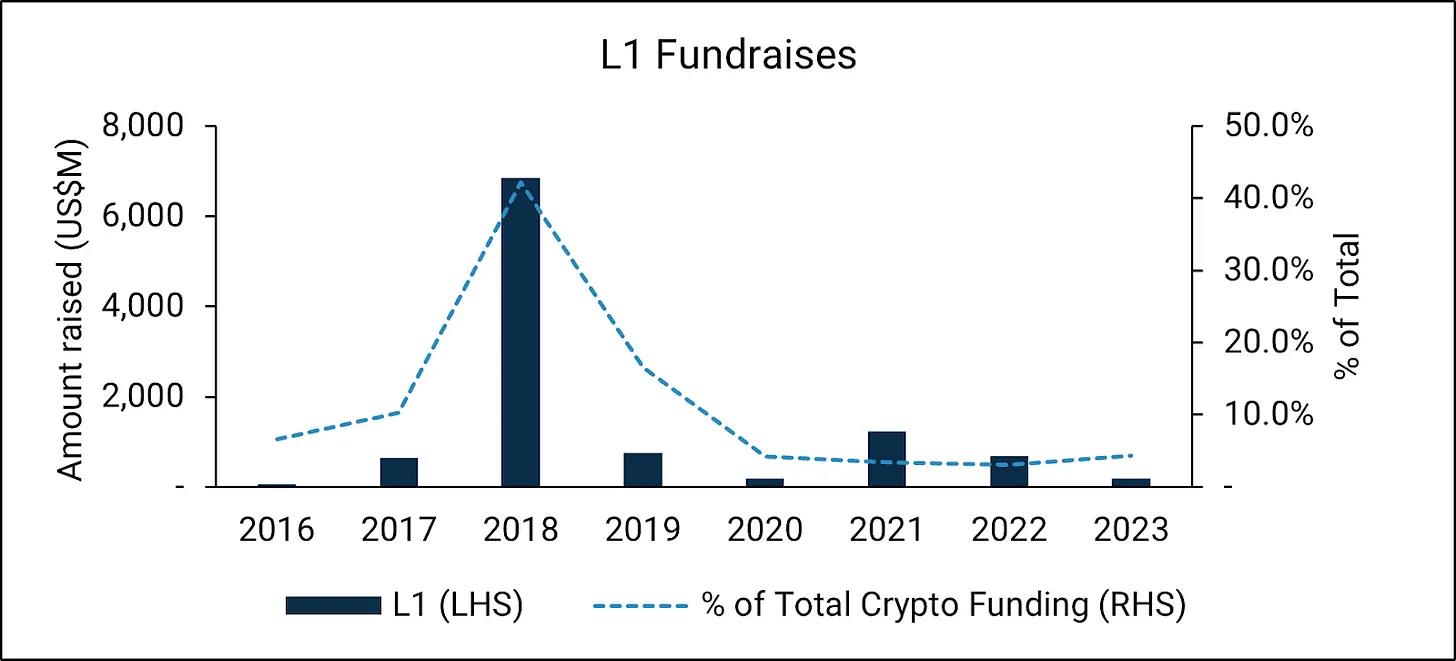
As a result, whenever Ethereum faced scalability issues, hype around new L1s emerged. During the ICO boom, blockchains like EOS, Tezos, and Cardano raised hundreds of millions of dollars, promising faster L1 architectures. A similar pattern occurred to a lesser extent in 2021. As shown below, peaks in L1 fundraising coincided with strong crypto adoption.
Current Market Landscape
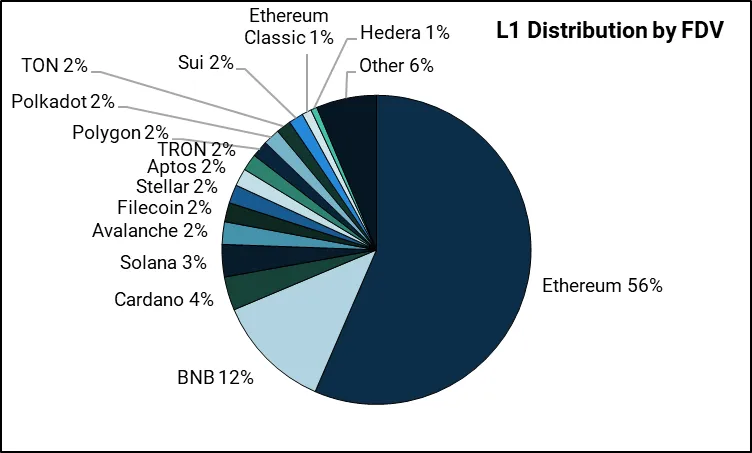
Despite hundreds of L1 competitors emerging since Ethereum’s launch, Ethereum remains the de facto standard. Clearly, Ethereum leads in market capitalization. Among the top 50 L1 blockchains, Ethereum holds over 55% market share. But where else does Ethereum lead? And what drives its premium valuation?
Users – Cheaper, Faster L1s Win
Users are often considered a driver of valuation, as network value is believed to grow super-linearly with user count (Metcalfe's Law).
Due to the lack of anti-Sybil systems and the relative ease of creating new addresses, measuring real active users in crypto is difficult. Nevertheless, active addresses provide a reasonable initial approximation of user adoption across blockchains.
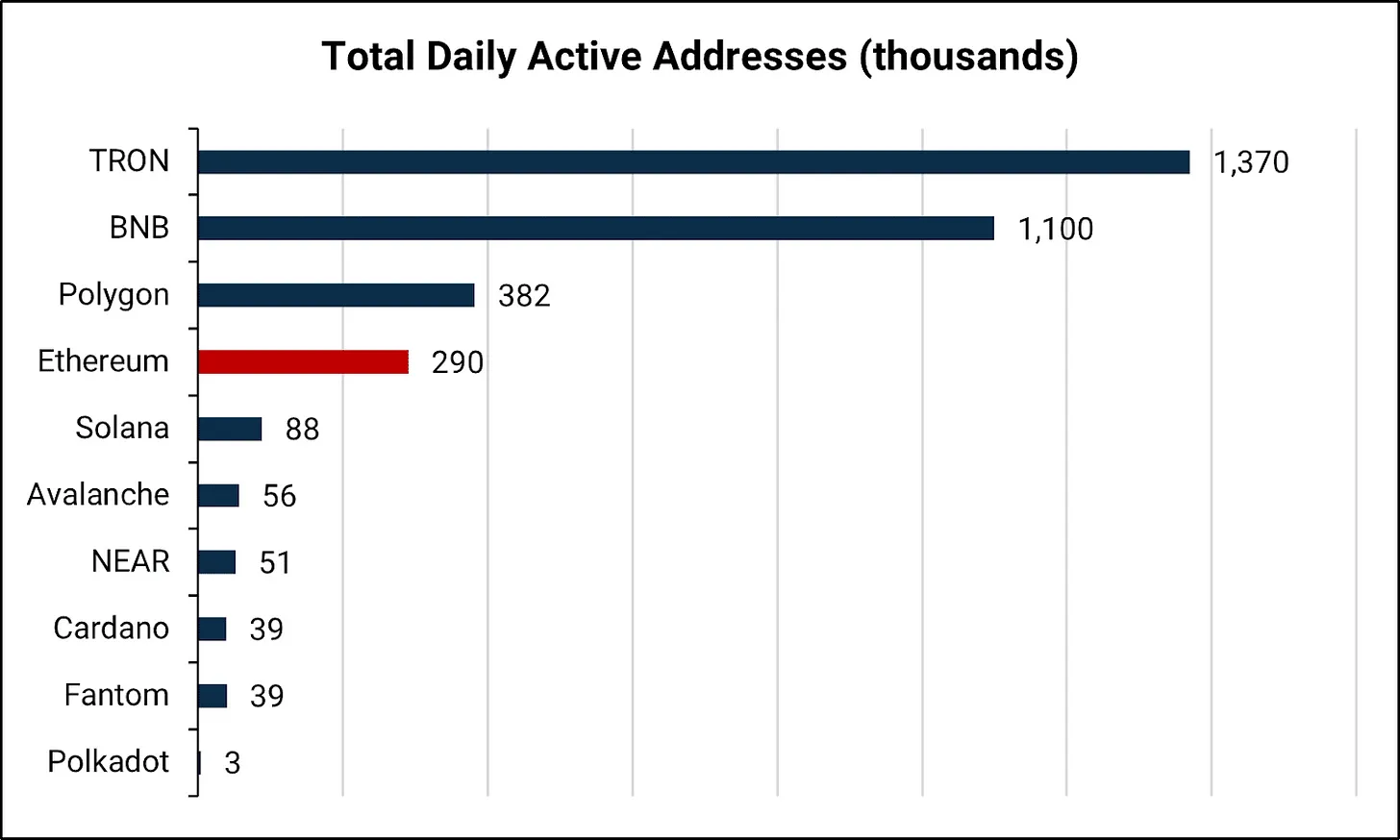
Clearly, Ethereum lags in active users. Its valuation premium does not stem from user numbers. Cheaper blockchains like Tron, BNB, and Polygon all have more users. Some networks, such as Polkadot and Cardano, have relatively high valuations despite minimal active users. Therefore, regarding the headline question, multiple L1s have already surpassed Ethereum in terms of user count.
Developers
Developers are another key metric for assessing network health. Developers not only maintain and improve the protocol layer but also build use cases on top of the L1. They can serve as a leading indicator of future value creation.
According to Electric Capital’s Developer Report, Ethereum stands out in total number of active developers.
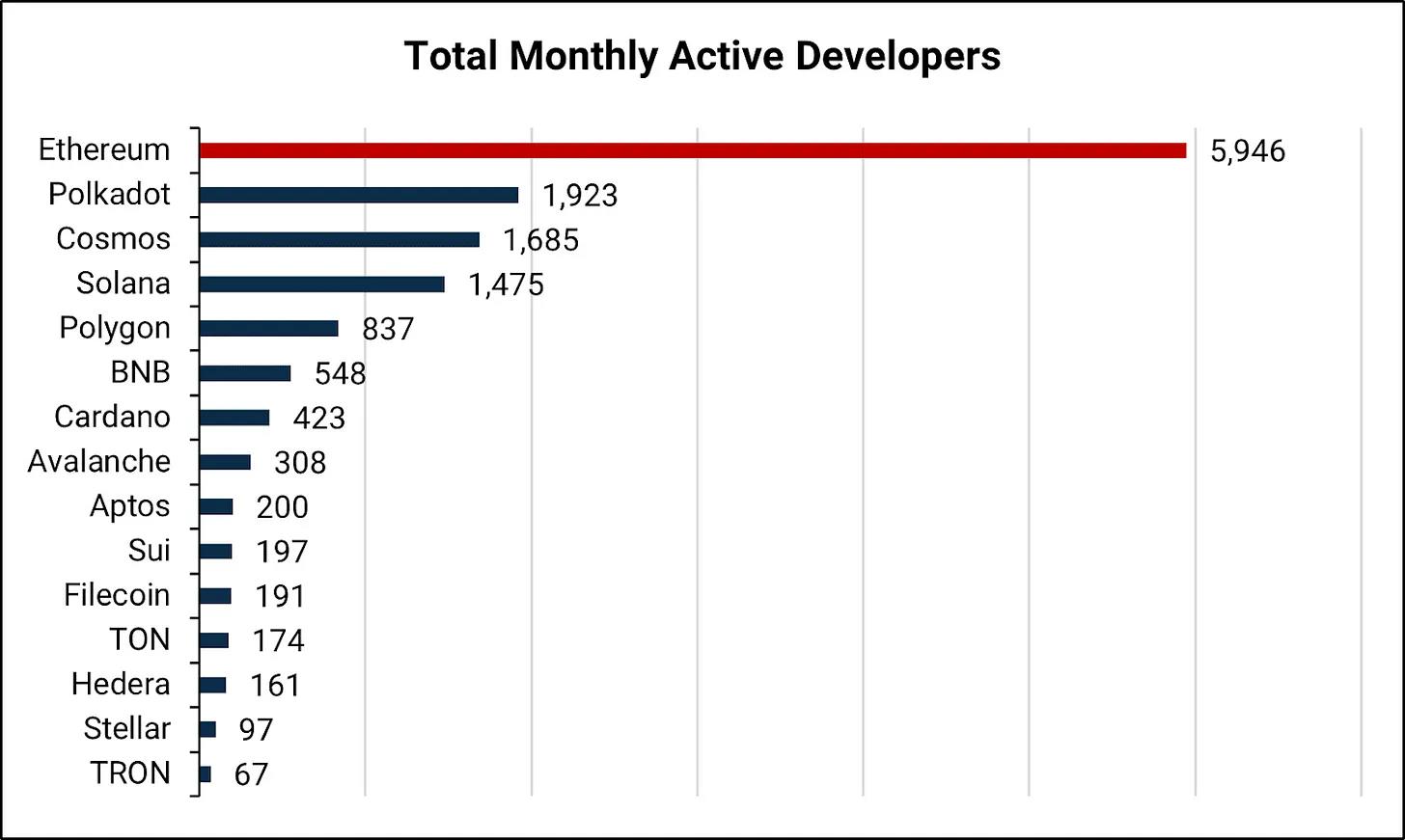
Polkadot, Cosmos, and Solana have impressive developer counts, especially considering they each use unique programming languages. Given that Aptos and Sui launched recently, their developer numbers are also notable.
Liquidity
Ethereum clearly leads all other L1s in liquidity on the network, measurable through metrics such as Total Value Locked (TVL), trading volume on decentralized exchanges (DEXs), and number of trading pairs. Since summer 2022, Ethereum’s TVL market share among other L1s has remained stable around 60%, aligning with the time of Terra’s collapse.
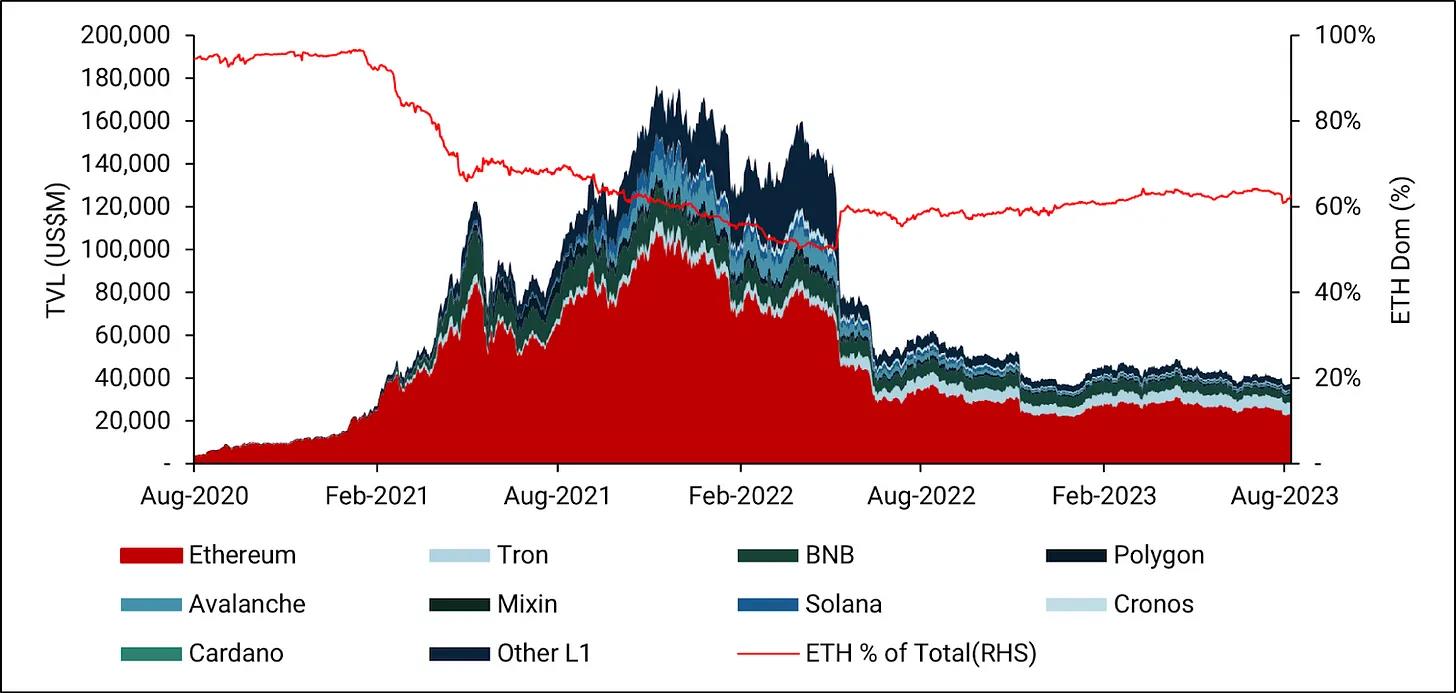
Ethereum Leads, But With Exceptions
To keep this article focused, we only examined a few key metrics. Many other factors exist. Nonetheless, Ethereum’s valuation lead clearly does not come from user adoption. BNB and Tron win decisively in these categories. Instead, Ethereum leads significantly in liquidity and capital flows. The market clearly assigns substantial premium to capital.
Factors Analyzing L1s
What drives the above metrics? Why do certain chains have more users? What drives capital flows between L1s? Why do some L1s remain resilient after multiple bear markets while others become marginalized? Below, we offer frameworks and models to help answer these questions.
Decentralization
We must first consider the fundamental property of blockchains: decentralization. Decentralization offers multiple benefits. First, greater decentralization enhances censorship resistance, helping networks withstand malicious attacks. It also improves network resilience and security, giving users confidence to store and transact value on the L1. We believe higher levels of decentralization command a premium for an L1.
Decentralization itself is an abstract concept and hard to measure—it may be something you recognize when you see it. Still, we can use several factors to assess a network’s degree of decentralization:
-
Number and distribution of nodes. Nodes actively participate in the network, maintain the blockchain state, and validate and relay transactions based on their type. Generally, more nodes enhance network resilience and security. If nodes are geographically and organizationally dispersed, it becomes harder for any single participant to exert influence. Whether nodes run on shared infrastructure (e.g., same cloud provider) or independently with dedicated hardware also matters.
-
Distribution of token holders. The risks of highly concentrated token ownership are evident. Under high concentration, a small number of token holders could dictate the network’s direction or prevent users from transacting.
-
Client diversity. Client diversity refers to the number of software clients available to run nodes. Multiple clients increase network resilience against attacks and bugs. If a network runs on only one client, a bug in that client could threaten the entire blockchain.
-
Nakamoto coefficient. The Nakamoto coefficient measures the number of entities or nodes required to gain majority control (typically 51%) of the system. A higher coefficient indicates better decentralization, meaning more entities are needed to compromise or control the system. However, this is a single metric that may overlook nuances. For example, Lido controls 32% of staked Ethereum, but distributes stakes across 30 node operators and cannot force them to act maliciously.
-
Governance model. Off-chain governance involves decision-making outside the blockchain via community coordination, while on-chain governance embeds governance directly into the protocol, enabling automated, token-based voting for changes. Their impact on decentralization varies. Off-chain governance is less vulnerable to token concentration but prone to political centralization and potentially high participation barriers.
-
Culture. Culture is an underappreciated aspect of blockchain decentralization. A strong cultural ethos can help resist centralization risks and threats—for example, Bitcoin’s cultural defense against application development or Ethereum’s unified push to improve client diversity.
Network Effects
Network effects in blockchains span multiple dimensions. One of the most apparent is the interaction between users and developers, analogous to Web2 platforms. User growth attracts developers, which often leads to new applications, further use cases, and more users joining the network, creating a self-reinforcing cycle.
Network effects exist in other areas too. For instance, programming languages like Solidity generate meaningful network effects. As more developers learn Solidity, the Solidity developer community grows, making it easier to find collaborators, hire talent, and get community support for problems. More developer resources—libraries, tools, best practices—emerge, simplifying robust smart contract development. It also becomes easier to find qualified security auditors. All of this accelerates innovation within the ecosystem by attracting more developers and reducing time-to-market for applications.
Given financial applications are a key use case in crypto, capital network effects are crucial. Liquidity begets more liquidity. New financial primitives are most likely to debut on networks with the largest market size and highest liquidity. These network effects are reinforced by key stakeholders. For example, Coinbase supports deposits/withdrawals, Circle enables native USDC issuance, and Fireblocks provides custody—all improving capital flow.
Lindy Effect
Given the novelty of digital assets and lack of historical data, many cite the Lindy Effect as a suitable mental model for judging L1 success. The longer a blockchain exists and remains relevant, the more likely it is to stay relevant in the future. This model may apply: L1s that have weathered various challenges—technical issues, hacks, market volatility, regulatory scrutiny, competition—and retained strong user appeal are more likely to succeed in future cycles.
This suggests more mature L1s that remain relevant have a better chance of eventually surpassing Ethereum.
Path Dependence
Path dependence describes how a system’s current state depends on its history. Once set on a particular path, a system tends to persist along it, and deviation becomes increasingly difficult the longer it stays on that trajectory.
Path dependence plays a key role in understanding several L1s. For example, Ethereum’s early adoption of PoW before transitioning to PoS may have contributed to broad participation and token distribution in its early years—an advantage difficult for new networks to replicate. Another example: despite FTX’s negative impact on Solana’s ecosystem in recent years, its early association may have helped propel Solana into the mainstream and establish it as a top alt L1 ecosystem.
From this perspective, Ethereum’s leadership is not due to technical superiority, but rather the result of its unique historical path, momentum built over the past decade, and compounding effects of its choices. Like many analogies in tech history (e.g., the oft-cited QWERTY example), Ethereum may maintain dominance primarily by being the first mover and having a unique history.
Differentiation
L1 blockchains often differentiate themselves from Ethereum and other L1s by offering superior architecture or targeting specific niches. This may involve superior scalability, reduced transaction costs, unique consensus mechanisms, enhanced privacy features, or specialized tools for specific industries. For example, Solana differentiates itself through a monolithic blockchain architecture designed to maximize composability and liquidity effects. Aptos and Sui offer Move, a safer and more intuitive programming language, to reduce the risk of accidental code errors.
Monetary Policy
A blockchain’s monetary policy is particularly important for its success, especially for Layer 1 (L1) protocols. This policy governs the issuance, distribution, and potential burning of the blockchain’s native cryptocurrency, influencing its scarcity and value proposition. Clear, consistent, and transparent monetary policies build trust among participants, attract long-term investors, and stabilize the network’s economic environment. Additionally, it directly impacts incentives for validators or miners, ensuring the blockchain’s security and functionality. When well-balanced, monetary policy can promote sustained growth, adoption, and stability, differentiating the L1 in a competitive market and ensuring its long-term viability.
Layer 2 (L2)
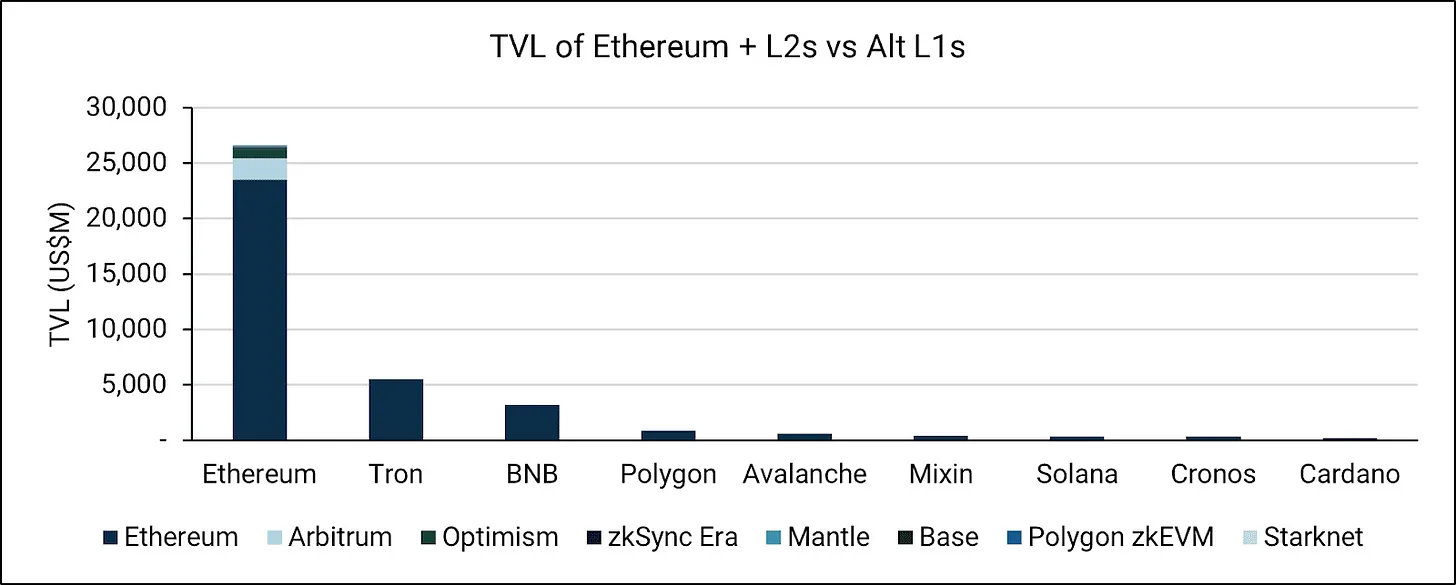
Alternative L1 solutions are no longer the only viable scaling option. Roll-ups became Ethereum’s unofficial official scaling roadmap in October 2020. Since then, they have gradually taken market share from other alt L1s. Indeed, Arbitrum and Optimism—both Optimistic Roll-ups—have more active users and TVL than most top L1s. Recently, Coinbase’s Optimistic Roll-up Base has also rapidly gained traction. In the coming years, ZK Roll-ups are also likely to follow suit.
In a broader context, Optimistic Roll-ups, ZK Roll-ups, and app-specific roll-ups are all part of the Ethereum ecosystem. When including these networks as part of Ethereum itself, the bar for “surpassing Ethereum” becomes much higher. From this angle, Ethereum’s leadership is not due to technological superiority, but rather its unique historical path, momentum built over the past decade, and compounding effect of its choices.
Conclusion
The technology sector, especially emerging fields like cryptocurrency, is constantly evolving and inherently uncertain. This question also implies zero-sum thinking—that one L1’s victory means another’s failure. As Warren Buffett aptly said: “Forecasts tell you a lot about the forecaster, but very little about the future.”
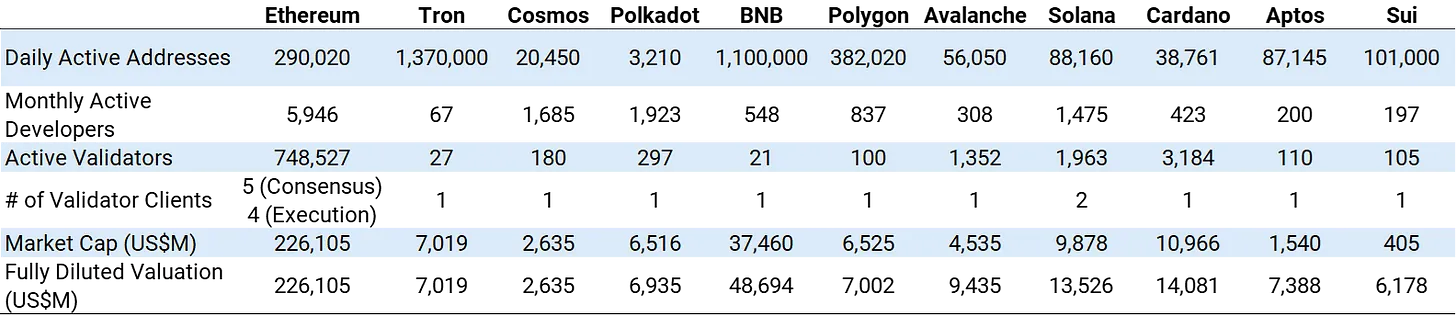
If forced to give an answer, Ethereum appears poised to maintain its leadership in the L1 space for the foreseeable future. It leads in the most critical metrics, especially decentralization. As active participants in crypto, we observe the most vibrant innovation in frontier technologies—scaling solutions, ZK tech and applications, privacy solutions, MEV mitigation/democratization—within the Ethereum ecosystem.
Among current new L1s, we view Solana as the most promising contender to potentially surpass Ethereum. Its monolithic, high-throughput architecture presents a meaningful architectural divergence from Ethereum. It is the only L1 with multiple validator clients. Despite severe setbacks in recent years, the Solana community remains highly active and passionate. Within this ecosystem, we see unique innovations not seen elsewhere—xNFTs, state compression, compressed NFTs, the Solana Mobile Stack, and more.
However, the crypto space is nascent and ever-evolving, and disruptive new technologies may emerge. In such a dynamic environment, narrow predictions are meaningless. A more productive approach is continuous observation, adaptability, and willingness to revise one’s views.
Join TechFlow official community to stay tuned
Telegram:https://t.me/TechFlowDaily
X (Twitter):https://x.com/TechFlowPost
X (Twitter) EN:https://x.com/BlockFlow_News
 @ambergroup_io