20 Reasons Why Ethereum Failed
TechFlow Selected TechFlow Selected
20 Reasons Why Ethereum Failed
Is it possible for a new public blockchain to achieve excellent performance in both decentralization and TPS, surpassing Ethereum by an order of magnitude?
 Navigating Web3 tides with focused insights
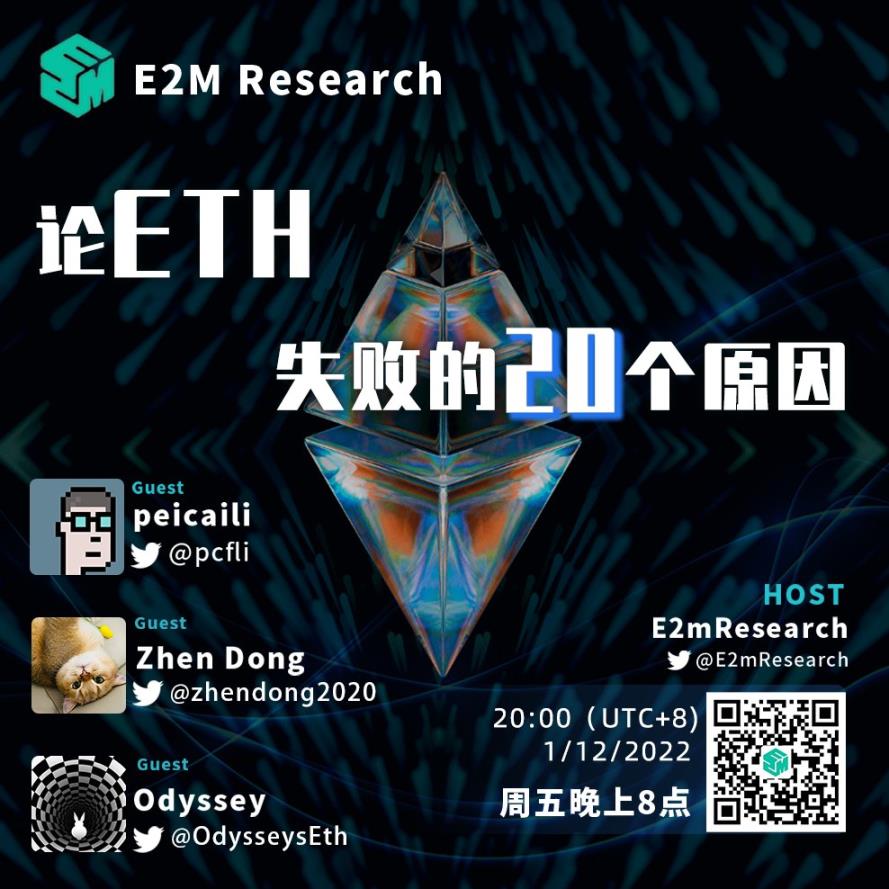
Guest Twitter: @pcfli, @zhendong2020, @OdysseysEth
AMA Content
Zhen Dong:
Welcome everyone to E2M Research's Friday Chat AMA. Every week we pick a topic for deep discussion in the field of cryptocurrency investing. Today’s theme is "20 Reasons Why Ethereum Might Fail." During our previous discussion on overcoming information cocoons, Odyssey mentioned a method: if you strongly support or oppose something, you should be able to argue against your own position better than your opponents can. If you understand all counterarguments and still believe your view holds, then you truly understand your stance. Regarding Ethereum, both Peicai and Odyssey are relatively bullish, or at least consider it a promising investment. So today, let's explore common criticisms and potential problems with Ethereum—discussing them deeply.
The idea of listing 20 reasons comes from an article by Wang Chuan titled “Why Tesla Will Go Bankrupt,” published in 2018. That piece sarcastically listed 20 reasons for Tesla’s impending failure—but as we now know, Tesla’s price trajectory turned out quite well. Many of those supposed fatal flaws later proved insignificant or invalid. I want us to similarly reflect: even though we’re optimistic about Ethereum, can we seriously examine its potential failure points right now?
That’s the main inspiration behind this “20 reasons” format. I’ll raise some common market concerns, negative opinions, and news items about Ethereum. We’ll discuss them—agree, refute, reflect—however we like.
When people think of negative news about Ethereum, the first thing that comes to mind is low TPS (transactions per second). Ethereum improved slightly around 2017, reducing block times to about 15 seconds, handling moderate transaction volume. But after DeFi Summer in 2020, Ethereum’s TPS could no longer meet speculative demand. The network became extremely congested—unless users paid very high gas fees, their transactions wouldn’t go through promptly. In contrast, newer chains like Solana, Avalanche, Polygon, and even BSC achieved much higher TPS. How do you see Ethereum’s low TPS affecting its ability to serve as a general-purpose network for transactions or commercial activity?
Odyssey:
Here’s how I think about it: comparing Solana and Ethereum purely on TPS isn’t the most important point. First, we should compare decentralization, then TPS. I’ve criticized other chains for high TPS before—if you build a private database, couldn’t you get even higher TPS? Chains like Solana or BSC have high centralization and have run into various issues. To me, any chain hosted by centralized nodes—even with high TPS—is ultimately meaningless because it cannot run permissionless applications and will inevitably face regulatory crackdowns and collapse. Second, look at whether the issue is fixable or unfixable. The first iPhone had few apps, fragile screens, poor signal, and more. Yet over time, it improved dramatically. Similarly, Ethereum’s TPS can increase 15–20x via Layer 2 and sharding—it’s a solvable problem. Right now, we shouldn’t treat low TPS as a flaw, but rather as a feature—a characteristic rooted in decentralization. That’s my main perspective.
Zhen Dong:
Is it possible that a new public chain, learning from predecessors like Solana, Ethereum, and Bitcoin, could emerge with superior algorithms—achieving both strong decentralization and TPS improvements of one or two orders of magnitude beyond Ethereum? After all, newer chains don’t carry legacy burdens. They can redesign architecture freely, while upgrading Ethereum—the “big ship”—is inherently difficult. Could a new chain surpass Ethereum in both decentralization and TPS?
Could there be a new chain that excels in both dimensions and exceeds Ethereum by an order of magnitude?
Odyssey:
Two parts here. First, technically, yes, it’s possible. If such a chain emerged and performed well, I might change my mind. Second, technology alone doesn’t decide everything. Ethereum is more like a platform than just a tool. Think back 20 years to Windows vs. Mac OS. At the time, Windows was technologically outdated and clunkier than Mac OS. But as a platform, it created a powerful network effect—a two-sided market. Most users were on Windows, so developers built games and apps exclusively for it. This attracted even more users. Even if the tech wasn’t the best, the network effect made it dominant. Technology matters, but unless it offers a 10x–100x advantage, it won’t dethrone an established leader. Being 200% better isn’t enough.
peicaili:
I mostly agree with Odyssey. If Ethereum is to succeed, it absolutely cannot remain stuck at current TPS levels—failure to solve this could lead to project-wide collapse. Also, current solutions like Layer 2 and sharding aren't fully mature yet—sharding is further off. The Ethereum community and foundation are currently focused on Layer 2. Among Layer 2 solutions, zkRollup and Optimistic Rollup are the main ones discussed, with growing preference for zkRollup. While zkRollup isn’t fully mature yet, there are already zkRollup-based chains, and progress seems fast. Plus, current on-chain transaction demand isn’t extremely high, and gas fees have dropped to acceptable levels. My take: this issue is important, but developers still have time. A chain achieving high TPS at the cost of decentralization won’t easily challenge Ethereum’s dominance. However, we can’t delay action indefinitely—we need to watch whether Layer 2 matures over the next six to twelve months. Once mature, it could partially resolve the issue. Now, Layer 2 gas fees are already low; quality apps like GMX run smoothly. So long-term, TPS is critical, but short-term, it won’t fatally harm Ethereum or enable a challenger to overtake it.
Zhen Dong:
Low TPS leads to two directions. One is when network activity spikes, users must bid higher gas fees to prioritize transactions. High-value actions—like large transfers or swaps—will pay more. At that point, not only is the network congested, but overall transaction costs rise sharply.
If Ethereum continues expanding its network effects, attracting more applications and users, leading to consistently high fees, could this crowd out or suppress usage? It becomes paradoxical: as user count and app count grow, the network becomes active—but rising fees then discourage use, undermining further growth. This feels less like a network effect. I thought network effects meant decreasing marginal cost—once software is written, serving more users should cost less. But on Ethereum, high fees mean marginal cost doesn’t decrease. Could this undermine its network effect?
Odyssey:
This is a tough question. Let’s look at some analogies.
There’s “Andy-Bill’s Law” from the internet era, named after Andy Grove and Bill Gates. Every time Intel improved hardware performance, Microsoft and its software would consume all the extra capacity, making systems feel slow again.
Another deeper concept is Jevons Paradox: when technological efficiency improves resource use, total consumption increases. For example, computers became more energy-efficient, yet total electricity usage soared. There are two layers here. First, if total capacity is fixed, increased usage hits limits, suppressing demand temporarily—short-cycle fluctuations. Second, during upward cycles, improved efficiency lowers usage cost, stimulating more demand, creating more value, causing congestion. But if the system is scalable, solving these bottlenecks unlocks more value, attracting more resources and innovation. Efficiency gains attract more users, causing congestion again, prompting new solutions—an upward spiral. A real-world parallel: big cities attract more people, leading to traffic jams. Does urban development stop? No—cities build subways and highways, expand, and thrive. Compared to physical cities, Ethereum has far greater technical potential to solve scalability. It won’t be trapped in a closed loop. I believe this cycle will repeat, but each time, newer technologies will overcome it.
Zhen Dong:
You suggest that as application count grows on Ethereum, it drives expansion, encouraging more technical solutions and resource investment. But what if solutions arrive too slowly? What if they mature unpredictably—and by then, Ethereum hasn’t succeeded? Could this process happen elsewhere, not centered on Ethereum?
Odyssey:
I have two thoughts. First, if Ethereum hits an insurmountable obstacle while another solution bypasses it easily, I’d reconsider my stance. Second, this involves probability. I believe breakthrough solutions aren’t evenly distributed. On this planet, intelligent minds overwhelmingly focus on high-value problems. Imagine solving congestion in a 20-million-person city—each person willing to pay $10. That’s a valuable problem. But trying to build infrastructure in a desert with one person, hoping it scales to 100 million? Such a problem won’t attract serious effort. Breakthroughs require massive resources, trial and error, and real-world testing. These kinds of innovations are far more likely to emerge where many people are already working on hard, valuable problems.
Sure, a genius could suddenly launch a chain that clears hurdles Ethereum struggled with for 5–10 years. I’d change my view—but the odds are extremely low. Solving problems on lesser platforms yields minimal rewards. Even if a solution emerges, few would notice globally. People focus on improving Windows, not building a new OS from scratch. Migration costs—for millions of developers and users—are enormous. People prefer iterating on existing platforms. So even if a superior solution appears, it would give us plenty of time to shift positions gradually.
Zhen Dong:
Earlier we said Ethereum’s high fees need time to fix, and due to its strong network effects, motivation to solve problems is highest on Ethereum. But I feel Ethereum lacks a killer app—one that reaches mainstream users, people unfamiliar with blockchain or Bitcoin. Suppose such an app emerges on Ethereum, gradually solving big problems, gaining revenue, users, and rapid growth—but before Ethereum solves scaling, TPS, and cost issues. Would it resemble Axie Infinity, whose user base exploded, forcing them to build a sidechain and move value off Ethereum? If this happens before Ethereum scales, could it hurt Ethereum’s value? Could the killer app capture value independently, depriving Ethereum of it?
Odyssey:
Let me break this into two phases. First, during low-TPS stages, a single app may dominate and find throughput insufficient. But this phase is very early—whether the app stays or leaves barely matters. I’d rather consider the second phase: when Ethereum achieves very high TPS, could it fail to capture value, instead being overtaken by applications? For example, imagine everyone uses only WeChat on their phones, ignoring all other apps. In that case, WeChat achieves a new level of monopoly.
But I think this scenario is harder on Ethereum than on the internet. Blockchains allow easy forking of protocols. Imagine someone easily forks WeChat—taking all contacts and competing directly. Would WeChat still dominate? The difficulty rises exponentially. When protocols exist in near-perfect competition, the underlying platform itself becomes more monopolistic. A key prerequisite: sufficiently high TPS to support intense protocol competition.
So I believe: once TPS is high enough, Ethereum’s ecosystem enters full protocol competition, allowing the platform to easily capture nearly all generated value. If TPS remains low, no app can become truly “killer-grade.” Whether such apps stay or leave won’t matter much.
Zhen Dong:
Is it possible for a killer app to emerge under current low-TPS conditions?
Odyssey:
It’s theoretically possible, but I respect real-world data. With current low TPS and Ethereum’s long-standing state, hasn’t your definition of a killer app failed to appear? So I think the probability is extremely low.
Zhen Dong:
Given current Ethereum scaling approaches, all Layer 2 solutions have native tokens—unlike Bitcoin’s Lightning Network, where fees are paid in BTC. If Layer 2 becomes the primary scaling path, could these Layer 2 protocols capture more value than Ethereum itself?
Odyssey:
Two possibilities come to mind. First, one Layer 2 could dominate, capturing value comparable to Ethereum.
Second, will only one solution survive? I doubt it. After iOS launched, who handles messaging—iMessage, WhatsApp, Telegram, or WeChat? User preferences differ, so multiple solutions coexist competitively, each with pros and cons.
At this structural level, think of upstream/downstream power dynamics—suppliers and distributors in competitive markets naturally elevate the platform to a monopolistic, unshakeable position. Another key point: Ethereum is Turing-complete, meaning future solutions may emerge organically. Those solutions themselves may face disruption, but Ethereum as a base layer is harder to displace. Take iOS: even if WeChat faces challenges, the operating system benefits.
That’s my thinking.
Zhen Dong:
Let me push back a bit. You compared Ethereum to iOS and Layer 2 to WeChat. But I see Layer 2 more like an operating system or network. Maybe Ethereum is like C language, and Layer 2 is a higher-level language built on it—better usability, higher TPS, enabling killer apps. Could Layer 2 then capture more value from those apps than Ethereum does?
Odyssey:
Yes, you can view Layer 2 as an OS. Then we can extend the metaphor: say Microsoft is an OS, built atop something like the United States. An awkward situation arises—Microsoft captures vast value, earns huge profits from Office or Windows sales, but must pay significant taxes to the U.S. government. And the U.S. doesn’t just tax Microsoft—it also taxes Apple, which itself extracts “taxes” from others. Yet Apple still pays taxes to a deeper, larger monopolist. So even if Layer 2 becomes an OS hosting many apps, Ethereum becomes an even more foundational, powerful layer. Without poetic license, I’ll just use the nation metaphor.
Zhen Dong:
But in the nation metaphor, you can’t hold equity in a country and profit from it, whereas you can benefit from holding an OS. So the analogy feels imperfect.
Odyssey:
The nation metaphor carries an abstract commonality: tax. Whether we talk about Apple’s tax, EIP-1559, or Alibaba’s commission, their revenue models differ, but fundamentally they represent mandatory value extraction—a cash flow, a payment mechanism. Deeper still, it reflects power structures—you *must* pay this entity. These metaphors share this abstract essence.
Zhen Dong:
Building on that, let me ask a slightly cheeky question: could a structure emerge where Layer 2, built on Ethereum’s architecture, captures more value than Ethereum itself?
Odyssey:
Layer 2 absolutely could. But if it operates in a near-perfectly competitive market, no one knows which player will win or who’ll be replaced tomorrow by newer tech. In contrast, the underlying platform becomes irreplaceable precisely because of its stability. This irreplaceability isn’t just technical—it hinges on scarcity. For instance, Windows runs on computer hardware like hard drives and RAM, none of which are scarce. Without scarcity, there’s no irreplaceability—just technical dependency, not power structure.
We can’t say Ethereum is built on a programming language—even if technically true, programming languages aren’t scarce, so they can’t capture value. To extract value, a layer needs both irreplaceability within the stack and inherent scarcity—like how you can’t own shares in a nation. Returning to Layer 2: imagine restaurants generating trillions in annual sales, yet thousands open and close every year. You never know which one will succeed. Unless you possess exceptional insight into which Layer 2 chain will capture value effectively *and* trade at fair valuation, switching makes little sense. Finding such a superior alternative is highly improbable and extremely difficult.
Zhen Dong:
Suppose Apple and Microsoft (as Layer 2 equivalents) emerge on Ethereum’s foundation. But Apple and Microsoft aren’t rooted solely in the U.S.—they operate globally, across China, Europe, Australia. Could Layer 2, as a multinational entity, capture value more effectively than investing directly in the “U.S.” (Ethereum)? Under this metaphor, could Layer 2 become a giant—not like restaurants or airlines, but an industry capable of birthing Apples and Microsofts? In that case, wouldn’t Ethereum become commoditized and competitive, while Layer 2 assumes stronger power structures?
Odyssey:
I understand your point. Many argue cross-chain bridges will thrive in a multi-chain future. I disagree—the premise doesn’t hold.
What enables a multi-chain era? Only applications requiring censorship resistance justify existence on-chain; otherwise, private databases are more efficient. Any app without this need gets shut down by regulators anyway. Today, only Bitcoin and Ethereum qualify as meaningfully decentralized. Other chains aren’t truly decentralized in my view. Thus, the premise of a “multi-chain era” collapses. There’s only one true sovereign entity in this world—the nation-state. Layer 2 can’t transcend it. First point. Second, will it ever happen? Consider Solidity’s dominance—over 90% of smart contracts use it. Like Microsoft developers, even if macOS existed, most devs and users are on Ethereum, creating a winner-takes-all dynamic. Latecomers struggle to overcome network effects. I don’t believe cross-chain will succeed. Layer 2 bridging Ethereum to other chains offers no advantage. In fact, other chains may eventually get淘汰ed.
Zhen Dong:
You mentioned many chains lack decentralization or lost first-mover advantage. You said only Bitcoin and Ethereum meet decentralization standards. But suppose BTC becomes another “nation”—many are building smart contracts on Lightning. If the future isn’t a global village but a bipolar world—USSR and USA—wouldn’t they compete?
Odyssey:
Here’s my take: Ethereum’s core strength is Turing-completeness, while Bitcoin intentionally chose non-Turing-completeness for security. Though Bitcoin’s design is admirable and technically sophisticated, Turing-completeness means anything a Turing machine can do, Ethereum can implement. I don’t see Bitcoin as equivalent to Ethereum. Bitcoin is like a sharp Japanese dagger—excellent for specific tasks—but fundamentally limited in scope. It cannot achieve everything a Turing machine can. So I don’t place Bitcoin and Ethereum on equal footing.
peicaili:
I think Layer 2 expansion is horizontal and doesn’t significantly boost ETH’s intrinsic value capture. TPS caps total transaction volume. If Layer 2 economies boom and must settle large volumes on Ethereum, they hit throughput limits. Users then bid up gas prices to secure scarce block space—could this make Layer 2’s security costs prohibitively high?
Also, if Layer 2 networks compete fiercely, driving gas prices sky-high, individual users may disappear from Ethereum entirely. Imagine a phone line shared by individuals and Microsoft—Microsoft can afford far higher call costs and generate more value per unit of bandwidth. This implies only enterprises can afford Ethereum, turning it into a pure B2B chain. Personal users vanish. That would severely weaken network effects. If Layer 2 thrives while Ethereum doesn’t shard, this problem exists objectively. Could this challenge Ethereum’s monopoly?
Overall, I think Layer 2 alone isn’t enough—we need sharding. What TPS level post-sharding would ensure low fees and support many Layer 2 chains? And will there be many Layer 2s, or will one dominate, hosting most apps, making expansion to others unnecessary?
Ultimately, if one Layer 2 dominates, Ethereum’s value capture could indeed be challenged—undermining our original power-structure assumption.
Odyssey:
Two points. First, I agree: if Ethereum serves only B2B clients, network effects weaken substantially. But even then, Ethereum’s market cap would already be over 100x higher than today. Second, will one Layer 2 break away to become its own L1? Absolutely, some will try. Third, will they succeed? I doubt it. Even successful Layer 2 projects attempting to spin off into independent chains face immense challenges. Running censorship-resistant, decentralized applications from scratch requires extreme security. New chains face two fates: either they’re centralized and get regulated away immediately, or they attempt decentralization but start with weak hash power or market cap, making them easy targets for attacks despite carrying high value. After reaching a certain scale, trying to build strong security from zero outside Ethereum’s mainnet is incredibly difficult. Ethereum spent years and huge costs building foundational decentralization—the hardest part. An apt metaphor: the U.S. Constitution’s system of checks and balances is extremely hard to replicate. Latin American nations copying semi-presidential systems repeatedly fail. In summary: if all Layer 2s go B2B, network effects suffer, but Ethereum’s value may still grow 100x; some chains will attempt independence, but lacking security, they’ll either fail or return.
peicaili:
I understand your view. Though it may seem to weaken ETH’s value capture, under current conditions, ETH’s dominance remains unchallenged. As you said, it might even grow another 100x.
Zhen Dong:
We’ve discussed Ethereum’s decentralization. Can Ethereum—or blockchain generally—maintain true decentralization while interacting with regulation and state power? Many critics compare it unfavorably to Bitcoin, citing three centralization risks. First, wealth distribution: ETH holdings are less dispersed than BTC’s, concentrated among whales, centralized exchanges, custodians, and node operators. Second, staking: post-Merge, about 30% of staked ETH relies on Lido, and many validators operate under U.S. jurisdiction. If U.S. policy turns harshly regulatory, could Ethereum’s network security be compromised? Third, OFAC recently sanctioned Tornado Cash. If governments demand Ethereum enforce censorship, that could severely damage its decentralization. Additionally, SEC Chair Gary Gensler has repeatedly stated only BTC qualifies as a commodity, suggesting Ethereum’s PoS mechanism resembles securities—could it fall under strict securities regulation, stifling its ecosystem?
Can Ethereum preserve relative independence amid evolving regulatory dynamics, while still enabling vibrant ecosystem growth?
Odyssey:
I acknowledge these are serious, significant issues. But I believe they’re improvable—including token distribution and validator concentration—via future proposals. There may be setbacks, but nothing insurmountable.
I’m especially attentive to the third point: government sanctions and censorship. Censorship can be effective in the short term and may harm Ethereum. Developers are numerous, but face a key challenge: true censorship resistance requires anonymous developers. Ironically, censorship might spur the emergence of anonymous teams building new tools. This possibility depends on future infrastructure becoming more robust. Under these conditions, Ethereum itself becomes more censorship-resistant, spawning more composable applications and inter-protocol interactions.
These are important issues—but solvable and improvable.
Zhen Dong:
You suggest governments may initially censor via front-end targeting of major project developers, but eventually anonymous developers will emerge. But I wonder: at the deepest internet protocol layer, with IP tracking, can true 100% anonymity be achieved? Second, if anonymous developers proliferate, could this provoke stronger government crackdowns—especially if linked to money laundering or illicit activities disliked by the U.S. or other governments—intensifying suppression? Third, I worry: Vitalik remains a central figure. What if one day he realizes Ethereum hosts大量 content governments dislike—and authorities target him? Could that severely impact Ethereum?
Odyssey:
First, can full technical anonymity be achieved at the base layer? I’m not a tech expert, but I believe it’s feasible—there are precedents. Second, will this provoke harsher crackdowns? Definitely. But conversely, if it weren’t valuable, no one would bother attacking it. Anything valuable attracts opposition. When ByteDance rose, competitors launched rival products to suppress it. Why attack something? Because it’s powerful and threatening. Being attacked doesn’t mean defeat—it means importance.
Third, Vitalik is a real human leader. Deep down, we already know the answer. If he’s arrested or disappears—or tries to sabotage Ethereum single-handedly—can he succeed? His presence is a bonus, but even if he vanished, the movement wouldn’t stop.
peicaili:
Application-layer censorship is manageable. I’m more concerned about direct protocol-level intervention—say, regulators forcing Lido to shut down. How impactful would that be? At least at the app layer, Ethereum’s security wouldn’t be compromised.
Odyssey:
Regarding protocol-level censorship like targeting Lido, I believe this too is improvable. Even if Ethereum suffered major impacts, the most radical response could be a fork to circumvent restrictions.
peicaili:
During bear markets, could PoS fall into a death spiral? When prices drop, do validators withdraw stakes en masse, weakening network security? In PoW, miners and coin prices are somewhat decoupled. Once ASICs are built, even if sold at peak prices, they keep mining—miners have incentive to keep machines running, minimizing network risk. But in PoS, when prices fall, do validators pull out coins to sell? If widespread, does this erode confidence in chain security, accelerating price declines? This is my concern about PoS—could it cause Ethereum’s failure?
Odyssey:
Here’s my take: price drops leading to withdrawals affecting security—is a valid concern. But I believe it’s fixable. If security weakens, we can propose EIPs. For example, after Shanghai Upgrade allowed withdrawals anytime, we could introduce mechanisms: withdrawing above a threshold incurs a fee; staking receives extra rewards. Such incentives easily resolve the issue. So I don’t see this as a major threat.
Zhen Dong:
Earlier we noted PoW pays miners to secure the network—costs are incurred. Ethereum similarly pays node operators to maintain security. Fundamentally, it’s a game-theoretic relationship: as long as service providers act honestly, the network stays secure; if they misbehave, forks may occur in extreme cases.
On the other hand, PoW isn’t perfectly secure either—this invites comparison between PoW and PoS. I recall when Bitmain released the S17 series, older S9 miners still dominated, accounting for over 50% of global hash power. During early bear markets, hash rate grew slowly while price surged rapidly. For a long period, miner market cap was low—only $1–2 billion—while Bitcoin’s market cap was already tens of billions. So PoW isn’t necessarily far superior to PoS.
As long as network participants don’t collude maliciously, the network remains secure. Their cost of betrayal appears low, but that doesn’t mean others won’t defend the network. For example, recently Curve faced manipulation by a single actor influencing token voting via liquidity control. When this happened, supporters stepped in, using their own ETH to vote. This reflects the anti-fragility of decentralized systems—I’m actually optimistic about this resilience.
Zhen Dong:
Since DeFi Summer 2020, Ethereum’s daily active addresses have hovered around 500,000. From 2021–2022, it fluctuated between 300,000 and 500,000. Meanwhile, BSC peaked at 1–2 million active addresses.
Ethereum has roughly 20 million unique addresses—growth has slowed drastically in recent years, both in total users and daily actives. Should we worry that Ethereum has hit a user-growth ceiling? We often say crypto is still in the “bowling alley”—a niche market appealing only to young people or specialized sectors. Could it remain stuck there, failing to enter the “tornado” phase of mass adoption? Might killer apps take decades—20, 30, or 50 years—to emerge?
Odyssey:
First, DAU (daily active users) isn’t inherently meaningful. Junk accounts come to farm airdrops and leave. OPPO once had massive user numbers, then collapsed overnight. Qutoutiao paid rural users to watch ads, burning high DAU—unsustainable. We must understand where DAU comes from. Second, Apple’s global market share has long been ~20%, ~50% in the U.S. Two features: low overall share, yet it captured 106% of industry profits (since others were losing money). Its monopoly status explains this. Apple’s example helps reframe understanding.
Third, realistically, will DAU stay low long-term? Consider why Apple’s share stays low: if iPhones halved in price, adoption would surge—but that might hurt profitability. Apple doesn’t chase user count; it strengthens monopoly power, letting market share grow organically. Similarly, Ethereum’s low active wallet count relates to TPS constraints. Higher TPS enables more apps, increasing DAU. Likely, Ethereum’s overall share will remain modest, like Apple—low penetration but undisputed dominance, continually strengthening its lead.
peicaili:
Most Ethereum apps today are financial—besides NFTs. But most real-world activity is consumer-oriented; finance is a small slice of the economy. Still, since Ethereum is an open, composable platform, I believe consumer-grade products will eventually emerge. Not necessarily in 10, 20, or 50 years—I’m not that pessimistic.
I still believe in the next 3–5 years, we’ll see better apps and more users joining ETH.
Odyssey:
I don’t think it’ll take 5, 10, 20, or 50 years. I expect it sooner, driven by fundamental forces. Moore’s Law—computing power keeps growing. Bandwidth expands continuously. These foundational trends keep pushing boundaries. Can we really imagine waiting 50 years—when computing power will be millions of times greater—before breakthroughs happen? I don’t think so.
Join TechFlow official community to stay tuned
Telegram:https://t.me/TechFlowDaily
X (Twitter):https://x.com/TechFlowPost
X (Twitter) EN:https://x.com/BlockFlow_News
 @E2mResearch