Under the RWA boom, is stUSDT an ideal investment target?
TechFlow Selected TechFlow Selected
Under the RWA boom, is stUSDT an ideal investment target?
TRON has recently launched its RWA product stUSDT, quickly earning the title of "Web3 Yu'ebao" thanks to its unique advantages.
 Navigating Web3 tides with focused insights
In 2023, as global macroeconomic conditions fluctuated and regulatory frameworks for traditional virtual assets became clearer across countries, the crypto world continued innovating on its existing narratives, creating more attractive products that meet community and user needs. Real World Asset Tokenization (RWA) emerged accordingly, gradually becoming a new blue ocean and value capture channel in today's crypto market.
Amid this wave of enthusiasm, native crypto DeFi protocols such as MakerDAO and Aave are adapting and actively embracing RWA. TRON recently launched its RWA product stUSDT, quickly earning the nickname "Web3 Yu'ebao" thanks to its unique advantages. Subsequently, Huobi Earn chose to partner with stUSDT to offer users more stable and higher-yield financial products.
After weeks of anticipation, can products like stUSDT become promising investment vehicles in the crypto market?
Is stUSDT safer?
According to the official website stusdt.io, stUSDT is the first rebase-based RWA protocol. Users can stake USDT on the stusdt.io platform to receive RWA-backed tokenized certificates, which are now operating via the decentralized platform JustLend DAO.
Specifically, when users stake USDT, they receive an equivalent amount of stUSDT at a 1:1 ratio. The stUSDT token is backed by real-world assets, and the stUSDT-RWA smart contract distributes yield to holders through a rebase mechanism.
Clearly, stUSDT offers several advantages: asset tokenization enabling free on-chain circulation, eliminating traditional financial barriers to high-quality investments, and being built on transparent, publicly verifiable smart contracts. Given these features, its security far exceeds that of other assets. Unless the underlying assets backing stUSDT fail to be redeemed—which currently seems nearly impossible—its safety remains robust.
stUSDT and USDT do not need to be pegged to each other, but both are pegged to the U.S. dollar. The former is backed by bond investments, while the latter relies heavily on real-world assets. stUSDT is unlikely to de-peg unless the previously mentioned redemption failure occurs.
What kind of returns does stUSDT offer?
TRON founder Justin Sun stated in a media interview, “stUSDT has very strong composability—it can exist across various DeFi lending, yield, and contract protocols, and can also be listed on exchanges for trading. In the future, stUSDT will serve as a baseline yield anchor for $50 billion worth of assets on the TRON blockchain, making it highly significant for the entire DeFi Lego ecosystem.”
Leading the charge is Huobi Earn. Huobi Earn takes USDT one step further by converting it into RWA-class assets.
It is reported that in June, Huobi partnered with the RWA asset stUSDT, primarily investing in stable bond assets yielding between 4–5% annually. The current flagship product—a 5% APY flexible large-amount USDT offering from Huobi Earn—is composed of 4.25% yield from stUSDT platform bond earnings plus a 0.75% subsidy from the Huobi platform.
For users, Huobi Earn generates returns by allocating funds into leveraged positions, loans, bonds, and other stable assets, as well as through staking rewards based on Proof-of-Stake (PoS) mechanisms and platform incentives. Compared to similar Huobi Earn-like products on other platforms where investment allocations were previously off-chain and opaque, stUSDT significantly improves capital transparency. More importantly, users can redeem their stUSDT back into USDT at any time, with no impact whatsoever on withdrawal functionality.
Additionally, although Huobi has recently faced market FUD leading to some fund outflows, there have been no reports from the community about users facing withdrawal restrictions. This indicates that Huobi continues to guarantee full user access to withdrawals, ensuring 100% rigid redemption with no impact on user assets.
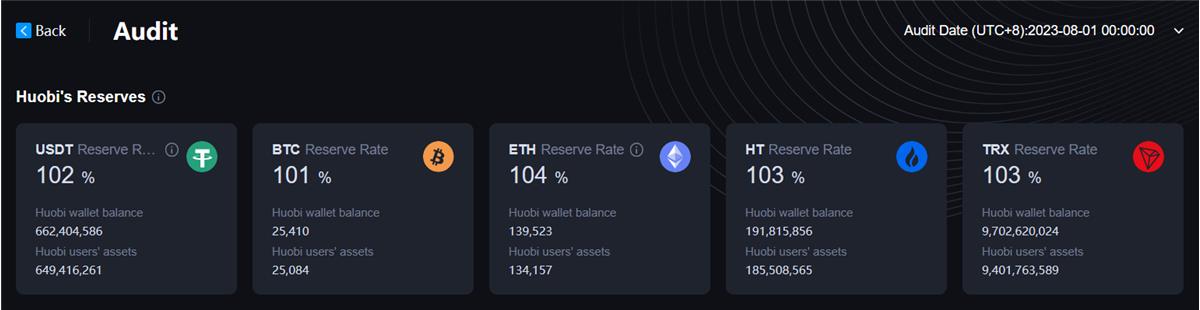
Screenshot of Huobi’s August Merkle Tree proof-of-reserves page
On August 11, Huobi announced an update to its August Merkle Tree proof-of-reserves data. According to the official press release, in addition to previously disclosed assets, newly included ETH now covers stETH, and USDT now includes stUSDT and off-chain T-Bills. Specific reserve ratios are: USDT 102% (Huobi assets: 662,404,586), BTC 101% (Huobi assets: 25,410), ETH 104% (Huobi assets: 139,523), HT 103% (Huobi assets: 191,815,856), TRX 103% (Huobi assets: 9,702,620,024). The USDT and ETH figures already include stUSDT and stETH respectively.
Huobi also stated in the announcement that it will conduct regular asset audits and use this page and feature to publicly demonstrate that it holds sufficient reserves to safeguard user assets. Additionally, users can verify the data independently via Nansen and Defillama.
Overall, RWA represented by stUSDT is merely one exploratory step in crypto innovation. We must approach such experiments with caution, yet also maintain a relatively inclusive attitude toward innovation, gradually expanding application scenarios and user scale to drive sustained growth and prosperity in the crypto digital economy.
Join TechFlow official community to stay tuned
Telegram:https://t.me/TechFlowDaily
X (Twitter):https://x.com/TechFlowPost
X (Twitter) EN:https://x.com/BlockFlow_News