Huobi updates Merkel Tree proof of assets for August, adding asset data including stUSDT and stETH, aiming to safeguard user asset security
TechFlow Selected TechFlow Selected
Huobi updates Merkel Tree proof of assets for August, adding asset data including stUSDT and stETH, aiming to safeguard user asset security
The Merkle Tree used by Huobi is an important data structure in blockchain, serving to quickly summarize and verify the existence and integrity of block data.
 Navigating Web3 tides with focused insights
According to the latest official announcement, Huobi has updated its August Merkle Tree proof-of-reserves data. In addition to previously disclosed assets, this update now includes stETH within ETH holdings, and stUSDT as well as off-chain T-Bills within USDT reserves.
Users can view reserve details via Huobi's official platform audit page, which displays key metrics such as reserve coverage ratios, Huobi wallet assets, and total user assets. Huobi stated that it will conduct regular asset audits and use this page and functionality to publicly demonstrate that user assets are fully backed by sufficient reserves.
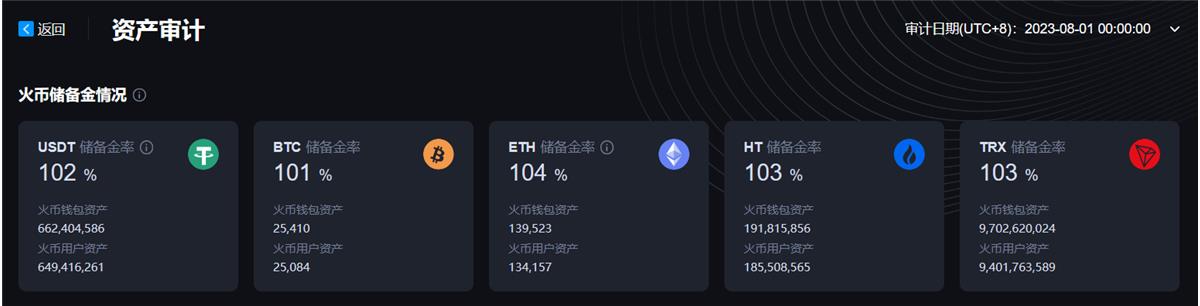
* Screenshot from Huobi’s official platform showing the reserves verification page
The specific reserve ratios for this month are: USDT 102% (Huobi assets: 662,404,586), BTC 101% (Huobi assets: 25,410), ETH 104% (Huobi assets: 139,523), HT 103% (Huobi assets: 191,815,856), TRX 103% (Huobi assets: 9,702,620,024). The USDT and ETH figures already include stUSDT and stETH respectively.
Reportedly, the Merkle Tree used by Huobi is a critical data structure in blockchain technology, designed to efficiently summarize and verify the existence and integrity of block data. It typically consists of the underlying transaction database in the block body, the root hash (i.e., Merkle Root) in the block header, and all branches connecting the bottom-level data to the root hash. The Merkle Tree process generally involves grouping and hashing transaction data, then inserting the resulting hashes into the tree recursively until only a single root hash remains, which is recorded as the Merkle Root in the block header.
According to Huobi’s official documentation on “the principles of proof of reserves,” proof of reserves is a common auditing method used to demonstrate that on-chain reserves are sufficient to cover all user balances held on the exchange. Huobi leverages the Merkle Tree mechanism to prove 100% reserves by first taking an anonymous snapshot of all user balances and constructing a Merkle Tree containing securely encrypted data of all user-held assets. From this, the Merkle Root is derived, which allows direct access to the total asset amount and hash within the snapshot. Next, Huobi verifies the digital signatures of its on-chain wallet addresses to prove ownership, thereby generating a publicly verifiable total asset value. Finally, by comparing and confirming that the total assets in Huobi’s on-chain wallets exceed the total asset amount provided by the Merkle Root, it proves that user assets are fully backed by 100% reserves.
A Huobi spokesperson said: “To ensure transparency and accuracy, the reserve data on the audit page is currently updated monthly, with snapshots typically taken at the beginning of each month, and Merkle Tree data updates completed within the first week. Going forward, we will continue optimizing our technical modules and integrating with additional technology providers, focusing on technology to deliver safer and more transparent exchange services. We remain committed to Huobi’s 'global compliance' strategy and to promoting healthy development across the crypto industry.”
Join TechFlow official community to stay tuned
Telegram:https://t.me/TechFlowDaily
X (Twitter):https://x.com/TechFlowPost
X (Twitter) EN:https://x.com/BlockFlow_News