Glassnode Data Research: BTC is Experiencing an Unprecedented Low Volatility Period
TechFlow Selected TechFlow Selected
Glassnode Data Research: BTC is Experiencing an Unprecedented Low Volatility Period
For Bitcoin, a consolidation and price compression of this magnitude is an extremely rare event.
 Navigating Web3 tides with focused insights
Written by: Checkmate, Glassnode
Compiled by: TechFlow
Summary
-
Bitcoin is famously volatile, yet the market is currently experiencing extreme volatility compression.
-
Futures markets are notably calm, with trading volumes for both Bitcoin and Ethereum at historical lows, while spot arbitrage yields stand at 5.3%, slightly above the risk-free rate.
-
Implied volatility in options markets is undergoing significant volatility compression, with volatility premiums less than half of the 2021–22 baseline.
-
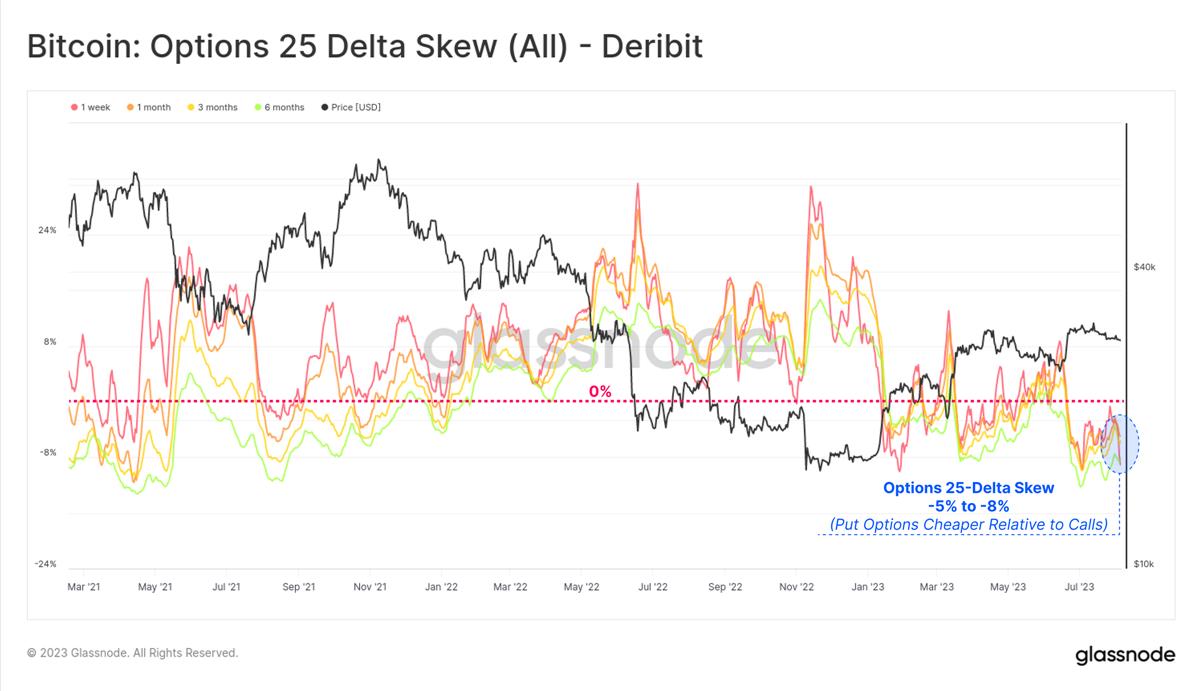
Put/call ratios and 25-delta skew indicators are at historic lows, indicating a bullish bias in options markets, while put pricing suggests minimal expected future volatility.
A Period of Calm
The Bitcoin market is undergoing an exceptionally quiet phase, with many volatility indicators reaching historic lows. In this article, we will first examine the remarkable nature of this calm period from a historical perspective, then explore how derivatives markets are pricing it.
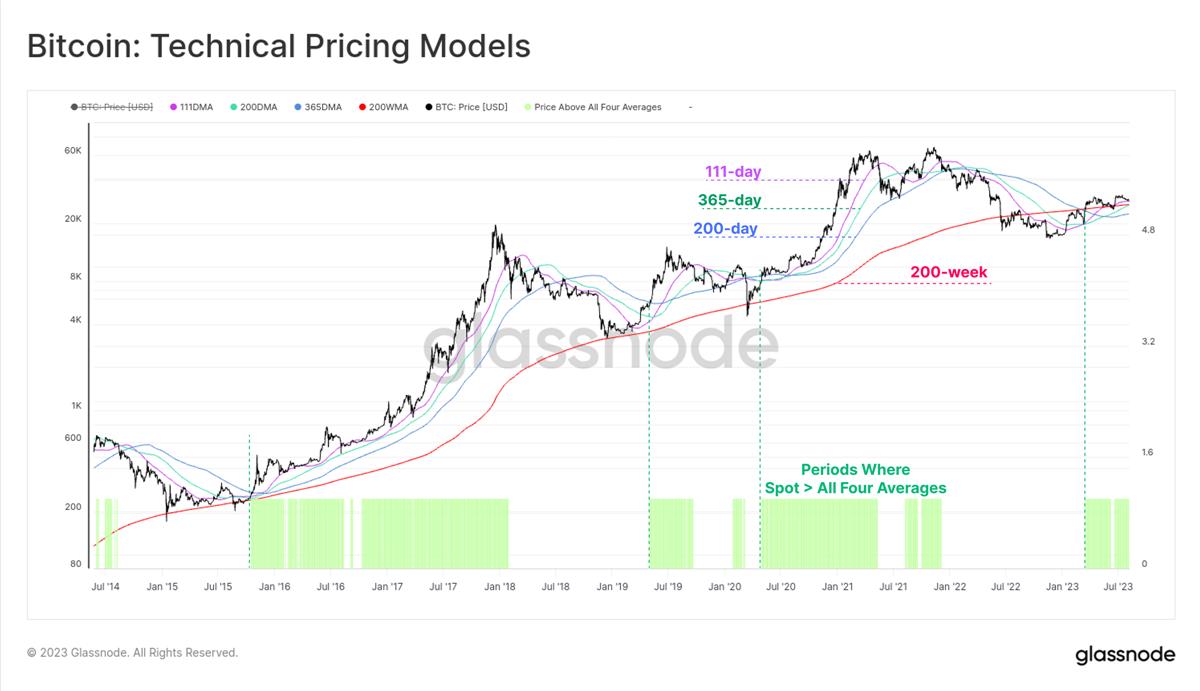
First, we observe that the Bitcoin spot price is above several widely watched long-term moving averages (111-day, 200-day, 365-day, and 200-week). These averages range from a low of $23,300 (200DMA) to a high of $28,500 (111DMA). The chart also highlights similar periods in the past two cycles, which tended to align with macro uptrends.
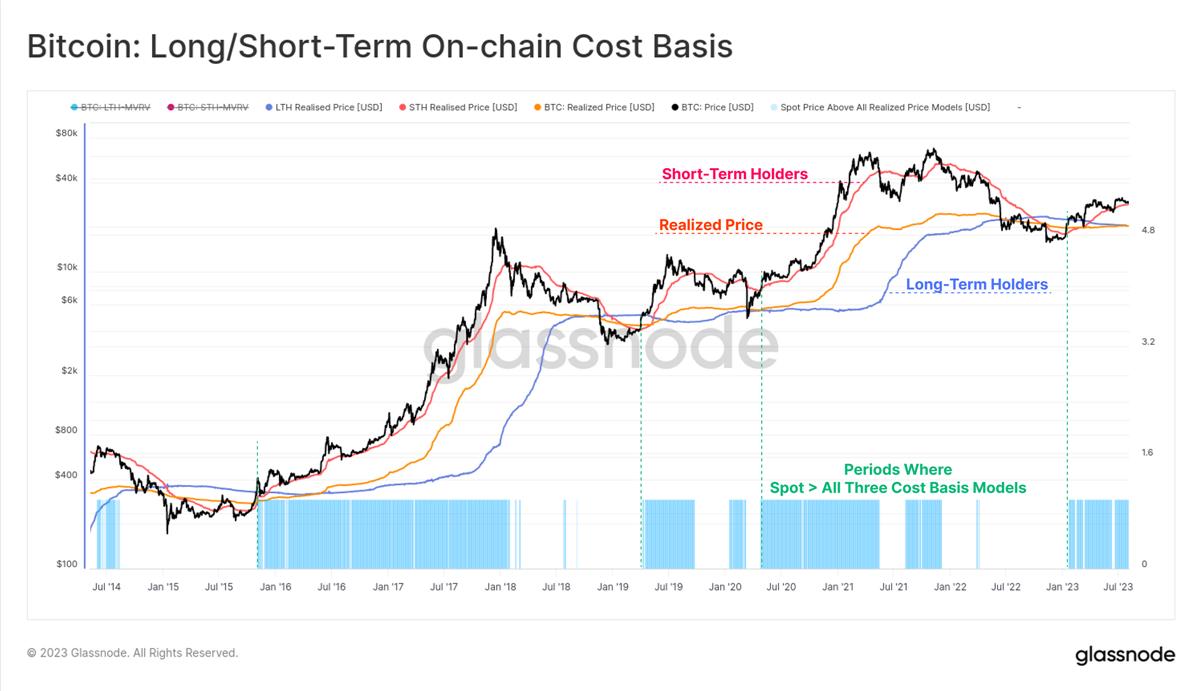
We can use on-chain realized prices to observe a very similar situation, simulating the cost basis of three cohorts:
-
🟠 The entire market (realized price).
-
🔴 Short-Term Holders (coins held for less than 155 days).
-
🔵 Long-Term Holders (coins held for more than 155 days).
The spot price once again sits above all three models, showing strong consistency with the classic technical analysis tools mentioned above.
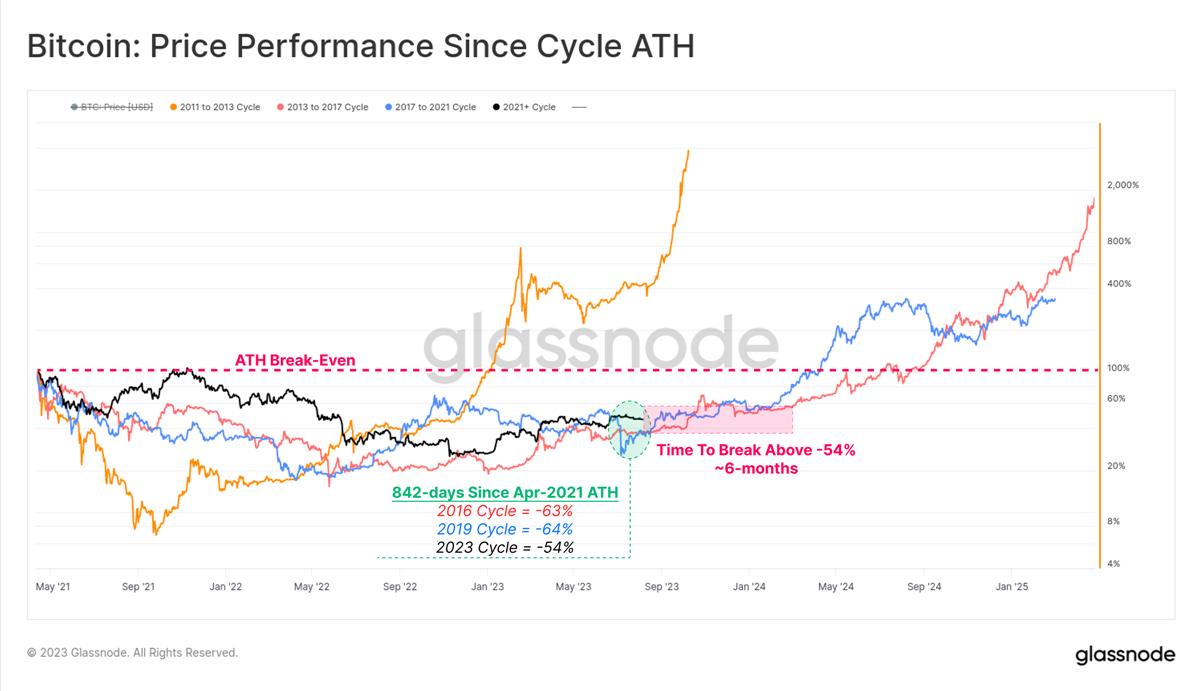
It has been 842 days since the April 2021 bull market peak. Compared to history, the 2023 recovery is actually somewhat better, with a drawdown of -54% from all-time highs versus the historical average of -64%.
We also note that in both the 2015–16 and 2019–20 cycles, there was a six-month sideways “boring” phase before the market accelerated past the -54% retracement level. This may hint at potential boredom ahead.
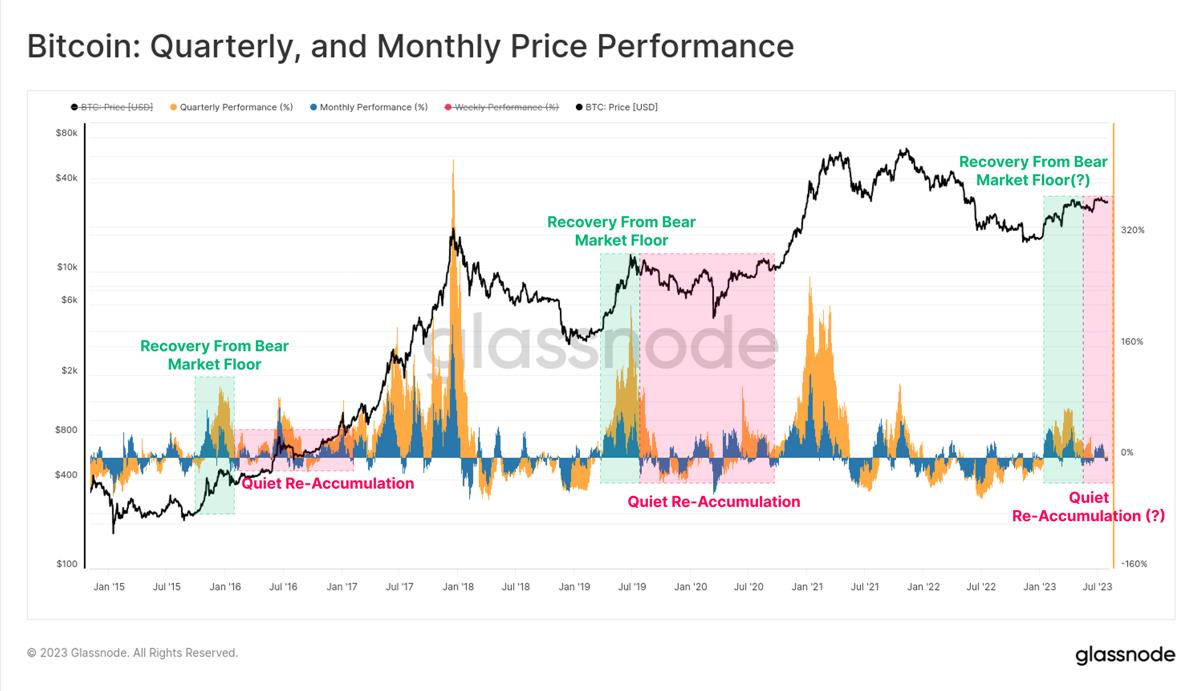
After a hot start to 2023, quarterly and monthly price performance has cooled down. We again see many similarities with prior cycles—strong initial momentum off the bottom, followed by a sustained consolidation phase.
Bitcoin analysts typically refer to this period as a re-accumulation phase.
Volatility Collapse
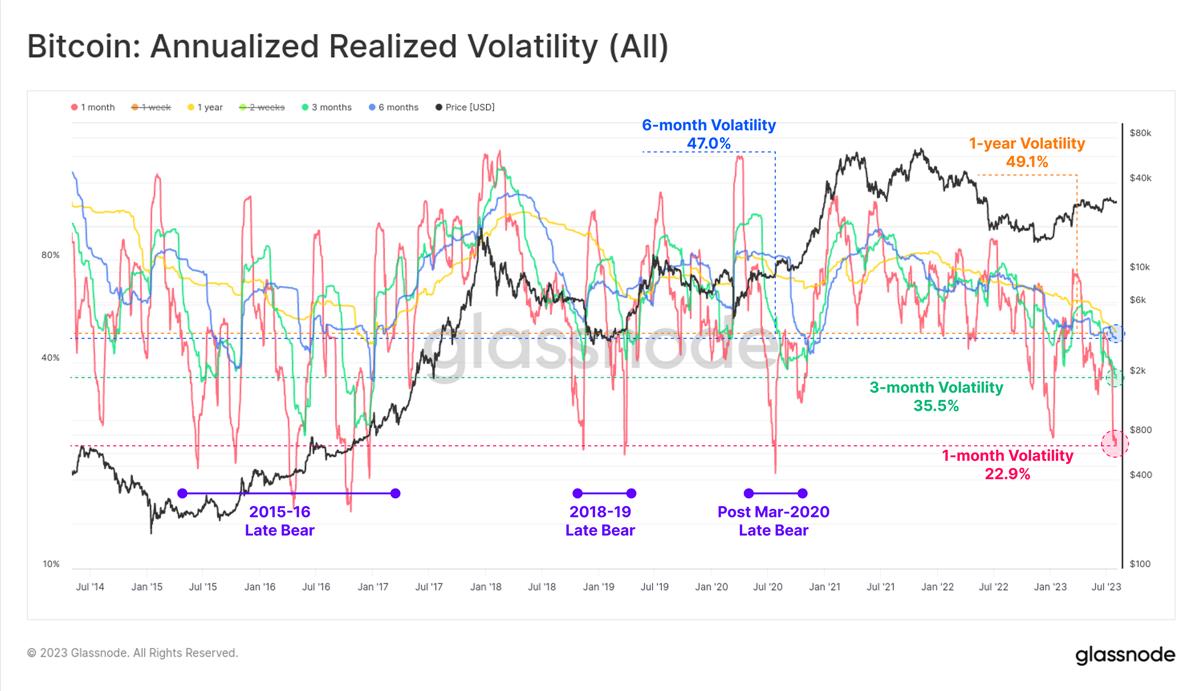
Realized volatility across observation windows from 1 month to 1 year has dropped sharply in 2023, reaching multi-year lows. One-year volatility is now at levels not seen since December 2016. This marks the fourth extreme volatility compression episode:
-
Bear market into 2016 accumulation phase at the end of 2015.
-
Late-stage bear market in late 2018, preceding the 50% sell-off in November. However, this was followed by a recovery rally in April 2019, rising from $4,000 to $14,000 within three months.
-
Market consolidation post-March 2020, as the world adapted to the onset of the COVID-19 pandemic.
-
Market digestion at the end of 2022, amid FTX’s collapse, and our current market conditions.
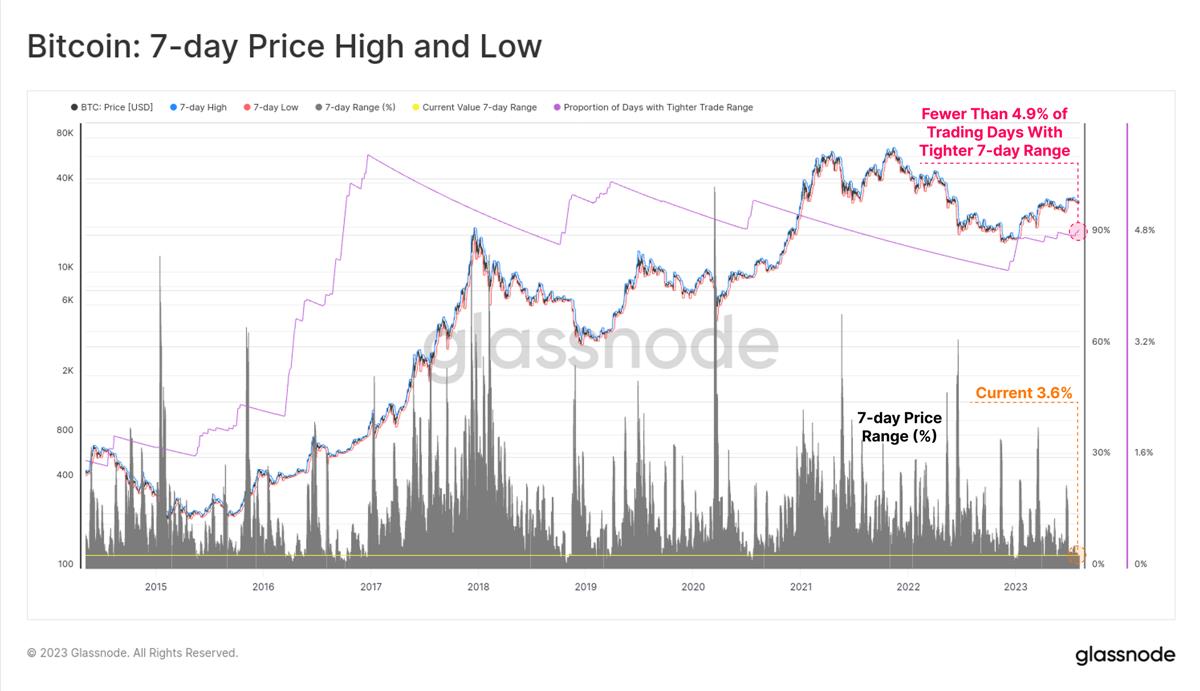
The price range between the weekly high and low over the past 7 days is just 3.6%. Only 4.8% of trading days have ever experienced a smaller weekly trading range.
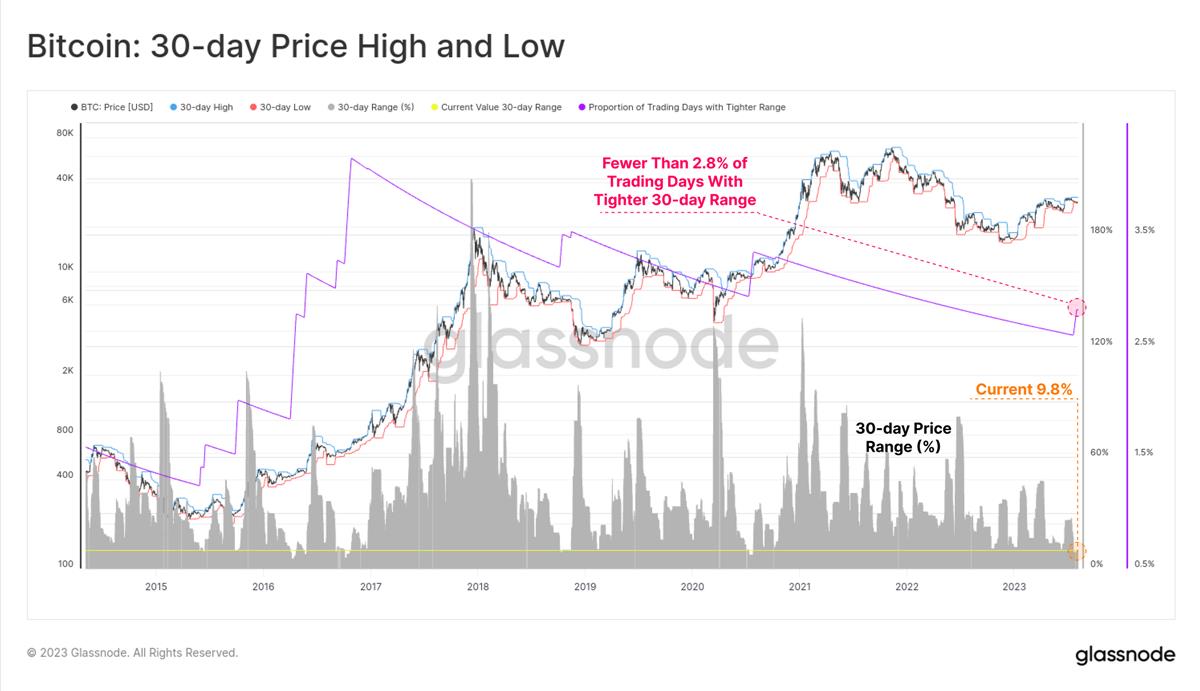
The 30-day price range is even more extreme: price has fluctuated within just a 9.8% band over the past month, with only 2.8% of months exhibiting a smaller range. For Bitcoin, this degree of consolidation and price compression is a rare event.
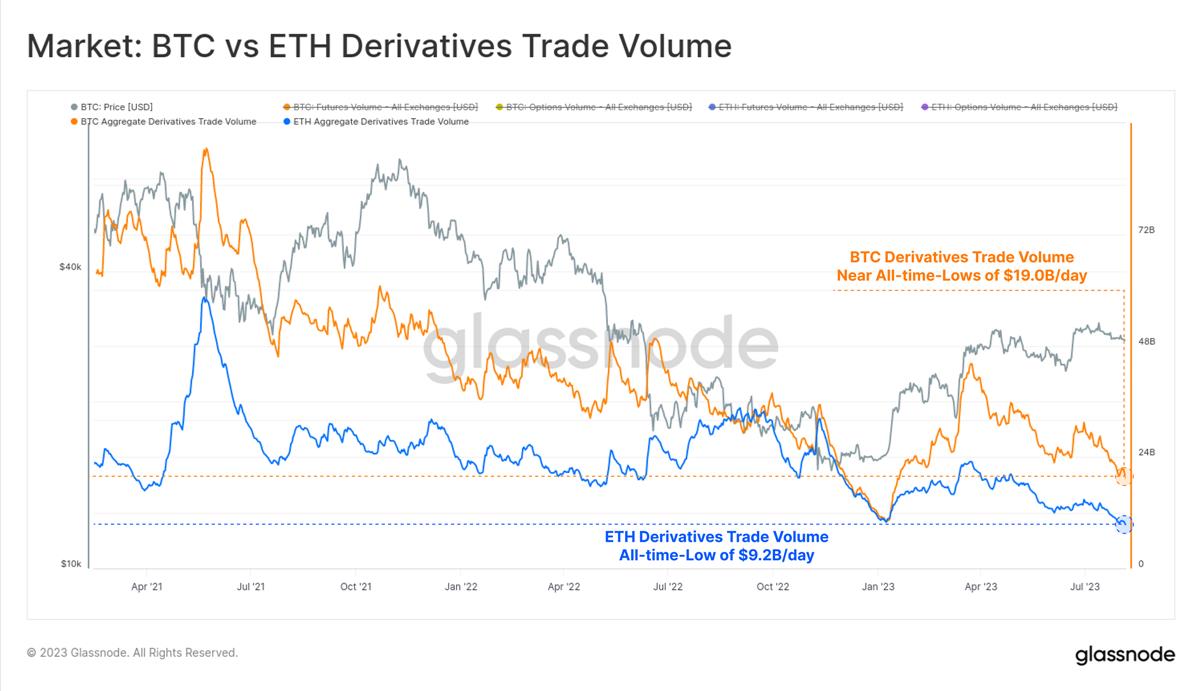
This calm period is also visible in the derivatives markets for both Bitcoin and Ethereum. For both assets, futures and options trading volumes are near or at historical lows.
Bitcoin derivative volumes are currently at $19 billion, while the Ethereum market sees only $9.2 billion in daily volume—the lowest since January 2023.
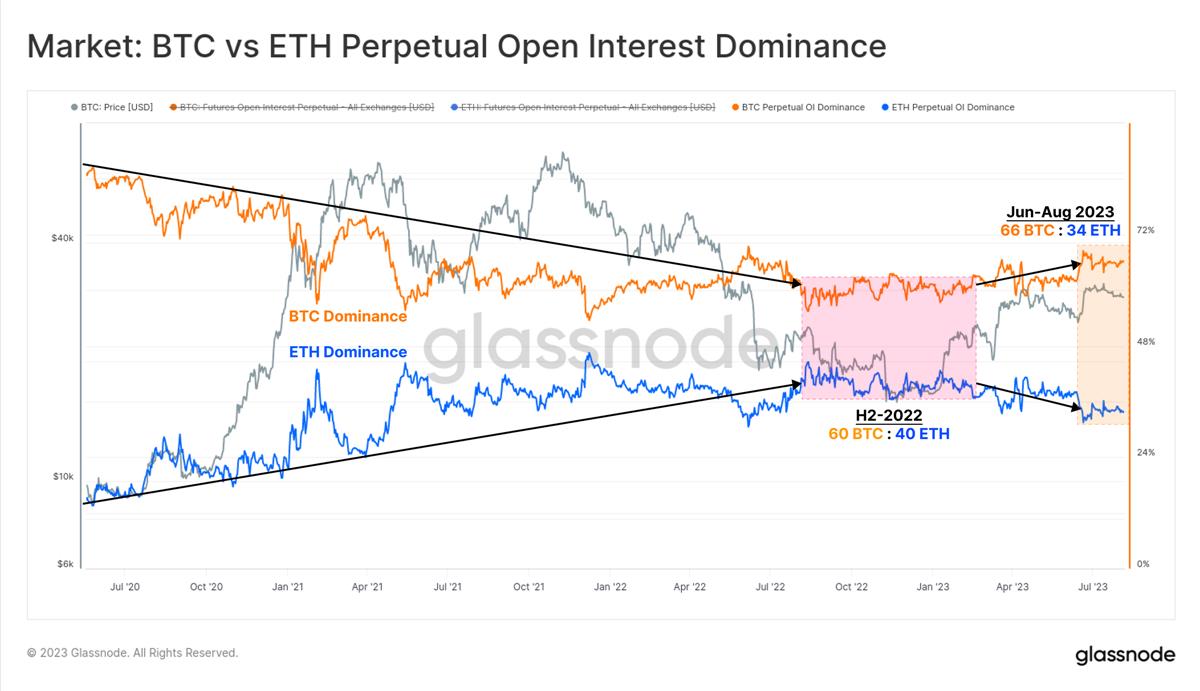
Markets also maintain a relatively risk-averse posture, with Bitcoin regaining dominance in futures markets. From 2021 to 2022, Ethereum futures trading volume and open interest steadily increased relative to Bitcoin, peaking at a 60 BTC : 40 ETH ratio in the second half of 2022.
This year, Bitcoin has regained its lead, suggesting that lower liquidity and reduced risk appetite remain key forces driving capital up the risk curve.
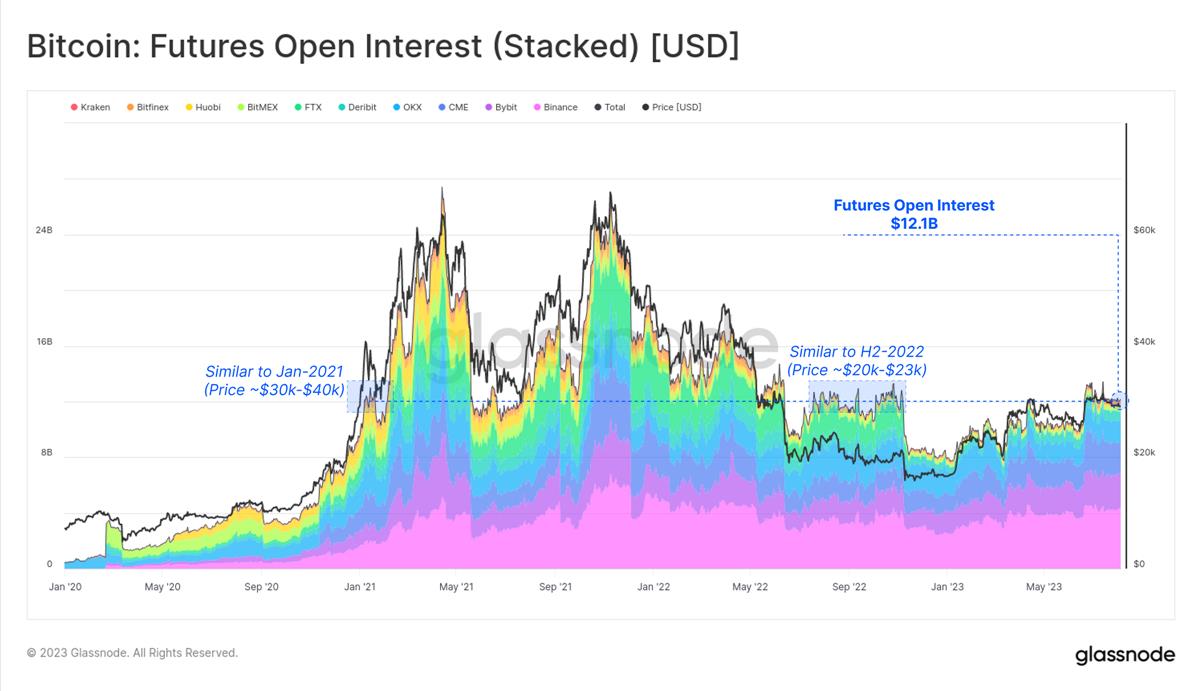
Over the past month, Bitcoin futures open interest has remained relatively stable at $12.1 billion. This is similar to levels in the second half of 2022, when Bitcoin was about 30% cheaper than today and the FTX exchange was still active. It also resembles conditions in January 2021 during the prior bull run, when Bitcoin was 30% higher than now, the market was less mature, and leveraged speculation was just beginning to heat up.
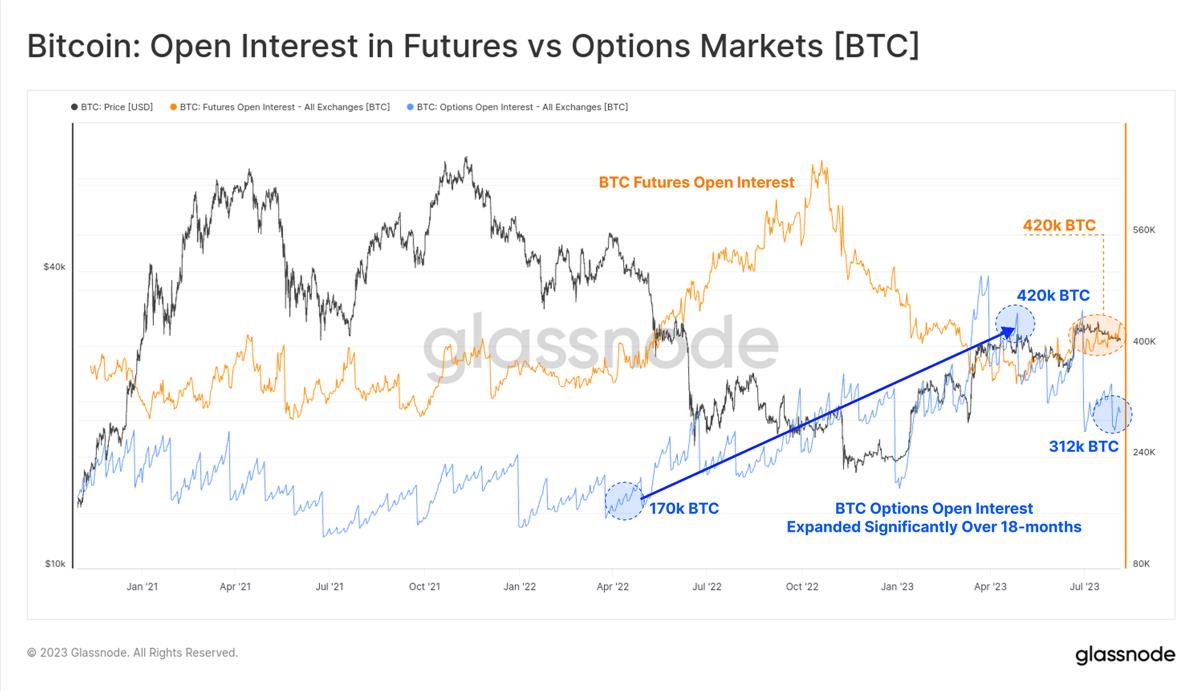
From a comparative standpoint, the options market has seen significant growth in dominance and scale, more than doubling its open interest over the past 12 months. The options market is now comparable in size to the futures market in terms of open interest.
In contrast, futures market open interest has steadily declined since the end of 2022 (around the time of the FTX collapse), with only a slight increase in 2023.
Given the low trading activity and lethargic futures markets, the next step is to identify what opportunities keep traders engaged in digital asset derivatives.
In futures markets, the term structure indicates annualized returns from cash-and-carry arbitrage strategies between 5.8% and 6.6%. However, this is only slightly above yields on short-term U.S. Treasury bills or money market funds.
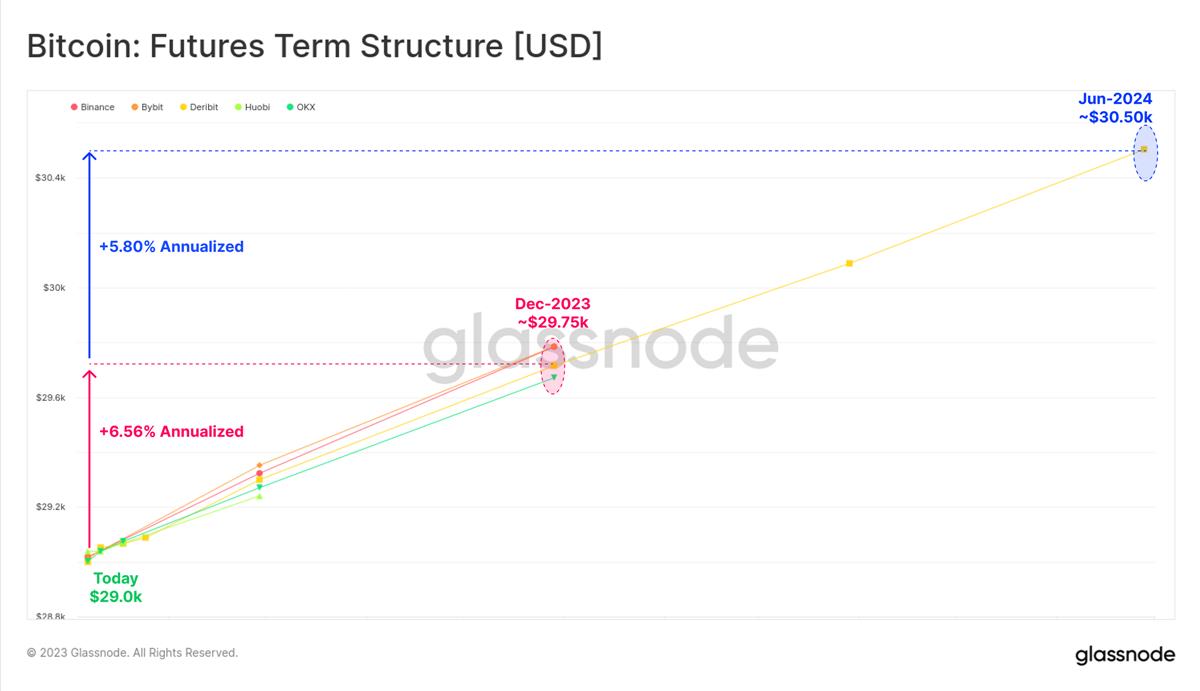
Perpetual contracts, the most liquid venues in digital assets, allow traders and market makers to lock in funding rate premiums to arbitrage differences between futures and spot prices. This form of spot arbitrage is more volatile and dynamic, but given the added risk, the current annualized yield of 8.13% is more attractive.
Notably, funding rates have remained consistently positive since the end of 2022, signaling a significant shift in market sentiment.
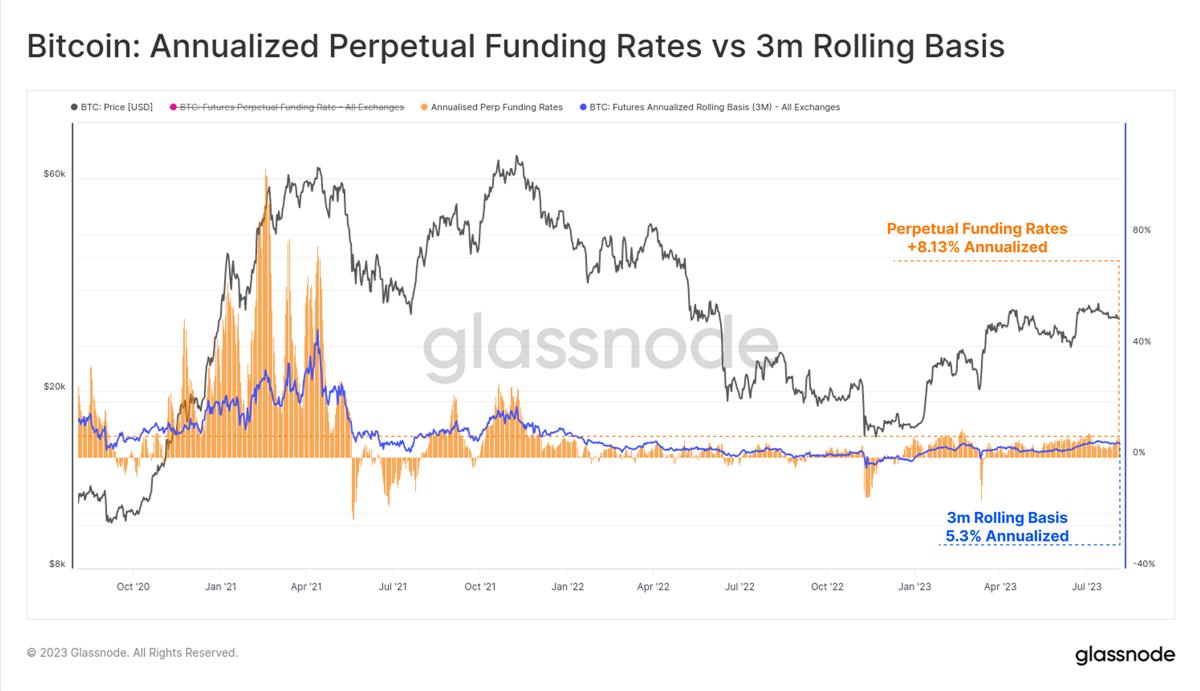
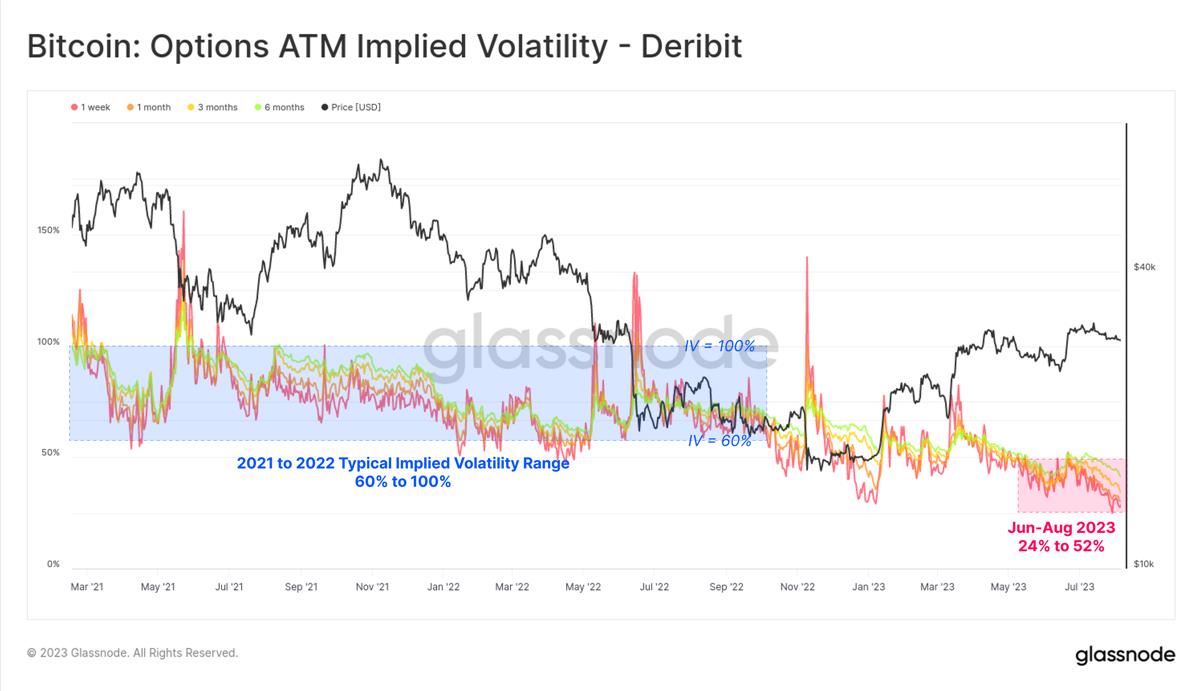
In the options market, we can clearly see the severity of volatility compression, with implied volatility across all expiry contracts falling to historic lows.
Bitcoin is highly volatile; from 2021 to 2022, option trades had implied volatilities consistently above 60%, often exceeding 100%. Today, however, volatility premiums are at their smallest ever, with IV ranging between 24% and 52%—less than half the long-term baseline.
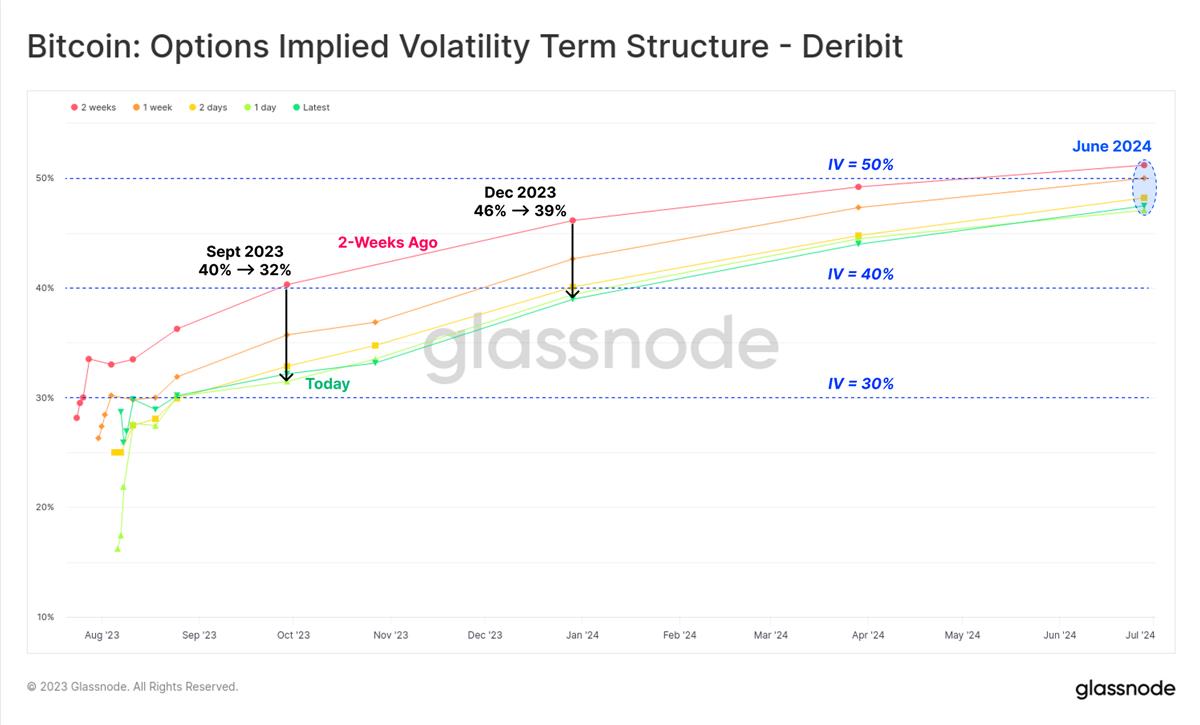
The IV term structure shows that volatility premiums have been contracting over the past two weeks. Just in the past fortnight, the December contract's implied volatility dropped from 46% to 39%. Options expiring in June 2024 have a volatility premium just above 50%, which is relatively low by historical standards.
Both volume and open interest put/call ratios are at or near historic lows, trading between 0.42 and 0.48. This reflects a net long sentiment in the market, with demand for call options remaining dominant.
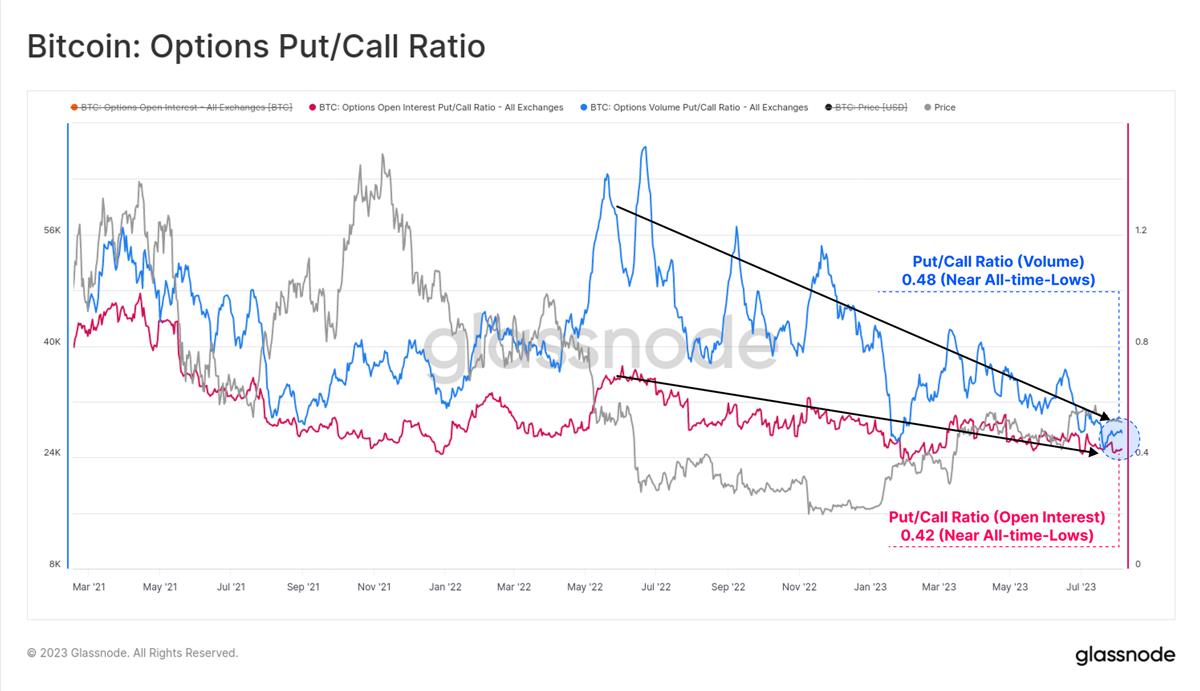
As a result, puts have become increasingly cheap relative to calls, reflected in the historically low 25-delta skew indicator. Overall, this suggests that the options market—which is now comparable in size to the futures market—expects future volatility to remain at historically low levels.
Summary & Conclusion
Few headlines claim Bitcoin is a stable, non-volatile asset, making a sub-10% monthly trading range particularly striking. Currently, market volatility is arguably at its lowest ever, raising questions about whether heightened volatility will truly return.
Futures cash-and-carry arbitrage yields range from 5.3% to 8.1%, slightly above the risk-free rate of short-term U.S. Treasuries. Implied volatility premiums in the options market are at historic lows, especially for put options, where demand is weakest.
Given Bitcoin’s inherent volatility, are we entering a new era of price stability—or is volatility simply mispriced?
Join TechFlow official community to stay tuned
Telegram:https://t.me/TechFlowDaily
X (Twitter):https://x.com/TechFlowPost
X (Twitter) EN:https://x.com/BlockFlow_News
 @glassnode