Podcast Notes | Multicoin Co-Founder: Insights on Modularity, Appchains, and the DePin Sector, Plus a Share of Personal Work Methods
TechFlow Selected TechFlow Selected
Podcast Notes | Multicoin Co-Founder: Insights on Modularity, Appchains, and the DePin Sector, Plus a Share of Personal Work Methods
Ideally, there would be a single asset ledger in the world tracking everyone's ownership. This would be a clear and simple construct.
 Navigating Web3 tides with focused insights
Compiled & Translated by TechFlow
In a recent Lightspeed podcast, Kyle Samani, co-founder of Multicoin Capital and one of the most independent thinkers in the crypto space, shared his insights on the current development across various sectors of the cryptocurrency market. Topics included "integrated L1s," the value of a global ledger, how protocols can build moats, and why DePIN is approaching product-market fit.
Following the thinking of top industry minds often helps us uncover new directions and opportunities.
Spend 5 minutes reading this podcast summary and save yourself 80 minutes.
Below are the key takeaways from the discussion, transcribed and compiled by TechFlow:
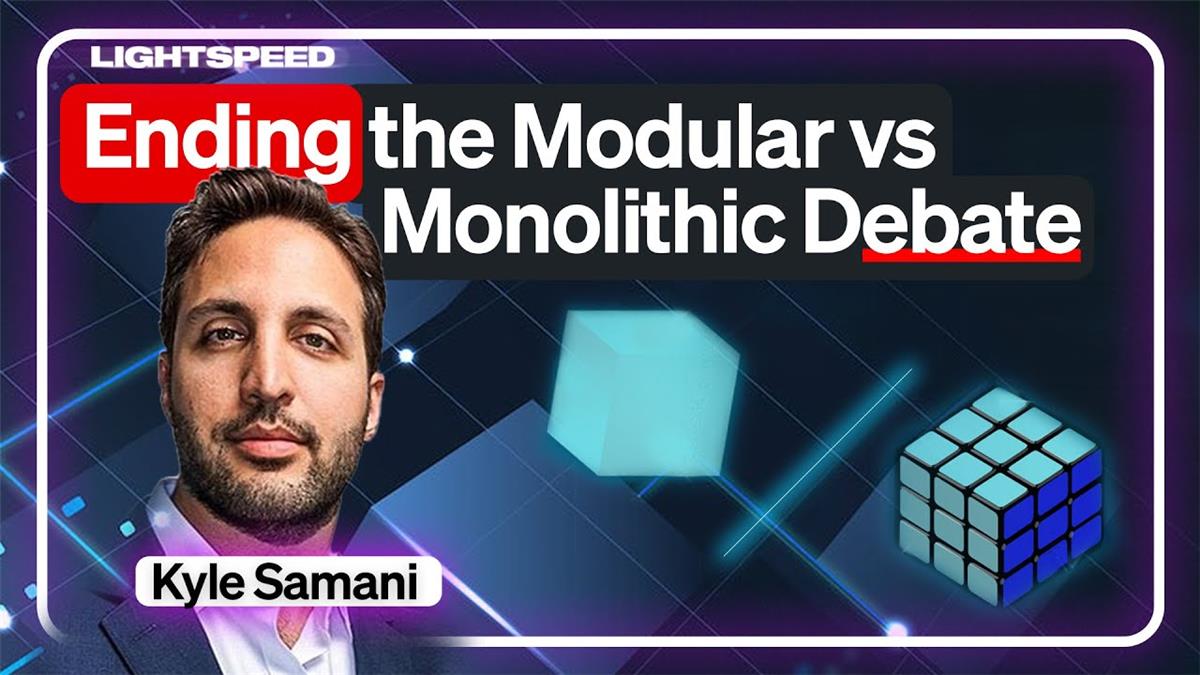
Hosts: Mert & Garrett, Lightspeed (Twitter @0xMert_ and @GarrettHarper_)
Guest: Kyle Samani, Co-founder of Multicoin Capital (@KyleSamani)
Content Ownership: Lightspeed Podcast
Episode: Link
Release Date: August 3
Learning from History: Blockchain Modularity vs. Integration?
-
The hosts brought up a major ongoing debate in crypto: modular vs. monolithic architectures.
-
Kyle argues that “monolithic” is a misnomer — a more accurate term would be “integrated.” He notes that this debate isn’t new and cites historical precedents such as the IBM mainframe model:
-
In early computing, IBM mainframes were fully integrated systems where all components — hardware, operating systems, and applications — were designed and built in-house. This integration ensured stability and efficiency but limited third-party innovation and market entry.
-
Over time, computing shifted toward modular designs, allowing different vendors to supply interchangeable components. This increased flexibility and innovation but introduced complexity and compatibility challenges.
-
Kyle emphasizes that the tension between modularity and integration is not unique to blockchain. The key insight is not to declare one approach universally superior, but to recognize that both can coexist and serve different use cases depending on specific needs.
-
He also highlights the technical complexity of current modular solutions. For example: How do users transfer assets across chains? How do address formats differ across EVM L2s? Most developers underestimate these complexities.
-
Community and financial incentives: Kyle points out a key difference between crypto and other tech markets — the large number of public token holders. Many participants make decisions based solely on their investment positions, and this “holder effect” has no clear precedent in determining technological winners and losers.
-
He adds that financial incentives matter significantly, and the word “community” is often used as an excuse for lack of rigorous thinking.
Rollups vs. App Chains
-
When asked about rollups, Kyle stated he doesn't oppose the concept. However, he believes the Ethereum community overestimates their necessity — in reality, very few applications may actually require them.
-
While rollups can be useful in certain contexts, they are not a one-size-fits-all solution. Kyle advocates choosing scaling strategies based on specific application requirements rather than defaulting to rollups.
-
He notes that app chains aren’t a new idea — Cosmos and Polkadot were among the first platforms to promote them. He frequently speaks with teams at Cosmos and Polkadot about their customized app chains.
-
Regarding app chains, Kyle sees derivatives exchanges as potentially the only compelling use case due to their unique characteristics like high-frequency trading and latency sensitivity. Beyond that, he hasn’t seen any other convincing applications.
-
Different scaling approaches — such as rollups and app chains — have distinct advantages and ideal use cases. The choice should be driven by the specific needs of the application.
Composability and the Global Shared State Ledger
-
Kyle explains the concept of composability. To him, it’s not just about atomic transactions or flash loans — it's fundamentally about enabling different systems and applications to work together seamlessly.
-
He distinguishes between two types of software: abundant software (e.g., infinite video streams, tweets) and scarce software (primarily related to money and finance). His point is to highlight the uniqueness of blockchain technology — while traditional software focuses on abundance, blockchains enable the creation of scarce digital assets.
-
He views blockchains primarily as asset ledgers — systems that track who owns what coins. Ideally, there would be a single global asset ledger tracking ownership for everyone. That would be a clean, simple foundation to build upon.
-
Advantages of a single asset ledger: Kyle believes a unified ledger could scale far beyond expectations while still preserving the social properties inherent to blockchains.
-
Unlike physical systems, blockchains don’t require hundreds of computers in every home to verify data. He contrasts real-world physical rules with digital asset ledgers, emphasizing the global enforceability of asset ownership through a unified ledger.
Moats in Crypto, Bridging to Traditional Worlds, and Solana’s Phone
-
Kyle discusses how crypto projects can build sustainable moats. Unlike traditional companies, they cannot rely on conventional advantages like network effects or economies of scale.
-
Instead, they must find novel ways to defend against competition. One key moat for crypto projects is their community — a strong, active community provides ongoing support and drives innovation.
-
He introduces the term “Meat Space,” referring to the physical world (as opposed to the digital realm). He explores how integrating crypto with real-world products and services can unlock new value. While crypto holds great potential digitally, its real-world applications remain limited.
-
Saga Phone exemplifies this integration — combining crypto-native features like built-in hardware wallets and encrypted communication tools into a consumer device.
-
Kyle expressed interest in Solana Mobile and mentioned owning a Saga phone. While he doubts the phone will sell in large volumes, he values the open-source Solana Mobile Stack (SMS), which is freely available to any Android OEM. He hopes other manufacturers adopt SMS, expanding distribution opportunities.
On DePIN (Decentralized Physical Infrastructure Networks)
-
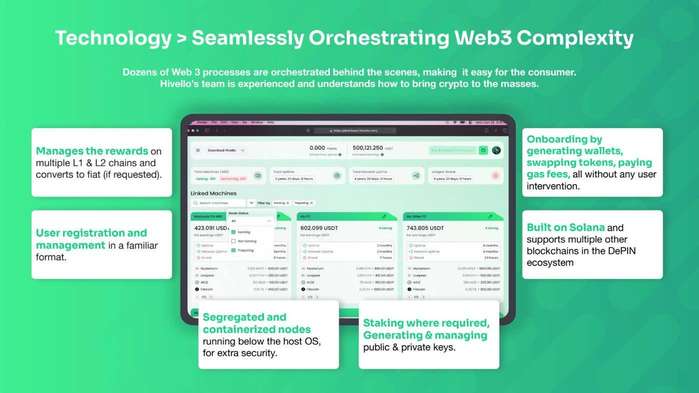
Kyle explains DePIN, stressing the importance of projects that leverage existing user behaviors — such as driving — to create decentralized infrastructure. To succeed, DePIN systems need a structural cost advantage over giants like Google or Amazon.
-
He notes that the easiest path to achieving this cost advantage is repurposing consumer-purchased hardware into income-generating assets.
-
He identifies two types of DePIN networks: GPS-dependent networks and server-based networks. He compares Filecoin and Hive Mapper to illustrate their differences.
-
Using examples like Hive Mapper and Helium, he explains why micropayments are essential. If supply-side participants come from hundreds of thousands of individuals globally, dealing with small amounts across multiple currencies and jurisdictions, blockchain becomes the only viable solution.
-
He stresses the need to reward early adopters. Since early participants take on higher risk — uncertain whether the network will reach critical mass — they should receive greater token rewards.
-
Kyle remains skeptical about claims of GPU irreplaceability and edge computing dominance. He argues that when demand spikes 100x or 1000x, software will inevitably adapt to utilize all available hardware.
On New Spatial Computing
-
Kyle discusses spatial computing as an emerging paradigm, particularly in the context of augmented reality (AR) and virtual reality (VR). He references Apple Vision Pro and its role in shaping this new era.
-
If people begin spending significant time in 3D virtual environments interacting with others and NPCs, those systems will develop their own economies — likely running on crypto rails, which offer a more elegant and acceptable monetary layer.
-
He identifies two major players in VR today: Apple and Meta (formerly Facebook). Apple Vision Pro emphasizes personal computing — productivity and home entertainment — while Quest focuses on social interaction and gaming.
-
On technology adoption: Looking back at desktop computing in the 1980s, adoption was driven by killer apps like Word and Excel. For smartphones, it was calling and texting. For Apple Watch, initial focus was on third-party apps, but evolved toward health and fitness. Similarly, spatial computing will likely follow a trajectory shaped by dominant use cases.
Kyle’s Personal Work and Life Methodology
-
Kyle emphasizes the importance of first-principles thinking. Rather than aiming to be “contrarian,” it’s more valuable to reason from fundamental truths instead of relying on conventional wisdom. This approach encourages re-examining problems from the ground up, rather than accepting existing frameworks.
-
He uses writing to refine his thinking. Writing forces clarity of thought, and through continuous revision, he sharpens his ideas.
-
He recommends that anyone looking to improve their thinking should write regularly — ideally at least one article per week, whether published publicly or kept private.
-
Developing Communication Style: Kyle’s communication style is direct and authentic. He encourages his team at Multicoin to adopt the same tone. Regular writing and self-editing help individuals express themselves more clearly and concisely.
-
Advice for Founders: Don’t blindly follow crypto Twitter. Focus on doing what you believe is right. Once again, he underscores the value of regular writing — not just for improving thought quality, but for noticing everyday experiences or observations worth capturing.
Join TechFlow official community to stay tuned
Telegram:https://t.me/TechFlowDaily
X (Twitter):https://x.com/TechFlowPost
X (Twitter) EN:https://x.com/BlockFlow_News
 深潮TechFlow