How Cloud Gaming Empowers Crypto Gaming in Emerging Markets Under DePin Innovation?
TechFlow Selected TechFlow Selected
How Cloud Gaming Empowers Crypto Gaming in Emerging Markets Under DePin Innovation?
Shaga goes beyond the positioning of "yet another cloud gaming platform" by building a decentralized, user-driven network that fundamentally transforms the underlying logic of game distribution, experience, and monetization.
 Navigating Web3 tides with focused insights
Author: Joey Shin @IOSG
Congratulations to Shaga on completing its latest funding round led by IOSG! We are honored to support Shaga in delivering unique value to the gaming industry through DePIN.

Pain Points and Opportunities in Cloud Gaming
The rapid development of cloud gaming has always faced a persistent challenge: despite continuous technological advancements, inherent limitations of centralized architectures still result in significant latency. Data shows that traditional cloud gaming services introduce 40–150 milliseconds of additional delay compared to local execution—an increase of 85%–800%.
Physical proximity and network distribution are critical for optimal experience—deploying game nodes closer to end users can dramatically reduce latency. However, building large data centers across multiple regions is both inefficient and costly.
Industry Landscape
Advantages of P2P Networks
Market Supply Alignment
Google attempted to solve this issue with its cloud gaming platform Stadia. While Stadia's failure can be attributed to various factors such as marketing missteps and mismatched user demand, an often-overlooked core reason lies in unfulfilled technical promises. Its claimed "negative latency" is unachievable under existing technical architectures, as latency ultimately remains bound by the physical laws of distance.
Similar issues persist widely. Take Xbox Cloud, which serves 40 million users but suffers from latency due to reliance on centralized data centers that are typically underutilized and located far from users. This setup may suffice for casual or single-player games, but clearly falls short for competitive or multiplayer gamers seeking immersive, high-performance experiences.
Industry Landscape
Advantages of P2P Networks
Market Supply Alignment
Cloud gaming’s unique characteristics make it an ideal testing ground for distributed networks:
-
Reducing physical distance and optimizing network distribution are key to lowering latency
-
High-quality service can be delivered without requiring massive hardware infrastructure
This is precisely where P2P networks outperform centralized cloud solutions: on one hand, P2P nodes can be placed much closer to end users; on the other, they eliminate the need for expensive, large-scale data centers—consumer-grade hardware suffices to deliver premium service while reaching areas traditionally underserved by conventional infrastructure.
Industry Landscape
Advantages of P2P Networks
Market Supply Alignment
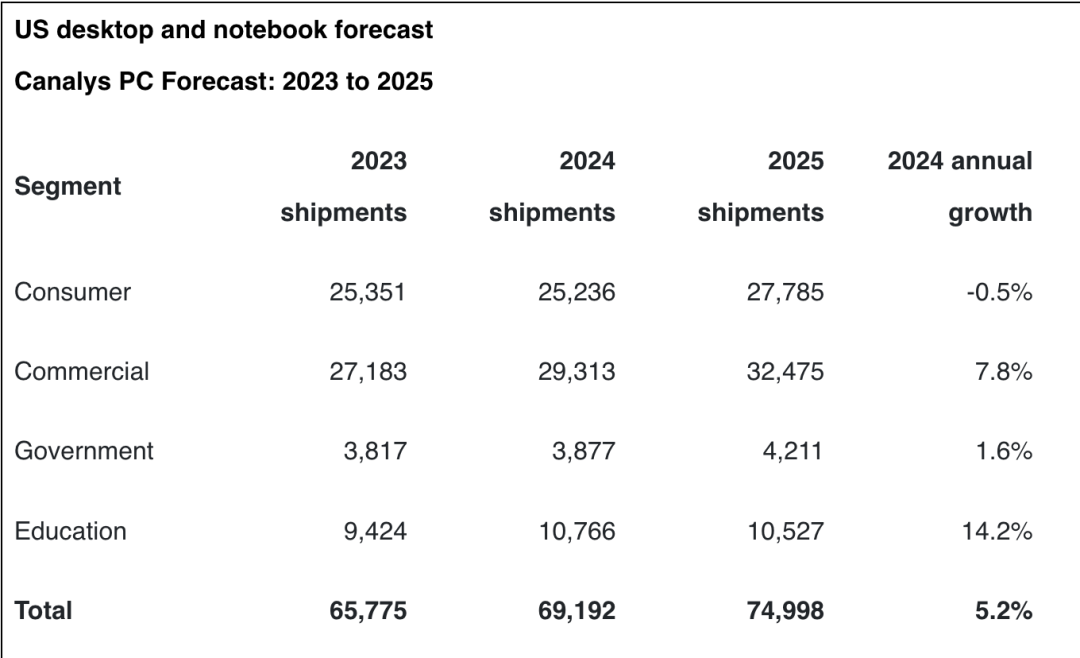
According to Canalys, there are currently 2 billion gaming PCs globally, with 100 million new units added annually. While PC production continues to grow, device utilization for entertainment purposes has not kept pace. Meanwhile, gaming demand is growing exponentially.
The contradiction between idle high-performance devices and surging gaming demand creates an opportunity for P2P cloud gaming networks: by aggregating unused computing power, they can serve players who need low-cost, high-quality game access—especially users in emerging markets who cannot afford dedicated hardware.
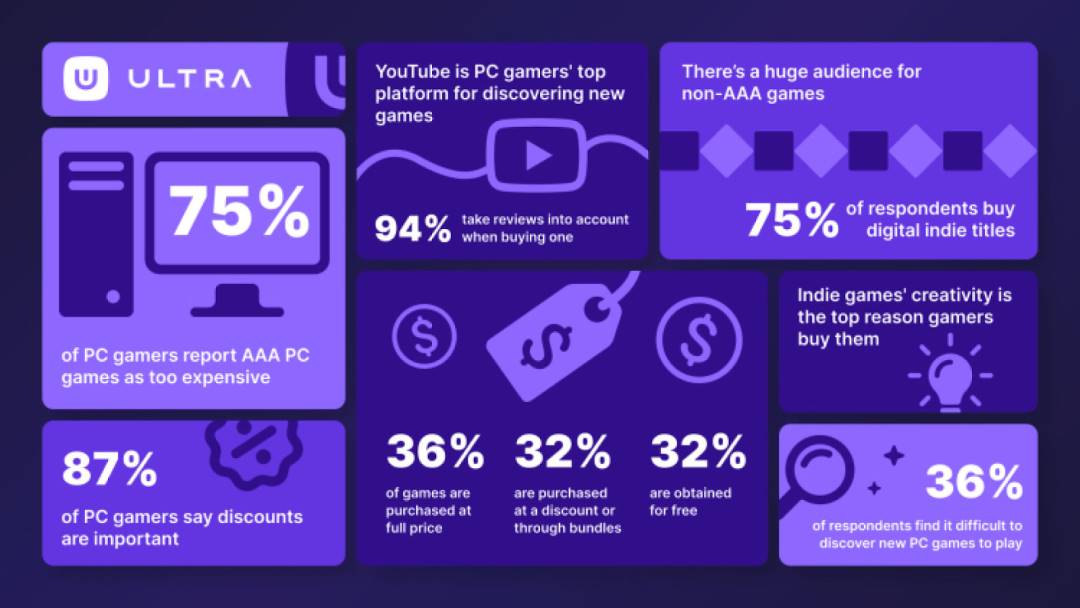
Therefore, we believe edge computing and ultra-low-latency cloud gaming are poised to become mainstream game distribution methods, much like how streaming platforms have made content delivery more flexible and accessible.

Shaga’s Solution
Shaga is a DePIN project within the Solana ecosystem, focused on achieving the lowest possible latency through edge computing.
Shaga leverages edge computing to deliver cloud gaming experiences: any user can set up a node and share gaming resources. Compute providers can fully utilize their optimized gaming hardware, while players enjoy high-performance, low-latency gaming at lower costs. Through this model, owners of gaming PCs can turn their devices into micro data centers at zero cost and earn passive income. Importantly, participation in the DePIN network does not require purchasing custom Shaga hardware, significantly lowering the barrier to entry.
While Shaga supports both Web2 and Web3 games, its innovative support for Web3 gaming stands out: via controllers equipped with built-in hardware wallets, blockchain interactions are seamlessly enabled without user awareness.
Comparison with Web2 Competitors
Compared to Web2 cloud gaming giants, Nvidia and Xbox may have larger user bases, but they all face limitations:
-
Higher latency
-
Limited game offerings
-
Service performance fluctuates based on user proximity to data centers
Shaga aims to stand out through the following advantages:
-
Decentralized cloud gaming model
-
Edge computing to minimize latency
-
AI-enhanced gaming experience
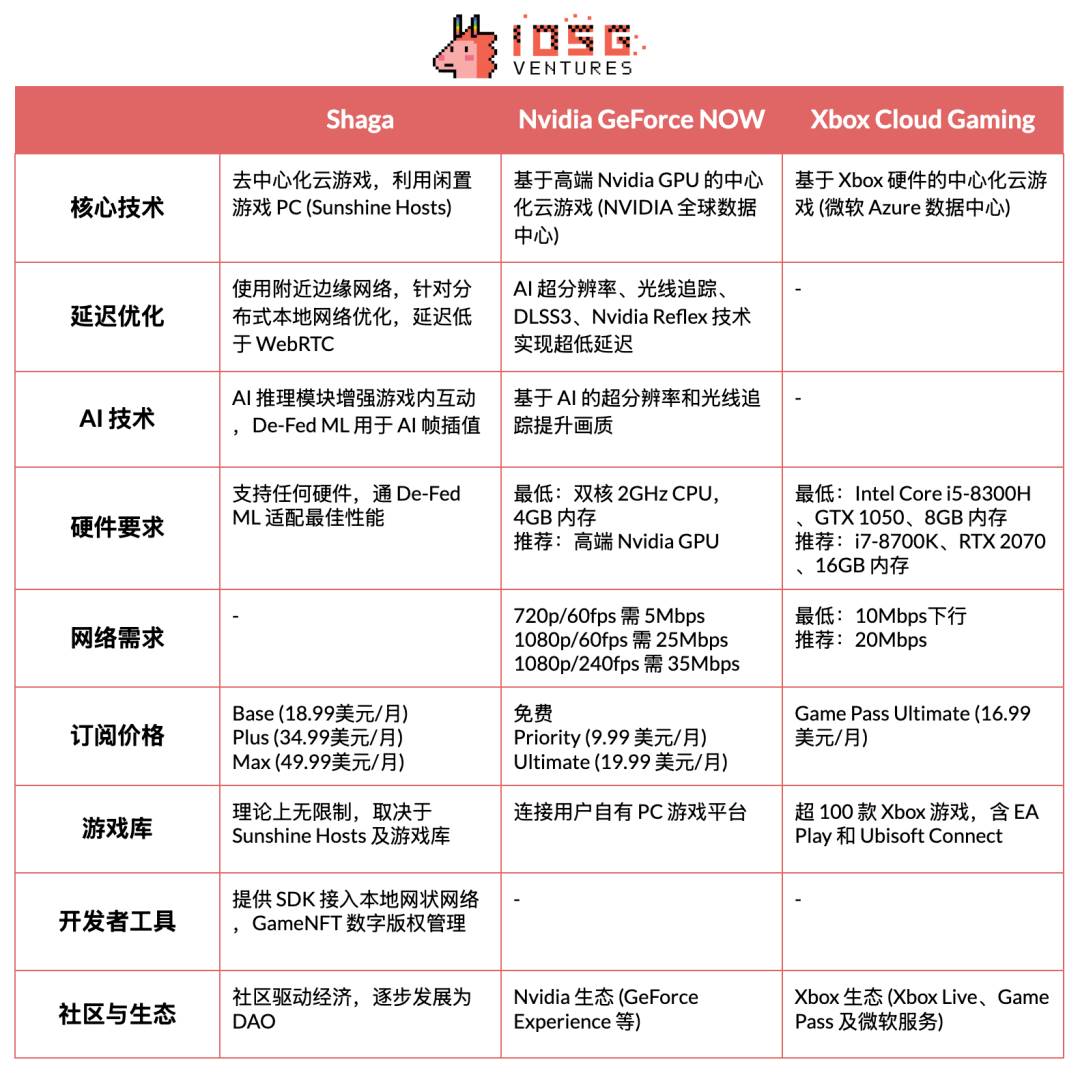
▲ Source: IOSG
Comparison with Web3 Competitors
Although numerous Web3 projects currently explore gaming and decentralized computing, their technical approaches and product positioning differ significantly:
-
Aethir focuses on enterprise-grade GPU compute services but centers on data centers, making it closer to traditional Web2 solutions;
-
iAgent primarily targets AI agent training;
Deeplink also operates in cloud gaming, but latency and security are not central design considerations, and it mainly relies on centralized compute supply from miners and internet cafes.
In contrast, Shaga specializes in cloud gaming and builds a unique competitive advantage through its “distributed node network + social incentive system”—delivering low-cost, low-latency, high-fidelity cloud gaming while enhancing player retention via social tasks and token rewards.
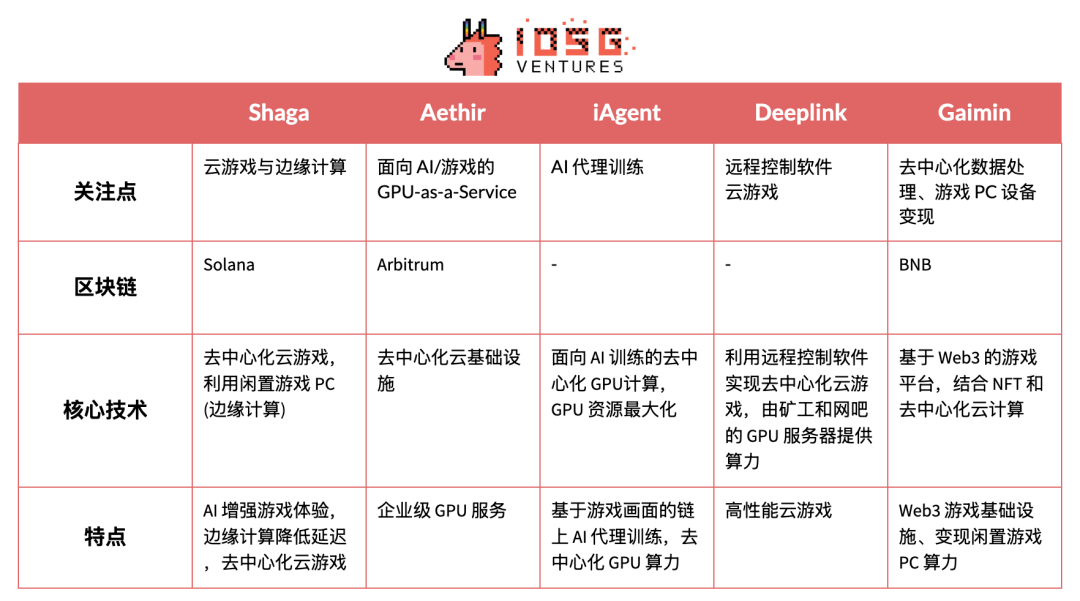
▲ Source: IOSG

Use Cases
#Mobile Gaming Experience
Imagine you don’t own a gaming PC, or you’re away from your personal device—whether at a café, library, or traveling—and want to play a high-quality game anytime. Without carrying a powerful laptop or relying on remote cloud servers, simply open Shaga on any device (tablet, phone, or lightweight notebook) to “borrow” nearby node computing power and enjoy low-latency, high-fidelity gaming anywhere, anytime.
#Local Multiplayer Gaming
Shaga is more than just a gaming platform—it’s also a social platform. Leveraging its edge computing infrastructure, Shaga enhances not only single-player experiences but also revolutionizes localized multiplayer games like *Super Smash Bros.*, *FIFA*, and *Tekken*. Through the FriendGrid system, users can engage in real-time multiplayer battles even when physically apart.
#Interactive Game Streaming
Game streaming is a massive market with 7 million active streamers and 35 million daily active viewers. Shaga enables streamers to directly collaborate with select audiences via a “one-click screen sharing” feature, adding a new dimension of social interaction. By transforming passive viewing into active participation, Shaga creates a more immersive experience.
We believe this is just the tip of the iceberg—the expansion of use cases will allow Shaga to deliver uniquely valuable experiences to the gaming community.
#User-Centric Design
Shaga is built around the needs of end users—both node providers and gamers. Node providers can leverage their idle computing resources to create value and earn passive income, while players enjoy an exceptional cloud gaming experience. Moreover, through the FriendGrid social system, gameplay becomes inherently more social and immersive.
To ensure high-quality user experience, Shaga plans to implement cloud-based game state saving with periodic checkpoints. If a node fails, the game can instantly resume on another node using the saved state. In the future, Shaga will also introduce a staking and reputation system, using game-theoretic mechanisms to incentivize high-quality node operators.

Team
The Shaga team is deeply focused on crafting exceptional user experiences. We believe they will redefine how people interact with games—not only within the Web3 space but also influencing the broader Web2 ecosystem. Shaga transcends being “just another cloud gaming platform,” building instead a decentralized, user-driven network that fundamentally reshapes the underlying logic of game distribution, experience, and monetization. Visit https://shaga.xyz to try it out, or follow updates on X (https://x.com/playonshaga).
Once again, congratulations to Guido, Daeshawn, and the entire Shaga team. We look forward to witnessing this journey and are proud to be part of it!
Join TechFlow official community to stay tuned
Telegram:https://t.me/TechFlowDaily
X (Twitter):https://x.com/TechFlowPost
X (Twitter) EN:https://x.com/BlockFlow_News
 IOSG Ventures