DePIN + AI is writing the prelude to a new era of DePIN robots
TechFlow Selected TechFlow Selected
DePIN + AI is writing the prelude to a new era of DePIN robots
The establishment of DePIN robot networks means that, leveraging the power of decentralized networks, robot data collection, computing resources, and capital investment can be coordinated on a global scale.
 Navigating Web3 tides with focused insights
Executive Summary
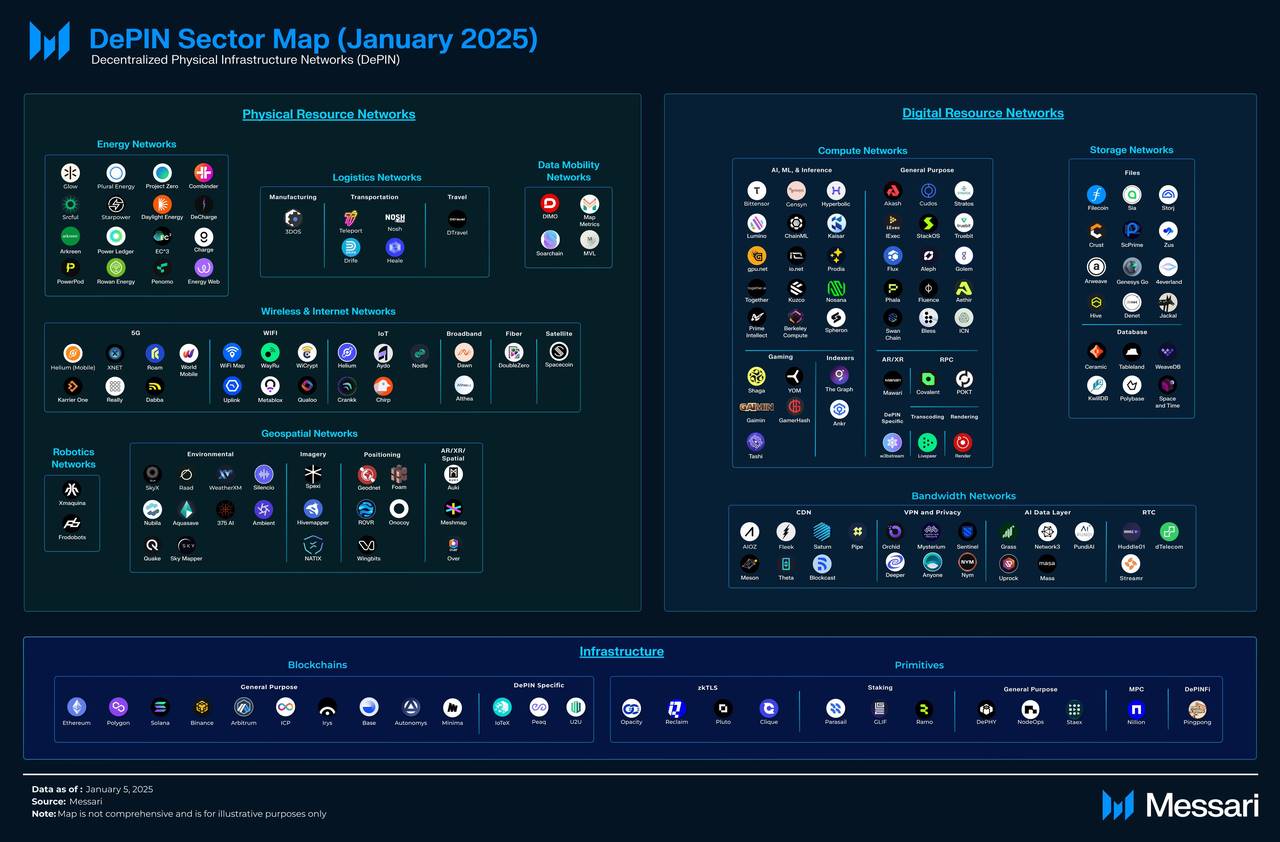
Grayscale’s Q2 top assets added three new projects, two of which are related to DePIN. According to Messari, the DePIN sector has grown to a $50 billion market cap. While first-quarter funding slightly increased compared to last year, the number of projects significantly decreased—indicating that DePIN is maturing.
Last month, Messari collaborated with FrodoBot Lab to explore the paradigm revolution of robotics in the AI era driven by DePIN+AI. The key insight is that embodied AI development depends not only on algorithms but also on hardware upgrades, data accumulation, capital support, and human participation. Historically, robot innovation was hindered by high costs and dominance from large corporations. Now, DePIN-powered robotic networks enable global collaboration in data collection, computing resources, and capital investment. This accelerates AI training and hardware optimization while lowering barriers to entry for researchers, entrepreneurs, and individual users. The vision is to shift robotics away from reliance on a few tech giants toward an open, sustainable, community-driven technological ecosystem.
1. DePIN+AI: Building the Robotic Paradigm of the AI Era
On February 27, Messari hosted a podcast titled “Building Decentralized Physical Artificial Intelligence,” featuring Michael Cho, co-founder of FrodoBot Lab. During the discussion, Michael explored opportunities and challenges at the intersection of DePIN and AI in robotics.
Following Messari's amplification, the concept of DePIN robots quickly gained traction, sparking widespread discussions online.
This week, our industry insights focus on analyzing this emerging trend.
Before diving into details, let’s first examine how AI itself is evolving across its core domains:
-
Compute: Nvidia’s quarterly revenue has grown fivefold over the past three years;
-
Bandwidth: Data center construction in North America has also increased fivefold over the same period;
-
Energy: Companies like OKLO require 12.0GW, and TerraPower needs 4.0GW;
-
Data: Large companies spend over $500 million annually purchasing wholesale data for AI model training.
Despite broader global economic slowdowns, AI—projected as the defining technological revolution of the next decade or two—is growing at multi-year acceleration rates, driving all related sectors (compute, energy, data) forward.
However, rapid advancement brings rising concerns. If AI compute (like car engines), large models (controllers), energy (fuel), and data (raw materials) are controlled by just a few centralized firms, we risk creating an era of absolute centralization and technological monopolies—an existential Pandora’s box.
To counter this concentration, a new direction has emerged: DePIN+AI. We at DePIN ONE define this convergence as DePAI, where DePAI = DePIN + AI.
How Can DePAI Help Make AI More Decentralized?
We expand upon the key points discussed in last month’s Messari podcast with Michael Cho.
Current AI systems, despite their diverse functions, mostly process superficial digital information such as text. This data lacks depth, context, and sensory richness. In contrast, DePIN networks can serve as AI’s “senses” and “limbs.”
The “senses” allow AI to perceive the real world comprehensively. Developers are already using tools like ioID and W3bstream to connect physical devices to blockchains, verifying real-world activities via zero-knowledge proofs.
The “limbs” enable AI to act based on perception—making precise decisions and executing actions—thus completing the cycle from “training” → “modeling” → “automation.”
1. DePIN Enables More Authentic and Diverse AI Data
Unlike traditional “online” AI models trained on vast internet datasets, DePIN devices interact directly with the physical world, generating authentic, real-time data. Only through such real-world data can AI-powered robots develop true embodied intelligence.
Since DePIN is still in early stages, there is currently no large-scale infrastructure for collecting this kind of data, nor consensus on best practices.
We believe future DePIN+AI data will fall into three main categories:
-
Human operation data: Generated when humans manually control robots. High-quality and rich in video streams and action labels—capturing what humans see and how they react. This is the most effective way to train AI to mimic human behavior, though it comes with high cost and labor intensity.
-
Synthetic (simulated) data: Useful for training robots in complex terrains, such as walking on rough ground. However, for highly variable tasks like cooking, simulation falls short. Consider training a robot to fry an egg: minor variations in pan type, oil temperature, or ambient conditions drastically affect outcomes—scenarios difficult to replicate fully in virtual environments.
-
Video learning: Training AI models by observing real-world videos. While promising, this method lacks direct physical interaction and feedback essential for true embodiment.
With access to these data types, the capabilities of AI’s embodied intelligence would be greatly enhanced.
2. DePIN Maximizes Capital Efficiency and Promotes True AI Decentralization
Traditional AI relies solely on computational power. In contrast, intelligent robotics requires deploying actual physical hardware—a major capital hurdle.
Robotics development is prohibitively expensive; only well-funded corporations can afford large-scale experimentation. Even efficient humanoid robots today cost tens of thousands of dollars, making mass adoption impractical.
Considering hardware, data, and evaluation challenges, general-purpose robot AI remains far from widespread use.
Here, DePIN offers hope.
A decentralized network can distribute financial burdens efficiently, enabling small teams and startups to participate. To accelerate progress and improve human-likeness, robotics development must be decentralized—not monopolized by a few giants. Instead of one company funding thousands of robots, individuals worldwide could contribute to a shared network.
Moreover, DePIN accelerates data collection and evaluation.
Rather than waiting for a single company to deploy limited units, decentralized networks can run in parallel at scale, gathering data rapidly.
For example, in a recent AI vs. human robot competition in Abu Dhabi, researchers from DeepMind and UT Austin tested their AI models against human players. Though humans still outperformed, the team was excited about the unique dataset gathered from real-world interactions. This highlights the need for subnetworks connecting various components of robotics technology. Even if full autonomy remains distant, DePIN already delivers tangible value—from data collection and training to real-world deployment and validation.
Furthermore, DePIN enables faster, lower-cost deployment of AI robots.
A concrete example: FrodoBot Lab partnered with a DePIN project to secure two boxes of NVIDIA H100 GPUs—each containing eight H100 chips—providing critical compute power to process and optimize real-world robot data. Without such resources, even the most valuable datasets remain underutilized. By democratizing access to decentralized computing infrastructure, DePIN allows global researchers to train and evaluate models without being constrained by GPU ownership. If DePIN successfully crowdsources both data and hardware advancements, the future of robotics may arrive sooner than expected.
3. DePIN Enhances Commercial Efficiency for AI and Embodied Intelligence
Sam, an AI agent (a travel KOL robot powered by a meme coin), exemplifies a new monetization model enabled by decentralized robotic networks.
Sam operates autonomously, streaming live 24/7 across multiple cities, while its associated meme coin appreciates in value.
This model shows how DePIN-driven intelligent robots can sustain themselves financially through decentralized ownership and token incentives. In the future, such AI agents might pay human operators in tokens, rent additional robot assets, or bid on real-world tasks—creating a virtuous economic loop benefiting both AI developers and DePIN participants.
Outlook
The advancement of embodied AI depends not only on algorithms but also on hardware upgrades, data accumulation, funding, and human involvement.
Historically, robotics innovation was stifled by high costs and corporate gatekeeping. Now, DePIN robot networks offer a path forward—leveraging decentralized networks to coordinate global data collection, computation, and capital investment. This accelerates AI training and hardware refinement while lowering entry barriers, inviting more researchers, entrepreneurs, and individuals into the ecosystem.
We envision a future where robotics no longer depends on a handful of tech giants, but is instead advanced collectively by a global community—ushering in a truly open and sustainable technological era.
2. DePIN Sector Data & Observations
1. DePIN Represents Just 0.1% of the Multi-Trillion-Dollar AI Market
The number of DePIN projects grew from 100 in 2022 to 1,170 in 2024. Market cap surged from $5 billion to $50 billion, and active node rates jumped from 2% to over 50%. Yet, DePIN still accounts for only 0.1% of the trillion-dollar AI market—implying 100x–1,000x growth potential.
2. DePIN Funding Amounts Rise While Deal Counts Fall
Messari data shows DePIN funding remained flat year-over-year, with higher amounts but fewer deals in Q1 2025.
Q1 2024: 62 rounds totaling $156 million.
Q1 2025: 36 rounds totaling $159 million.
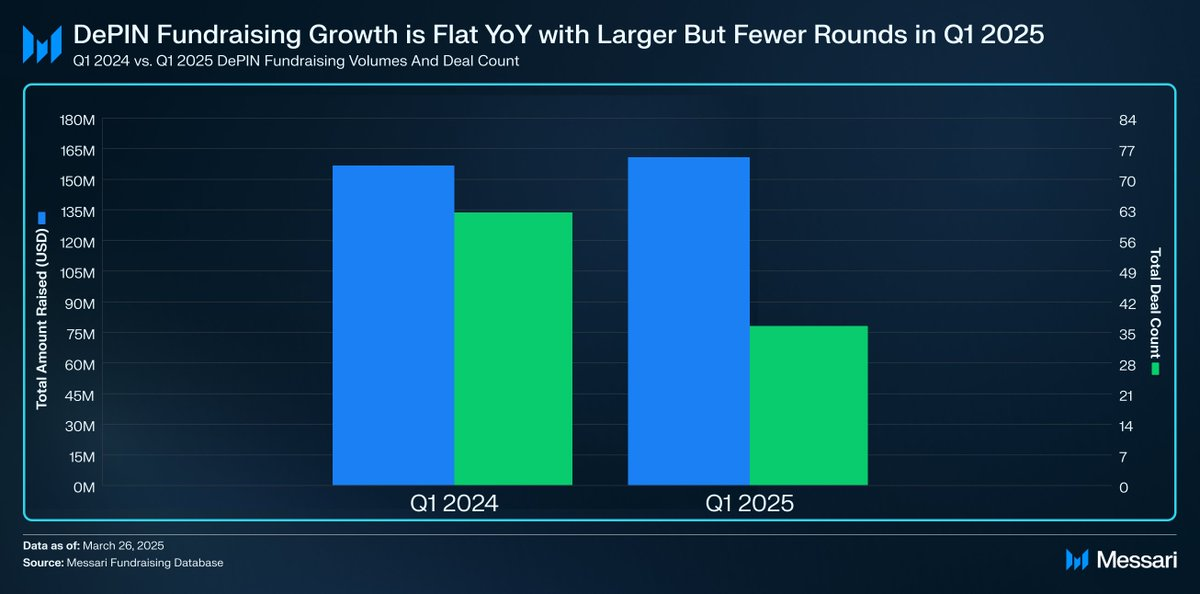
This indicates fewer early-stage startups entering the space, while mature DePIN projects are scaling up.
Market share for leading DePIN projects globally remains tiny, signaling early-stage opportunity across all verticals:
- Wireless: 0.002% (Helium)
- Compute: 0.03% (Filecoin)
- Energy: 0.001% (Daylight)
- Identity: 0.2% (Worldcoin and Anymal)
In the AI agent market specifically, revenue is projected to grow from $520 million in 2024 to $196.6 billion by 2034, representing a CAGR of 43.8%.
3. Grayscale Releases Q2 Report, Highlights RWA, DePIN, and IP Tokenization
Grayscale released its Q2 2025 report, emphasizing RWA, DePIN, and IP tokenization. Three new tokens were added to its Top 20 list: IP, SYRUP, and GEOD, replacing Akash Network, Arweave, and Jupiter.
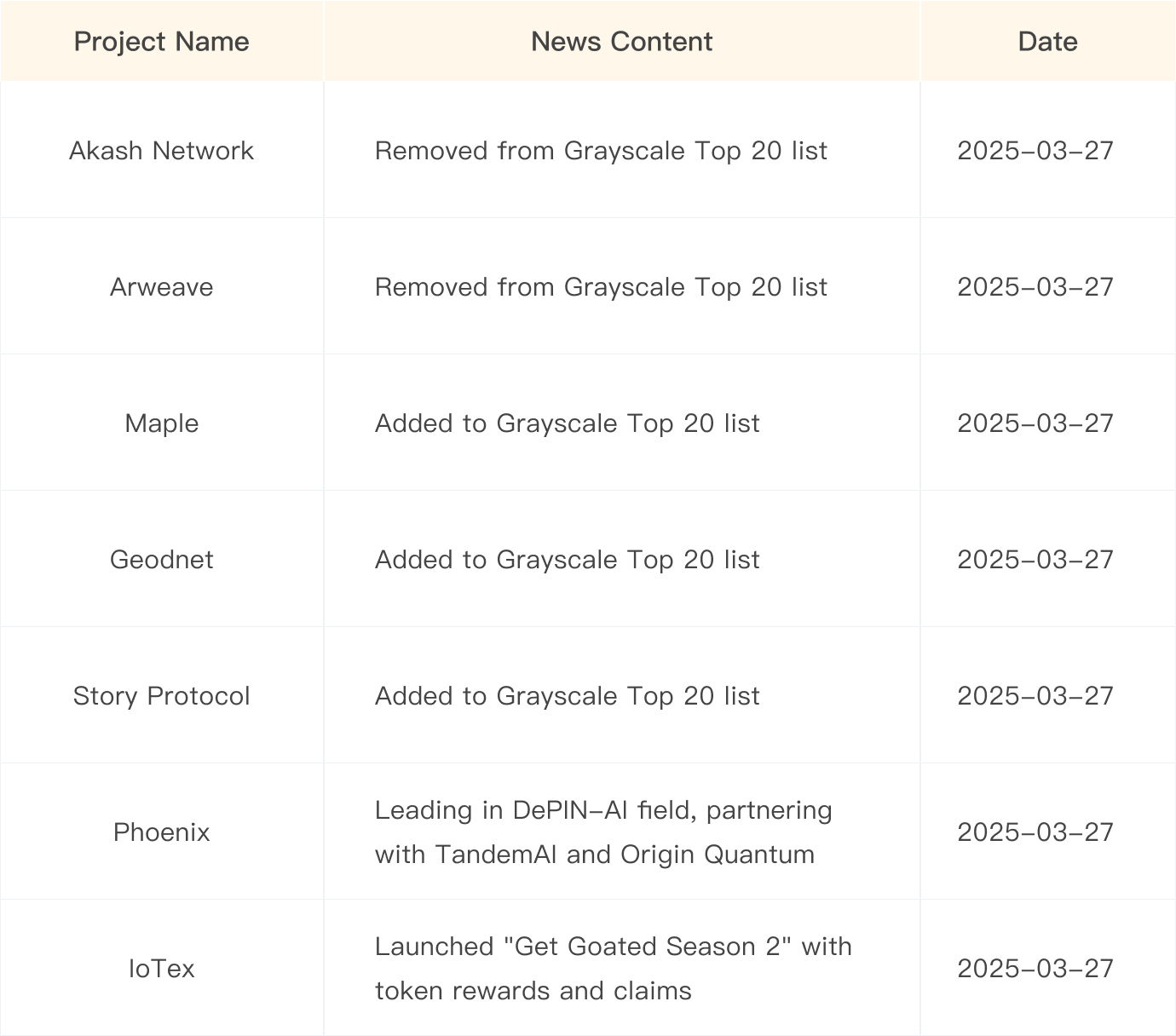
The report states Grayscale is focusing on tokens reflecting non-speculative, real-world blockchain applications, categorized into three areas: RWA (real-world assets), DePIN (decentralized physical infrastructure networks), and IP (intellectual property tokenization).
Of the three newly added assets—Maple (SYRUP), Geodnet (GEOD), and Story (IP)—two are DePIN projects:
-
Geodnet (GEOD): A DePIN project collecting real-time positioning data. As the world’s largest real-time kinematic (RTK) provider, Geodnet delivers centimeter-level geospatial accuracy, offering affordable solutions for users like farmers. It may also provide value for autonomous vehicles and robots in the future. The network spans over 14,000 devices across 130 countries. Its annualized network fee revenue over the past 30 days has exceeded $3 million (up ~500% YoY). Notably, GEOD has a relatively low market cap and limited exchange listings compared to other Top 20 assets, implying higher risk.
-
Story Protocol: Focused on blockchain-based intellectual property management, it leans more toward decentralized applications than physical infrastructure, placing it at the edge of the DePIN category (Story Protocol). Story aims to tokenize the $70 trillion IP market. In the AI era, proprietary IP is used to train models, leading to copyright disputes and lawsuits—such as the legal battle between The New York Times and OpenAI. By bringing IP on-chain, Story enables companies to license their IP for AI training while allowing individuals to invest in, trade, and earn royalties from IP. Story has already brought songs by Justin Bieber and BTS on-chain and launched an IP-focused blockchain and token in February.
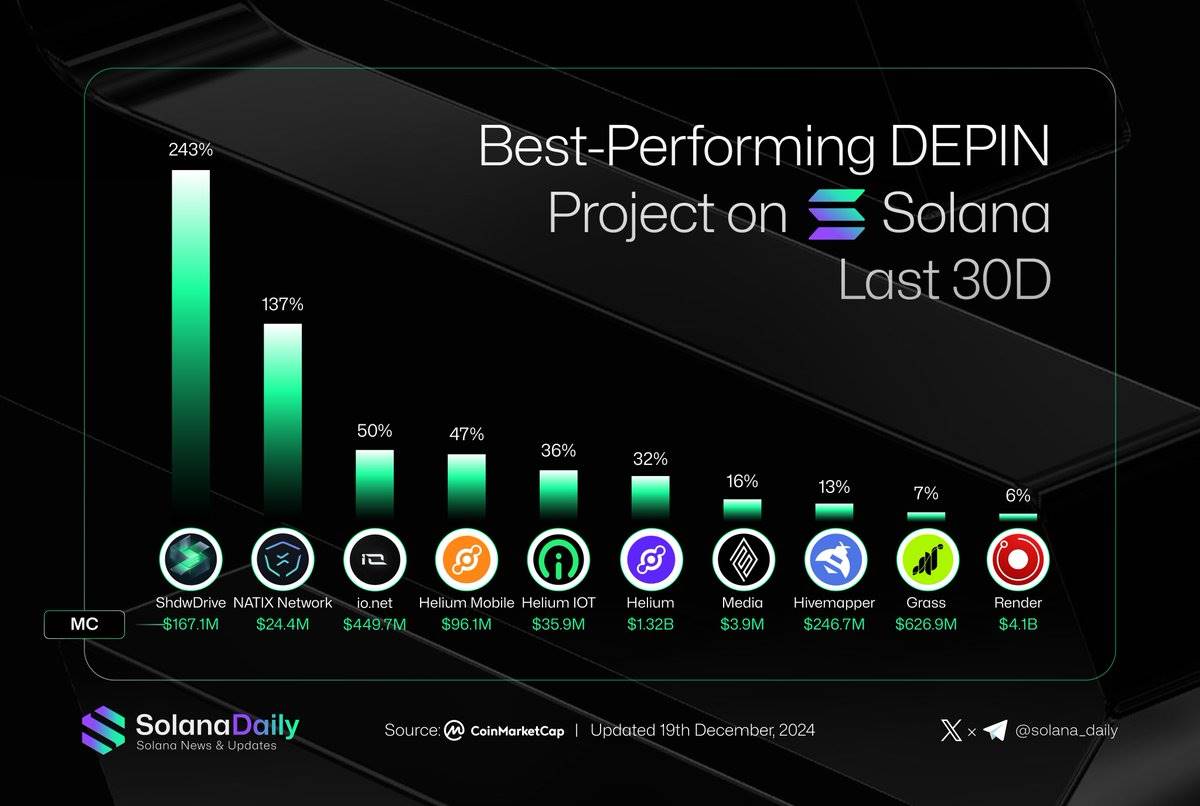
4. Top DePIN Project Revenues Over the Past 30 Days
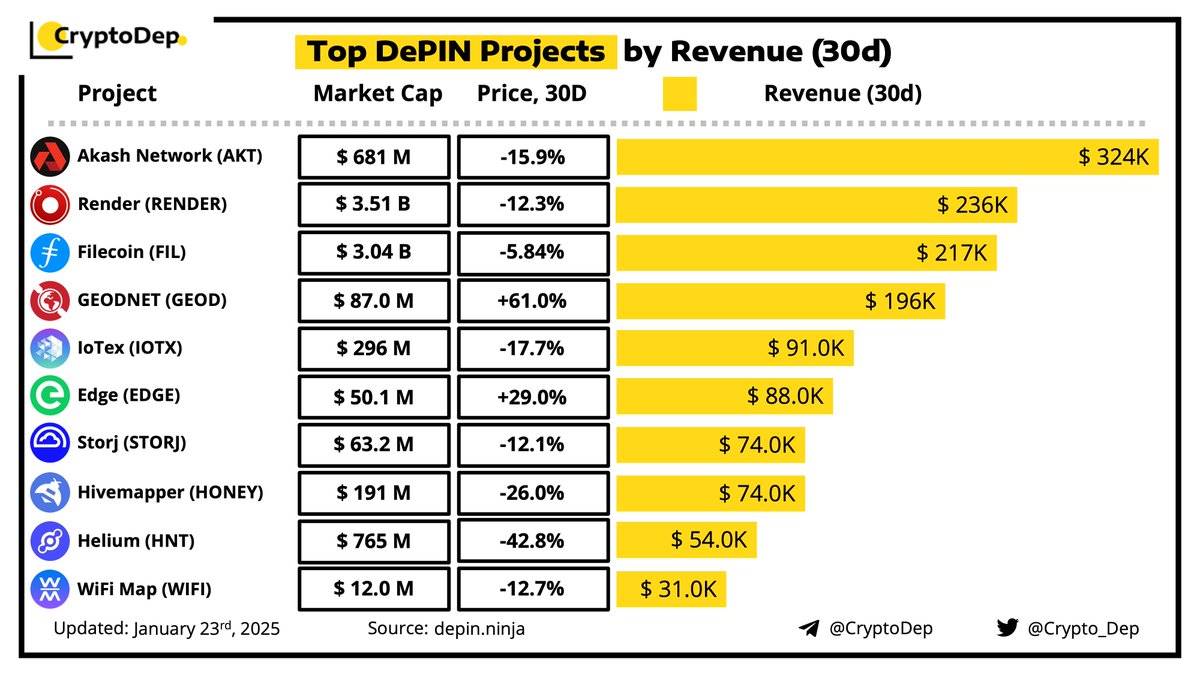
Solana’s top-performing DePIN projects over the past 30 days
5. Industry Event Tracking
-
Roam, the essential Web3 networking service for global travelers, now boasts 2.8 million nodes worldwide, enabling cross-border seamless roaming at 30% of traditional carrier costs. Roam plans to launch incentive mechanisms in H2 2025, turning spatiotemporal data collected by distributed nodes into fuel for training vertical AI models.
-
Phoenix partners with TandemAI and Origin Quantum to integrate AI with decentralized physical infrastructure, strengthening its leadership position in the DePIN-AI space.
-
IoTeX launched “Get Goated Season 2,” involving token rewards and claim procedures. The $IOTX claim window closed on March 27; unclaimed tokens have been returned to the IoTeX treasury pool. Sponsors include Geodnet, Uprock, Drop Wireless, and Network3. The next claim window opens April 7, with review dates from March 28 to 31, verified via zkPass. This initiative may boost community engagement and attract more users to the IoTeX ecosystem.
-
According to Messari’s Helium Q4 report, Helium network operations saw significant growth: operator data offload increased 555% MoM to 576TB, mobile hotspots rose 14% to 24,800, and daily paid mobile traffic grew 99%, demonstrating disruptive potential in telecom. Helium also unified $HNT as its sole token via HIP 138, optimizing its economic model, and announced a partnership with Telefónica to enter Mexico, covering 2 million Movistar users. Additionally, Helium was included in Grayscale’s top 20 monitored tokens and listed in Coinbase’s COIN50 index, attracting institutional interest. In smart city applications, the network is already used for flood monitoring and wildfire alerts in the U.S. Through its DePIN (Decentralized Physical Infrastructure Network) model, Helium continues to solidify its leadership in the Web3 telecom space.
6. Funding Updates
-
GLIF, the largest DeFi protocol on Filecoin, launched its governance token $GLF and airdropped 94 million tokens (9.4% of total supply). $GLF will expand into loyalty rewards and other features. GLIF is extending beyond the Filecoin ecosystem into broader DePIN networks. Currently, GLIF has over $102 million in TVL on Filecoin and plans to support more DePIN platforms in the future.
-
Domin Network, a decentralized business network, announced strategic investments from Animoca Brands, KuCoin Labs, Web3Labs.club, IBC Group Official, DWF Ventures, Presto, Outlier Ventures, KnightFury, ThreeDAO, Awakening Ventures, and AB DAO. Domin Network connects software, hardware, and consumer behavior data on-chain using NFTs and DePIN Rollup technology, rewarding users with crypto for sharing consumption data.
Join TechFlow official community to stay tuned
Telegram:https://t.me/TechFlowDaily
X (Twitter):https://x.com/TechFlowPost
X (Twitter) EN:https://x.com/BlockFlow_News
 @DePINoneLabs