








Understanding the Latest Developments and Practical Features of DeSci
TechFlow Selected TechFlow Selected
Understanding the Latest Developments and Practical Features of DeSci
DeSci is more inclusive than the broader web3 ecosystem and traditional science, aligning with the ideals of decentralization.
 Navigating Web3 tides with focused insights
Written by: DAOrayaki
Decentralized Science, or DeSci, is an expanding movement within the web3 space exploring how blockchain-based solutions can improve issues in scientific research such as publishing and funding. This movement resonates with the principles and practices of open science, aiming to make scientific knowledge more accessible, inclusive, equitable, and sustainable. The movement gained momentum when a group of scientists, technologists, and crypto enthusiasts began exploring decentralized funding channels such as DAOs, science NFTs, token launches, and crowdfunding. Due to the nascent nature of the ecosystem, many definitions are still evolving—including whether distributed ledger technology is an essential component of what qualifies as a DeSci project.
Decentralized Science aims to address some of the problems in traditional science, such as funding allocation and decision-making. Currently, most scientific funding decisions come from a small number of centralized or governmental sources, which are known to carry biases (e.g., preferences for established labs, male-led projects, or politically aligned initiatives). This results in chronic underfunding across many scientific fields, especially for more disruptive lines of inquiry. Such a closed-group approach also excludes broader community participation, including communities directly impacted by the research. A decentralized approach could help address this gap.
The Gitcoin Grants program is an initiative run by the Gitcoin DAO in the cryptocurrency space aimed at funding public goods. Through this platform, the community has the opportunity to directly support projects via donations, which are then matched with funds from specific partner pools. The matching amount follows a quadratic funding mechanism, meaning the number of donors matters more than the size of individual contributions.
In September 2022, Gitcoin hosted a DeSci-focused round (GR15), resulting in $568,000 being allocated to 82 projects within the ecosystem. This influx of support enabled many DeSci projects to advance to their next stages. TalentDAO and DeSciWorld conducted an analysis to examine the impact and contributions of these donations to the DeSci ecosystem—exploring what these projects are and what they achieved using the received funds. This report covers 41 out of the 82 Gitcoin Round 15 DeSci projects that responded to a survey on their achievements, challenges, needs, resources, funding, and demographics.
Survey Overview
We posed 21 questions covering identifiers such as project purpose, affiliations, team composition, and perceived achievements. We also included open-ended questions to allow respondents to elaborate on their needs, obstacles faced, and accomplishments during the GR15 round.
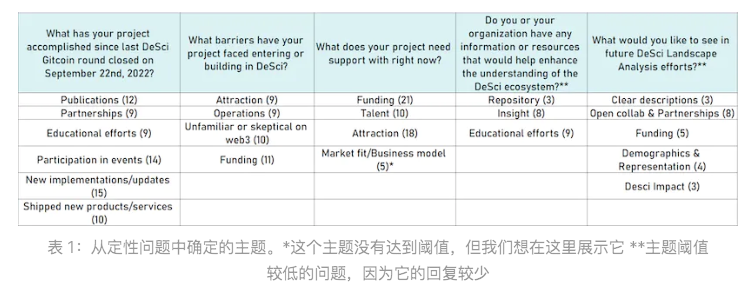
To analyze information from the open-ended responses, we used inductive content analysis coding—an exploratory method allowing themes to emerge directly from the data. We identified these themes and then categorized participant responses according to a selected list of thematic codes. We set a threshold for each theme, requiring at least nine responses before considering it significant. The aggregated counts are shown below:
DeSci Projects Achieved Progress Across Multiple Domains
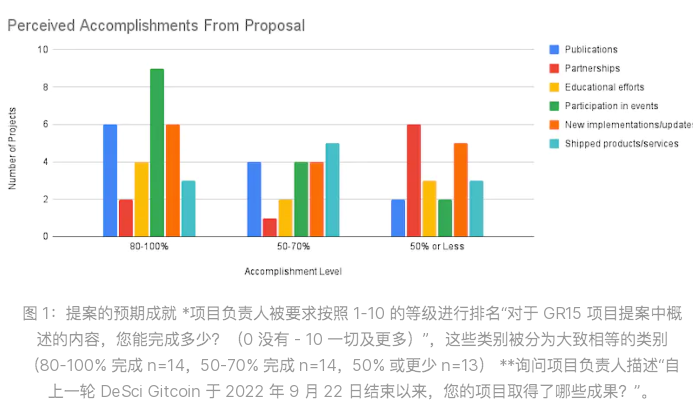
DeSci projects reported achievements in publications, partnerships, educational efforts, event participation, new implementations/updates, and delivered products/services. Among those who indicated they achieved all their goals, five out of seven participated in events. However, partnerships were often realized by projects that did not achieve their intended goals.
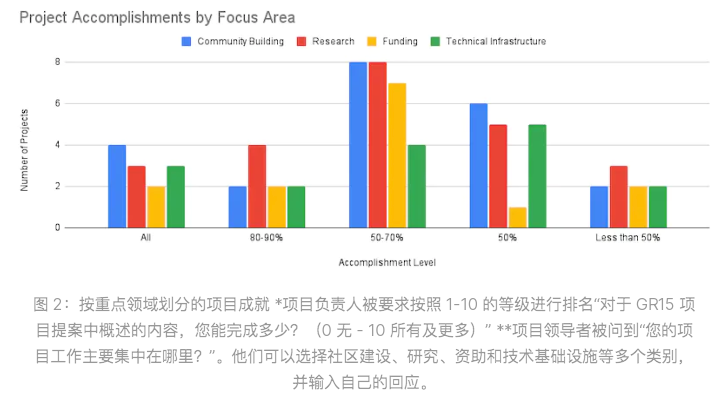
Project Work Focuses on Community Building, Research, Funding, and Technical Infrastructure
Notable Findings:
1. Among 22 projects focused on community building, 8 participated in events, but only 2 reported forming partnerships.
2. Of the 9 projects completing educational work, 7 focused on community building, while only 3 focused on fundraising.
3. Among 16 projects focused on technical infrastructure, 11 implemented new features/updates or launched products/services.
4. Of the 3 projects that received additional funding, 2 also focused on research activities.
DeSci Projects Require Comprehensive Funding and Specific Talent Across Different Stages of Development
The needs of DeSci projects vary depending on their stage of development or level of achievement.
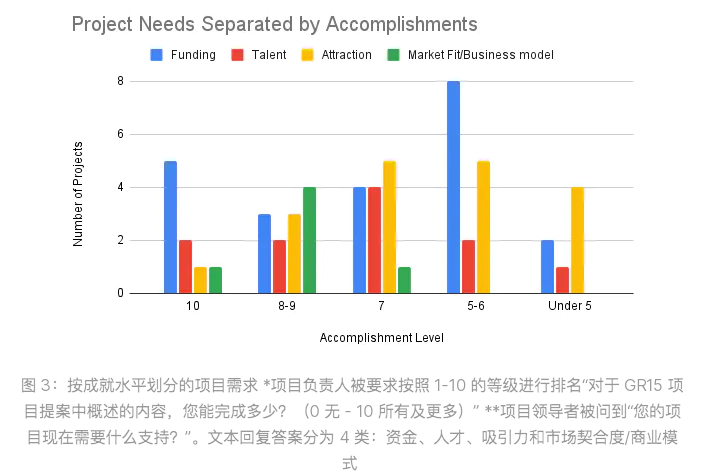
Projects that achieved all their goals require funding to reach the next level. Four out of six projects that completed all proposed objectives stated that funding was their sole need—indicating unmet demand from investors or funders to scale the DeSci ecosystem and advance science.
Projects achieving most of their goals (scoring 8–9 out of 10) most frequently cited the need for support in business model development and market fit—suggesting that with talented business professionals supporting them at this stage, more projects could achieve full success.
Projects completing 70% or less of their goals consistently identified engagement as their top need—indicating that the primary focus at this stage may be community expansion and outreach.
Sponsorship Has Played a Key Role So Far in Supporting Ecosystem Funding
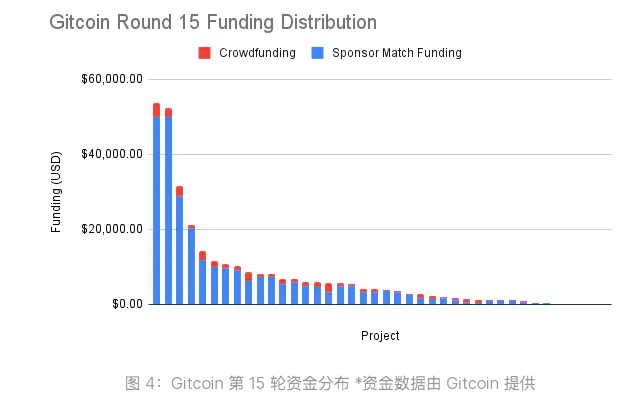
During Gitcoin Round 15, $587,000 flowed into the DeSci ecosystem, with the majority coming from sponsor matches determined by Gitcoin’s quadratic funding formula—which weighs the number of donors more heavily than traditional sponsorship models. Given the early-stage nature of the DeSci ecosystem, further analysis is needed to establish stronger correlations between funding mechanisms and outcomes.
Demographics in DeSci Still Have Room for Improvement
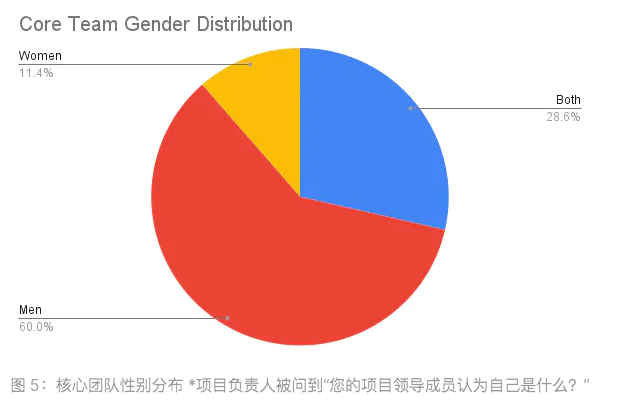
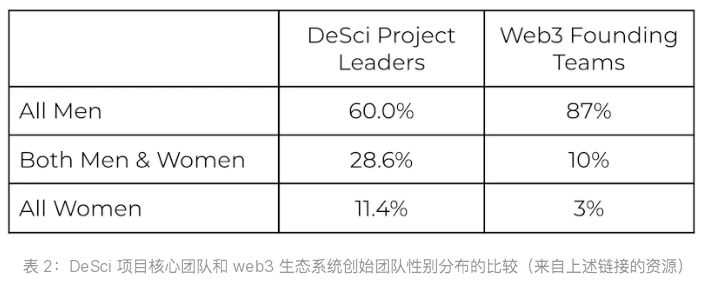
Although DeSci shows significantly better representation compared to the broader web3 ecosystem, gender distribution among project leads still requires improvement. Currently, teams led solely by women account for just 1 in 6, while teams led solely by men remain at 3 in 5. DeSci projects with female-led core teams also more frequently focus on research and community building.
DeSci Can Be a Space for People of All Ages
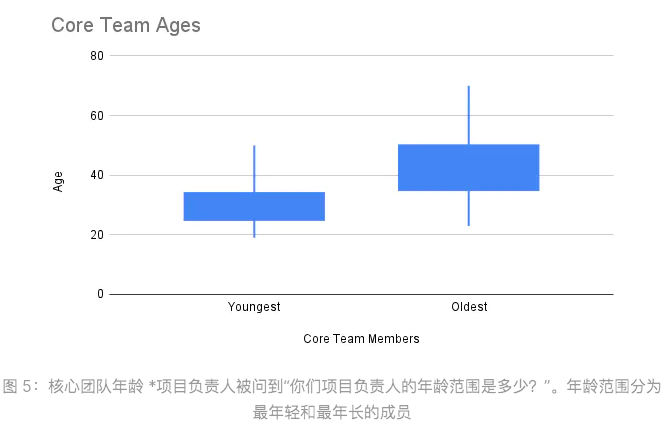
Web3 is often portrayed in media as an industry dominated by young participants. In the DeSci ecosystem, this portrayal may be less accurate.
Project leads range in age from 19 to 70. This provides DeSci with a stable foundation as a space accessible to people of all ages—appealing both to experienced individuals and those less familiar with traditional scientific systems.
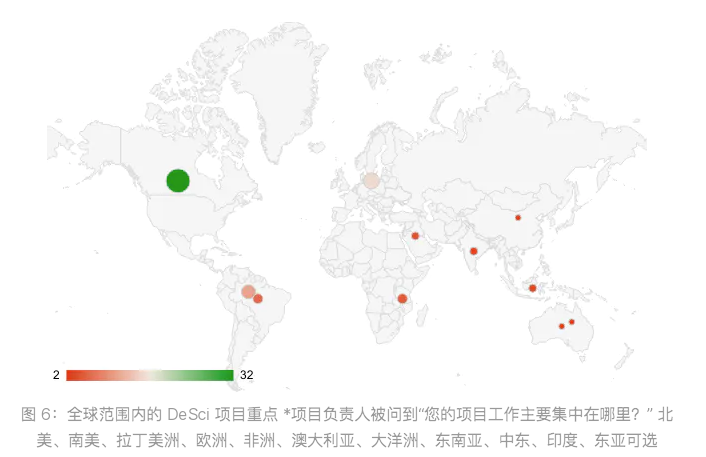
Gitcoin-supported DeSci projects are currently concentrated primarily in North America and Europe.
DeSci is currently centered mainly in North America (78%) and Europe (41%), followed by Latin America (26%), South America (17%), and Africa (12%), with all other regions accounting for less than 10%.
The DeSci Ecosystem Is Highly Interested in Sharing Knowledge and Learning from Other Projects in the Field
A common critique of traditional or institutional science is its lack of collaboration and competitive nature. DeSci tends to counter this stance—half of the surveyed projects offered “information or resources that help deepen understanding of the DeSci ecosystem.” These include repositories, insights into legal structuring or onboarding scientists, and educational tools such as documentation, videos, and lecture series.
Moreover, there is a strong desire for mutual learning. Forty-two percent of projects expressed interest in future landscape analyses exploring open collaboration and partnerships—hoping to see more projects working openly, collaborating with others, and sharing how they do so.
Future DeSci Landscape Analyses Can Expand Our Understanding of the Evolving Ecosystem
The DeSci landscape represents an emerging ecosystem where clearer trends may surface as projects mature.
This survey reveals that the ecosystem desires more transparent definitions and dialogue about what these projects are actually doing, to make tracking their progress and collaborations easier. There is also interest in learning more about demographic characteristics of each project (gender, age, professional background, nationality, etc.). Additional requests include more information on how to collaborate and receive funding, as well as methods to measure DeSci's impact—helping people understand how funding these projects can truly affect science, such as overcoming pain points that hinder traditional scientific progress.
Conclusion
At a high level, opportunities to participate in and support DeSci vary based on the achievement level demonstrated by individual projects. From the perspectives of age and gender, DeSci is more inclusive than both the broader web3 ecosystem and traditional science—aligning well with decentralization ideals.
As DeSci continues to expand and evolve, we expect to see greater participation and community growth. Talent is needed across all areas, though the specific talent requirements differ by stage. There is ample room for scientists to join DeSci projects, but developers, lawyers, marketing experts, and project managers are also essential.
DeSci is still in the early stages of ecosystem development, with many projects underway and communities actively forming. We believe that as it grows, it has the potential to profoundly impact the scientific landscape and deliver meaningful outcomes in the years ahead.
Join TechFlow official community to stay tuned
Telegram:https://t.me/TechFlowDaily
X (Twitter):https://x.com/TechFlowPost
X (Twitter) EN:https://x.com/BlockFlow_News
 Dora Factory






