The Endgame Thinking of the Ethereum Cosmos: When L2 to L3 Becomes a Present Continuous Tense
TechFlow Selected TechFlow Selected
The Endgame Thinking of the Ethereum Cosmos: When L2 to L3 Becomes a Present Continuous Tense
Does the Ethereum universe represent the final form of blockchain?
 Navigating Web3 tides with focused insights
Authors: Roy, Lyv, Aki Network Research
Just one or two months ago, a series of major updates from leading zkEVM projects emerged in quick succession, sparking growing discussions about whether zkEVMs represent Ethereum's future—or perhaps even its ultimate form.
Yet the evolution of Ethereum’s technical roadmap always reveals intriguing business logic, often accompanied by compromises and regrets. After conducting an in-depth study into the underlying dynamics driving Ethereum’s current L1-L2-L3 architecture, Aki Network Research believes it may be time to reframe the earlier question. In fact, the issue we face might be broader: does the Ethereum universe represent the final form of blockchain?
1. Why Layer 2?
Ten years after Bitcoin’s debut, our blockchain world still hasn’t solved the scalability problem.
Ethereum’s mainnet TPS remains in the low double digits—far short not only of Ethereum’s own roadmap goal of reaching tens of thousands of TPS, but also vastly behind traditional financial networks like Visa or Mastercard, which process tens of thousands of transactions per second. Under such constraints, Web3, as represented by blockchain, continues to struggle under heavy load.
The first issue is obvious: as more users join the Ethereum network with limited TPS capacity, congestion increases and average transaction confirmation times grow longer. The second issue stems from Ethereum’s gas auction mechanism, meaning gas fees tend toward only two outcomes: increasingly expensive, or suddenly extremely expensive.
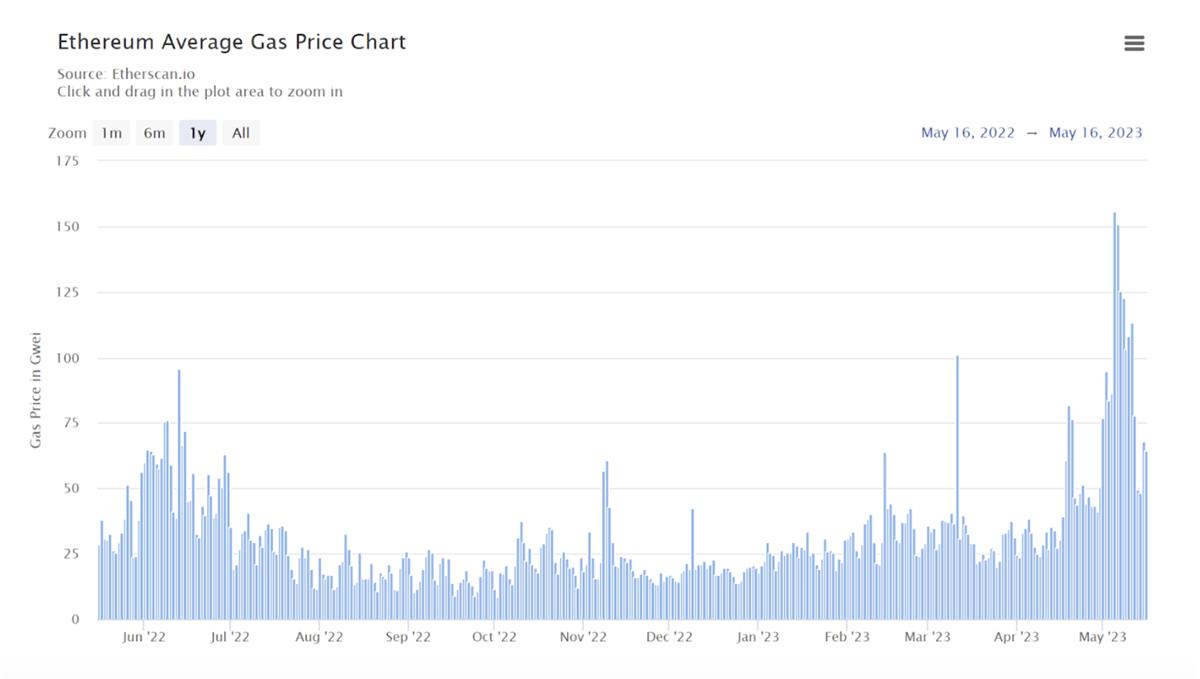
A network must at minimum be usable—capable of fast and affordable basic information exchange—for its existence and future development to hold any meaningful discussion. To address blockchain scalability, the industry currently has two paths: one being various Layer 2 solutions discussed here today, and the other being Danksharding sharding, which we will cover in a future piece.
After scaling, Ethereum’s gas fees will become cheaper—and more importantly, lower fees unlock possibilities that were previously unfeasible. This is where our real interest lies.
2. What Should Layer 2 Look Like?
This is not just a technical question, but also a political-economic one. So let us clearly define:
-
It must at least be a blockchain. This means it can issue native tokens, build a full community, retain loyal users, and lay the foundation for its own Layer 3.
-
It inherits security from Ethereum’s L1.
-
Its purpose is to scale Ethereum.
Combining points B and C, we see that Layer 2’s theoretical safety and credibility stem technically from inheriting Ethereum’s own security. Layer 2 posts data onto the Ethereum mainnet to achieve final settlement—this is the key distinction from previous scaling solutions like Plasma, enabling Data Availability (DA) on the main chain.
From an economic perspective, Ethereum “feudalizes” its value, and one anchor of Layer 2 tokens is their nominal role as servants to Ethereum. Layer 2 is not unique to Ethereum; for example, Sei Network, a Cosmos-based L1, is actively developing SVM Layer 2 C. Other L1 blockchains currently show little interest in this concept.
3. What Do Today’s Ethereum Layer 2s Look Like?
3.1 Current Popular L2 Scaling Solution: Rollups
Many people have used rollups. Technically, they fall into two categories: Optimistic Rollup and ZK Rollup. On the OP Rollup side, familiar chains like Arbitrum and Optimism are well-known, and many have interacted with their popular dApps.
Although OP Rollups have reduced transaction costs to 5–10% of mainnet fees through offloading execution, the poor user experience during Arbitrum’s airdrop shows we still have a long way to go. When hundreds of thousands of users interact with an L2 within hours, transaction fees can spike 5–10x—completely offsetting the 10x cost savings EIP-4844 promised L2s. Seamless UX under such network pressure is the bare minimum required for Web3 to onboard the next billion users.
ZK Rollups gained significant attention over the past two years, though practical adoption lagged due to EVM compatibility issues—see our prior article “Zero-Knowledge Proofs and zkEVM: Where They Come From, Where They’re Going.” Good news: this challenge is now largely resolved, leveling the playing field between ZK and OP Rollups in developer accessibility. We expect many developers to deploy dApps on ZK L2s.
From a user standpoint, ZK Rollups offer shorter withdrawal times and mathematically stronger security, which are attractive. But from a commercial perspective focused on ordinary users, the appeal of faster withdrawals and enhanced security may be debatable. As native Web3 ecosystems on L2s flourish, more new users may become “L2 natives,” entirely unaware of L1 transactions or ecosystems (imagine a new StepN user built entirely on L2). The need to bridge back from L2 to L1 may become increasingly marginal and infrequent as L2 ecosystems grow richer.
3.2 Enough theory—where are we practically with L2s?
OP Stack: To compete against zkEVM-powered ZK Rollups, Optimism (on the OP Rollup path) introduced OP Stack, aiming to expand the pie. We believe OP Stack’s vision resembles Cosmos’ goal of multi-chain shared security and decentralized ecosystems.
Notably, OP Stack is an extremely open technical stack, but economically highly fragmented. An L2 built on it might have only minimal ties to the Ethereum ecosystem, no direct economic relationship with Optimism, and opt out of the OP shared sequencer. That said, a decentralized OP shared sequencer could eventually gain strong economic and ideological appeal.
Various zkEVMs—see “Zero-Knowledge Proofs and zkEVM: Where They Come From, Where They’re Going”
Starknet launched a Type 4 scaling solution, differing from all others in B by not being EVM-compatible. Theoretically, this allows faster speeds and lower costs than Type 2 solutions. To improve developer experience, Starknet has made several upgrades:
-
Cairo 1.0: The most significant upgrade since Cairo’s 2020 launch, with testnet already live. Cairo 1.0 is a high-level language resembling Rust, freeing developers from earlier limitations and greatly improving usability. However, this renders years of prior Cairo learning obsolete. Meanwhile, Cairo 1.0 itself is still incomplete, likely requiring another 3–6 months to mature.
-
KAKAROT: An EVM solution built on Cairo 1.0, boasting “fighting power of 9000” (per developers), but still in early stages.
4. Having Discussed Layer 2, What Is Layer 3?
4.1 First, what problem is the L2-to-L3 structure trying to solve?
Let’s examine the economics of rollups: posting a batch on-chain incurs high fixed costs. If overall L2 traffic is low, a rollup either waits longer to accumulate a valuable batch or raises transaction fees per participant to cover batching costs. This is like carpooling: either wait until the car is full, or pay extra to leave early. Ideally, enough people join the ride so passengers enjoy short waits and low average costs, while the driver earns more per unit time.
In this context, L2 solves a critical issue: early-stage ideas with insufficient traffic or low-value transactions cannot viably deploy directly on mainnet or launch their own L2. By becoming an L3 on an existing L2, they significantly reduce costs. This is fundamentally an economic calculation—very similar to a dApp deciding whether to deploy directly on Optimism or use OP Stack to create a dedicated L2.
Only when infrastructure becomes cheap enough can diverse ecosystems truly flourish. Conversely, this very issue reflects the current state of the blockchain industry: dominated by exchanges and DeFi Lego applications, because only money-related projects can justify blockchain operating costs.
4.2 The Real Logic Behind Each L2’s L3 Ambitions
Digging deeper, this isn’t just a simple carpool model—because of the magic of tokenomics!
Take a simple example: centralized sequencers on L2s work fine today. Why do roadmaps universally push for decentralization? Sure, security is a politically correct justification, but the unspoken truth is: decentralization enables monetization.
Only once decentralization is achieved can validator and sequencer staking mechanisms exist, provers and verifiers charge fees, and the L2’s native token circulate via L3 ecosystem growth. Whether Op Stack, Arb Orbit, or future zk-based L3 designs, all follow this relatively conventional blockchain business model—nothing particularly innovative.
In Web3, traffic is money—more straightforwardly than even in Web2. L2s initially exist to scale L1, so they naturally inherit L1’s traffic. Hence the question: if traffic comes from L1, won’t it mostly return there? Since traffic equals money, and you’re given L1-native assets, those assets ultimately flow back to L1. In blockchain, this is framed as “inheriting Ethereum’s legitimacy”—only assets confirmed on L1 are considered real “money.”
The term “legitimacy” sounds feudal, and indeed the L1-L2-L3 hierarchy bears subtle resemblance to feudal systems. Liquidity flows from L1 to L2, making L2 inherently dependent on L1. Interaction between L1 and L2 isn’t merely depositing or withdrawing funds. The truth is, every L2 transaction strengthens the credit and value of L1’s native token—a kind of seigniorage tax on L1. This explains why all Ethereum L2s today use ETH as gas currency.
But L2-L3 logic differs slightly from L1-L2. L1-L2 exists to scale L1; L2-L3 exists to drive traffic to L2. This is a real issue because L2 traffic is still insufficient—like drivers unable to depart efficiently due to too few riders. For large ecosystems like Coinbase’s Base, L2s like Optimism struggle to absorb them into their L3 ecosystem, instead relying on Op Stack’s cross-chain convenience (potential user acquisition) and Base’s promised ecosystem fund contributions to capture some of that value.
4.3 Rollup-over-Rollup or Validium Likely to Dominate L3 Scaling
Before discussing this, consider: if ZK Rollups are so great, can we build multi-layer ZK-Rollup structures beyond L3 for infinite scaling?
Short answer: no. Even though ZKP proof complexity can theoretically be reduced through recursive ZKPs, data compressibility has inherent limits.
We analyze from two angles: computational proofs and data (availability).
In current rollup schemes, regardless of type, the proof computation process can be nested. In ZKPs, provers generate proofs per block, and verifiers perform minimal computation to validate them. Thus, creating a ZKP proving the correctness of another ZKP is theoretically feasible.
But data availability (DA) is different.
Data must eventually be posted on the main chain so users can verify it. Given this requirement, rollup nesting becomes meaningless. Rollups work by compressing transaction data before on-chain storage—reducing size lowers costs. But compression has a hard limit: the point where Data Availability holds, i.e., any user can independently reconstruct how the rollup changed the mainnet state using the compressed on-chain data to verify correctness.
If we create a ZKP proving another ZKP’s correctness, from a DA standpoint we’d still need to upload all the original ZKP-compressed content to the chain. This offers no workload reduction—better to just make one consolidated ZKP.
That doesn’t mean “rollup-over-rollup” is technically impossible. In summary, simple stacking of rollups within the same layer or dApp is meaningless.
But in the L2-L3 scenario, L3 uploads transaction batches to L2, and L2 aggregates multiple L3 batches plus native L2 transactions into a new batch uploaded to L1—effectively creating a ZKP over “several ZKPs from different entities.” Here, although data compression has hit DA limits, economically merging multiple batches exceeds the gas fee threshold for uploading to L1 (as mentioned in Section 4.1), making it commercially rational and likely reducing per-user transaction costs.
Thus, we believe potential L3 structures include rollup-over-rollup or validium:
A.Top-down structure: Vitalik’s vision involves L2 as a general-purpose rollup, while L3 provides specialized services—either privacy computing, custom rollups for specific dApp data structures, or cheaper validiums with weaker trust assumptions.
B.Bottom-up structure: Consider a more app-centric narrative: suppose a successful Ethereum L3 dApp seeks greater autonomy. It then has options:
-
Cosmos app chain – become an independent L1;
-
Op Superchain / zkSync Hyperchain – become a parallel L2, likely joining shared sequencers while maintaining economic ties;
-
Remain as L3 but launch a token, then follow an L2-style decentralization roadmap.
The essence of route B is that once a dApp generates massive traffic, its self-interest outweighs platform benefits—especially if it dominates its niche. We can optimistically assume that as infrastructure improves, non-financial dApps creating real Web3 utility scenarios can successfully take this path.
4.4 Then, what is the role of L1 in the L2-L3 structure?
Here arises a philosophical question: if L3 fulfills its vision by enabling mass Web3 migration via App Chains and generating economically meaningful traffic for L2, then that traffic becomes true native asset for L2—resources born and raised there, with L2 providing their “legitimacy.”
So we must ask: if sufficient assets never return to L1, why do we need L1 at all?
First, L1 currently provides valuable traffic—a point we’ve covered extensively. Second, L1 offers credibility. By settling finality on L1, users tolerate significant centralization on L2 for performance gains.
If one day an L2 declares independence from L1—which isn’t unimaginable in today’s modular blockchain era—it would then have to resemble today’s Ethereum, bearing the full burden of security, decentralization, and associated costs.
Thus, from both technical and economic perspectives, the L1-L2-L3 “feudal system” fits together tightly and cohesively.
4.5 With structural aspects covered, what about current application-level developments?
When new public chains launch, the fastest movers are inevitably scammy meme projects—they have no real workload.
Most chain teams can do little about this: opening a food street requires vendors. If early tenants look semi-legitimate, you greet them warmly and give support—even if later they rug pull and users blame you. This is simply growing pains. For slower-moving chains like Starknet, these pains may only arrive after Cairo 1.0 documentation is fully clear.
On a positive note, what new applications can we expect in the L2-L3 architecture?
Smart Wallets: Due to technical debt from L1, deploying and managing a smart contract wallet is costly and cumbersome for individual users. With improvements from ERC-4337, account abstraction (AA) on L2 should roll out more smoothly thanks to drastically lower operating costs.
On-chain Gaming: With Validium support, sub-cent transaction scenarios (under $0.01 per tx) make genuinely fun games viable in Web3.
-
As a weak-trust scaling solution, Validium allows provers to selectively provide verification data. In gaming, this trade-off for efficiency and performance is acceptable, since not every action carries high economic value—e.g., player movements, chat, or combat animations.
-
Such games can thrive across various L2s or L3s, chosen based on gameplay mechanics and data structure—similar to earlier economic considerations.
Finally, a brief note on the recently popular Rollup-as-a-Service (RaaS): services in Web3 can capture substantial value—unlike in Web2. Imagine renting a server on AWS to run a website—you just pay monthly rent.
But in Web3, you not only pay AWS-like fees, but also get charged MEV-like “protection fees” every time you run or update your site! Rather than feeding this value to RaaS providers, it makes more economic sense for dApps to deploy their own app chains—as parallel L2s or L3s on existing L2s.
5. If L2-L3 is so good, what’s the cost?
5.1 Centralization
A. Censorship and KYC
Currently, sequencers across various rollups are highly centralized.
Blockchain’s private-key signing ensures sequencers cannot forge transactions, but centralized sequencers still wield enormous power: they can refuse certain user transactions, reorder transactions for profit, or decide whether to accept external assets from cross-chain protocols.
For example, on Base (an L2), beyond common sandwich attacks by centralized sequencers, Coinbase could require KYC verification via Coinbase before allowing fund deposits into BASE. Base could further use whitelists to block non-KYC users’ transactions from being included in L1 withdrawals, effectively preventing non-KYC users from exiting BASE.
B. MEV
MEV is a challenge for all blockchains. L2s, with fewer users, lack viable MEV mitigation or democratization methods available on L1. Meanwhile, MEV extraction strategies already obsolete on L1 remain feasible on current L2s. Centralized sequencer systems inevitably lead to such outcomes, and sequencer decentralization requires visionary project teams to pioneer industry standards.
5.2 L2s Are Still Not Cheap Enough
Even if we realize all visions of L3 scaling via rollup-over-rollup or validium, fundamental issues remain. Per-interaction costs still can’t meet sub-cent requirements; during demand spikes, fees rise again.
5.3 Client Diversity
Ethereum does not mandate specific block-producing or validation clients. This diversity protects overall security—if one client has a bug, others remain unaffected. Most L2s are still early in client diversity, especially since prover/sequencer decentralization roadmaps are still conceptual.
5.4 Upgrades and Updates
When the mainnet upgrades, L2s must follow. This poses major challenges to governance and trustlessness goals.
6. End Game and End “Game”
By now, our analysis of the L1-L2-L3 structure is largely complete. As stated at the outset, the real question we aim to answer is: is the Ethereum universe the endgame of blockchain?
6.1 The Ethereum Universe Is Unlikely to Be Blockchain’s Final Form
Simply put: no. We believe the Ethereum universe is merely a mid-term solution for Web3 financial needs.
First, we argue that the current L1-L2-L3 structure, constrained by the blockchain trilemma, still hits a performance ceiling too low to support mass-user, high-frequency, low-value interactions—such as social media or gaming at Web2 scale. Fundamentally, human behavior follows a strong power-law distribution: the vast majority of economic value concentrates in a tiny fraction of actions.
Blockchain cannot be only finance. Web3 itself was created to help blockchain break out of niche circles—so the industry cannot keep playing zero-sum games in silos. Currently, gaming appears one of the few (if not the only) breakout sectors, capable of generating artificial demand, setting rules, and building user stickiness without relying on real-world use cases.
Broadly speaking, Web3 games fall into several categories:
-
Traditional games with economic systems moved on-chain—ranging from casual card games and turn-based battles to higher-dimensional SLG, RTG, or even open worlds
-
Lightweight games centered around X-to-Earn models
-
NFT-first strategy: launch NFTs to build IP and funding before game development
-
Fully on-chain games delivering experiences akin to low-fidelity Minecraft or battle royale games
-
Gamified versions of Web3-native gambling models
Convincing traditional game studios to abandon established distribution channels and revenue models—despite financial and legal risks—is a major bottleneck for Web3 gaming. Meanwhile, small-team Web3 games face intense homogenization and struggle with user growth.
The other four models require strong economic incentives to sustain healthy operations. As noted earlier, traffic (or liquidity) borrowed from L1 mostly needs to be repaid. Pure Ponzi models don’t retain real users. If everyone is here just for money, don’t talk about ideals—let alone making games fun.
So stepping back: could we focus on game quality instead of chasing profits? We believe this mindset might be part of the right answer.
Yet, as previously explained, Ethereum’s hierarchical L1-L2-L3 “feudal” structure drives economically motivated traffic—essentially harvesting the highest APY/ROI within the system at any given time. This same economic force underlies sector rotations, NFTFi, China-themed trends, and meme booms during this bull market.
Moreover, this structure poorly supports high-frequency, low-value dApps like games. In other words, launching games on today’s popular L2s may not be optimal. This presents the core paradox of this approach—excessive liquidity is a double-edged sword for game longevity.
In creating and solving Web3 finance demands, we’ve done passably well. But in gaming, we still have a long journey ahead. It’s not that good games don’t exist—it’s that the right soil for them to grow is missing.
6.2 If Finance’s Answer Is Ethereum L123, What’s Gaming’s Answer?
The GameFi sector is in a period of confusion, with past attempts largely failed experiments. But by elimination, Ethereum’s economic feudalism proves unsuitable for nurturing genuinely playable games. Our hope lies in architectures that are economically looser, tolerate lower data availability, and accept higher centralization—such as Cosmos, Binance Greenfield, or Starknet’s zkVM.
Some believe that innovations like L2/zkEVM/L3 render non-Ethereum public chains obsolete. We believe the opposite: their greatest value is precisely that they are *not* Ethereum. The nature of blockchain is self-disintegration, due to free capital flows, open technology, and limited barriers.
Ethereum maintains system cohesion through its economic feudal structure—but this expansion isn’t infinite. Conversely, the Ethereum ecosystem may unconsciously dislike low-value use cases, keeping thresholds just high enough for finance to survive while other sectors struggle—ensuring its native token price never drops too low.
In short, Ethereum may capture nearly all high-value individual behaviors in Web3, but may be overkill for low-value random actions. Some may say, “Not every action needs to be on-chain—it’s too expensive.” But this statement might better be phrased as: “Not every action needs to be on Ethereum—Ethereum has its own mission.” This implies that ecosystems outside Ethereum—or remote corners within it—can still grow unexpected blossoms.
Join TechFlow official community to stay tuned
Telegram:https://t.me/TechFlowDaily
X (Twitter):https://x.com/TechFlowPost
X (Twitter) EN:https://x.com/BlockFlow_News
 Aki Network