Ethereum is about to undergo the Cancun upgrade; here's a look back at 12 pivotal upgrades in its history.
TechFlow Selected TechFlow Selected
Ethereum is about to undergo the Cancun upgrade; here's a look back at 12 pivotal upgrades in its history.
This year, Ethereum is scheduled to undergo two major upgrades. If you're active in the Ethereum ecosystem, it's essential to understand Ethereum's development journey clearly.
 Navigating Web3 tides with focused insights
Author: Chen Jian Jason Wanwu Research Institute
This year, Ethereum is scheduled to undergo two major upgrades: the Shanghai upgrade completed on April 12 and the upcoming Cancun upgrade expected in the fourth quarter. According to Ethereum's official documentation, since the release of its whitepaper in 2013, there have been 24 milestone events, most of which were fork upgrades, with 12 being particularly significant. If you're involved in the Ethereum ecosystem, understanding Ethereum’s growth journey is essential.
The history of Ethereum:
https://ethereum.org/en/history/#2023
Traditional centralized software typically releases a new version that replaces the old one directly. However, blockchain networks are decentralized and lack central ownership, so upgrades occur via forks. Miners and validator nodes must update their Ethereum clients to follow the new fork’s rules when producing blocks. The upgraded fork becomes the new main chain, while the old chain—no longer maintained—is abandoned. In rare cases, some miners may refuse to abandon the old chain, continuing to support it and causing a permanent network split, as seen today in the relationship between ETH and ETC (Ethereum Classic).
July 30, 2015 Frontier Upgrade
The Frontier upgrade was the first quasi-system-level version of Ethereum released for developers. Operated through code and command lines without a graphical interface or standalone software, it can be understood as a beta version of Ethereum—hence the name "Frontier." At this stage, Ethereum resembled the American Wild West—an environment full of great risks and opportunities.
In the Frontier version, the gas limit per block was hardcoded at 5,000 gas. Just two months later, during the subsequent Frontier Thawing upgrade, this 5,000 gas cap was removed, the default gas price was set to 50 gwei, and the difficulty bomb was introduced. The difficulty bomb was designed to artificially increase mining difficulty over time, making proof-of-work (PoW) mining unprofitable when the transition to proof-of-stake (PoS) occurred—laying the groundwork for future PoS adoption. When the difficulty bomb “explodes,” Ethereum enters what the official team calls the “Ice Age.” Note that even in Ethereum’s earliest stages, the decision to transition to PoS had already been firmly made.
From this point onward, Ethereum officially entered the usable PoW mining era, with each ETH priced at $1.24.
March 14, 2016 Homestead Upgrade
The Homestead upgrade was Ethereum’s second major release. As the name suggests, the initial pioneers who explored the "frontier" had now moved on to building homes and establishing stable communities.
Homestead was also the first upgrade to include Ethereum Improvement Proposals (EIPs), specifically EIP-2, EIP-7, and EIP-8. EIP-2 increased the gas cost of contract creation from 21,000 to 53,000. EIP-7 introduced a new function called DELEGATECALL to facilitate code reuse. EIP-8 implemented forward compatibility for the devp2p network protocol.
At this time, the price of Ethereum was $12.50 per ETH.
July 20, 2016 The DAO Fork (Ethereum’s Darkest Hour)
This was not a regular upgrade but rather a reluctant compromise forced upon Ethereum during its darkest moment, resulting in a split that created both ETH and ETC.
The DAO was a decentralized autonomous organization launched on Ethereum in 2016 via a smart contract, raising 150 million USD worth of ETH—about 14% of the total circulating supply at the time. However, due to a vulnerability in its code, it was hacked. After extensive efforts failed to stop the attacker, Ethereum ultimately executed a hard fork to recover the stolen funds. This decision deeply divided the community, especially among those who believed strongly in “Code Is Law” and decentralization. The original unforked chain continued to be supported by believers and became known as ETC (Ethereum Classic).
At this time, the price of Ethereum was $12.54 per ETH.
October 16, 2017 Byzantium Upgrade
By this time, Ethereum had passed through the Frontier and Homestead milestones. The next planned phase was Metropolis, symbolizing the transformation from isolated settlements into a bustling metropolis. Due to the complexity of Metropolis, it was initially split into two parts: Byzantium and Constantinople. In practice, the Metropolis phase proved far more complex than anticipated, leading to further splits including Istanbul and Berlin upgrades.
Before entering the long-term sustainable Metropolis phase, Vitalik Buterin believed Ethereum must shift toward PoS. To achieve this, miners needed to be gradually disincentivized under PoW so they would be “pushed” into accepting PoS. Otherwise, if PoS launched while many miners remained on PoW, it could cause a catastrophic split worse than the ETC split. Therefore, PoW rewards began to be reduced. This upgrade included 10 EIPs. Notably, EIP-649 delayed the difficulty bomb by 18 months and reduced block rewards from 5 ETH to 3 ETH. The delay was necessary because Ethereum wasn’t ready for the PoS transition.
Additionally, learning from the trauma of The DAO hack, Ethereum improved security with EIP-214, which restricted state modifications during contract calls.
At this time, the price of Ethereum was $334.32 per ETH.
February 28, 2019 Constantinople (St. Petersburg) Upgrade
The originally scheduled Constantinople upgrade was postponed due to a critical vulnerability discovered by ChainSecurity. Two years after the previous major upgrade, Ethereum finally proceeded—but in fact, this was a dual upgrade combining both Constantinople and St. Petersburg in a single block.
This upgrade further incentivized the move to PoS. EIP-1234 reduced block rewards from 3 ETH to 2 ETH. Once again, due to unpreparedness for PoS, the difficulty bomb was delayed another 12 months.
EIP-1014 introduced CREATE2, a new opcode allowing pre-calculation of contract addresses before deployment. This enabled concepts like Bitcoin’s Lightning Network—state channels—to be adapted to Ethereum, where off-chain computations could precede on-chain settlement.
At this time, the price of Ethereum was $136.29 per ETH.
January 2, 2020 Muir Glacier Upgrade
Less than a month after the Istanbul upgrade, Ethereum conducted an emergency, unscheduled upgrade. Performing two hard forks within a month is extremely rare. The reason was a miscalculation regarding the timing of the difficulty bomb explosion, which risked detonating prematurely while the PoS transition was still unready. Thus, an urgent upgrade was required to delay the difficulty bomb once again. Because this was an unplanned intervention, it did not follow the Metropolis city-naming convention. Recall earlier mention of the “Ice Age” triggered by the difficulty bomb? Muir Glacier is the name of a glacier in Alaska that has already melted and been replaced by seawater—symbolizing the temporary “disappearance” of the ice age.
At this time, the price of Ethereum was $127.18 per ETH.
December 1, 2020 Beacon Chain Launch
The long-planned PoS initiative took a crucial step forward as the PoS Beacon Chain officially launched and began running parallel to the PoW mainnet. Two years later, during the Paris upgrade, these chains would merge in an epic event known as “The Merge.”
At this time, the price of Ethereum was $586.23 per ETH.
April 15, 2021 Berlin Upgrade
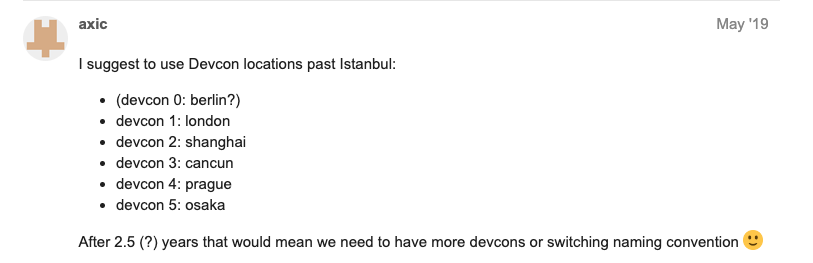
The Berlin upgrade marked the beginning of naming Ethereum upgrades after Devcon conference cities. During discussions about future naming conventions, various suggestions emerged—including constellations, musical instruments, and World of Warcraft characters—but the proposal to use Devcon host cities won the vote. Since the first Devcon was held in Berlin, this upgrade was named accordingly.
At this time, the price of Ethereum was $2,454 per ETH.
August 5, 2021 London Upgrade
This upgrade introduced one of the most impactful EIPs in Ethereum’s history: EIP-1559. It fundamentally changed Ethereum’s economic model. Previously, block inclusion operated like an auction—higher gas fees secured priority, and all fees went entirely to miners. EIP-1559 split transaction fees into two parts: one portion goes to validators, and the other is burned, ushering Ethereum into a deflationary era. To date, approximately 3.2 million ETH—worth around $6 billion—has been burned.
At this time, the price of Ethereum was $2,621 per ETH.
September 15, 2022 Paris Upgrade (The Merge)
Ethereum successfully completed “The Merge,” the historic Paris upgrade—a direct modification of both the execution layer and consensus layer. EIP-3675 upgraded the consensus mechanism to PoS (Proof-of-Stake). The Beacon Chain, which had run alongside the mainnet for two years, finally took over. After seven years of planning, Ethereum’s journey to PoS reached its climax—though one final issue remained unresolved: staking withdrawals. For two years, users who staked ETH on the Beacon Chain could not withdraw their funds. Coming just six months after a bull market peak near $4,000, early stakers watched helplessly as prices fluctuated without being able to exit. Resolving withdrawal functionality was critical—if users couldn’t retrieve their stakes, few would participate in staking, risking centralization of the PoS network. While solutions like Lido partially addressed liquidity issues, true native withdrawal support was still pending. (I’ve previously written articles on Lido and SSV—feel free to revisit them.)
《On Ethereum 2.0, PoS Staking, and Lido with $590 Million in TVL》
《Deep Dive into SSV: A Leading Project in Decentralized PoS Staking》
At this time, the price of Ethereum was $1,472 per ETH.
April 12, 2023 Shanghai Upgrade
The Shanghai upgrade primarily solved the long-awaited staking withdrawal problem. Validators who had waited two grueling years on the Beacon Chain could finally withdraw their staked ETH. Simultaneously, this unlock encouraged even more participation in staking—over 19 million ETH have now been staked—marking the dawn of the LSDFi era.
At this time, the price of Ethereum was $1,917 per ETH.
2023 TBA Cancun Upgrade
With consensus-layer challenges resolved, Ethereum now focuses on scalability. Its path is clear: scaling via Layer 2 solutions. Supporting Layer 2 effectively is now paramount. The Cancun upgrade, expected in late 2023, will introduce key features such as EIP-4844, which adds a new transaction type capable of storing data in a space called “blobs” at significantly lower costs. This allows Layer 2 rollups to store data previously published on Layer 1 within blobs, drastically reducing transaction fees for Layer 2 users.
This concludes Ethereum’s growth story. Reviewing it evokes awe and inspiration. It's hard to imagine that much of this roadmap was envisioned as far back as seven years ago, when Ethereum’s first official version launched—and at that time, Vitalik Buterin was only 21 years old.
Join TechFlow official community to stay tuned
Telegram:https://t.me/TechFlowDaily
X (Twitter):https://x.com/TechFlowPost
X (Twitter) EN:https://x.com/BlockFlow_News