Interview with OKX Ventures Partner: Unveiling the Mysteries of the VC Industry and Exploring the Current State and Future of the Crypto Market Economy
TechFlow Selected TechFlow Selected
Interview with OKX Ventures Partner: Unveiling the Mysteries of the VC Industry and Exploring the Current State and Future of the Crypto Market Economy
At the Hong Kong Web3 Festival, Jeff Ren, Partner at OKX Ventures, appeared on-site and unveiled the mysteries of the VC industry with us.
 Navigating Web3 tides with focused insights
By 0xJigglypuff
With an initial capital of up to $100 million and having invested in over 300 projects within two years, OKX Ventures has nearly perfectly hit early funding rounds of recently booming projects such as Arbitrum, zkSync, and LayerZero—showcasing remarkably sharp vision. This naturally raises curiosity about the logic and selection strategies behind their success.
At the Hong Kong Web3 Festival, Jeff Ren, Partner at OKX Ventures, appeared on-site to lift the veil on the VC industry. Beyond engaging with numerous frontline developers in the crypto space, he also shared unique insights into crypto sectors, current market conditions, and future outlooks during our exclusive interview.
Investment Journey: From Lehman Brothers to Bitcoin Miners
After graduating from Peking University and Harvard Law School, Jeff Ren spent over 20 years in finance, witnessing firsthand the collapse of Lehman Brothers during the subprime mortgage crisis. He later served as an Executive Director at UBS Group—an experience that cemented his status among the financial elite who have weathered major storms.
However, his early entry into the cryptocurrency world eventually led him toward the Web3 industry. Starting in 2013, he invested in exchanges like OKX and experimented with PoW mining—not only operating as a miner studying Bitcoin hash power but also seizing opportunities in mining hardware investments. Reflecting on this period, Jeff emphasized that one of the best aspects of the blockchain industry is its endless learning opportunities:
I’ve always seen myself more as a tech investor—someone who believes technology can transform how we live, communicate, and build things… Blockchain is definitely where I’ve learned the most so far… I feel fortunate to be able to keep learning continuously in the mid-stage of my career, exploring new frontiers alongside young, talented founders and developers.
What are some special reflections when viewing the Web3 industry through the lens of traditional finance?
Jeff responded that while traditional finance and Web3 may seem binary opposites, he doesn’t believe they truly are. The dichotomy, he said, is merely a phase rather than a fundamental truth. He also explained why he ultimately bet his career on the crypto industry:
I don't think the two (traditional finance and Web3) must necessarily be opposed or different. For Bitcoin believers back then, it was all about faith—but today, it’s become a vast industry. I believe the entire sector is still in an upward trajectory, similar to any FinTech wave. We’re in an exploratory phase filled with skepticism, struggles, and confusion—just like the early days of the internet or mobile startups. It requires a longer time horizon to validate.
It's been a privilege to work for top-tier institutions globally. Since joining OKX, there have been many changes in the industry, but staying committed has brought rewards. I tell my team, colleagues, and partners: now we can proudly tell our parents what industry we're actually in.
Analyzing the Current State and Future of the Crypto Industry
-
Bull or Bear Market? Not Important
Since its founding in 2021, OKX Ventures has largely operated during a bear market. Yet Jeff argues that market cycles themselves aren’t particularly significant—because bull and bear labels are highly subjective. From a VC perspective, the reality differs greatly from popular perception. One certainty remains: building never stops. Only by focusing on continuous development can progress be made, without getting distracted by short-term market fluctuations.
We take a relatively objective view on bulls and bears—what seems like a bear market today might look incredibly bullish three years from now.
We don’t define bull or bear markets solely based on prices of major assets. Instead, we focus on on-chain data and observe the state of our broader investment and ecosystem communities. As long as we keep seeing new projects and fresh ideas emerge, it's always springtime for us haha. We don't obsess over short-term returns—the key is empowering innovation…
Bull and bear markets are relative. If major crypto assets (BTC and ETH) rise significantly in price over a period, maintain stable dominance across total crypto market cap (indicating altcoins also rise), and active addresses and transaction volumes increase sustainably alongside positive sentiment in media and communities, it's widely perceived as a bull market.
-
Layer 2 Is Key to the Next Market Cycle
When discussing the next big narrative and hot themes for the upcoming bull run, Jeff highlighted Ethereum’s Shanghai upgrade followed by the upcoming Cancun upgrade, along with emerging sectors such as DA (Data Availability) and RaaS (Rollup-as-a-Service). Among these, Layer 2 will play a pivotal role. Improving product experience and lowering barriers will be essential, setting the stage for widespread adoption in the next cycle:
Layer 2 solves Ethereum’s scalability challenges—it's a high-conviction area. Layer 1 and Layer 2 aren't just competitors; they complement each other. We've invested in multiple star Layer 2 projects including Arbitrum, Scroll, Starkware, zkSync, Taiko, and Metis.
Recent upgrades like Ethereum’s Shanghai and the upcoming Cancun upgrade could boost Layer 2 diversification, advance the DA (data availability) layer, and catalyze growth in the RaaS (rollup-as-a-service) sector… With improved infrastructure and technological innovation, Web3 user experiences are set to improve and lower entry barriers. The next bull market will attract more users and capital, expanding the industry further.
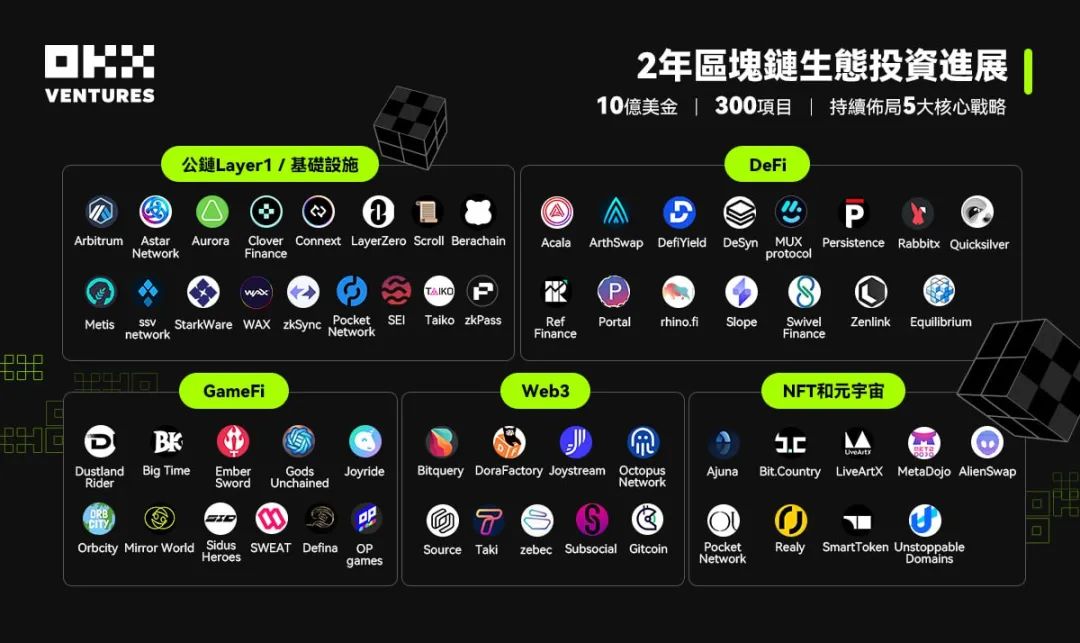
Source: OKX
Among the projects OKX has backed, OKX Ventures has heavily invested in zero-knowledge proof-related blockchains and protocols. Jeff noted that OKX itself runs its own ZK Lab because they believe current DeFi faces significant trust issues that need to be addressed via zero-knowledge proofs (zk):
-
Wallets Are Key to Web3 Mass Adoption
Wallets are considered the gateway to blockchain. Jeff emphasized design flaws in existing crypto wallets and expressed hope that improvements here would drive mass adoption:
The biggest issue with wallets today is usability. We’re working to fix that. Issues like seed phrases and security aside, OKX Web3 Wallet allows login via email, delivering a seamless user experience comparable to traditional Web2 mobile apps—users won’t feel like they’re using something strange or complicated.
OKX Web3 Wallet is also multi-chain. Many novice users don’t understand this—they assume blockchain means just one chain—and get confused when sending tokens to an address only to find they can't receive them. That’s exactly the barrier we aim to remove. From day one, our multi-chain experience vastly outperforms MetaMask. Usability and clarity open possibilities for cross-chain DeFi and unified protocol use cases. Within a short time, we’ve integrated support for 500–600 projects.
As a VC, How Do You Support the Web3 Industry?
As a VC, Jeff shared insights into his daily work—mentioning he often lurks in Ethereum developer community forums like Gitcoin, where he has long served as an advisor, discussing ways to enhance project visibility in Asia. He stressed that OKX Ventures, as a centralized entity, plays a limited role in the Web3 space, making it crucial to maintain appropriate distance from projects—helping them without interference:
We are members of Gitcoin DAO, the largest global Ethereum developer community. I serve on its Governance Advisory Committee. I regularly discuss with Gitcoin founders how to strengthen presence and influence in the Asia-Pacific region, empower the Ethereum developer community, identify meaningful projects, and attract more developers to participate in building and promoting these initiatives. Throughout this process, we remain humble—constantly asking how a centralized organization can genuinely help. Our motto is “help without causing trouble.” We’re mindful of our position and avoid overstepping or pushing too hard.
Beyond connecting with diverse project teams, VCs also organize various events to attract more builders. These events rarely center only on OKX—they typically align with public chains and other projects. We humbly engage and actively contribute as part of the Web3 builder community:
We’ve made strategic moves across infrastructure, NFTs, GameFi, DAOs, and more—investing and forming partnerships, hosting hackathons, dev cons, demo days, and similar events. It's not just the OKX Ventures team involved, but also our public chain team, wallet team, and other product units.
We act as a connector within the industry—representing OKX externally and serving as an ambassador in the ecosystem. We rarely talk about annual carry (profit share).
Advice for Web3 Developers: Getting Started and Seeking Funding
With the Web3 Festival held in Hong Kong, Chinese projects have gathered there seeking funding. Jeff took the opportunity to encourage startup teams—urging emerging founders to deeply understand industry pain points and user needs. He emphasized that communication between new teams and VCs should be mutual:
If developers read whitepapers and feel confident about a language or public chain, and want to build applications on it, they should focus on platforms with strong onboarding capabilities, large user bases, and real solutions to pressing problems—whether around security, reproducibility, or cost reduction. Projects achieving breakthroughs in these areas will succeed. I always say, “It’s only the beginning.” You're learning, we're learning—you can guide us, teach us. And if we do our job right, we’ll show up.
Regarding funding, I encourage developers to attend our (OKX) events, reach out to Layer 1 foundations. We maintain regular contact and meetings with nearly all major foundations, so no promising project will go unnoticed. Engage in Twitter AMAs, ask questions, participate actively.
Interestingly, during our conversation in Hong Kong, Jeff also addressed some sensitive topics—such as retail investors’ common stereotype of VCs being akin to large-scale dumpers who acquire cheap early tokens and immediately sell upon unlocking to maximize quick returns.
On this point, Jeff smiled and responded that this perception isn't accurate. He argued that VCs can only survive by growing alongside projects. He emphasized that OKX Ventures is not a traditional financial investor and does not answer to external LPs—making most of their investments long-term with no pressure to recycle capital:
OKX Ventures focuses on long-term structural value investing. Market cycles don’t directly impact our investment decisions. Our efforts aren’t driven purely by financial returns—we’re not traditional financial investors in the conventional sense.
OKX Ventures is a corporate venture arm under OKX, managing OKX’s own capital entirely. We face no pressure regarding ROI or capital recycling. We don’t manage outside funds—all capital is 100% from OKX, and we don’t fundraise from LPs. This sets us apart from typical investment firms. We prefer to see ourselves as entrepreneurs—or enablers of entrepreneurs—rather than risk-seeking venture capitalists chasing high returns.
Hong Kong vs. Singapore
Discussions about Hong Kong’s current environment often compare it with another Asian financial hub—Singapore. What are Jeff’s thoughts on Hong Kong’s positioning?
Jeff replied that in terms of real economy and talent, Hong Kong holds clear advantages over Singapore:
Ultimately, economic foundations revolve around China and the U.S.—and where there’s strong economy, you attract abundant talent. In this regard, the scale difference between Hong Kong and Singapore is enormous. Everyone knows Hong Kong’s capital market and stock exchange are nine times larger than Singapore’s—not to mention depth.
There’s also demographic dividend and potential market size. Hong Kong is no longer just a small window into mainland China—it’s increasingly attracting back outstanding enterprises and projects that previously left due to policy shifts.
The Hong Kong government is strategically embracing Web3, cautiously bringing crypto and precious metals—two categories previously unregulated by SFC—under regulatory oversight to prevent money laundering. I find this very wise. We look forward to detailed regulations being released and remain optimistic and observant.
Prepare for—but Don’t Fear—the "Lehman Moment"
Beyond Hong Kong, Jeff shared deep reflections on recent macroeconomic and monetary trends at the end of the interview. He finds the current global economic landscape deeply pessimistic and had much to say about the recent collapse of crypto-friendly banks:
It’s heartbreaking. Disappointing. Every time something goes wrong, people call it a “Lehman moment”—and unfortunately, I actually came from Lehman. I remember that weekend when U.S. regulators issued statements saying they’d save Silicon Valley Bank and take over Signature Bank. To us, it felt helpless—like when I was at Lehman, watching The Wall Street Journal report that America bought everyone else but let Lehman fail. I thought, “Why me?” “What did I do?” Why should Signature Bank die? After all these years, after so many financial reforms and community efforts, we still haven’t shaken off the weight of history. Still, I hope this gives everyone a chance to start anew.
Jeff pointed out that Bitcoin emerged as a product of the financial crisis, yet even today it remains constrained by traditional finance—a pity. He also expressed cautious pessimism about the future economy, citing volatile geopolitics and profound impacts of national policies—some nearing uncontrollable levels.
The U.S. also faces serious internal issues—the two-party political system responds to social problems with increasing extremism. Elections deepen societal divides. Externally, it refuses to lower its guard, continually provoking conflicts. Values and commerce are deeply affected. As for China, well—I’d better not comment haha.
Join TechFlow official community to stay tuned
Telegram:https://t.me/TechFlowDaily
X (Twitter):https://x.com/TechFlowPost
X (Twitter) EN:https://x.com/BlockFlow_News
 Centreless