









Breaking Language Barriers: Communicating the Importance and Potential of Web3
TechFlow Selected TechFlow Selected
Breaking Language Barriers: Communicating the Importance and Potential of Web3
Web3 is a space for everyone.
 Navigating Web3 tides with focused insights
Written by: ETHAN LYLE, ROBERT LEDNICZKY
Compiled by: TechFlow
To us, Web3 is a vibrant and innovative space. But to outsiders, it's often associated with negative terms like "scam." So we need to explain crypto technology in a way that doesn't scare newcomers away, helping them understand the field's importance and potential.

Imagine this scenario: you attend a friend’s party and find yourself talking with people from finance. They’re discussing EBITDA, asset amortization, and capital gains taxes—specialized concepts. Or doctors talking about lectin pathways and actin filaments. Or engineers discussing superheterodyne receivers and adiabatic expansion.
How do you join the conversation?
It’s hard to break in.
You’ll probably just nod along, make an excuse to get a drink, and think about how to leave as soon as possible.
Language is a key tool we use to connect. It builds communities and fosters belonging. But language can also be exclusive—it can make people feel left out.
For Web3, cryptocurrency, and blockchain, the lack of accessible, mainstream-friendly language is undermining industry success.
The Language Problem
The Web3 party started small but has now spread widely. Yet the path to mass adoption remains full of challenges.
Today, many “mainstream” people are paying attention to Web3—but they don’t like what they see. According to a recent CNBC survey, 43% of Americans have a negative view of cryptocurrency. Only 8% hold a positive view.
So far, the popular language around Web3 has done little to overcome these concerns.
The industry is filled with technical jargon that hides Web3’s remarkable innovations and transformative power. And when Web3 is explained in plain language, the story is often negative. “Fraud” is a word everyone knows—SBF’s story brings it to mind.
What Is Web3?
Simply put, Web3 faces a language crisis. Even the name itself creates a barrier. To understand “Web3,” an audience must first know what we mean by Web1 and Web2. Isn’t that our problem?
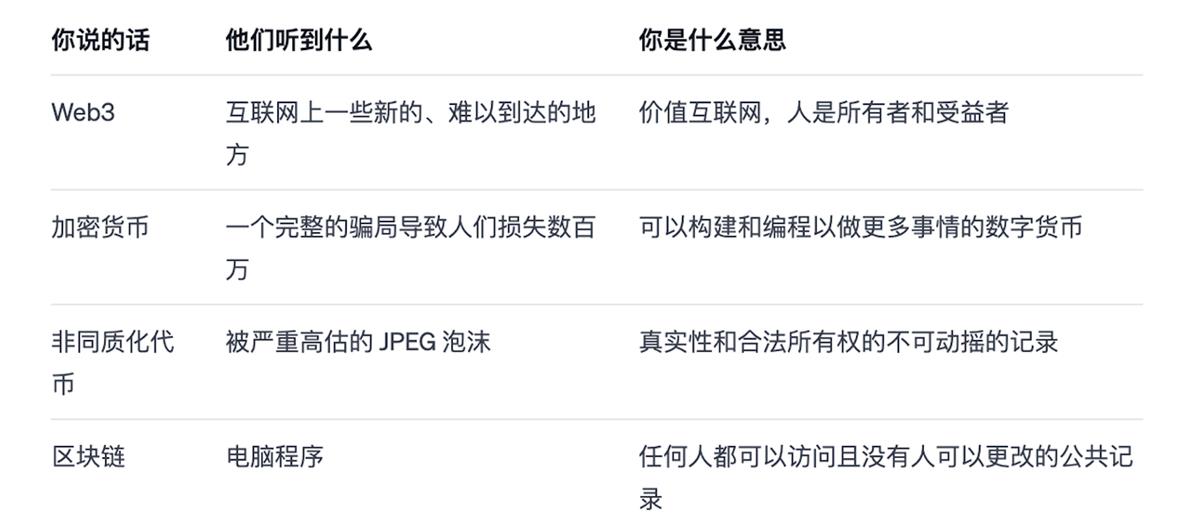
These technologies are new, and the language has been shaped by developers and evangelists. But now, the Web3 world must have compelling conversations with newcomers. That means explaining what the technology can do in the simplest way possible—and most importantly, why people should care.
Okay, So What Now?
Simpler, more engaging language is a first step—but it’s not enough. Impactful Web3 messaging must be authentic. Not about how amazing our technology is, but about users. Let’s show people we genuinely care about solving their problems. Sparking curiosity is key to welcoming the mainstream.
When we speak to newcomers, we should ask questions like: What do you think is wrong with the internet? They might talk about privacy—how Google knows everything about them, or Facebook sells their data.
What would you change about banking? They might mention how difficult and expensive it still is to transfer money between people and accounts—or express concerns about security.
What would you change about online shopping? They might complain about not being able to get Beyoncé tickets despite being a superfan, while hundreds are already resold on StubHub at five times the original price.
We must understand where our audience is coming from and what matters to them. Put the audience at the center. Ask whether Web3 is genuinely doing something meaningful to improve that person’s life—not just throwing jargon at them. Only then do we stand a chance of breaking through.
In our Web3 writing—marketing, product descriptions, or any communication—let’s keep this in mind. Instead of educating the ignorant or showing off technically impressive feats, start and end with their needs. Web3 connects the dots between them. We can do better. If Web3 fails to connect those dots, the fault lies with us…
This sounds simple, but it’s incredibly difficult in practice. Just look at most Web3 content today and assess how well our industry communicates with the public—the results are underwhelming.
Conclusion
Web3 is evolving at an incredible pace. We’re still learning what all these technologies can do, let alone how to describe them. As professional communicators, we believe in the powerful potential of Web3—and we can strive to be humble, curious, and kind. Web3 is a space for everyone.
The Web3 party will continue. It’s time to find better words—to open the doors and invite everyone in.
Join TechFlow official community to stay tuned
Telegram:https://t.me/TechFlowDaily
X (Twitter):https://x.com/TechFlowPost
X (Twitter) EN:https://x.com/BlockFlow_News
 Blockworks






