BTC NFT Ecosystem Overview: Current Development, Trading Markets, and Value Analysis
TechFlow Selected TechFlow Selected
BTC NFT Ecosystem Overview: Current Development, Trading Markets, and Value Analysis
Currently, the blue-chip projects for BTC NFTs have not yet established a definitive landscape.
 Navigating Web3 tides with focused insights
Author: Elaine Yang, Investment Director at Waterdrip Capital
I. Introduction to the Bitcoin NFT Protocol Ordinals
NFTs, as cryptographic tokens representing unique digital or physical assets, possess uniqueness and non-fungibility on blockchains. NFTs have evolved for years on smart contract platforms like Ethereum, giving rise to many well-known projects and applications. However, on Bitcoin—the earliest and most secure blockchain—NFTs have not seen widespread development or adoption due to its lack of native smart contract functionality and high transaction fees.
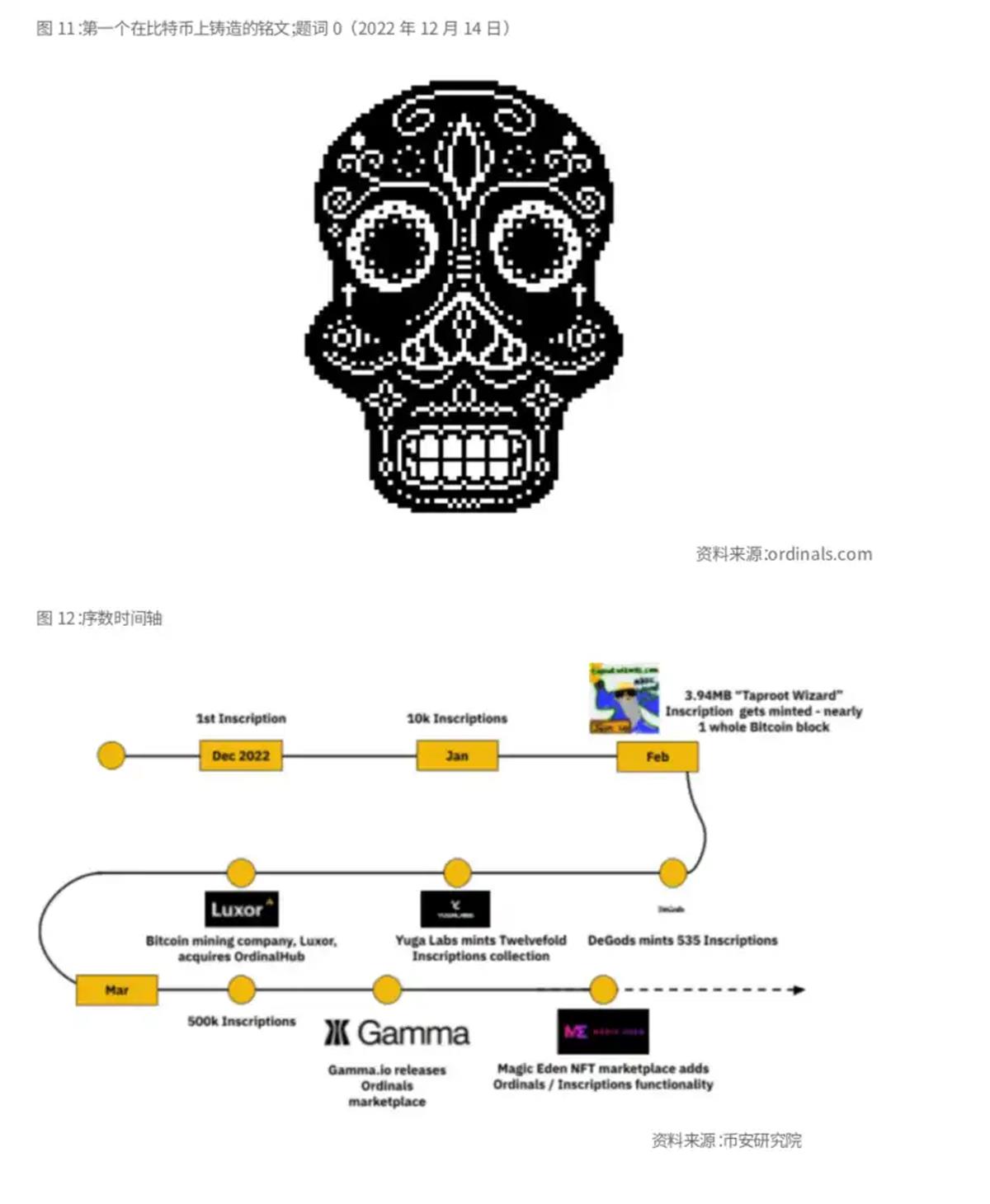
To address this issue, a protocol called Ordinals was officially launched on December 14, 2022. Leveraging Segregated Witness (SegWit) and Taproot technologies on the Bitcoin network—which reduce transaction data size, accelerate transactions, improve scalability, and lower fees—Ordinals enables direct minting, transferring, and burning of NFTs directly on the Bitcoin chain. The Ordinals protocol assigns an identifier to each smallest unit of Bitcoin (the satoshi), linking it with metadata to form a unique and traceable NFT. This protocol requires no centralized or trusted parties, nor does it rely on any Layer 2 or sidechain solutions; it fully adheres to Bitcoin’s own rules and security model.
The next major milestone for Bitcoin NFTs occurred in December 2022 when the first ordinal inscription was minted.
On May 10, the number of inscriptions on the Bitcoin NFT protocol Ordinals surpassed 5 million, generating approximately 213.1 BTC in total fees to date.
How Do Ordinals and Inscriptions Work?
ORD is open-source software that runs atop any Bitcoin full node and tracks individual Satoshis based on what founder Casey Rodarmor calls the "ordinal theory." Satoshis ("sats") are the smallest units of the Bitcoin network, where 1 BTC = 100,000,000 sats. The ordinal theory assigns a unique identifier to every satoshi on Bitcoin. Furthermore, these individual sats can be "inscribed" with arbitrary content such as text, images, or videos to create an "inscription"—a native digital artifact on Bitcoin, also known as an NFT. Individual sats can thus carry any content to become inscriptions, i.e., natively issued digital artifacts on Bitcoin, equivalent to NFTs.
Current inscription volume data from some Ordinals protocols: Data
II. Current State of BTC NFT Development
1. Blue-Chip Projects from ETH and Solana Launching NFTs on Bitcoin
High-profile positioning NFT projects
These refer to blue-chip NFT projects originally from Ethereum and Solana launching on the Bitcoin network—for example, Yuga Labs’ "TwelveFold" and the Bitcoin version of DeGods. TwelveFold is an NFT collection released by Yuga, limited to only 300 pieces. It's currently the only NFT project backed by major institutions, following an art-focused approach. Since the ceiling for art is far higher than PFP avatars, if successful, it could become a top-tier luxury brand!
Such projects already wield significant influence, hence their high launch prices. Yuga Labs sold 288 TwelveFold NFTs via auction, with winning bids ranging from 7.1159 BTC at the highest to 2.2501 BTC at the lowest, generating about $16.5 million in revenue. Currently, on ordinals.market, the floor price of TwelveFold exceeds 30 ETH, with a cumulative trading volume of 108.49 ETH. DeGods sold 500 Bitcoin-based NFTs at 0.333 BTC each within two minutes.
2. 'Sub 10K'
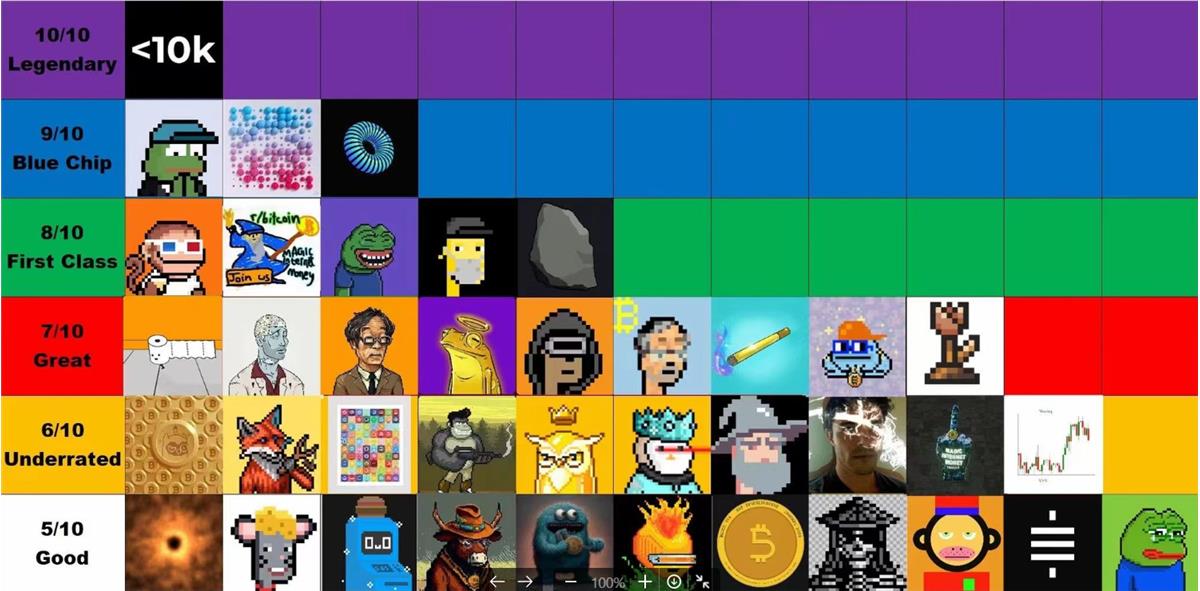
Each inscription (Bitcoin NFT) has a sequential inscription number. The earlier an inscription is minted, the smaller its number. Thus, NFTs with inscription numbers below 10,000 or 100,000 gain a sense of being “antique.” Although these early inscriptions often lack thematic content, they are valued purely for their temporal significance—their “time” value.
Currently, the second and eighth ever-minted Bitcoin NFTs—Inscription #2 and Inscription #8—are listed on the Ordinals Wallet marketplace.
The highest-selling "Sub 10K" Bitcoin NFT so far is Ordinals Punk #87 (Inscription #613), which sold for 2.77 BTC. On March 17, the Bitcoin logo image Inscription #3384 was traded at 0.31 BTC. Notable "Sub 10K" series include Ordinals Punks, Bitcoin Shrooms, and Planetary Ordinal. The widely recognized Bitcoin Punks belong to the "Sub 100K" category.
3. Native Bitcoin Crypto Culture
Bitcoin Punks, a perfect replica of ETH’s CryptoPunks, feature inscription numbers within the first 40K—very early mints, mostly held by OG veteran players—and backed by OKX. Like Bitmonkeys, they currently represent one of the most widely accepted NFTs.
Taproot Wizards' official social media shared founder Udi Wertheimer’s personal journey: “On the day Silicon Valley Bank collapsed and there was panic around USDC, I decided to launch the Taproot Wizard NFT project and invited people to record videos of themselves taking showers dressed as wizards.” Taproot Wizards is an NFT project built on the Bitcoin chain, initiated by crypto developer Udi Wertheimer, intended to commemorate Bitcoin’s Taproot upgrade and celebrate the iconic image of the Bitcoin Wizard within the community.
4. Tool-Enabled (Shovel-Type) NFTs
These are NFT series whose holders continuously receive valuable airdrops. A prominent example is BTC Machine, which has already airdropped two follow-up projects: BTC Operators and BTC Virus. Currently, BTC Machine has a floor price of 0.088 BTC on the Ordinals Wallet marketplace, while BTC Operators and BTC Virus sit at 0.018 BTC and 0.0012 BTC respectively. An important observation is that using various Bitcoin NFT-related tools increases the likelihood of receiving “shovel-type” airdrops. For instance, in late February, Ordinals Wallet airdropped 1,563 pixel-style PFPs themed around Sad Frogs—"Pixel Pepes"—to early users. This series now has a floor price of 0.066 BTC. As one of the top three Bitcoin NFT marketplaces by trading volume, much of Pixel Pepes’ value stems from expectations of future airdrops. Given that current Bitcoin NFT tools offer overlapping functionalities, it's highly plausible that new platforms will use NFT airdrops to attract traffic. Therefore, users should start actively engaging with Bitcoin NFT tools today.
List of notable BTC NFT series worth watching:
TwelveFold: An NFT project launched by Yuga, limited to just 300 pieces—the only NFT project backed by a major institution. Positioned as digital art, its potential ceiling far exceeds typical PFP avatars. If successful, it could become a top-tier luxury asset!
DeGods: A blue-chip project from Solana launching its NFTs on the Bitcoin network.
Sub 10K: Refers to inscriptions ranked among the first 10,000. Currently favored by OG veteran collectors.
Bitcoin Punks: Also known as BitPunks, a faithful recreation of CryptoPunks from Ethereum, with inscription numbers all within the first 40K—very early mints, primarily held by OGs and backed by OKX. Alongside Bitmonkeys, they represent one of the most consensus-driven NFTs today.
Taproot Wizard: An NFT project created on the Bitcoin chain by crypto developer Udi Wertheimer, commemorating Bitcoin’s Taproot upgrade and the legendary Bitcoin Wizard figure.
Pixel Pepes: In late February, Ordinals Wallet airdropped 1,563 pixel-art PFPs themed around Sad Frogs—"Pixel Pepes"—to early users (an Ordinals Wallet airdrop).
BTC Machine: A shovel-type project that has already airdropped two subsequent projects: BTC Operators and BTC Virus.
Bitcoin Pizzas: Gains traction around the May 22 Pizza Day event. Limited supply may lead to value appreciation during periods of heightened interest.
DogePunk: Dog-themed BitPunks, strong buyer demand, part of a 10K series.
bitcoin frogs: Also known as Bitfrogs, a 10K series. With recent popularity of Pepe, frog-themed collections are gaining momentum, especially those associated with prosperity symbolism like Golden Cicada Frogs.
JOMO HIPPO: JOMO Hippo, an original BTC NFT series.
Bitcoin Moonbirds: The Bitcoin-chain version of Moonbirds, a 10K series. As a CC0 project with no copyright restrictions, it avoids legal issues—making it the first major ETH-originated blue-chip IP adapted to Bitcoin without intellectual property conflicts.
(Source: @elaineyang73)
III. BTC NFT Marketplaces
1. Exchange-Based NFT Marketplaces
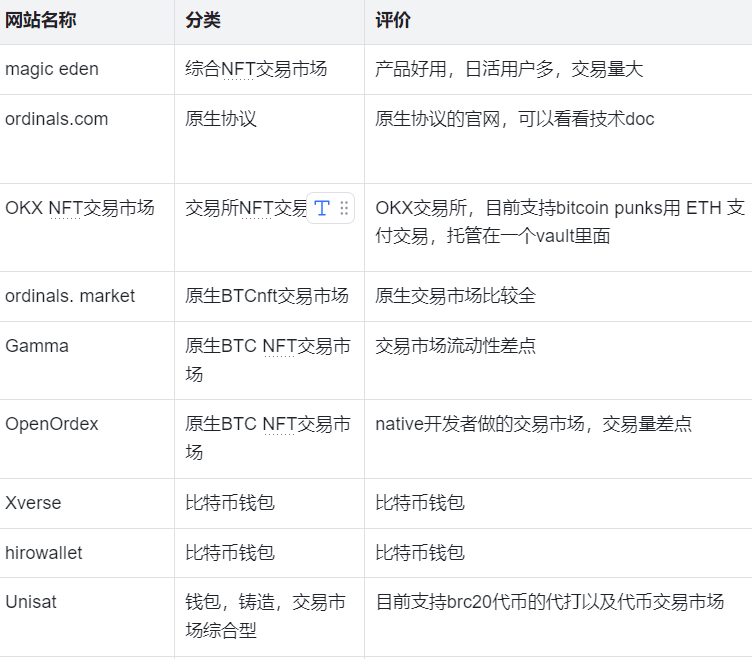
OKX founder Star Xu stated that OKX Web3 Wallet will soon support trading markets for Ordinals and BRC-20 tokens.
2. Native Ethereum Marketplaces Supporting the Ordinals Protocol
Magic Eden launched a Launchpad for creators of Bitcoin Ordinals NFTs.
3. Native Bitcoin Marketplaces
Gamma.io:
Formerly known as STXNFT, Gamma on Stacks announced its rebranding to Gamma on April 27, 2022. The platform aims to bring collectors, creators, and investors together within the Bitcoin ecosystem to explore, trade, and showcase NFTs. Gamma comprises three core products: an NFT marketplace, a Launchpad, and a social platform. Gamma.io supports both primary and secondary markets for Bitcoin NFTs.
Gamma.io offers a minting method called Gamma bot. Users can create their own unique digital artworks via Gamma bot for collection or sale. Minting an NFT requires no coding or technical expertise—just add the Gamma bot on Discord and enter a command like create <image_url> to generate an NFT. Gamma.io has also launched a .btc domain marketplace, enabling users to claim decentralized identities and websites. Users can register, buy, sell, and transfer .btc domains on Gamma.io and link them to their NFTs.
4. Comprehensive Platforms for Inscriptions, BRC-20 Trading, and More
Unisats:
Currently the leading platform for issuing and deploying BRC-20 tokens, inscribing ordinals, and registering domains. It supports peer-to-peer trading of BRC-20 tokens and boasts the highest daily active and transaction users. However, it currently does not support trading on Bitcoin NFT marketplaces. Despite its large user base, frequent lagging and crashes occur. Continued product iterations are expected. At present, Chinese teams are moving fastest in developing such products.
IDclub:
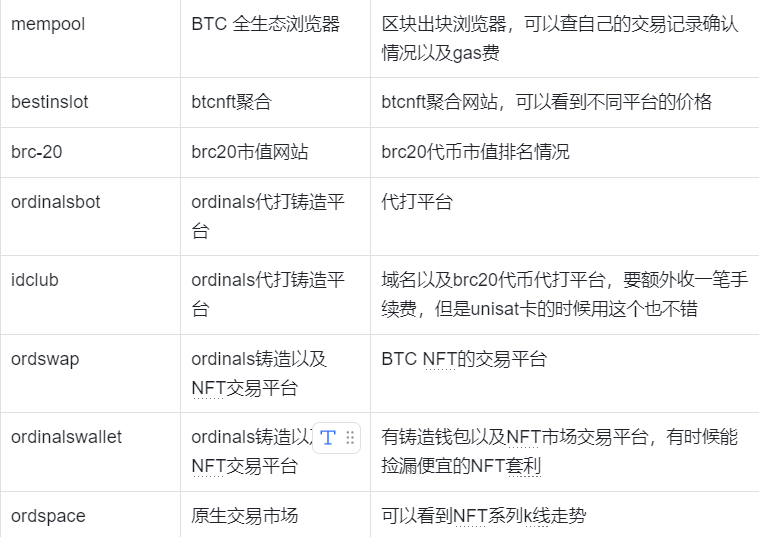
A platform for domain registration and inscription services but lacks support for peer-to-peer BRC-20 token trading or Bitcoin NFT marketplace functions.
Overview of tools for creating inscriptions and minting BRC-20 tokens in the Ordinals ecosystem:
(Source: @elaineyang73)
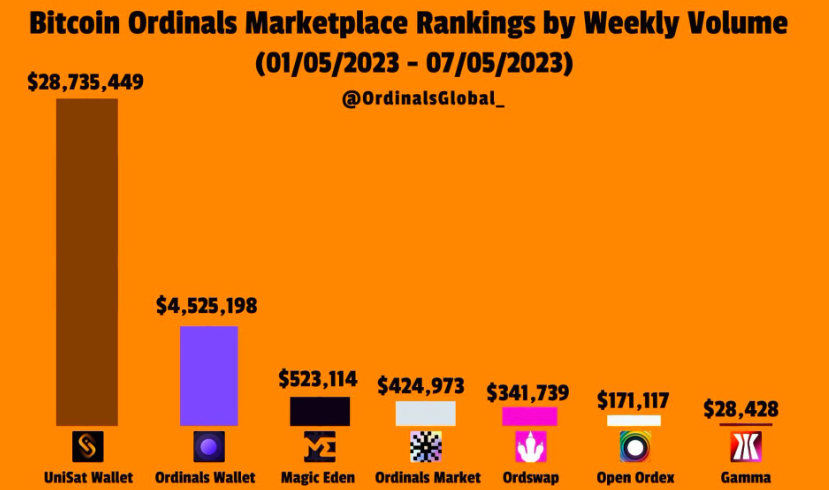
Current ranking of NFT marketplaces by trading volume:
IV. Value of BTC NFTs
A single BRC-20 token contains at least 546 satoshis and cannot drop to zero. From this perspective, BRC-20 tokens inherently hold more value than ERC-20 meme coins. Therefore, we should adopt an open-minded attitude toward BRC-20 tokens—not outright rejecting them, nor blindly embracing them—but observing their evolution over time.
It grants everyone the equal right to freely explore the diverse values of Bitcoin. You can create your own 'NFT series,' or treat the Bitcoin network as your 'personal diary'—recording your writings, drawings, songs... Throughout history, humans have recorded information on cave walls, bamboo slips, paper, computers, and now on the Bitcoin blockchain. If you believe the Bitcoin network is eternal, then the information stored on it is eternal too. And the medium itself is Bitcoin—nothing could be cooler than that.
If you had to pick one word to describe the difference between Bitcoin NFTs and Ethereum NFTs, what would it be?
Some say Bitcoin NFTs are "eternal." As long as you believe the Bitcoin network is eternal, all data inscribed onto it will persist forever. No off-chain dependencies—everything lives fully on-chain.
Others say—it's like writing something on a numbered banknote. Does it change anything? Hong Kong dollars might not care, but Bitcoin does! 1 Satoshi = Whatever you inscribed. This is the fundamental value distinction between Bitcoin NFTs and Ethereum NFTs.
Some argue Bitcoin NFTs have "historical value." Because the order of inscription creates numerical differences among Bitcoin NFTs, earlier inscriptions may gain greater value over time—like Jurassic dinosaur fossils, Shang Dynasty bronzes, or modern steel structures.
Others call Bitcoin NFTs "free." From Silk Road to online malls, then Amazon and eBay, Bitcoin has consistently evolved along the path of becoming a more widely accepted currency. The emergence of the Ordinals protocol makes Bitcoin even freer. Who knows what additional value an inscribed satoshi might hold? Free market dynamics will assign new values to these inscribed satoshis. One day, we’ll find the answer. These perspectives reveal the unique charm of Bitcoin NFTs compared to Ethereum NFTs. (Original source)
V. Challenges Facing Bitcoin NFTs
Lack of Scalability
Due to cost factors (fully on-chain storage), Bitcoin NFTs may currently struggle to achieve mass adoption or widespread application.
Lack of Infrastructure
The Bitcoin NFT ecosystem remains immature, lacking essential infrastructure and real-world use cases, relying heavily on over-the-counter (OTC) trading.
High Operational Barriers
As mentioned above, most Bitcoin NFT trades happen OTC, making operations complex. For average users, understanding and using these systems can be particularly challenging.
Increased Bitcoin Network Fees
Rising Bitcoin network transaction fees are a side effect of adding NFT data to the blockchain, causing the worst Bitcoin block congestion since the FTX collapse.
Violation of Bitcoin’s Core Principles
Bitcoin maximalists argue that Bitcoin NFTs violate Satoshi Nakamoto’s original vision of a “peer-to-peer electronic cash system,” claiming that storing NFT data on Bitcoin wastes block space.
VI. Market Outlook
1. The landscape for blue-chip BTC NFT projects has yet to solidify, but Bitfrogs show strong potential as a leading 10K series. Reaching a floor price of 1 BTC for a 10K series is a major threshold—but achievable, especially as exchanges begin endorsing BTC NFTs.
2. The BTC NFTs that will succeed in the future will likely be original creations from the Bitcoin ecosystem rather than copied PFP series from Ethereum. Moreover, they will continue leveraging the popular PFP avatar model. Only PFP-based BTC NFT series have the potential to become blue-chip projects.
3. For optimal pump dynamics, BTC NFT floor prices should ideally start around 0.001 BTC. Such low entry points offer up to 20x upside potential. Current thresholds to watch: 0.01 BTC, 0.02 BTC, and 0.1 BTC—a key level for ascending into blue-chip status.
4. Ethereum currently lacks new narratives, and on-chain activity shows that many NFT projects have begun migrating to BTC NFTs over the past fortnight. NFT artists should focus more on creating works infused with Bitcoin culture and themes.
Join TechFlow official community to stay tuned
Telegram:https://t.me/TechFlowDaily
X (Twitter):https://x.com/TechFlowPost
X (Twitter) EN:https://x.com/BlockFlow_News
 0xElaine