Artemis: An open-source MEV bot framework by Paradigm
TechFlow Selected TechFlow Selected
Artemis: An open-source MEV bot framework by Paradigm
Paradigm has announced the open-sourcing of Artemis, a framework for MEV bots. In this article, Frankie, a research associate at Paradigm, will explain the motivations behind building Artemis and the goals of this framework.
 Navigating Web3 tides with focused insights
Author: Frankie
Translation: TechFlow
Paradigm has announced the open-sourcing of Artemis, a framework for building MEV bots. In this article, Frankie, a research associate at Paradigm, explains the motivation behind developing Artemis and the goals of this framework.

Artemis is an open-source framework written in Rust for building MEV robots. The main features of Artemis are simplicity, modularity, and speed.
Why Build Artemis?
MEV remains one of the most powerful centralizing forces on Ethereum today. We believe that building open-source tools for MEV research and extraction is a clear path toward mitigating this centralization pressure.
Currently, new entrants into the MEV market face several barriers:
- It's difficult for new searchers to get started: Bot operators have little incentive to share their code, so new searchers often end up rewriting the same components and rebuilding similar infrastructure from scratch.
- It's hard for new protocols to find searchers to run keepers: It’s difficult to attract searcher attention before your protocol reaches scale.
We hope Artemis can help alleviate some of these issues by providing flexible and reusable components for writing MEV bots, as well as serving as a repository for contributed strategies and keepers.
What Is Artemis?
Artemis is both a library for writing bots and a strategy repository. When designing this project, we had several goals in mind:
-
Simplicity: Artemis is designed as a simple event engine, meaning it is flexible enough to support a wide range of strategies while avoiding unnecessary complexity.
-
Modularity: Artemis provides commonly used bot components. These components can be mixed and matched to write strategies, allowing searchers to focus on implementing the core logic for each opportunity.
-
Performance: We want Artemis to be performant, which is why the framework is written in Rust.
-
Production-ready: Artemis includes tools that make it easy to run in production environments, such as dockerized deployment, and monitoring and alerting via Prometheus and Grafana.
Artemis Architecture
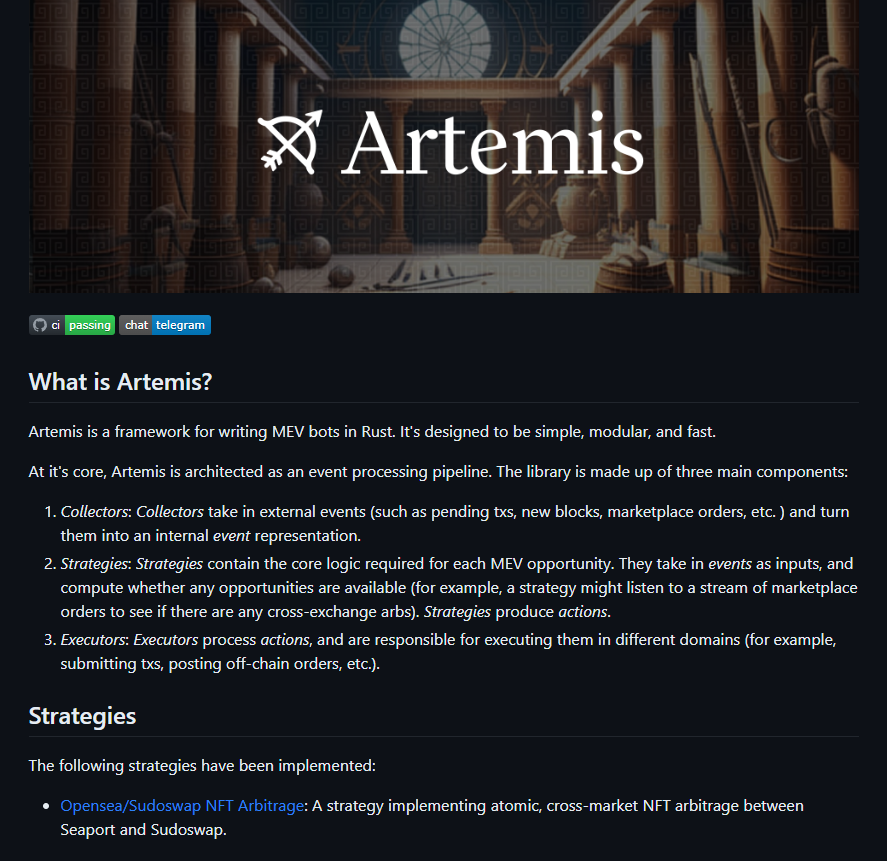
At its core, Artemis is built as an event-processing pipeline consisting of three main components:
-
Collectors: Gather and receive external events (such as pending transactions, new blocks, off-chain orders, etc.) and convert them into internal event representations.
-
Strategies: Contain the core logic required for each MEV opportunity. They take events as input and compute whether any opportunities exist (for example, a strategy might monitor market order flow to detect cross-exchange arbitrage). Strategies generate actions.
-
Executors: Handle actions and are responsible for executing them across different domains (e.g., submitting transactions to the public mempool, sending Flashbots bundles, or placing off-chain orders).
Additionally, we are open-sourcing a cross-market NFT arbitrage strategy and will be releasing more strategies soon.
TechFlow note: The Artemis framework is now open-source and available for use via its repository on GitHub.
The contributor information on the project homepage shows that the primary contributor to this framework is Frankie, the author of this article and a researcher at Paradigm.
Furthermore, the NFT arbitrage strategy mentioned above is also included in the repository—an open-source, replicable strategy that enables atomic, cross-market NFT arbitrage between Seaport and Sudoswap.
Join TechFlow official community to stay tuned
Telegram:https://t.me/TechFlowDaily
X (Twitter):https://x.com/TechFlowPost
X (Twitter) EN:https://x.com/BlockFlow_News
 Paradigm