Interpreting CCTP: Circle Enters the Ring, Intensifying Competition in Cross-Chain Bridges
TechFlow Selected TechFlow Selected
Interpreting CCTP: Circle Enters the Ring, Intensifying Competition in Cross-Chain Bridges
Recently, Circle launched its Cross-Chain Transfer Protocol (CCTP), setting a new standard for USDC's pricing power and cross-chain dominance.
 Navigating Web3 tides with focused insights
Author: Winter Soldier
Compiled by: TechFlow
Recently, Circle launched its Cross-Chain Transfer Protocol (CCTP), setting a new standard for USDC's pricing power and cross-chain dominance. By eliminating the need for liquidity on any single chain, the protocol elevates capital efficiency to a new level. This means Circle could potentially monopolize the USDC bridging market and strengthen USDC’s position in DeFi. Meanwhile, existing cross-chain bridges may face intensified competitive pressure.
Here’s a quick overview of how CCTP works and its implications.
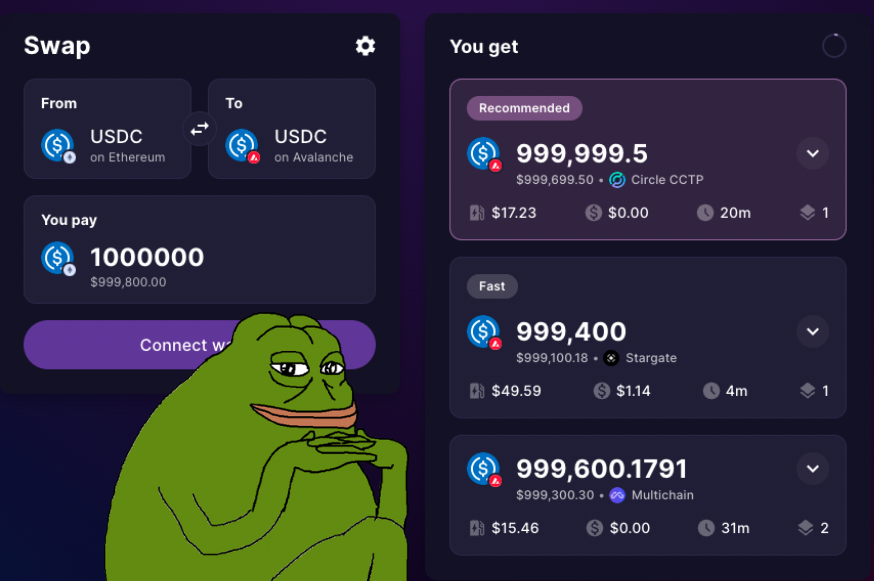
Current cross-chain bridges adopt various design choices, making trade-offs between native assets, liquidity, and security. Circle’s CCTP raises capital efficiency to a new level by removing the need for liquidity on any one chain.
How do they achieve this?
As the issuer of native USDC, Circle has the ability to burn and mint USDC on any chain where native USDC is deployed. Here’s how it works:
i. The user initiates a transfer via an integrated portal, and USDC is burned on the source chain;
ii. A signed attestation from Circle confirms the burn transaction and authorizes minting on the destination chain;
iii. USDC is minted and sent to the target address.

The most immediate implication is that Circle could dominate the USDC cross-chain market. Since transfers are cheaper, cross-chain applications currently integrated with other bridges may quickly switch to Circle (including Radiant, Sushi, etc.).
Existing cross-chain bridges like Stargate Finance will struggle to compete on pricing power. This also reinforces USDC’s already strong advantage in DeFi, as it becomes the cheapest and lowest-slippage token to send across chains.
This is good news for end users, who no longer need to worry about which bridge to use or how to find cheaper options—dApps (such as cross-chain routers and protocols) will handle all integrations.
Currently, Circle has rolled out the service with several strong partners.

Join TechFlow official community to stay tuned
Telegram:https://t.me/TechFlowDaily
X (Twitter):https://x.com/TechFlowPost
X (Twitter) EN:https://x.com/BlockFlow_News
 Winter Soldier