Discover Web3 games that may rise in the next cycle
TechFlow Selected TechFlow Selected
Discover Web3 games that may rise in the next cycle
This article will review the history of Web3 gaming, explore its current state, and examine several highly anticipated projects.
 Navigating Web3 tides with focused insights
Author: Seth Goldfarb
Translated by: TechFlow
Web3 gaming is gradually entering its second half, and evolving gameplay experiences and economic models are giving us hope for mass adoption.
Therefore, it's worth revisiting the development trajectory of this sector to prepare for what could be an imminent breakout.
This article will review the history of Web3 gaming, examine its current state and several high-profile projects, aiming to provide readers with a deeper understanding of the Web3 gaming landscape. Here is the original text:
Although we constantly hear discussions about Web3 gaming—from promises of NFT ownership and interoperability to fleeting hype cycles around GameFi and Play-to-Earn (P2E)—we don't seem to be seeing the real fulfillment of those promises.
That’s not to say there haven’t been interesting games (e.g., Gods Unchained), or that some people haven’t made money from P2E games. But honestly: so far, nothing has truly lived up to expectations.
However, the next cycle may arrive sooner than we expect.
Backed by massive investments, several independent and AAA game developers are emerging as dominant players in the space, preparing to launch games that can showcase the true potential of Web3 and spark the next wave of token-driven hype.
If there’s one sector poised to deliver mass adoption first, I believe it will be Web3 gaming. I’ll explain why shortly—but first, I want to discuss what Web3 initially brings to gaming.
The Promise of Web3 Gaming

The key difference between Web3 gaming and traditional gaming lies in its promise of ownership and interoperability. By using blockchains as public registries for in-game assets, Web3 aims to allow players to own components of games and use them even across different titles.
Players already care deeply about ownership—free-to-play battle royale shooter Fortnite generated over $5 billion in revenue for parent company Epic Games within its first year alone.
Gamers willingly spend large sums to play as certain characters or buy flashy, colorful skins for weapons, yet few realize that Epic ultimately retains ownership of these skins. If Fortnite were to disappear, those skins would vanish too, and all money spent on them would be lost.
By introducing distributed ledgers, Web3 solves this problem by creating systems where players can track their digital property. Expanding further on the concept of digital ownership, Web3 fundamentally enhances gaming experiences by enabling composability, interoperability, and open-source development.
Imagine if game design allowed items, characters, or even maps to be transferred from one game to another—enabling continuity across games. Could different games leverage the same maps or items? Could the same asset appear differently across various games? The possibilities are endless.
When we talk about fulfilling the promise of Web3 gaming, we’re not just talking about one or a few Web3 games achieving mainstream success; we're envisioning an open gaming ecosystem where players enjoy seamless cross-game experiences, which could mark the watershed moment for explosive growth in Web3 gaming.
Current State of Web3 Gaming
Some statistics from Cointelegraph’s March 2023 blockchain gaming report offer insight into the growth and potential of Web3 gaming:

Beyond substantial funding and numerous game projects, Web3 gaming accounted for 49% of all on-chain transactions in 2022, while daily active users grew by 60% from 2021 to 2022—indicating both user base expansion and significant relative potential compared to other blockchain sectors.
Currently, vast resources are being dedicated to turning this vision into reality. To understand the industry's status, let’s look at some headline events over the past five years that have shaped blockchain/NFT/Web3 game development:
-
December 4, 2017 - Bloomberg - CryptoKitties craze overwhelms Ethereum network;
-
August 22, 2018 - CoinDesk - A crypto card game tests Magic: The Gathering records—even before launch;
-
March 12, 2019 - Ledger Insights - Ripple launches $100 million fund focused on supporting game developers;
-
June 4, 2020 - Cointelegraph - Blockchain gamers earn $20 million in one year;
-
March 9, 2021 - Bloomberg - Controversy erupts as crypto artists profit from NFTs;
-
October 15, 2021 - The Verge - Valve bans blockchain games and NFTs from Steam;
-
November 3, 2021 - PC Gamer - EA calls NFTs and blockchain gaming “the future of our industry”;
-
July 25, 2022 - TIME Magazine - Can crypto games help lift Filipinos out of poverty? What actually happened?
-
January 30, 2023 - BeInCrypto - Blockchain gaming industry moves beyond P2E model.
Despite market downturns, investment and development activity shows no signs of slowing. In fact, Steve Allison, General Manager at Epic Games, recently stated that Epic currently has five crypto games on its marketplace, with nearly twenty more in the pipeline.
From an investment perspective, DappRadar’s 2022 Blockchain Gaming Report shows rapid growth in blockchain gaming investments. From 2019 to 2022, funding for blockchain gaming surged from $27 million to $7.6 billion.

Venture capital firms aren’t infallible, but they wouldn’t invest heavily in a sector without seeing enormous growth potential. Not only does confidence in Web3 gaming appear to be rising, but a survey of nearly 1,000 Web3 deals reveals that VCs have invested more in Web3 gaming than any other category.

VCs may feel they’ve missed opportunities in other areas of Web3, or more likely, they simply believe Web3 gaming offers greater potential for financial returns compared to other segments.
In other words, investors clearly see what’s happening—and they’re not the only ones. Several Web3 gaming infrastructure providers have also launched funding programs to support studios and developers building in Web3 gaming, including ImmutableX ($500 million), Avalanche ($290 million), and Game7 ($100 million).
With so many resources available, the only remaining question is whether game studios can transform these investments into genuinely enjoyable new gaming experiences that players actually want.
Games on the Horizon
While many released games so far have merely integrated NFTs into generic RPGs, a few projects appear to be developing truly innovative Web3 games with the potential to build full-fledged ecosystems around Web3 gaming:
1. GALA

Upcoming games from Gala include shooters, role-playing games, simulators, and strategy titles:
-
Battlestar Galactica Eternity (4x MMO)
-
Grit (battle royale)
-
Last Expedition (survival FPS)
-
Legacy (business simulation)
-
Legends Reborn (card/strategy)
-
The Walking Dead: Empires (survival MMORPG)
Gala’s games incorporate Web3 technology, though it remains unclear how they will implement interoperability. At this stage, they seem focused on creating playable games, integrating interoperability where appropriate.
2. Illuvium

Illuvium takes a different approach: It is building what it calls an "Interoperable Blockchain Game (IBG) Universe," consisting of multiple games set within a shared universe.
Illuvium Zero, a world-building simulator, has already released an alpha version. Two other titles are currently in testing: Overworld, an open-world RPG, and Beyond, an auto-battler game.
The project is built on Immutable X, infrastructure specifically designed for Web3 gaming. Besides offering two blockchains optimized for Web3 gaming—zkEVM and ZK-rollup—Immutable also provides solutions for wallet onboarding and NFT-based gameplay, making Web3 game development easier. Gods Unchained, one of the most popular Web3 card games to date, is also hosted on Immutable X.
3. Vulcan Forged

Vulcan Forged is like an enhanced version of Illuvium. The company describes itself as “an established NFT game studio, marketplace, and dApp incubator with over 10 games, 20,000+ community members, and ranking among the top five NFT marketplaces by trading volume.”
Vulcan Forged integrates at least five games, two tokens, and diverse game mechanics into its ecosystem, appearing highly vibrant.
Vulcan Forged uses two tokens: PYR and LAVA. Both can be earned through gameplay and serve various utility functions outlined in Vulcan’s documentation.
4. Yield Guild Games

Yield Guild Games (YGG) has played a pivotal role in many well-known games. Known for Axie Infinity, Splinterlands, and The Sandbox, YGG focuses on building and investing in P2E games.
Yield Guild held its YGG token sale in July 2021, and according to its whitepaper, YGG tokens can be staked to earn rewards, access exclusive content and merchandise, and participate in DAO voting and governance.
Many of YGG’s marketing materials feature its co-founders: gaming veteran Gabby Dizon, fintech entrepreneur Beryl Li, and developer Owl of Moistness. YGG also operates eight sub-DAOs, six of which convened at a subDAO summit in Manila in November 2022.
I learned that YGG did set up a DAO on Snapshot, but was told that launching full DAO governance is a lower-priority item on their roadmap. YGG frequently shares updates on investments and ecosystem development via its blog, so we must watch closely for when and how they plan to advance decentralized governance.
5. Midnight Society
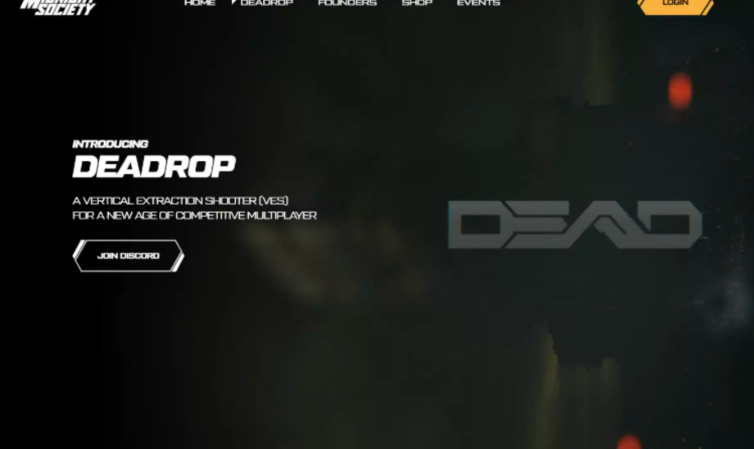
DeadDrop, formerly known as "Project Moon," defines itself as an extraction shooter—a hybrid between battle royale and extraction-style games that emphasizes stealth.
Developed by Midnight Society, the team includes veterans from games like Call of Duty, Halo Infinite, and Gears of War. The studio was founded by Dr. Disrespect, a popular streamer who had over four million followers before being banned from Twitch in 2020.
Midnight Society raised 199 ETH by selling 10,000 Founders Pass NFTs, granting holders exclusive access to in-game assets, merchandise, live events, and testing participation.
DeadDrop is one of several upcoming Web3 shooters, alongside others such as Citizen Conflict, The Harvest, and Shrapnel.
Conclusion
As more Web3 games emerge and on-chain and off-chain metrics show signs of vitality, success seems inevitable—it's only a matter of time before certain projects break through. If ICOs sparked the first bull run at the end of 2017, and NFTs drove the second in 2021—largely due to speculative excitement over new technological applications—just imagine what might happen when Web3 gaming finally takes off.
Join TechFlow official community to stay tuned
Telegram:https://t.me/TechFlowDaily
X (Twitter):https://x.com/TechFlowPost
X (Twitter) EN:https://x.com/BlockFlow_News
 Seth Goldfarb