








Decoding Stader: DVT Hybrid Nodes, Can This Multi-chain Low-Market-Cap LSD Protocol Find Its Spring?
TechFlow Selected TechFlow Selected
Decoding Stader: DVT Hybrid Nodes, Can This Multi-chain Low-Market-Cap LSD Protocol Find Its Spring?
Deep dive into Stader's LSD product design and model.
 Navigating Web3 tides with focused insights
Produced by: TechFlow Research Institute
Author: Rain Sleeping in the Wind
There is a consensus: the core narrative of this year’s crypto market is LSD (Liquid Staking Derivatives). As such, we’ve seen many protocols pivot toward LSD offerings—Frax Finance launched frxETH, MakerDAO is preparing to launch ETHD, and Yearn is set to introduce yETH. Established staking protocol Stader Labs is also riding this wave, launching its own Ethereum-based LSD product.
In this highly competitive sector, we can broadly divide players into three layers:
The foundational layer consists of DVT (Distributed Validator Technology)-focused projects like SSV.Network and Obol Network.
The second layer includes well-known protocols such as Lido and Rocket Pool, which enable users to stake Ethereum more easily and with higher capital efficiency.
The top layer comprises DeFi protocols that use various DeFi mechanisms to enhance yields on LSD tokens like stETH.
Stader Labs’ upcoming ETHx falls into the second category.
Originally conceived to provide liquid staking services for Terra, Stader shifted focus following Terra’s collapse, expanding across multiple chains to offer liquid staking on Polygon, BNB Chain, Near, Fantom, Hedera, and Terra 2.0. According to DeFiLlama data, Stader currently has a total value locked (TVL) of $109 million. Its native token $SD has a market cap of $24 million and an FDV of $160 million.
Will ETHx become a new TVL growth driver for Stader? Let’s explore the design and model behind Stader’s LSD offering.
Hybrid Node Operator Model
Stader aims for ETHx node operators to primarily consist of home stakers and independent node operators, enabling permissionless support for users who stake via Stader. This approach enhances decentralization of ETHx and reduces the risk of penalties on Ethereum staking. To achieve this,Stader will leverage DVT technology.
In addition to permissionless node operators, Stader will also incorporate permissioned node operators. These will participate through whitelisting within Stader’s staking ecosystem. Permissionless node operators are required to post collateral (a bond), whereas permissioned operators face little or no collateral requirements.
By using DVT technology, Stader can reduce both the collateral requirements and slashing risks for permissionless node operators, thereby attracting more participants and enhancing decentralization in Ethereum staking. Stader has already conducted tests on the SSV testnet.
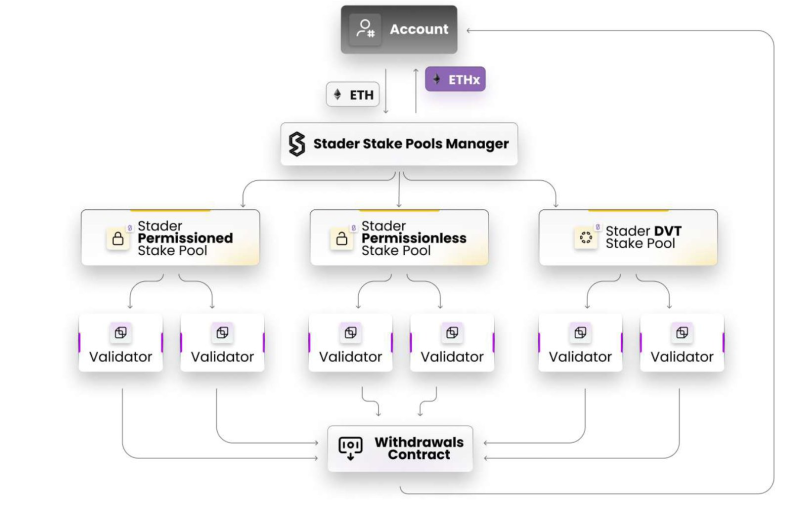
This hybrid structure allows Stader to meet user demand early on through trusted permissioned operators while gradually growing its base of decentralized, permissionless operators over time.
Liquid Staking Design
Thanks to DVT, Stader has reduced the minimum Ethereum staking requirement to just 4 ETH—compared to Rocket Pool’s 16 ETH minimum. For those running a permissionless node, an additional $SD equivalent to 0.4 ETH must be staked, where $SD is Stader’s native token. Node operators can also participate in governance by staking $SD.
To further lower entry barriers, Stader allows node operators to borrow $SD worth 0.4 ETH without posting collateral. In return, lenders receive reserved $SD incentives and 10% of the node operator’s commission.
Overall, the cost for a Stader node operator—4.4 ETH—is lower than other decentralized liquid staking protocols, giving Stader a distinct edge. Additionally,to attract more node operators, Stader plans to distribute 800,000 to 1.5 million $SD as incentives.
As modular architecture gains traction, Stader’s liquid staking solution introduces modular smart contracts—anyone can use pre-built components from Stader to create their own custom staking solutions.
Liquid Staking Tokens
Lido’s strength lies in zero staking threshold and issuing stETH as a liquid staking token. Similarly, Stader’s ETHx is designed for broad utility across DeFi. Stader’s confidence comes from its existing network of DeFi partners developed during its multi-chain expansion, including Aave and Balancer. It has already partnered with Aura Finance to launch a $SD-$ETH liquidity mining program.
The four main DeFi applications for ETHx are:
Liquidity Mining: Stader’s $ETH-$ETHx LP pairs have partnered with Balancer, Quickswap, BeethovenX, Apeswap, and Wombat.
Lending: Stader ETHx has integrated with lending protocols including Aave, 0vix, and Granary.
Stablecoins: QiDAO will accept ETHx as collateral for minting stablecoins.
Options Trading and Option Vaults: On this front, Stader has partnered with Olive Finance and Delta Theta.
Looking at Stader’s partner distribution, we clearly see both its established multi-chain relationships and future plans for ETHx expansion. Multi-chain deployment will expand ETHx’s use cases. Unlike other LSD protocols focused on Layer 2 expansion within the Ethereum ecosystem, ETHx will extend into non-Ethereum Alt-Layer1 ecosystems.
Native Token $SD
Beyond potential selling pressure from operator incentives, the new product impacts Stader’s native token $SD in four key ways:
Node operators must stake $SD to run nodes.
$SD holders can lend their tokens to earn $SD rewards plus 10% of node operator commissions.
Stader has introduced a new tokenomics model with $xSD: $SD holders who stake their tokens receive $xSD. $xSD holders earn a portion of protocol revenue and gain governance rights. $xSD can be redeemed back to $SD at real-time exchange rates, subject to a 7-day waiting period.
A portion of protocol revenue will be used to buy back $SD, which will then be staked into $xSD.
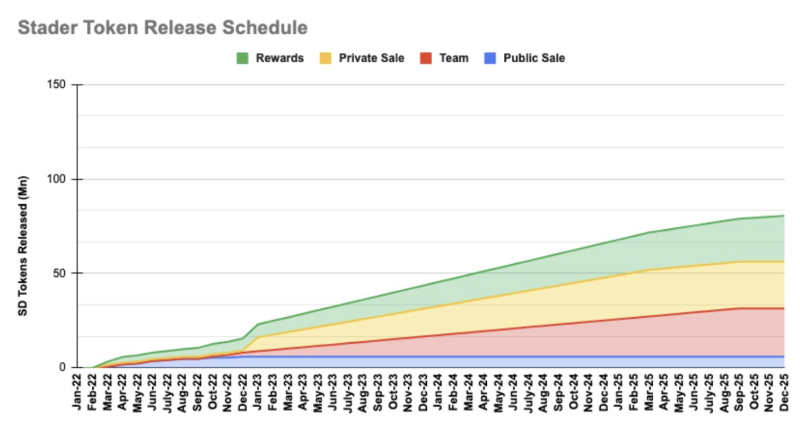
However, it should be noted that $SD also faces downward pressure—not only from operator rewards mentioned above, but also from team token unlocks that began in January this year after earlier delays.
Final Thoughts
It must be acknowledged that Stader’s ETHx model represents an optimization over current liquid staking solutions in terms of decentralization and cost-efficiency, while also advancing adoption of DVT technology.
From a product design perspective, Stader holds certain advantages among current liquid staking offerings. However, competing protocols are also evolving—Lido V2 will soon launch its Staking Router, allowing anyone to become a node operator via modular plug-and-play components to improve decentralization; Rocket Pool has introduced Mini Pools, reducing the ETH threshold to 8 ETH.
The competition in the LSD space is poised to intensify. Therefore, building DeFi ecosystems around derivatives like stETH and ETHx will become the next battleground.
Join TechFlow official community to stay tuned
Telegram:https://t.me/TechFlowDaily
X (Twitter):https://x.com/TechFlowPost
X (Twitter) EN:https://x.com/BlockFlow_News
 雨中狂睡Sleeping in the Rain






