








Chen Zhan | From Web2 to Web3: The Great Voyage Era for New Economy Entrepreneurs
TechFlow Selected TechFlow Selected
Chen Zhan | From Web2 to Web3: The Great Voyage Era for New Economy Entrepreneurs
Given such a historic opportunity of massive traffic shift, why shouldn't PC internet entrepreneurs go all-in on mobile internet?
 Navigating Web3 tides with focused insights
By Claudia
Introduction: Achieving mass adoption of Web3 is a shared goal across the industry, and many practitioners often use Web2's user scale as a benchmark to assess Web3's stage of development. In fact, an increasing number of former Web2 entrepreneurs are now diving into the Web3 rabbit hole.
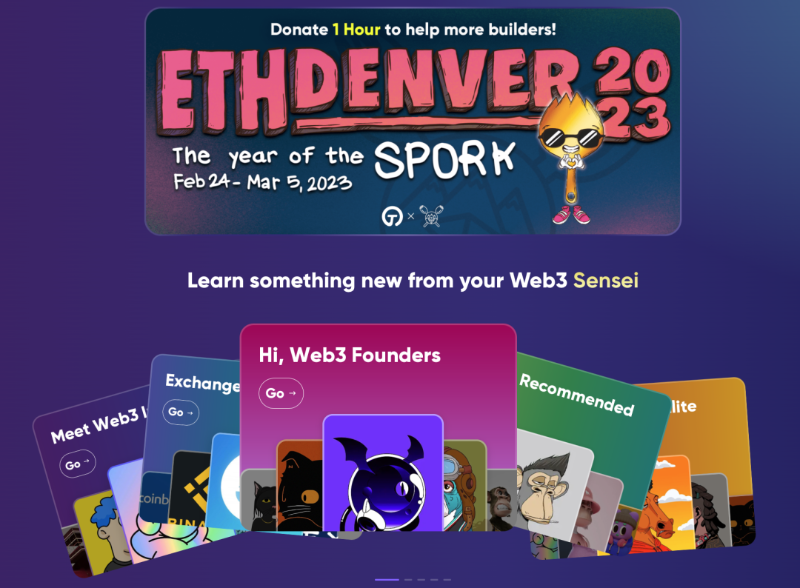
TechFlow will continue interviewing experienced Web2 founders who have transitioned into Web3 entrepreneurship, inviting them to share their insights on how to achieve mass adoption, along with reflections on the differences between building in Web2 versus Web3, and what lessons can be carried over. We welcome you to read, engage, and reach out for discussion. In this issue, we speak with Chen Zhan, founder of Timely. At the upcoming EthDenver conference, Timely is partnering with the ETHDenver Foundation to launch the “Donate One Hour” initiative—minting time as NFTs for charity auctions, leveraging Web3 to empower public good and give back to the community.
"You know, it’s like a grand maritime adventure—you’re at the helm, sailing forward. You don’t know which direction is right or what lies ahead, but that horizon where sea meets sky fills you with anticipation." As his plane touched down at San Francisco International Airport, Chen Zhan—a true Web2 native—embarked on an unknown journey to build in Web3, far from home.
For a Web2 entrepreneur venturing into Web3, there is no clear roadmap to validate a business model. Builders must keep walking through this new ecosystem, trying to find familiar patterns using their past knowledge and experience from Web2, then gradually discovering their path through real-world experimentation.
Chen Zhan shares this sentiment: "Unlike traditional industries with century-old established paths, Web3 is full of opportunities but also faces greater challenges. It's nearly impossible to predict a product's trajectory using Web2 logic. In Web2, most processes have been tested by time and events, forming a relatively systematic methodology. But in Web3, such frameworks simply don't exist yet. Every voyage, every decision, comes with unpredictable outcomes—we can only navigate through the fog. In this sense, Web3 is defined by its winners."
This uncharted blue ocean is now attracting more and more Web2 OGs at an accelerating pace.
I. Though Thousands Oppose, We Shall Go Forward
Before entering Web3, Chen Zhan had already built a notable track record. He launched the fintech app "Caishen Grandpa" in just 19 days, achieving over 2 billion yuan in transaction volume within 99 days. He once led a company to build a team of over 300 people in three months, operating in 70 cities with cumulative transactions surpassing 1 billion yuan. But these achievements belong to Web2. Now, he has embarked on a new entrepreneurial journey in Web3.
If prior experiences allowed many Web2 professionals to write entire books on product growth, those books now feel outdated in Web3—many of their methodologies no longer apply. Some Web3 purists shout slogans like "Crypto Native," questioning entrepreneurs migrating from Web2, arguing that their pre-existing mindsets around products, communities, brands, and incentives create obstacles in building for Web3.
Chen Zhan acknowledges this truth. The fundamental logics of Web2 and Web3 differ significantly, making the transition extremely difficult. Yet he remains optimistic. This process of reinvention is like a "golden cicada shedding its shell"—once the barrier is broken, the experience accumulated in Web2 can accelerate success. "Web3 has now reached a tipping point for application-layer explosion. Chinese Web2 entrepreneurs possess inherent advantages—it’s time to enter the space."
This moment of entry might well define the next two decades of the future.
"The impact blockchain will bring to the world is irreversible and immeasurable. If we look at it from the perspective of productivity and production relations, AI enhances productivity and efficiency, while Web3 brings transformative change to production relations. At this pivotal juncture, if we recognize the dual boost of productivity + production relations, and understand how tokens reshape economic life in Web3, we’ll see that this value represents an exponential entropy explosion—an unimaginable magnitude. This transformation is fundamentally unpredictable."
And if our vision of Web3’s future is seen as a value judgment rooted in individual worldview, then for many Web2 entrepreneurs, the leap from Web2 to Web3 becomes a pilgrimage driven by belief.
"What excites me most about Web3 is that blockchain will fundamentally transform humanity’s production relations. This shift may seem faint and fragile today, but it actually holds immense power—just like the early days of the joint-stock company over 400 years ago. I believe most of us Web3 entrepreneurs may end up as dust in this historical transformation, but being part of reshaping organizations and commerce according to the future is far more thrilling than building another Web2 company."
II. The Vast Blue Ocean of Web2 User Migration
"Globally, Web2 has five billion users, while Web3 has only around 20 million real users. That gap represents a massive opportunity for user migration." From the early days of mobile internet with devices like Dopod smartphones, to the iPhone 4, and then the Android ecosystem boom, Web2 achieved global saturation in just over a decade, shaping today’s digital landscape.
Chen Zhan believes, "In the next 20 years, a large portion of Web2 users will migrate to Web3, and at some inflection point, we’ll see exponential growth—all of which depends on infrastructure maturity and native application innovation."
Web3 operates on fairer value distribution, community consensus, and data ownership. If the user experience matches that of Web2, there’s no reason for the next generation, GenZ, to reject Web3 products. Our mission as innovators at the application layer is to continuously learn and adapt, using creative Web3 applications and protocols to break through the walls keeping Web2 users out—to drive the leap from 20 million to 1 billion users. Over the next two years, as Layer2, wallets, DID, decentralized storage, and other infrastructures mature, every sector of the Web2 internet economy—gaming, finance, communities, social, tools, content—is worth rebuilding from scratch."
In other words, Web3 applications and protocols will redefine every industry just as traditional software once did. Against this backdrop of traffic migration, seeking matrix-style application opportunities within Web3 communities—and capturing traffic gateways at both the application and protocol layers—offers inherent advantages. And it is precisely under these conditions that Timely was born.
Timely is Chen Zhan’s first product since entering Web3. As an NFT-based time-sharing protocol, on Timely, time providers can mint their time into NFTs, while time seekers can acquire access to meet them by trading these NFTs. In this process, time becomes a monetizable on-chain asset, enabling price discovery, decentralized demand matching, free trading and circulation, and fair incentive mechanisms via blockchain technology.
In this context, time is not just time—it’s insight, and it’s opportunity. Imagine the iconic "Buffett Lunch," now minted as an NFT and tradable on the market; Web2 users looking to enter the space could directly book mentorship sessions; investors hunting for promising projects could purchase time with a founder. These connections and knowledge exchanges are systematized through time NFTs, allowing insight to be priced by the market and value to flow more efficiently across society.
On the other hand, Chen Zhan firmly believes, "NFTs with real utility will dominate the future of NFT technology applications." As Marc Andreessen, one of A16Z’s founders, once said, "Software is eating the world"—well, utility-driven NFTs are also eating the world.
III. The Great Age of Exploration for New-Economy Entrepreneurs
Over the past 20 years, a generation of exceptional, even legendary, entrepreneurs emerged. Chen Zhan firmly believes: "This generation of millennials and GenZ, whether in China or abroad, regardless of external conditions, will continue to carry the torch of innovation and entrepreneurship in the new economy—driven by ideals, striving to build products that change and impact the world."
If the last 20 years saw Web2 evolve rapidly from infancy to golden age, then in the next 20 years, "one of Web3’s key missions is onboarding more Web2 users into Web3. In this regard, bringing more outstanding Web2 builders into Web3 will help tear open breakthroughs at the application layer," Chen Zhan says when discussing how to achieve mass adoption in Web3.
And this is exactly what Timely aims to do. On Timely’s platform, influential experts are already listed across various niche sectors and roles, helping Web2 entrepreneurs quickly upgrade their understanding of Web3 and enabling more traditionally-defined Web2 founders to enter the space swiftly.
Building in Web3 inevitably means going global, embarking on voyages across continents. It requires not just physical travel, but mental navigation—embracing globalization and constant self-disruption. Chen Zhan admits his own journey transitioning from Web2 to Web3 has been incredibly challenging. To those hesitating, he offers this advice: "Be brave—take that first step and move forward. Faced with such a historic wave of traffic migration, how could any entrepreneur who once bet everything on mobile internet during the PC era hesitate to dive into Web3 today?"
Even amid a bear market, now is still the time to enter. "Today, I believe it's an ideal moment for Web2-background entrepreneurs to enter Web3. The industry already has a solid user base and several successful application cases to learn from, while the current bear market allows relatively ample time to study, explore directions, refine products and teams, and accumulate users. Diving deep now puts you in a stronger position to seize opportunities when the next cycle arrives."
Join TechFlow official community to stay tuned
Telegram:https://t.me/TechFlowDaily
X (Twitter):https://x.com/TechFlowPost
X (Twitter) EN:https://x.com/BlockFlow_News






