BTC NFT Sustainability Analysis: Improved Wallet and Market Infrastructure Required to Trigger the Next Hype Cycle
TechFlow Selected TechFlow Selected
BTC NFT Sustainability Analysis: Improved Wallet and Market Infrastructure Required to Trigger the Next Hype Cycle
Last week, a new protocol launched on the Bitcoin mainnet and quickly became a hot topic.
 Navigating Web3 tides with focused insights
Written by: Teng Yan
Compiled by: TechFlow
Last week, a new protocol launched on the Bitcoin mainnet and quickly became a hot topic. It's called Ordinals, which turns each Satoshi (1 Bitcoin = 100,000,000 Satoshis) into an NFT by assigning it a unique number. Leveraging Taproot, people can now inscribe data onto each Satoshi. JPEGs, audio files, short videos, and even simple games have already been inscribed—all permanently stored on-chain.
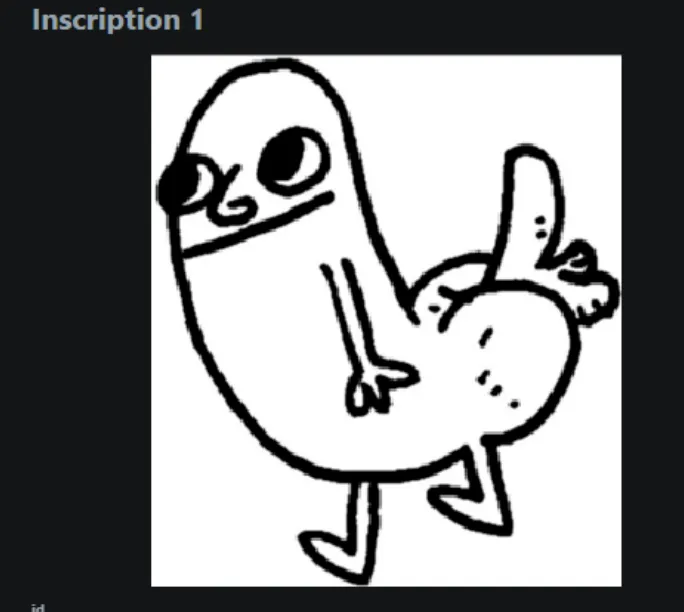
It’s great to see Bitcoin enthusiasts finally showing some interest in NFTs. More importantly, it allows newcomers to interact with the Bitcoin network and learn how it works—many are downloading Bitcoin Core and attempting to run full nodes (500+ GB).
Over the past few days, I’ve been diving deep down this rabbit hole, trying to understand the implications of Ordinals. Here are some of my thoughts:
- Right now, all activity stems from (1) people experimenting with the new tools available to them, and (2) crypto speculators trying to grab what they believe could become valuable historical artifacts in the future.
- The “historical artifact” theory holds some merit in my view. In the NFT world, we place immense value on the provenance and history of an object. That’s why Autoglyphs and CryptoPunks are so expensive today. In this case, I believe the greatest historical value will belong to the first 1,000 interesting Ordinals.
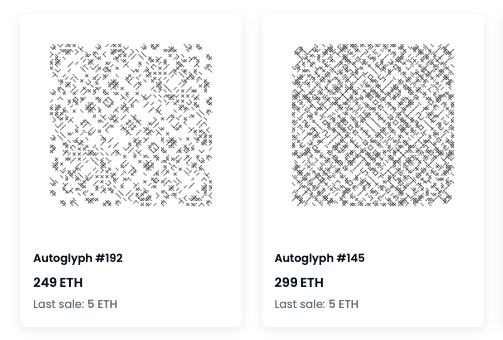
- Currently, there are over 40,000 Ordinal inscriptions; anything beyond the first 10,000 is unlikely to be particularly valuable based purely on provenance.
- Compared to Ethereum NFTs, Ordinal NFTs have extremely limited programmability, severely restricting their use cases. There is no NFT community on Bitcoin, and NFT infrastructure and tools are nearly nonexistent. While exploring, I felt as if I’d traveled back in time to the early days of Ethereum NFTs around 2017.
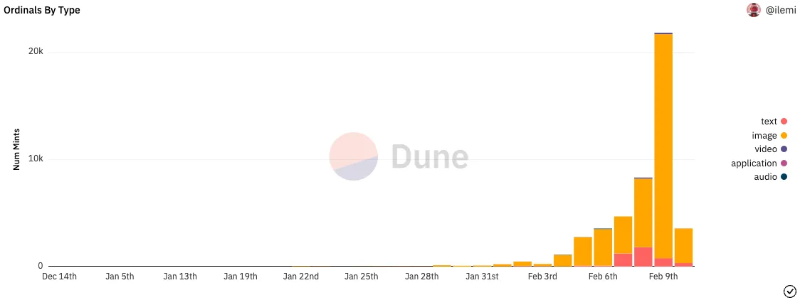
Intuitively, the only type of NFT that makes sense on Bitcoin is a store-of-value NFT, such as high-quality artwork. Storing data in Bitcoin block space is expensive—minting a 10K PFP collection would cost six figures in fees alone.
I expect that once people realize today’s use cases are limited to PFPs and static art, the hype around Ordinals will quickly fade. Currently, trading is limited to OTC deals, making it difficult to buy or sell NFTs. Wallet solutions focused on Ordinals are being developed, and once reasonably usable wallets and market infrastructure emerge, perhaps a second wave could follow.
The crucial moment will come when the hype dies down. Are there enough builders on Bitcoin who want to use these NFTs to create innovative things? The next wave of users will only arrive when someone builds something truly novel on top. My guess is that it will more likely be a social innovation—for example, unique communities or DAOs built around these NFTs—rather than a technical one. I’ve already highlighted the limitations of the Bitcoin blockchain—it poses a very tough challenge for ambitious builders.
Frankly, it’s hard to envision mainstream interest in these NFTs. Ordinals will likely remain a niche, enthusiast-driven phenomenon—much like collecting old stamps.
Join TechFlow official community to stay tuned
Telegram:https://t.me/TechFlowDaily
X (Twitter):https://x.com/TechFlowPost
X (Twitter) EN:https://x.com/BlockFlow_News
 @0xPrismatic