








Can Arbitrum's newly launched programming environment, Stylus, surpass the EVM?
TechFlow Selected TechFlow Selected
Can Arbitrum's newly launched programming environment, Stylus, surpass the EVM?
Stylus will not replace EVM, but rather enhance it.
 Navigating Web3 tides with focused insights
By Offchain Labs
Translation: Moni, Odaily
On February 7, Arbitrum development team Offchain Labs announced it will launch Stylus, a next-generation programming environment for Arbitrum One and Arbitrum Nova later this year. With WebAssembly smart contract capabilities, Stylus allows developers to deploy applications using familiar programming languages—including Rust, C, and C++—alongside existing EVM programs on Arbitrum.
More importantly, Offchain Labs claims that Stylus is an order of magnitude faster, reduces fees, and achieves full interoperability with the Ethereum Virtual Machine (EVM), even dubbing it an upgraded version of the EVM—“EVM+”. Can Stylus truly surpass the EVM?
Stylus: Going Beyond EVM Equivalence
With the mainnet launch in August 2021, Arbitrum One became the only EVM-equivalent Rollup with effective fraud proofs, meaning anything previously possible on Layer 1 can now be done securely on Layer 2—with faster speeds and lower costs.
EVM equivalence is essential for any general-purpose Rollup technology and has enabled vibrant ecosystems of decentralized applications and protocols on both Arbitrum One and Arbitrum Nova.
However, achieving EVM equivalence isn't Arbitrum’s end goal—it's just the starting point. Arbitrum has maintained EVM compatibility from the beginning but quickly realized it could do much more. Thus, Arbitrum introduced a "paradigm-defining" concept called “EVM+”. Launching Stylus marks the first step toward realizing this vision—a new phase in Arbitrum’s evolution: a universal programming environment and WASM-based virtual machine.
For users leveraging Stylus, deploying programs written in popular programming languages—such as Rust, C, and C++—onto Arbitrum One and Arbitrum Nova becomes extremely convenient, while also running in parallel with existing Solidity dApps on the Arbitrum blockchain.
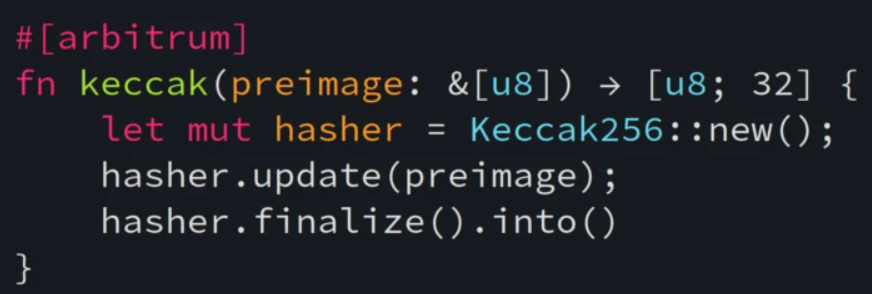
Above: A program written in Rust
From game development to social media, Stylus simplifies the transition into Web3 by making upgrades easier. Developers can build on Arbitrum without needing to understand Solidity, using tools they already know and love—regardless of their preferred coding paradigms.
For experienced Web3 developers, there’s no longer a need to choose between Ethereum and other Layer 1s. Whether it’s traditional Solidity-based DeFi apps seeking a one-to-one Ethereum experience or next-gen ZK Rollups verifying zero-knowledge proofs in Rust, Arbitrum can become one of the best platforms available.
This is because programs written in different languages can seamlessly interoperate—contracts never need to know which language the other uses, and neither do users. Ultimately, everything speaks through the product itself.
Faster DApps, Lower Fees
Stylus not only expands how people write decentralized programs but also optimizes performance, significantly accelerating execution speed. Following last year’s Nitro upgrade, Arbitrum already achieved a tenfold performance boost. With Stylus, performance will improve even further—nearly an order of magnitude faster than decentralized applications written in Rust or programs developed in Solidity and Vyper on Arbitrum.
Stylus can also drastically reduce transaction fees, ushering in a new era of high-computational blockchain applications across diverse fields. When combined with Arbitrum Nova’s data cost savings, decentralized games built on Stylus will receive strong support, while DeFi, DAOs, and other crypto use cases on Arbitrum One will enjoy highly efficient services, thanks to Stylus being fully integrated into both Arbitrum One and Arbitrum Nova blockchains.
Low-cost computation grants developers powerful programming freedom—this is precisely why the Ethereum community has long focused on accelerating the EVM, primarily through:
1. Occasionally adding special smart contracts known as precompiles;
2. Efficiently executing specific tasks like computing hashes.
With Stylus, users will be able to create their own precompiles:
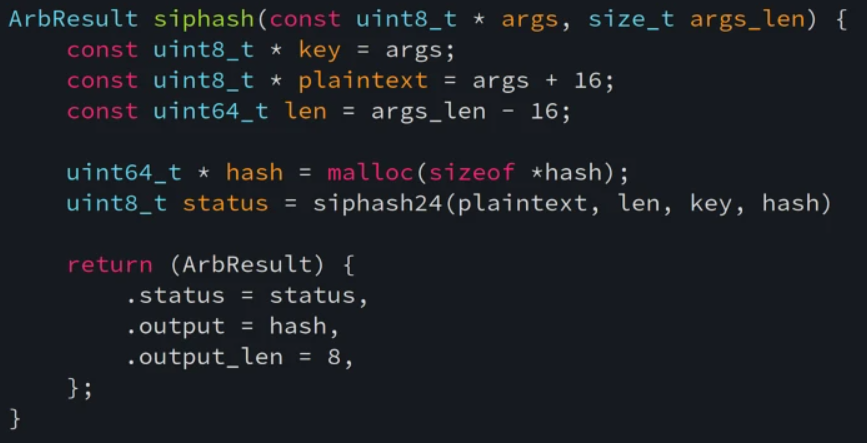
AC Precompile
If a zero-knowledge proof team needs to build a new pairing curve, or if an alternative Layer 1 bridge requires an unusual hashing algorithm, they can simply deploy a cryptographic library as a custom precompile. Any cryptosystem, any reference implementation—can function as natively as SHA-2 in the EVM. Layer 3s, and even machine learning applications, can benefit from this capability.
For Ethereum researchers, Stylus’ AC precompile functionality will be highly valuable, enabling them to design and iterate EIP precompiles using Stylus without setting up their own testnets. The EVM will likely welcome Arbitrum’s pivotal role in advancing this space. Many of Arbitrum’s breakthroughs are also aligned with eWASM—an Ethereum Layer 1 initiative to integrate WASM into the EVM.
How It Works
In August 2022, the Nitro upgrade transformed Layer 2.
Arbitrum validators began running Geth—the most popular Ethereum execution client—and validating fraudulent behavior in WebAssembly. For the first time in history, Layer 2 could run at native blockchain speeds, occasionally switching to slower WASM only when necessary to prove and defeat potential attackers (which, post-merge, rarely occurs).
Stylus represents the natural next step in Arbitrum’s evolution. Thanks to Nitro, Arbitrum’s fraud proofs can execute trusted WASM code, requiring validators to agree that Geth is honest and behaves correctly. While this forms a sufficient foundation for permissionless EVM networks—and is exactly what Ethereum and all Geth-based Layer 2s currently do—scaling demands the next leap: proving fraud against untrusted WASM code.
In the Stylus model, users compile their programs into WASM, then convert them on-chain into a restricted-execution format with enforced security. Through a WASM sandbox, Arbitrum runs user programs at near-native blockchain speeds, offering the same security guarantees relied upon by web browsers rendering web pages—malicious programs terminate in ways that “can be proven on-chain without invoking the EVM.”
When a transaction calls an EVM contract, Geth executes and returns the result. If that EVM contract makes a sub-call to a WASM program, Stylus steps in to compute that portion of the result.
The EVM remains intact and continues to function exactly as before. Stylus does not replace the EVM; it enhances it.
Everything Arbitrum does remains fully scalable—this is precisely why Stylus is called “EVM+”.
Join TechFlow official community to stay tuned
Telegram:https://t.me/TechFlowDaily
X (Twitter):https://x.com/TechFlowPost
X (Twitter) EN:https://x.com/BlockFlow_News






