Interview with Offchain Labs Co-founder: From Academia to the White House, How He Shapes Arbitrum's Future with a Long-term Vision
TechFlow Selected TechFlow Selected
Interview with Offchain Labs Co-founder: From Academia to the White House, How He Shapes Arbitrum's Future with a Long-term Vision
When discussing Arbitrum's development path, Ed mentioned that sustainable growth must start with "creating value," and his role is precisely focused on this.
 Navigating Web3 tides with focused insights
Interview: Chloe, PANews
Article: Weilin, PANews
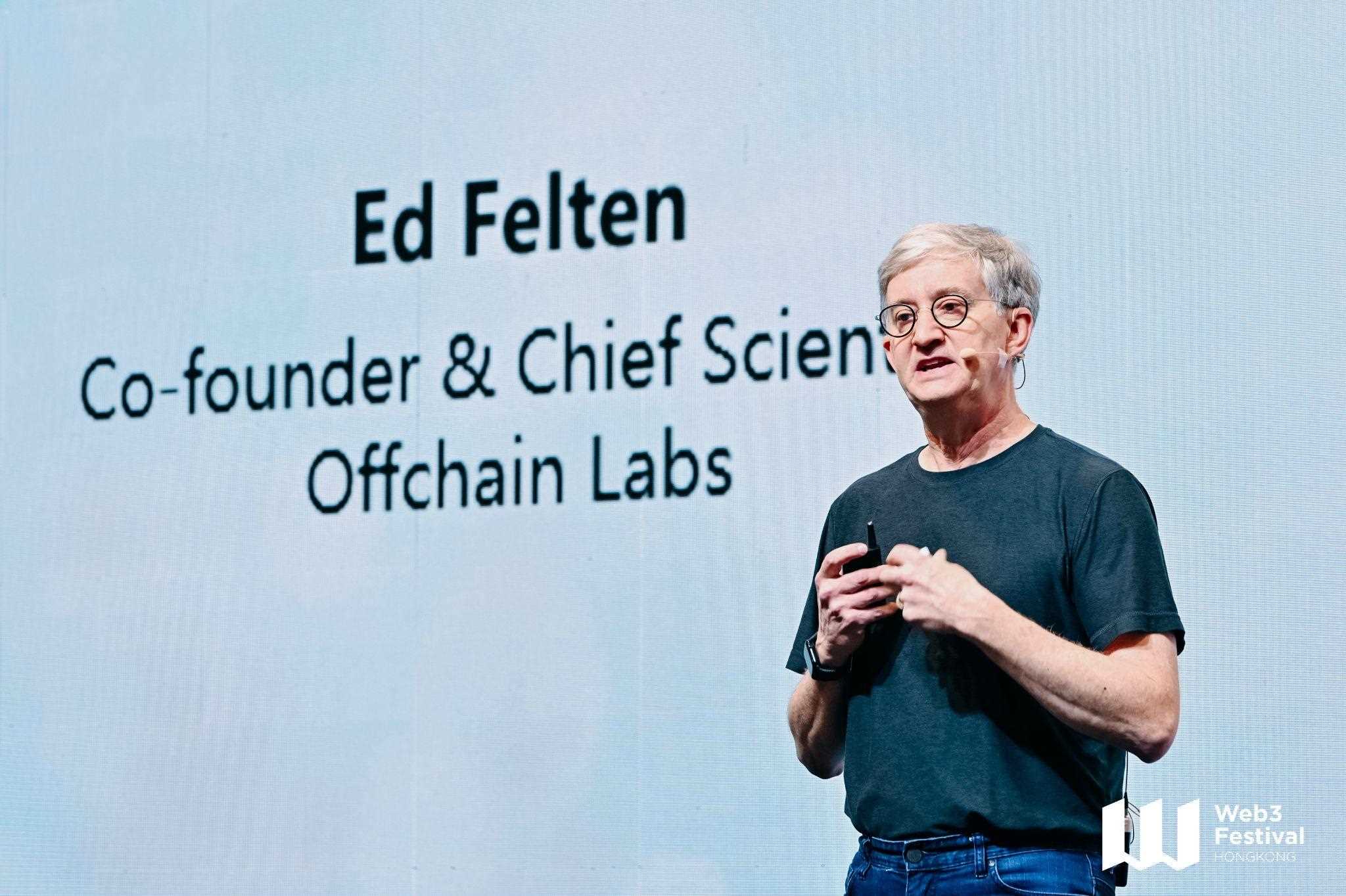
Ed Felten may be one of the most academically inclined entrepreneurs in the blockchain industry. He currently serves as co-founder and chief scientist at Offchain Labs, and is also a key driving force behind Arbitrum, Ethereum’s Layer 2 scaling solution.
Felten became a professor in the Department of Computer Science at Princeton University as early as 2003, and served as the first Chief Technologist at the U.S. Federal Trade Commission in 2010. Starting in 2012, he returned to academia and began researching Bitcoin and blockchain technology. In early 2015, Arbitrum initially caught Felten’s attention as a final project in a Princeton computer science course, prompting him to dive deeper into Rollup technology. Shortly afterward, however, he was invited to join the White House as Deputy U.S. Chief Technology Officer, focusing on technology security. After returning to academia in 2018, Felten resumed work on Arbitrum with two Ph.D. students, and together they founded Offchain Labs that same year, officially launching Arbitrum into systematic development.
During Hong Kong Web3 Festival, PANews interviewed Ed Felten, who shared insights into his journey from research and public policy to blockchain entrepreneurship. He discussed how Layer 2 can balance the growth of the Ethereum ecosystem, how Arbitrum builds technological competitiveness, and the convergence of AI and blockchain.
In his view, Ethereum indeed faces a choice: does it want to maximize revenue for validators, or does it aim to have the most users and most active developers? Currently, its strategy leans toward growing users and developers—precisely where L2s excel. When discussing Arbitrum’s development path, Ed emphasized that sustainable development must begin with “creating value,” which is exactly where his focus lies.
PANews: You’ve held important roles in academia and government. What inspired you to enter blockchain entrepreneurship? How has your background influenced Offchain Labs’ research direction and technical decisions?
Ed Felten: I spent many years as a professor, during which I constantly looked for research areas that combined deep technical challenges with societal or public policy implications. When I first learned about blockchain through Bitcoin, I immediately recognized it as a textbook example. Starting around 2011, I began studying blockchain topics purely from an academic perspective. I kept asking: what technical factors might hinder this technology from reaching its full potential?
I started by examining blockchain economics—that was my earliest research focus—and gradually shifted toward scalability issues. In 2014, when I discovered smart contracts, I was extremely excited because it reminded me of the early days of the internet—when web pages evolved from static content for reading or viewing images into interactive, programmable experiences. Seeing smart contracts, I felt this transformation would happen again, and just as profoundly.
This led me to explore scalability solutions, which laid the foundation for my initial work on Arbitrum. Later, I spent two years working in the White House. Upon returning, I connected with my future co-founders, and we began formal collaboration in 2017 and 2018.
My experience as a professor continues to influence me in several ways. As a technical professor, success requires strong management skills—recruiting talent, managing teams, budgets, and timelines—all of which are highly applicable when running a startup. Running a startup feels very much like managing an academic research group.
But I also learned to think long-term and focus on fundamentals—a mindset shaped during my academic years. This has deeply informed our thinking about medium- and long-term research.
During my time in government, I worked alongside many outstanding leaders. I learned valuable lessons about community building and consensus formation. I believe this emphasis on “building communities” and “engaging communities in governance” is central to Arbitrum.
Thinking about the Arbitrum DAO and how it governs itself and Arbitrum’s chains reminds me of political processes.
As early as 2014, we foresaw that smart contract blockchains would become critically important, but scalability would remain a core challenge. From day one, we focused on solving the problem of scaling smart contracts.
PANews: The Layer 2 space shows clear signs of winner-takes-most dynamics, with fragmentation leading to scattered liquidity and fragmented user experience. How should L2 projects address this challenge?
Ed Felten: Regarding your first question—whether L2s are “extractive”—I don’t believe so. Look at the relationship between L2 and L1: L2s are actually the biggest users of L1s. They bring more users, more transactions, and more traffic.
Take Ethereum: over 95% of activity now happens on L2s and L3s. Without these L2s, much of this activity would likely have migrated to other L1s.
The daily numbers fluctuate, but the proportion remains consistently high. L2s dramatically expand Ethereum’s overall system capacity—something impossible without them.
I believe part of Ethereum’s current scale stems directly from the existence of L2s. And I think L2s play a major role in why Ethereum still leads in the smart contract blockchain space. I see L2s as part of Ethereum’s tech stack. Viewing L2 and L1 as competing entities is a false dichotomy—they’re collaborative, serving users together.
The second issue—fragmented liquidity and fragmented user experience—is indeed one of the most critical problems L2 teams are now tackling. I expect significant progress in this area.
We have a bold vision: to create a more unified user interface. Users will still need to know which chain they’re on—just like knowing which website you’re visiting online, which matters for trust and security. But just as you can easily jump from one website to another across the internet, the experience should feel interconnected. I believe we can achieve this in the blockchain world too.
That requires clever design at the user interface level, along with necessary protocol-level support to enable the kind of seamless interaction users truly want.
I’m confident we’ll get there. We’re moving toward a smoother cross-chain experience: users holding funds on one chain will be able to use them seamlessly on another, without tedious clicks or complex cross-chain operations.
Of course, achieving this will require sustained, long-term effort from many teams.
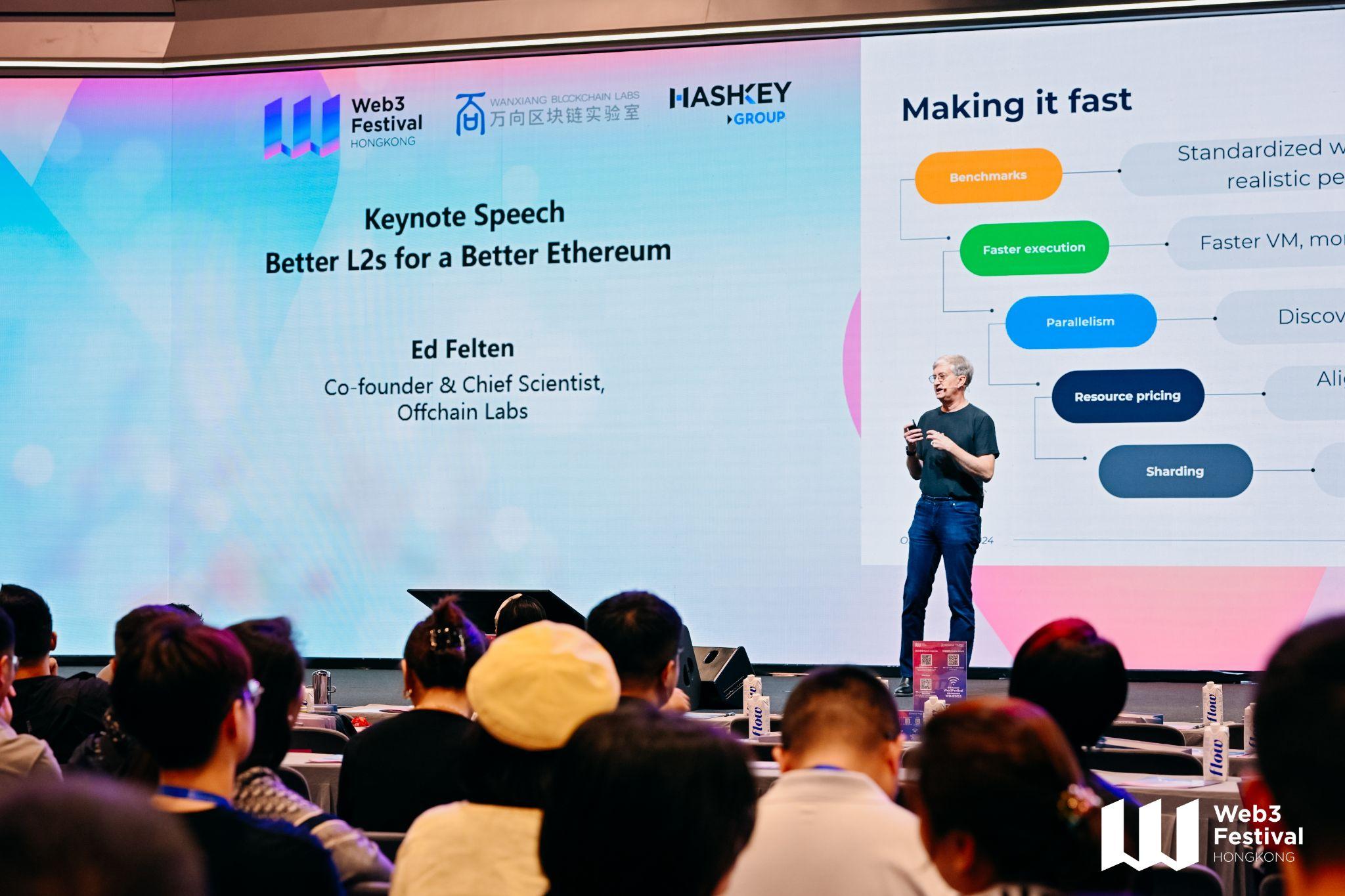
PANews: In this market cycle, some blame Layer 2 for Ethereum’s declining economic value, even labeling it “parasitic.” What’s your take? How should L2 balance its own growth with Ethereum’s long-term health?
Ed Felten: This comes down to a core dilemma in operating a blockchain: do you want to maximize revenue, or maximize usage and community size?
If you aim to maximize revenue, you’d tend to limit network capacity, forcing users to bid for scarce block space. But when L2s emerge and expand Ethereum’s block space, that aligns with what I believe has always been Ethereum’s strategy—to provide more block space.
You can’t simultaneously increase block space and raise prices—that’s contradictory.
To me, Ethereum clearly faces a choice: should it maximize income for validators, or attract the most users and most active developers? Right now, its strategy favors growing users and developers—exactly what L2s excel at. But I don’t think you can have both.
PANews: Optimistic rollups dominate the current L2 market share. Compared to ZK-based approaches, what are their core advantages? How does Arbitrum ensure long-term competitiveness in its tech stack?
Ed Felten: Optimistic rollups have two main advantages over ZK: simplicity and lower cost.
They’re simpler because they don’t rely on highly complex cryptography or require entirely new toolchains to convert programs into mathematical proof systems—which is an extremely complicated process.
The second advantage is cost. With ZK, generating proofs is inherently expensive. In contrast, Optimistic protocols only perform on-chain verification if a dispute arises. If a dispute occurs, it means someone acted maliciously and their stake gets slashed. So in an Optimistic system, honest participants never pay for verification—delivering a massive cost advantage.
That said, ZK costs are decreasing. I do believe we’ll eventually reach a stage where different chains combine both Optimistic and ZK verification. But for that hybrid model to work, ZK costs need to drop significantly below today’s levels.
Currently, Arbitrum supports only Optimistic rollups. In the future, we plan to support both mechanisms, allowing users to choose freely based on cost or other factors.
PANews: DAOs play an increasingly vital role in ecosystem governance, yet face challenges such as centralized decision-making, low voter participation, and balancing commercial interests. How will Arbitrum DAO further improve governance efficiency while preserving decentralization?
Ed Felten: The Arbitrum DAO decides its own actions. So I don’t speak on its behalf in any official capacity—but I can share my personal views.
One thing I learned in government is that publicly driven decision-making processes are both challenging and powerful. Yes, they can be messy and sometimes slow, but I believe they’re resilient. When a community reaches consensus, it can accomplish truly ambitious goals.
We’re still in very early stages. The Arbitrum DAO is different from others—it holds real power and operates in a genuinely decentralized way. You can see diverse voices, differing opinions, and open debate—this is healthy. It’s exactly the outcome we hoped for when transferring control of the chain to the DAO.
Overall, I consider this successful, though it faces—and will always face—the common challenges of governing any large, diverse group.
PANews: Offchain Labs recently launched Onchain Labs to support early-stage projects. Can you share what specific support (technical, funding, or market resources) these projects will receive? Any future plans to incentivize diversification within the Arbitrum ecosystem?
Ed Felten: I prefer to think of it as a “lightweight incubator” designed to help launch projects and ensure they get funded.
One goal of Onchain Labs is to spark creativity and accelerate execution.
We don’t intend to exert strong control or direct these teams. Instead, we help them launch, provide some funding, and then let them grow independently.
PANews: We’ve noticed Arbitrum is expanding into AI—for instance, launching the Trailblazer AI Agent Grant Program and supporting AI projects like ElizaOS. How do you see AI reshaping blockchain, and what unique advantages does Arbitrum have in this space?
Ed Felten: I see two distinct ways AI and blockchain can interact.
The first involves off-chain AI agents—either acting on behalf of users or using the chain themselves. These off-chain agents have needs similar to regular users: they require a low-cost, reliable blockchain. But response speed matters even more for machines than for humans. A delay of 0.1 or 0.2 seconds feels fast to a human, but to a machine, that’s already “slow.”
Once such AI agents become widespread, I expect to see far more complex and dynamic DeFi markets, as well as more sophisticated gaming applications.
The next major phase is on-chain AI agents. This will require computational power and data processing capabilities beyond what most current blockchains offer.
We’re working on two fronts: expanding chain capacity to directly support this goal, and developing specialized mechanisms for training, verifying, and evaluating AI models on-chain.
PANews: Buyback programs have become common in crypto projects, but some argue they only provide short-term confidence boosts without solving fundamental issues. What considerations, long-term goals, and execution strategies underlie Arbitrum’s buyback program?
Ed Felten: I believe my role is to focus on long-term growth and sustainability. I firmly believe everything must start with “creating value.” If you create value for users and the community, people will naturally find ways to capture and utilize that value.
So for me, as I mentioned earlier, the priority is creating value. How that value is captured should ultimately be decided by the community.
PANews: Altcoin markets are generally sluggish. Beyond buybacks, does Arbitrum have deeper plans to enhance the intrinsic value of its token?
This question should really be answered by the DAO, not me. But I believe value ultimately comes from people’s willingness to participate in governance and from revenue generated on-chain. And revenue stems from traffic and usage. Therefore, driving growth in technology adoption is the most critical factor.
At Offchain Labs, we’ve always taken a long-term view on technology development and value creation. I believe the DAO shares a similar perspective.
In my view, the DAO is focused on driving growth to achieve long-term value creation.
Join TechFlow official community to stay tuned
Telegram:https://t.me/TechFlowDaily
X (Twitter):https://x.com/TechFlowPost
X (Twitter) EN:https://x.com/BlockFlow_News
 PANews