








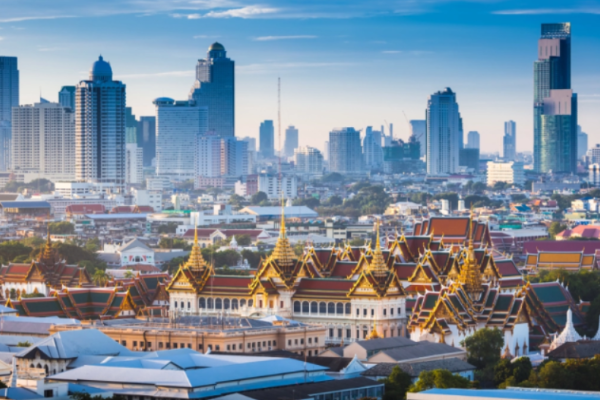
Bangkok Web3 Travelogue: A Digital Nomad Paradise, a Secular and Divided "City of Sin"
TechFlow Selected TechFlow Selected
Bangkok Web3 Travelogue: A Digital Nomad Paradise, a Secular and Divided "City of Sin"
Bangkok, a city that sparks endless imagination, yet feels within reach.
 Navigating Web3 tides with focused insights
Author: 0xmin/Runchen
The first chapter of this article was written by Runchen—our sincere thanks to him!
Bangkok—an endlessly fascinating city that feels both distant and within reach.
With the global wave of Web3, an increasing number of industry professionals are setting their sights overseas, seeking expansion opportunities abroad.
In this context, Bangkok has emerged as a “not bad” choice—lower living costs than Singapore, more openness than China, and yet also branded as a "sin city" filled with urban legends: the backyard of gray-market tycoons, Thai government suppression of ethnic Chinese, kidney harvesting…
What is the real Bangkok like? Is it a place where you can thrive freely, or one where others hold the knife and you're the fish on the chopping block? If you're considering Bangkok as a base for building Web3, start by understanding the real Thailand and Bangkok.
Thailand Through History
Thailand—a magical country.
Thailand has about 70 million people, of whom 14% are ethnic Chinese (mainly from Chaoshan), and 2.3% are Malay. If we count the Lao group separately (Laos was once part of the Siamese Empire), they make up 33.7% of Thailand’s population. It's no exaggeration to say Thailand is a nation of blended populations and intertwined cultures, and Bangkok epitomizes this most of all.
An economy dominated by tourism has shaped Bangkok’s unique urban structure and Thailand’s distinctive political and economic landscape.
On one hand, with foreign investment, Bangkok has become a bustling international metropolis—luxury shopping malls and high-end apartments rise everywhere. Cultures from around the world, especially Japanese and Chinese, permeate every aspect of the city. For instance, areas like Sukhumvit and Thong Lo feel more Japanese than Japan itself—even if locals don’t speak Japanese.
“Tolerance,” or even “over-tolerance,” is Thailand’s defining trait. To understand modern Thailand, one must look at its near-miraculous modern history.
Compared to other Southeast Asian nations, Thailand stands out: the only country in the region never colonized, transitioning directly from a slave society into a modern state.
The year 1868 changed the course of three nations:
Japan’s Emperor Mutsuhito ascended the throne under the name Meiji, opening the door to the “new world” and beginning Japan’s modernization;
Abraham Lincoln secured victory in the American Civil War, and in 1868 the U.S. formally amended its Constitution to grant full citizenship rights to Black Americans;
King Chulalongkorn (Rama V) was crowned in Thailand, marking the beginning of Thailand’s modernization.
During his reign, King Rama V implemented the Chulalongkorn Reforms, transforming Thailand into a modern nation across diplomacy, domestic affairs, and military.
Diplomatically, Chulalongkorn used territorial concessions and skillful negotiation to maintain peace between British and French imperial powers. Domestically, he abolished a six-hundred-year-old slavery system, established a centralized government, and founded basic schools while sending numerous students to Europe.
After ruling for 42 years, King Chulalongkorn passed away. His son, Rama VI, founded Chulalongkorn University (Thailand’s top university) and established constitutional monarchy in Thailand.
Although Thailand’s constitutional monarchy and democratic politics were initially tools for window-dressing, it’s undeniable that Thailand firmly seized historical opportunities, leaping from a slave society to a modern “democratic” nation.
Notably, throughout Southeast Asia, Thailand is the only modern nation never colonized. Its skillful balancing act made it a strategic buffer zone between Britain and France on the Indochinese Peninsula—a paragon of extreme “pragmatism.”
During WWII, Thailand allied with Japan and declared war on the UK and US when the Pacific War broke out. After Japan’s defeat, Thailand declared its declaration of war invalid—and the U.S. accepted this. Thus, Thailand avoided becoming a defeated nation and became America’s sole close ally on the peninsula.
Thailand’s modernization occurred with almost no bloodshed—partly because the monarchy was pragmatic, but also because Thailand didn’t go far down the path of democracy, creating a unique, even contradictory, national character.
On one hand, the Thai king holds immense power over the country’s military, political, and economic lifelines; yet on the other, Thailand hasn’t shut itself off into left-leaning nationalism, instead opening wide its doors, prioritizing economic interests above all.
On one hand, Thailand is a Buddhist nation where people believe in reincarnation; yet monks are allowed to eat meat and marry—showing its extreme secularism.
On one hand, systemic corruption plagues various Thai government agencies, and wealth inequality is severe; yet the country appears orderly, with citizens accustomed to the status quo and reporting relatively high happiness levels.
This is Thailand—a place where contradiction and fragmentation unfold every second:
A country whose laws explicitly ban prostitution, yet is globally famous for red-light districts;
A country where the nation’s top university lies just one subway stop away from a renowned red-light district;
A country where anyone—regardless of gender, age, height, or body type—can sell their body for money. This is the real Thailand.
Thailand’s Web3 Landscape
Crypto is a deconstructive force—the more chaotic and contradictory the environment, the greater the stage, and yes, that describes Thailand perfectly.
The crypto world often speaks of Koreans’ aggressive trading habits, but Thais are hardly less intense.
In June 2022, after the cryptocurrency market crash, a Thai man robbed a Bangkok jewelry store of gold necklaces worth about 2 million THB. When arrested, he said his criminal intent stemmed from severe losses in cryptocurrency investments.

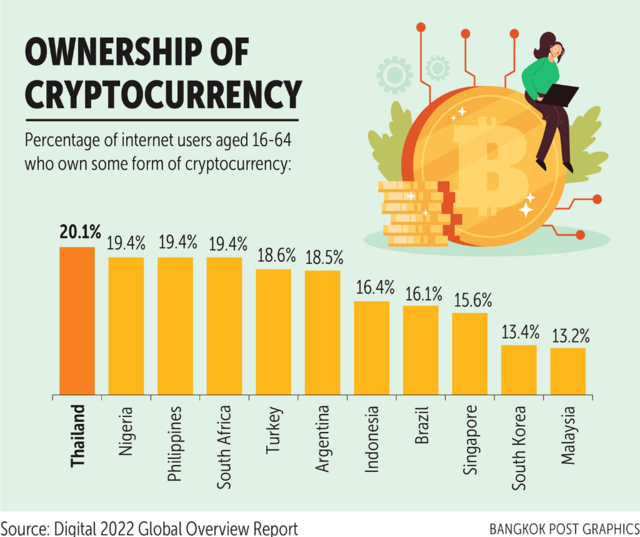
In 2022, data showed that around 20% of Thais aged 16–64 owned cryptocurrency—the highest rate globally.
However, entering this market isn’t easy. Like the internet, Thailand’s crypto ecosystem has strong local characteristics and entrenched “interest groups.”
The Thai market remains Thai-language dominant. Most people use Facebook as their main social platform, while LINE and Instagram are popular among youth—similar to Taiwan.
When thinking of Thai crypto projects, what comes to mind?
Pre-2020, I’d think of OmiseGo, Everex, and Velo.
These were blockchain-based cross-border payment projects launched by Thai fintech firms—fitting Thailand’s profile well. As a major tourist destination, Thailand hosts many migrant workers from Laos, Cambodia, and elsewhere, generating massive remittance demand. Combined with underdeveloped financial infrastructure across Southeast Asia, blockchain and crypto seemed “theoretically” promising. But why “theoretically”? Because these projects ultimately underperformed: OMG pivoted to become an Ethereum Layer2 (now Boba Network); Velo, backed by Thailand’s largest conglomerate CP Group, announced in 2021 its acquisition of Stellar’s commercial operations firm—but its secondary market performance remained lackluster.
Post-2020, Thailand’s crypto stars have been DeFi and GameFi projects—such as Band Protocol, Alpha Labs, GuildFi, collectively known as the “Band Gang.”
On the capital side, traditional giants—large banks and conglomerates—still dominate, such as SCB (Siam Commercial Bank) and Kasikorn Bank (KBank).
SCB’s fintech investment arm, SCB 10X, now functions almost like a dedicated crypto fund, investing in and incubating startups. It has backed over 40 projects, including Fireblocks, Nansen, Axelar, and The Sandbox.
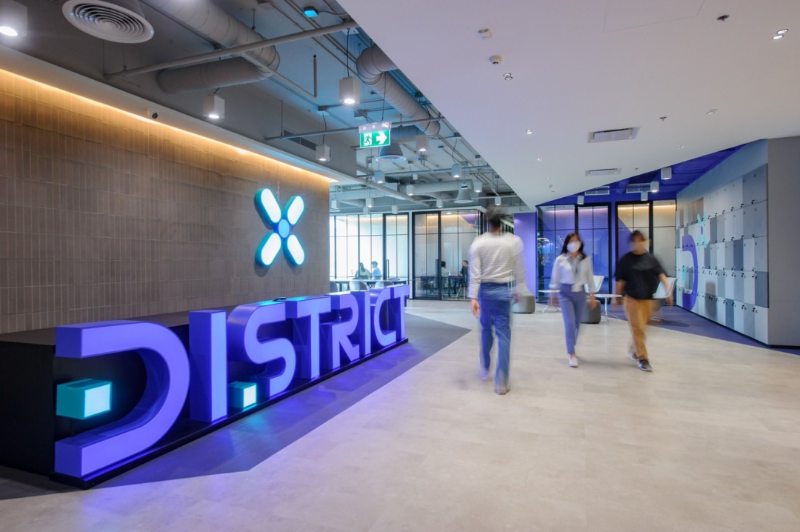
In October 2022, SCB 10X launched DistrictX—a 1,000-square-meter Web3 co-working space in Bangkok, hosting companies like Nansen, TokenUnlocks, and Fireblocks. DistrictX also serves as an incubator. Mukaya (Tai) Panich, CEO of SCB 10X, stated that SCB 10X plans to incubate six Web3 startups in the first half of 2023.
Kasikorn Bank’s tech subsidiary KBTG launched KX in 2021—a DeFi-focused incubator—and Coral, an NFT art platform allowing users to buy digital art with fiat currencies like THB or USD.
On the exchange front, while many Thais use Binance, the local market is dominated by homegrown players. The most prominent is BitKub, a licensed exchange supporting THB deposits and withdrawals, capturing 95% of Thailand’s local market share. In November 2021, BitKub sold a majority stake (51%) to SCB.
Overall, to succeed in Bangkok’s market, it helps greatly to partner with local powerhouses like SCB or CP Group—doing so makes progress much smoother. At the end of January, members of the Ethereum Foundation visited Bangkok and attended a welcome dinner hosted by SCB 10X.
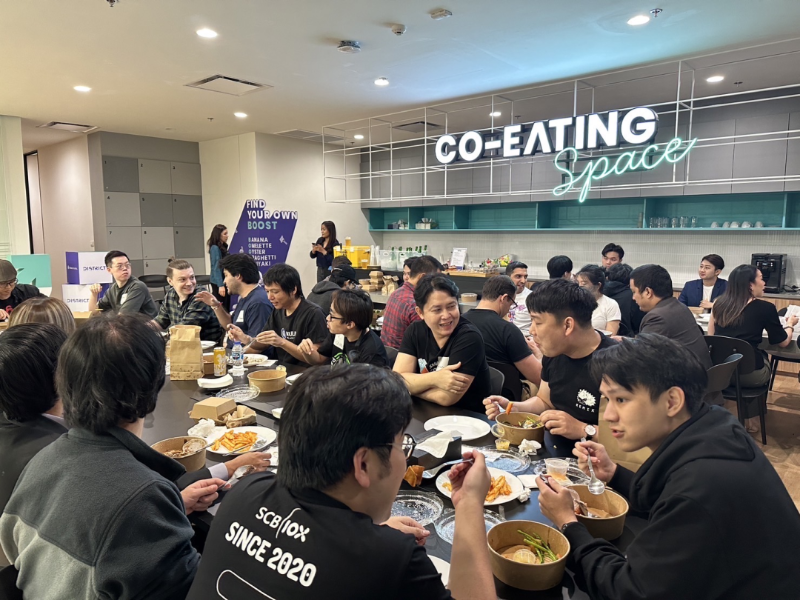
Welcome dinner for the Ethereum Foundation
A Digital Nomad’s Paradise
When discussing digital nomads, Thailand is unavoidable.
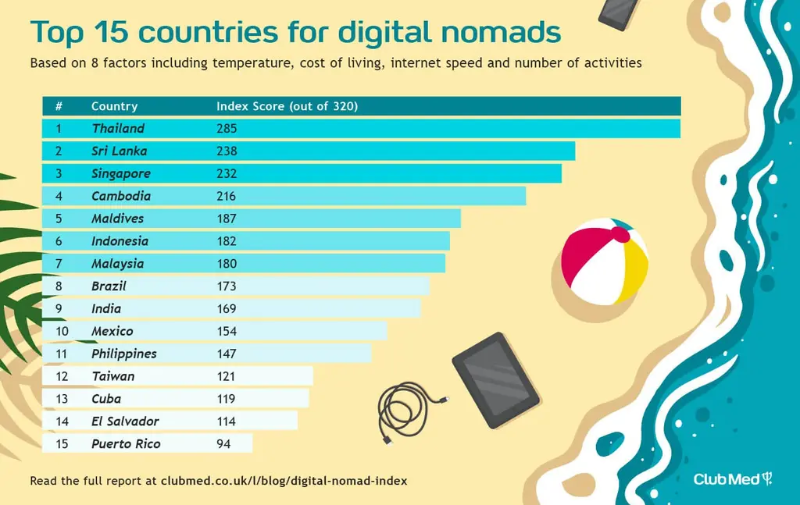
In 2021, the UK-based ClubMed ranked the 15 best countries for digital nomads based on climate, cost of living, internet speed, and availability of offline activities—Thailand ranked first. (Singapore came third, which seems questionable.)
Recently returning to Singapore from Bangkok, I finally grasped Thailand’s appeal.
At Jewel Changi, I paid 25 SGD (125 RMB) for a small, unimpressive shrimp fried rice, and another 40 SGD (200 RMB) for a taxi ride. By contrast, Bangkok feels like paradise for the proletariat.
A large plate of crab-filled seafood fried rice costs 120 THB (24 RMB). For 300 THB, you can enjoy a fine meal at a Michelin-recommended restaurant. High-end Japanese dining is no longer reserved for the wealthy. Massage parlors are everywhere—one hour at a roadside shop costs just 250 THB (50 RMB), with surprisingly good technique… In Chiang Mai, prices are even lower.
Moreover, Thailand excels in healthcare, consistently ranking #1 globally in medical tourism, particularly in plastic surgery, gender reassignment, dental care, and IVF treatments. Every year, many Australians travel to Thailand for dental work and cosmetic procedures. On Xiaohongshu, countless Chinese users post about their medical tourism experiences in Thailand.
Just as many Westerners long-term reside in Thailand to live as “elites,” Chinese in Thailand engage in cross-border arbitrage—enjoying a “premium lifestyle” at low cost. But therein lies the problem.
Thailand’s extreme secularism means those staying long-term without external constraints may fall into lives of hedonism and excess. Even walking along Sukhumvit at night, you might involuntarily inhale secondhand marijuana smoke.
Additionally, Thailand suffers from “systemic corruption”—money solves most problems. Low barriers and relative freedom attract a mixed crowd. While in Bangkok, I was advised to avoid ethnic Chinese enclaves and limit interactions with local Chinese communities.
In sum, Thailand has its charms, but isn’t suitable for everyone. As mentioned earlier, this is an extremely “secular” and “divided” country—sightseeing tourism versus long-term residency are entirely different experiences and mindsets, and the latter carries certain entry barriers.
First, visas: Tourist visas (up to 90 days) plus multiple-entry landing visas allow stays of around six months. But for long-term residency beyond a year, you’ll need a long-term visa. Recently, Thai authorities cracked down on certain Chinese criminal networks and tightened work visa policies for Chinese nationals.
For long-term residence, many opt for the “Elite Visa”—pay 120,000 RMB upfront for a 5-year visa. Others enroll in English-taught master’s programs at local universities to obtain student visas valid for a year or two.
Whether in Bangkok or Chiang Mai, a significant number of Web3 professionals have gathered—many relocating from Singapore, Hong Kong, or Shanghai, including project founders, VC partners, OTC traders, and exchanges planning large-scale relocations to Bangkok.
The downside? Thailand’s education leans humanities-heavy, developer communities and resources are severely lacking, and the abundance of distractions makes it easy to lose oneself in the city’s nightlife.
During a dinner with Web3 friends in Bangkok, someone shared that upon landing back in the city, he felt a sense of coming home—in that moment, Bangkok truly felt like home.
Join TechFlow official community to stay tuned
Telegram:https://t.me/TechFlowDaily
X (Twitter):https://x.com/TechFlowPost
X (Twitter) EN:https://x.com/BlockFlow_News






