Optimism vs ZK: Which Rollup Solution Will Come Out on Top?
TechFlow Selected TechFlow Selected
Optimism vs ZK: Which Rollup Solution Will Come Out on Top?
For now, we can only conclude that Layer 2 will play a significant role in making Ethereum more scalable, but it's unclear which Rollup solution is superior.
 Navigating Web3 tides with focused insights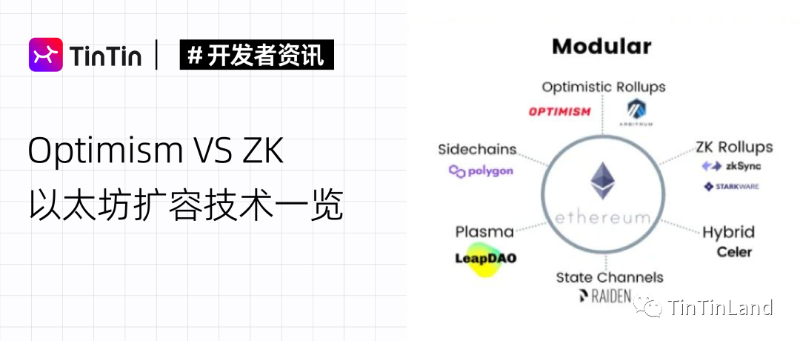
Before diving into a comparative analysis of Optimism Rollup and ZK Rollup, we must first understand the background behind the emergence of Rollups.
Rollups are considered the ultimate scaling solution for Ethereum. They execute transactions off Layer 1 but publish transaction data back on Layer 1. This allows Rollups to scale the network while still inheriting security from Ethereum's consensus. The entire process is essentially about executing transactions, gathering data, compressing it, and bundling everything into a single batch posted onto the main chain—hence the name "Rollup."
Why Do We Need Rollup Scaling Solutions?
In reality, the growing research interest in Rollups closely correlates with Ethereum’s development in recent years. Ethereum scaling has long been one of the most discussed topics in the crypto space. Whether it was the CryptoKitties craze in 2017, the DeFi Summer of 2020, or the crypto bull run at the beginning of 2021, surging demand for Ethereum intensified debates around scalability, causing gas fees to skyrocket and making transaction costs increasingly expensive for users.
Meanwhile, against the backdrop of rapid Web3 development, Ethereum has increasingly become home to thousands of DApps. The massive volume of transactions inevitably leads to performance bottlenecks, slowing down transaction speeds and gradually reducing user retention.
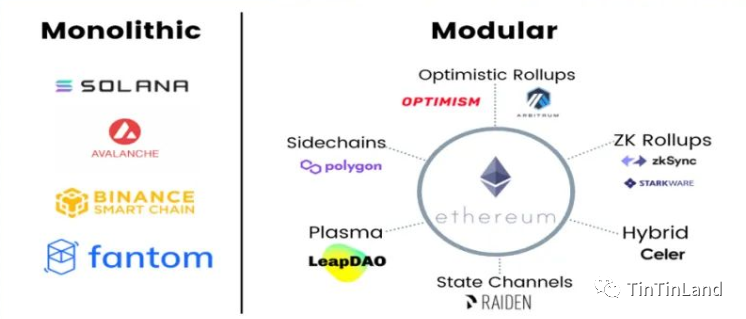
Given this, finding the perfect scaling solution has become a key goal for multiple teams and the broader Ethereum community. Generally speaking, there are three primary approaches to scaling Ethereum: scaling the blockchain itself—Layer 1 (L1) scaling; building on top of Layer 1—Layer 2 (L2) scaling; and constructing sidechains alongside Layer 1.
The core principle of Rollup scaling involves aggregating hundreds of processed transactions into batches, executing them on an L2 chain that runs parallel to the Ethereum mainnet, and then periodically submitting these finalized batches back to the base layer (L1). This improves transaction speed and reduces gas fees.
Among various Rollup solutions, both Optimistic Rollup and ZK Rollup have demonstrated strong potential. In fact, the execution principles of Optimistic Rollup and ZK Rollup are largely similar—the key difference lies in their validation mechanisms. Today, let's explore these two outstanding scaling solutions, compare their respective strengths and weaknesses in practical implementation, and look ahead to the ideal model for next-generation Ethereum scaling.
Decoding the Ecosystems of Optimism and ZK
Optimism
Optimistic Rollup, as the name suggests, operates under an "optimistic" mechanism—Fraud Proofs. The system assumes the validity of transaction data by default and proceeds without immediate verification, entering a challenge period during which any node can raise an objection and prove malicious activity—if so, the transaction is reverted. If no objections arise, the transaction finalizes and gets written into the block. This "fraud proof" approach avoids large-scale computational verification, saving computing resources while ensuring transaction integrity.
Prominent implementations within Optimistic Rollup include Arbitrum and Optimism. Although Optimism pioneered the first EVM-compatible Optimistic Rollup protocol, delays in its mainnet launch allowed Arbitrum to gain a late-mover advantage.
Optimism: Single-Round Non-Interactive Fraud Proofs
Optimism uses smart contracts to move transaction data from the Ethereum mainnet to Layer 2. Sequencers bundle multiple transactions into a batch and submit the entire batch back to the main chain via a single transaction. Operating under the assumption that all transactions are valid, the sequencer optimistically executes the process. The system sets a one-week challenge window, during which any party can dispute invalid transactions and trigger a fraud proof if necessary.
Arbitrum: Multi-Round Interactive Fraud Proofs
Arbitrum launched on the Ethereum mainnet on May 28, 2021. While the overall workflow is similar, the key distinction lies in how Arbitrum's validators and challengers resolve disputes. They use a binary search method off-chain to progressively narrow down disputed steps until only a single contested operation remains, which is then verified on Layer 1. This enables highly efficient dispute resolution. As a result, compared to Optimism, Arbitrum supports higher transaction throughput and achieves more thorough "root-cause verification."
ZK Rollup
ZK Rollup (Zero-Knowledge Rollup), a concept introduced by MIT researchers in the 1980s and once dubbed "moon math," relies on zero-knowledge validity proofs for scaling.
ZK Rollup processes transactions off-chain in batches and generates cryptographic validity proofs to verify their authenticity. These validity proofs are submitted along with the batch to the L1 blockchain, where they can be quickly verified by L1 contracts—invalid batches are immediately rejected.
If Optimistic Rollups assume that every participant acts honestly, ZK Rollup strives to mathematically prove that this is indeed the case. Currently, major players in the ZK Rollup ecosystem include Hermez, ZKSync, and others.
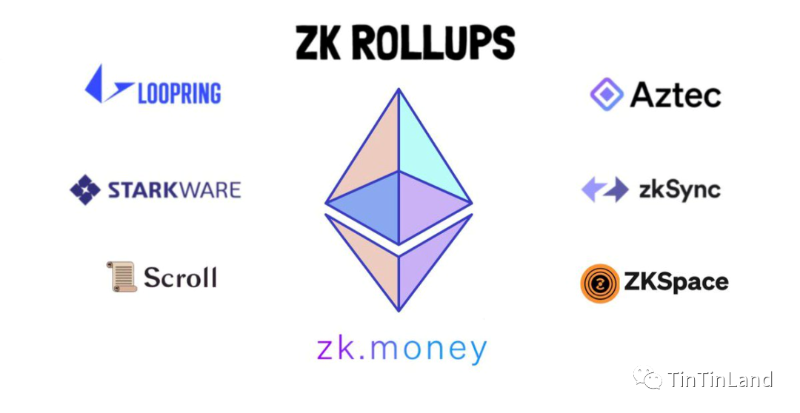
Hermez: Generating Succinct Non-Interactive Arguments of Knowledge
Hermez generates cryptographic proofs using SNARKs (Succinct Non-Interactive Arguments of Knowledge), capable of scaling Ethereum to handle up to 2,000 transactions per second. The system relies on coordinators to process transactions and generate validity proofs. Coordinators are selected through an auction mechanism, with registered network nodes bidding to become the next coordinator. Notably, the Hermez team has announced ongoing development of a zero-knowledge Ethereum Virtual Machine (ZKEMV), aiming for full opcode compatibility.
ZKSync: Generating Succinct Non-Interactive Arguments of Knowledge
ZKSync describes its project as a scalability and privacy engine supporting low-gas transfers of Ether and ERC-20 tokens on Ethereum. In ZKSync, a single prover handles each batch and generates the validity proof. With the release of ZKSync 2.0, it now serves as an off-chain data availability solution, providing stake confirmation and data availability guarantees, while ensuring guardians cannot steal funds.
Optimism vs ZK: Who Comes Out Ahead?
From the moment they entered the market, Optimism and ZK have followed divergent paths in scaling. Fraud proofs and validity proofs cater to different needs of developers and users, showcasing distinct "highlight features" across aspects such as throughput, latency, and cost. Let’s examine several dimensions to better understand how each performs under different development scenarios, helping inform strategic choices between the two.
Development Barrier and Usage Cost
Optimism does not require extensive validation deployment. By assuming all transactions are valid upfront, it skips numerous verification steps and simply posts the data to the base layer. This optimistic approach significantly lowers technical barriers for developers, saving substantial time, effort, and financial costs. For developers seeking a quick entry into Rollup solutions, Optimism is the preferred choice. Data indicates Optimism can deliver scalability improvements of up to 10–100x.
By contrast, ZK Rollup requires generating and submitting validity proofs for each batch to the mainnet—a step that introduces significantly higher technical complexity than Optimism. New developers often encounter numerous issues when adopting ZK Rollup, which can reduce scaling efficiency and slow down operations.
Smart Contract Executability
Optimism offers strong interoperability and supports smart contract execution. This gives Optimism greater flexibility on Layer 2, fostering trust through collective user participation and delivering additional benefits such as enhanced data protection and clear rights enforcement for transacting parties. Notably, teams like Fuel, OMGX, and Cartesi are actively developing EVM-compatible versions for their Rollups, further enhancing Optimism’s adaptability and performance.
Currently, ZK Rollup is mostly limited to simple transactions, posing significant constraints on its scalability. To expand functionality, ZK currently relies on ZKSync’s EMV-compatible virtual machine to support arbitrary Solidity-written smart contracts, thereby expanding its application scope. Alternatively, projects like Loopring, Hermez, and ZKTube focus on scaling payment capacity and introducing privacy features.
Withdrawal Efficiency
The speed of fund withdrawals post-transaction is a critical factor for both developers and users when choosing a Rollup solution. From this perspective, ZK Rollup holds a clear advantage. Optimism’s dispute resolution process is cumbersome, requiring sufficient time for participants to submit fraud proofs before finalizing transactions. This waiting period is notably long—to account for worst-case scenarios involving fraudulent activity. Withdrawing funds from Optimism can take one to two weeks.
In contrast, ZK Rollup avoids prolonged withdrawal delays. Once a Rollup batch and its validity proof are submitted to Layer 1, funds can be withdrawn immediately. This saves users considerable time and accelerates transaction circulation, improving overall efficiency of the transaction environment.
Security and Privacy Protection
Currently, ZK Rollup employs complex mathematical computations and cryptography to ensure transactions are "settled" securely on the Ethereum mainnet, fundamentally differing from Optimism’s verification model. Proof systems deployed on ZK Rollups—such as SNARK, STARK, PLONK, and DARK—vary in terms of data footprint, proof generation time, verification time, and collusion risks, each offering different levels of security assurance.
Clearly, compared to simple fraud proofs, ZK provides multiple layers of safeguards and verification mechanisms, ensuring rigorous and comprehensive transaction validation. Projects like Aztec are actively integrating privacy features into their ZK Rollup technology, further strengthening ZK Rollup’s privacy framework.
Outlook for Optimism and ZK in 2023
As we’ve seen, Optimism and ZK each bring unique strengths to the table as Rollup solutions. In the new year, both will continue innovating along their respective paths. We may look forward to Optimism and ZK being adopted in more real-world applications throughout 2023, continuously empowering Ethereum’s evolution.
At present, we can only conclude that Layer 2 will play a crucial role in making Ethereum more scalable, but determining which Rollup solution is superior remains inconclusive. Undoubtedly, both Optimism and ZK will introduce further optimizations, emerging as dark horses in the Web3 Rollup landscape.
In the long run, as ZK-related technologies continue advancing, the limitations of ZK Rollup may be overcome, unlocking powerful application potential. We hope that in the future, these two Rollup approaches can achieve complementary strengths, integrating factors like security, privacy, timeliness, cost-efficiency, and developer accessibility into even better products—ushering in a new era. As we've seen, Optimism and ZK each possess unique advantages as Rollup solutions. In the coming year, they will continue iterating on their respective paths. Perhaps we can look forward to seeing both Optimism and ZK scaling solutions applied in more practical projects in 2023, continuously fueling Ethereum’s growth.
References:
Optimistic, zk-Rollups, L3... Where Does Ethereum’s Scalability Research Stand Today?
https://techflowpost.mirror.xyz/DCQiiuK5_p2UhF32jCVk3ZmHy-B15qNXXuvK1guaMZk
Ethereum's Path to Scaling
https://juejin.cn/post/7127205065839869959
Deep Dive: Understanding the Prospects and Differences Between ZK and Optimistic Rollups
Optimistic Rollups VS ZK Rollups: Six Most Exciting Ethereum Layer 2 Scaling Projects
The Future of Optimism: Bedrock Upgrade, Rollup Decentralization, and Integration with ZK
Join TechFlow official community to stay tuned
Telegram:https://t.me/TechFlowDaily
X (Twitter):https://x.com/TechFlowPost
X (Twitter) EN:https://x.com/BlockFlow_News
 @OurTinTinLand