








The Complete Ecosystem Map of the Crypto Gaming Industry: Game Engines, Publishers, Aggregators...
TechFlow Selected TechFlow Selected
The Complete Ecosystem Map of the Crypto Gaming Industry: Game Engines, Publishers, Aggregators...
GameFi is a rather large ecosystem that includes more than just games and studios.
 Navigating Web3 tides with focused insights
Author: Fiona, IOSG Ventures
We are currently undergoing a shift from focusing on infrastructure to focusing on users. The reasons are as follows:
1) Just like the past booms of DeFi and GameFi, infrastructure has become relatively mature for building vertical applications;
2) Many developers have attempted to acquire users by building vertical applications in DeFi/GameFi/SocialFi, but the user base remains very small. Therefore, the future requires thinking about how to acquire users and maintain high retention rates.
GameFi is a substantial ecosystem that encompasses far more than just games and studios. Below, we will describe GameFi users and their value flows from a user-centric perspective.
At a macro level, the entire GameFi ecosystem consists of eight components—user-side aggregators, games, multi-game platforms/publishers, liquidity providers/financial tools, blockchain solution providers, game engines, developers/studios, and chains. Based on Steam’s game categorization and revenue-ranked mobile game categories, we have summarized five main categories and eleven subcategories to cover the current landscape of crypto games.
Let's follow the industry overview diagram below todive into these major categories:
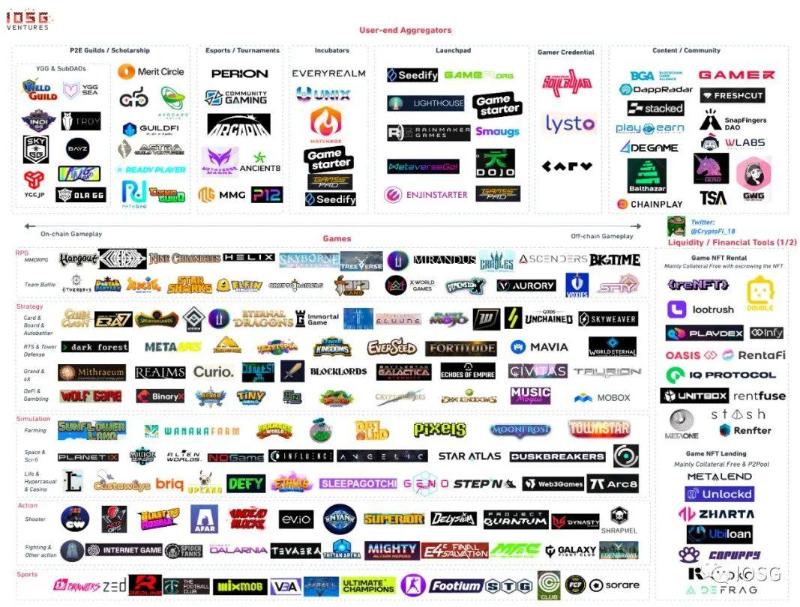
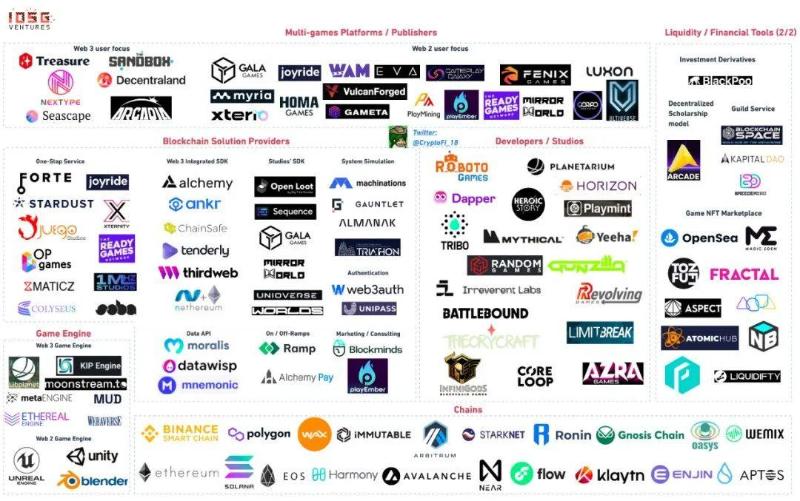
Source: IOSG Ventures
Chains
A fascinating new trend is the migration or replication of GameFi projects onto new blockchains, similar to what happened previously in DeFi.
Currently, BSC, ETH, Polygon, and Wax lead the GameFi space, hosting over 80% of on-chain games.
Meanwhile, Arbitrum and zkSync are ambitious new challengers. For example:
Beacon on Arbitrum is an action rogue-like game that reached 21,000 DAU within less than a month of launch, attracting significant attention.
Tevaera, active on zkSync, is an arcade action game and one of the first titles launched on its mainnet.
Game Engines
Before game engines existed, developers had to write code from scratch repeatedly and manually check every line without being able to run or test it in real time.
However, developers soon realized thatmuch of this code—including graphical assets—could be reused, optimizing development processes and saving time.
Thus,developers gradually began integrating required code and assets into unified development toolkits, giving rise to game engines.
Today, most games—both Web2 and Web3—are built on Unity and Unreal Engine. Just as Epic Games developed Unreal Engine, some Web3 game studios such as Planetarium Labs and Lattice are developing their own Web3 game engines, enabling developers to write complex game logic and interactive content.
Blockchain Solution Providers
Once gameplay is designed, developers or publishers need to integrate blockchain technology into their games, including selecting chain partners, embeddable wallets, NFT minting and marketplaces, compliance solutions, and SDKs/APIs or other services supporting tokenomics and management.
As players grow, their needs become increasingly diverse. With traditional game companies entering the space, these demands will only increase further. Most traditional game builders lack deep blockchain knowledge, making integration and economic model design particularly challenging.
Based on the different services offered by solution providers to game developers or publishers, we classify them into eight industry types.
One-stop service providers: They typically offer the most comprehensive blockchain integration tech stack and related services. For instance, Forte includes nearly all the functionalities mentioned above and helps offload blockchain-related work for AAA game studios transitioning into blockchain gaming.
Web3 integration SDKs: These generally include most Web3 development frameworks and tools, offering a dedicated game toolkit for blockchain-based games. For example, Thirdweb provides a Unity SDK with ready-made contracts for markets, NFT staking, and airdrops.
Studio SDKs: Services provided by game studios themselves, such as Open Loot from Bigtime and Sequence from Horizon (Skyweaver). They leverage their experience to help Web2 developers enter the market. Open Loot also offers marketing support, payment integration, and comprehensive game analytics.
System simulation: Widely used in game design, especially in Web3 games where economic cycles are crucial. By simulating, testing, and monitoring GameFi systems, they ensure healthy in-game economies. Currently, over 20 Web3 games have partnered with Machinations, publicly announced on their website.
Authentication providers: Use their Unity and Unreal Engine SDKs to onboard players, reducing friction and lowering learning curves to accelerate blockchain adoption among mainstream audiences.
Data API providers: Build Web2 and/or Web3 databases allowing developers to read and write user data in real-time—for example, exporting analytics to websites and apps, creating in-game leaderboards, whitelisting wallet addresses, etc.
On/off ramps: Allow developers to integrate SDKs enabling in-game purchase and sale of cryptocurrencies without worrying about KYC.
Marketplaces / consulting services: Include tokenomics design support, branding services, and more.
Multi-Game Platforms / Publishers
These are to-C game publishers offering various types of games (some of which are also developers). Gala, Sandbox, and TreasureDAO are leaders in this category.
TreasureDAO is building a decentralized gaming and publishing platform with over 100,000 community players, ranking as the top game and NFT ecosystem on Arbitrum. Such platforms establish infrastructure and ecosystems tailored for independent developers while forming economies based on accumulated player activity. Their resilience isn't tied to any single game's short lifecycle, resulting in stronger ecosystem sustainability.
Liquidity / Financial Tools
Financial tools include lending, leasing, investment derivatives, guild services, marketplaces, etc. However, most of these services remain in early stages because each game operates under its own independent financial model, and demand for external services remains unclear.For example, compared to lending protocols, leasing protocols aren’t technically difficult to build, leading to many projects in this space.
Yet, demand for such services is often questioned for several reasons:
1. Major game studios tend to build their own leasing systems (easy to implement), while smaller games have shorter lifespans and insufficient user bases to justify leasing;
2. Many games are actively lowering barriers for mainstream users, making in-game NFTs increasingly affordable;
3. Most leasing protocols require custodial accounts to lease NFTs, but this must be approved and recognized by the game itself. Otherwise, leased NFTs won’t be allowed into the game, increasing operational difficulty.
Games
Based on Steam’s classification and top-revenue mobile game types, we summarize five categories and eleven subcategories covering current crypto games. (See glossary at the end of the article for definitions of each type.)
RPG: MMORPG, Team Battle. For example, Bigtime is among the first fast-to-market MMORPGs, where players form six-member teams to complete dungeon quests and earn NFTs and tokens. It hosts the largest Web3 gaming community, with over 400,000 members on Discord.
Strategy: Cards & Board & Autobattler, Real-Time Strategy (RTS) and Tower Defense, Grand & 4X, DeFi & Gambling. Illuvium, for example, is launching a series of tightly integrated, interoperable games, with core gameplay centered around open-world exploration featuring auto-battling mechanics.
Simulation: Farming, Space & Sci-fi, Life & Hypercasual & Casino. Castaways, for instance, is a fishing game where players drift at sea searching for islands, gathering resources, and surviving by fishing. It gained massive traction two months ago, reaching over 70,000 daily active accounts.
Action: Shooter, Fighting, and other action games. ev.io is a highly popular FPS (first-person shooter) game, attracting 1.3 million visitors in April 2022 (averaging 550,000 per quarter recently).
Sports: MixMob: Racer 1 is a unique card-battle racing game developed by veterans from FIFA, Halo, and Battlefield.
According to analyses by data.ai and SensorTower, the most popular Web2 game genres (on mobile) over the past two years have been: RPG, strategy, action, simulation, and sports games.
To illustrate with specific examples:
"Rise of Kingdoms" was the highest-spending game in 2021. Its gameplay resembles "Rise of Kingdoms," falling under the RTS subcategory of strategy games.
The second-highest ranked is "Lineage M," a massively multiplayer online role-playing game.
Others include: Fate/Grand Order (team battle RPG, Japanese fantasy style), Slotomania (casino, simulation), Homescapes & Candy Crush (match-3, casual), PUBG (battle royale shooter, action), Monster Strike (team battle RPG), Professional Baseball Spirits A (sports), Roblox (sandbox, simulation).
Our logic is that if a certain genre fails to attract players in traditional gaming, succeeding in Web3 becomes significantly more challenging.Given this reality, Web3 games can capture Web2 markets by improving player experiences, creating efficient secondary markets for in-game items, introducing more compelling and sustainable economic models, and enabling new content creators to join the ecosystem.
User-Side Aggregators
Beyond spectators, GameFi users mainly fall into three types, ranging fromreward-driven to fun-driven.
Web3 users (crypto-native users)
Web3 players (crypto-native gamers)
Web2 users (traditional gamers)
Currently, there are approximately 400,000 active addresses in Web3 games (source: Capital and Talent Flows Behind Web3 Games), still tiny compared to 3 billion users in traditional gaming. To attract traditional gamers, user-side aggregators are crucial for delivering seamless experiences, and can be categorized into eight types:
P2E guilds/scholarships: Popularized by YGG and its sub-DAOs, this model surged alongside Axie Infinity.
eSports/tournaments: Some guilds find scholarship models potentially unprofitable long-term and are shifting toward organizing eSports and gaming tournaments. While nascent in Web3, this model is mature and widespread in traditional gaming.
Incubators: For example, Everyrealm incubates game-related ventures such as The Row, Fantasy Islands, Narcos Metaverse, and Hometopia. It also runs the eSports guild and tournament platform Bedlam and manages a portfolio including stakes across 30+ platforms and 4,000+ gaming assets.
Launchpads: Help players or investors participate in IGOs and INOs; serve as interaction hubs between players and games/metaverses, since players often need to purchase NFTs for game access.
Player credentials: A unified Web3 gamer identity that preserves reputation across different games and experiences, promoting cross-game interactions and higher player retention.
Content/community: Group gamers and provide services such as content distribution, streaming, KOLs or communities, education, etc.
We thank TJ Kawamura (Co-founder at Everyrealm), Alex Qin (Founder at Ubiloan), Alex Liu (Game Studio Advisor), and Yele Bademosi (Founder at Metaverse Magna) for their strong support and valuable input on this article.
Glossary:
RPG: Role-playing game, where each participant assumes a character role, usually set in a fantasy or sci-fi world, allowing players to interact within the game’s imagined universe.
MMORPG: Massively Multiplayer Online Role-Playing Game, a role-playing game played simultaneously by large numbers of players online.
Team Battle: In this genre, players may control multiple characters or act as commanders of a team.
Strategy: In strategy games, players have unrestricted autonomy, and decision-making significantly impacts game outcomes.
Card & Board & Autobattler: Card games use playing cards as core elements, whether traditional or custom-designed.
Board Game: Played by placing or moving pieces on a board (e.g., checkers, chess, backgammon).
Autobattler Game: Auto-battler games typically feature chess-like elements where players position characters on a grid during a prep phase, then fight automatically without direct player input.
RTS and Tower Defense: Real-time strategy games allow all players to compete simultaneously in “real time,” engaging in competitive economic activities, managing limited resources to expand multiple game elements for advantage. In tower defense games, players strategically build towers to defeat enemies.
Grand & 4X: Grand strategy games are the most complex, incorporating political, economic, military, and diplomatic factors. 4X games (Explore, Expand, Exploit, Exterminate) give players broad control over their empire, including warfare, research, agriculture, and governance.
DeFi & Gambling: A category specifically defined here, centered on gambling strategies with simple gameplay mechanics.
Simulation: Simulation games mimic real-world activities observed by players.
Farming: Farming simulation games where players enjoy growth and progression through cultivation.
Space & Sci-fi: A genre maximizing self-invention, imagination, and storytelling. Sci-fi pushes our current reality to distant horizons, exploring the logical endpoints of human endeavor.
Life & Hypercasual & Casino: Lifestyle games focus on mastering hobbies as gameplay. Hypercasual games are lightweight, instantly playable titles that players often replay due to short session lengths and entertainment value.
Casino Game: Games where players gamble chips on random outcomes or combinations.
Action: A fast-paced genre emphasizing movement, combat, hand-eye coordination, and reaction time.
Shooter: Focuses on players using weapons to defeat enemies.
Fighting & Other Action: Require players to control on-screen characters in close combat against opponents.
Sports: Sports games simulate traditional sports practices and competitions.
Join TechFlow official community to stay tuned
Telegram:https://t.me/TechFlowDaily
X (Twitter):https://x.com/TechFlowPost
X (Twitter) EN:https://x.com/BlockFlow_News
 IOSG Ventures


