








How to Find the Next StepN? – Starting with the Establishment of an X-to-Earn Taxonomy
TechFlow Selected TechFlow Selected
How to Find the Next StepN? – Starting with the Establishment of an X-to-Earn Taxonomy
Establish a logical X-to-Earn classification system to identify the next GameFi project with massive potential.
 Navigating Web3 tides with focused insights
Looking back at the complete "trough-peak-trough" crypto industry cycle from 2020 to 2022, three new sectors—DeFi, NFTs, and blockchain gaming—each had their moment in the spotlight. Within the blockchain gaming space, two projects stood out most prominently: Axie and StepN. Axie pioneered the "play-to-earn" model, sparking a gold-rush frenzy around pixelated creature battling; while after Axie's decline, StepN took a different path with its lightweight "walk-to-earn" approach, more closely tied to users' real lives, guiding players toward a new consensus: beyond just earning money in games, you could also gain the satisfaction of improved health.
Judging by metrics like veteran player retention and actual effectiveness in motivating physical activity, StepN was indeed the first blockchain game to achieve crossover appeal, arguably qualifying as an outstanding Web3 product. As a result, the X-to-Earn sector surged unexpectedly, becoming one of the most important modules within blockchain gaming.
StepN’s “walking to earn” concept swept through the crypto community, peaking when shoes launched on BNB Chain with promises of “breaking even in four days.” This triggered an explosion of various X-to-Earn projects. At the time, we even published a long-form series titled *“Move to Earn Sector Analysis,”* reviewing several StepN clones. But before we could finish writing, StepN began cooling down rapidly on BSC—faster than we could type—so we ended up abandoning the series… Was the issue rooted in StepN’s gameplay or operations? I don’t think so. The root cause lies in the dual-token model inherited from Axie. That model’s underlying logic leads inevitably to “live by FOMO, die by FOMO.” It’s fair to say that StepN’s successful crossover attempt and diligent team simply extended its lifecycle beyond most other projects.
Even today, the X-to-Earn sector remains highly attractive to both investors and players, primarily because it has real potential for mainstream adoption and integration with everyday life. But upon closer inspection, are all projects in this space truly homogeneous? How can we categorize them from different angles? And how should we evaluate their investment potential? Guatian Lab always likes to be the first to try something new, so we’ve attempted to build a logical classification framework for X-to-Earn:
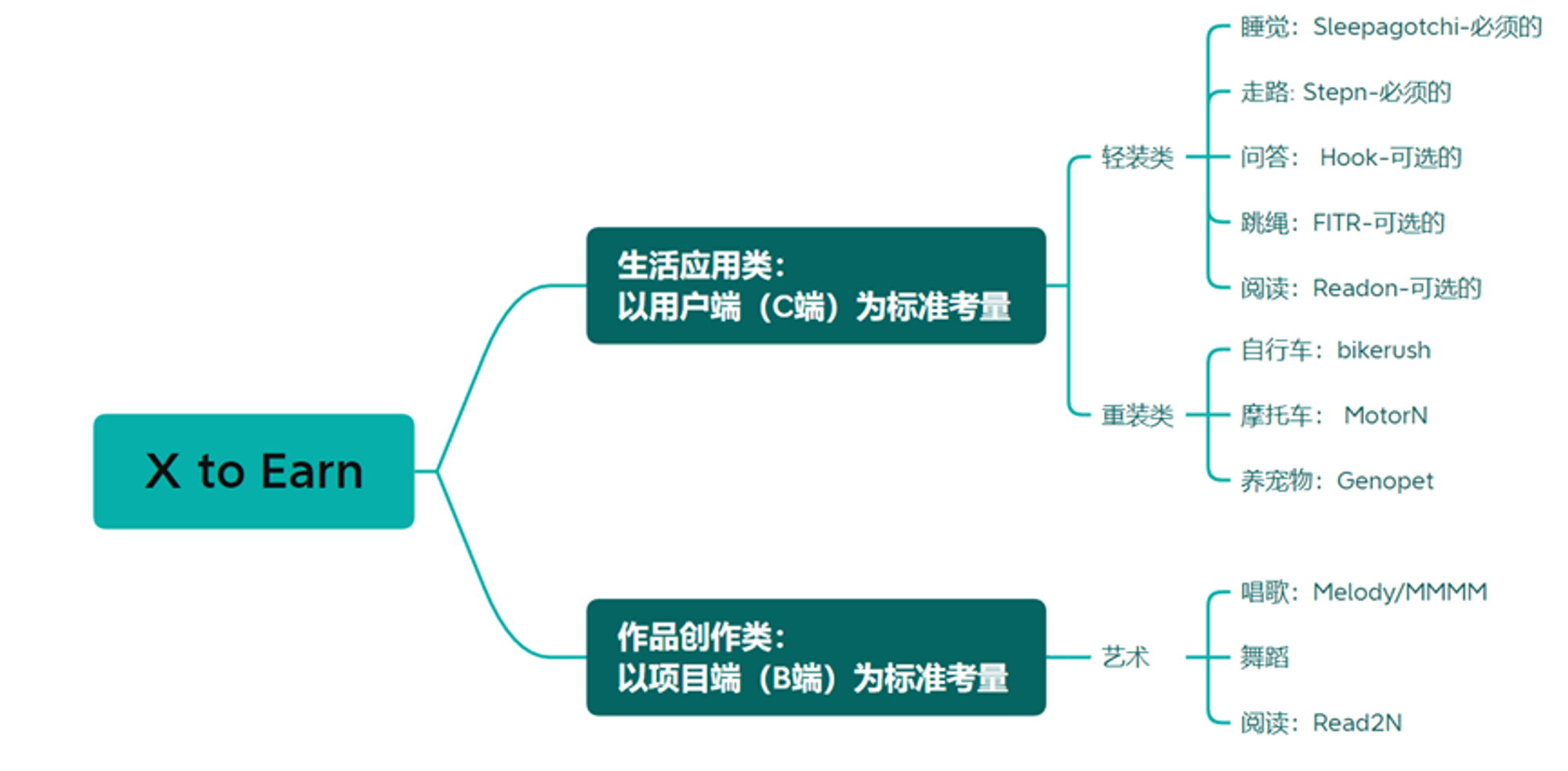
(1) Lifestyle Application Category
Based on the ease of entry for end-users (C-end), we define the standard for the “Lifestyle Application” category. Projects in this category extract high-frequency actions from daily life and allow users to earn rewards while performing them. As a user, these are things you’d do anyway—using such products adds incentives, encouraging better habits.
The lifestyle application category can be further divided into lightweight and heavyweight types. Lightweight refers to products that don't require additional expensive external hardware—low barrier to entry for C-end users. For example, Sleepagotchi (assuming no extra device purchase is needed and existing devices like phones or watches suffice)—everyone sleeps; or StepN, where all you need is a pair of shoes to start running.
Currently, lightweight products show two key characteristics:
-
First, the lighter the product, the broader its audience and the greater its potential for breakout success. Investment institutions currently favor lighter projects in the X-to-Earn space—for instance, Sleepagotchi reportedly attracted many VCs eager to invest but unable to secure allocations;
-
Second, the lighter the product, the stronger the “fun factor” must be—that is, benefits beyond earning should be clearly noticeable and compelling.
For example, reading apps fall somewhere between light and heavy—book lovers already form a niche community who use such tools purely for their passion. But sleeping isn’t a hobby—it’s a necessity for everyone. Therefore, a sleep-tracking product needs another powerful added benefit (beyond earning) to justify its existence.
Take Sleepagotchi, for instance. It emphasizes improving sleep quality, similar to Web2 apps like SleepOn. Honestly, if Sleepagotchi truly delivered on that promise, I wouldn’t mind paying for it—never mind earning tokens. It would be the Web3 version of Brain White-Gold (a famous Chinese supplement). Similarly, StepN falls heavier than sleep apps but lighter than jump-rope or reading apps, so it leverages the idea of “the more you run, the healthier you get.” Both Sleepagotchi and StepN share a positive, uplifting narrative: Sleepagotchi promotes healthy routines (better sleep = higher rewards), while StepN encourages regular exercise (longer runs = higher earnings).
Let’s briefly analyze the recently popular Hook, a star project launched via Binance IEO after nine months of development. It belongs to the “Learn to Earn” type, rewarding users for answering questions. From a product design perspective, I’m skeptical for several reasons:
-
First, while the entry barrier is low—anyone can answer questions—is answering questions something people must do every day? Unlike sleeping or walking?
-
Second, there’s no fun factor. Learning goes against human nature—laziness is innate. Can answering questions become a hobby like reading or running? You’re not a Super Boy Repeater.
-
Third, will users really brag about knowledge gained here at dinner parties? Then why not just go to TikTok or Zhihu?
Thus, Hook’s usage logic feels awkward—people only participate to earn money. I wonder if Binance considered these points when promoting it. Though honestly, none of this matters much—having Binance as a backing “daddy” is what really counts, haha.
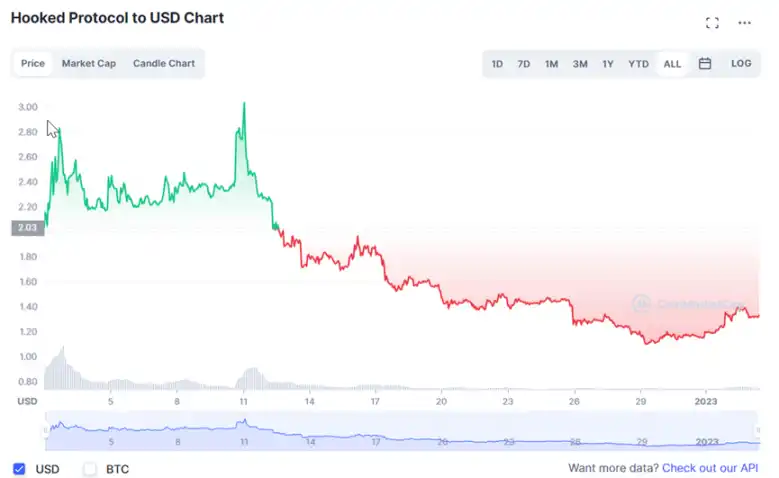
Notice that among lightweight activities like sleeping and walking, both are things users do daily in real life. Hence, their non-monetary benefits (the “fun factor”) need to be particularly strong—or at least heavily emphasized in marketing. When moving to slightly heavier activities like jump-rope or reading, which are optional in daily life, fandom begins to play a role—enthusiasts join in, forming private traffic communities. Going further, heavyweight products rely almost entirely on such dedicated fanbases.
Heavyweight products require external equipment or accessories, raising the C-end entry barrier. Examples include cycling (shared bikes being a special case in China) or pet ownership—you need a bike or a pet, implying extra cost. Only true fans will enter. Thus, we strongly recommend that heavyweight products be operated by teams already established in Web2 with existing private traffic, emphasizing transition from Web2 to Web3. Giant could launch Bike-to-Earn; dog food brands could create Raise-to-Earn. Without an existing fanbase, building from scratch becomes extremely difficult.
In summary, focus on analyzing C-end characteristics for lifestyle application projects. How to judge the potential of a lifestyle-focused X-to-Earn product? If it leans toward lightweight:
Is the user entry barrier low enough to attract mass participation? The size of the user base determines the project’s ceiling. Is the non-financial incentive (the “fun factor”) convincing and genuinely useful? Does the team have strong operational and promotional capabilities to onboard new users?
If it leans toward heavyweight, focus instead on:
Does the team have an existing private traffic base? Can the product develop strong social features around a shared interest?
(2) Content Creation Category
Compared to “Lifestyle Applications,” we at Guatian Lab have recently paid more attention to “Content Creation” projects, as they hold potential for generating high-quality content (IPs), possibly evolving into broad social platforms akin to Douyin. This opens new utility scenarios for native tokens (entering the SocialFi domain) and even enables external ad revenue, leading to healthier economic models.
Content creation projects may produce exceptional works or creators that go viral, capturing significant attention. Great singing, dancing, or storytelling can all achieve this. In contrast, lifestyle applications—like sleeping soundly or running fast and far—rarely generate shareable masterpieces unless it’s Guan Xiaotong live-streaming her sleep or StepN training an Olympic marathon champion. Thus, lifestyle apps are largely confined to optimizing core functionality without clear evolutionary paths—perhaps explaining why StepN’s attempts at social features remain underwhelming.
Content creation platforms empower top-tier creators among C-end users to earn substantial income—this embodies the “Skill-to-Earn” philosophy. Such income doesn’t stem from Ponzi dynamics but from genuine fan spending (imagine Web2 livestream gifts or chapter-by-chapter novel purchases) and future advertising revenue.
However, the challenge for content creation lies on the B-end: high startup costs (what we call “foundation-building costs”). For singing apps, most users initially cover copyrighted songs, requiring the project to license music rights. For reading platforms, attracting quality writers requires extensive outreach and significant investment.
In summary, content creation projects may spawn viral hits or standout creators. Analysis should begin with the B-end: does the team have sufficient funding to cover foundation costs? These projects require long-term vision, aiming to evolve into social platforms capable of generating external revenue and achieving self-sustaining economies.
(3) Case Studies
Within the Sing-to-Earn domain, we examine two directly competing content creation projects: Melody and MMMM, to explore how such platforms might evolve.
First, let’s review these two projects:
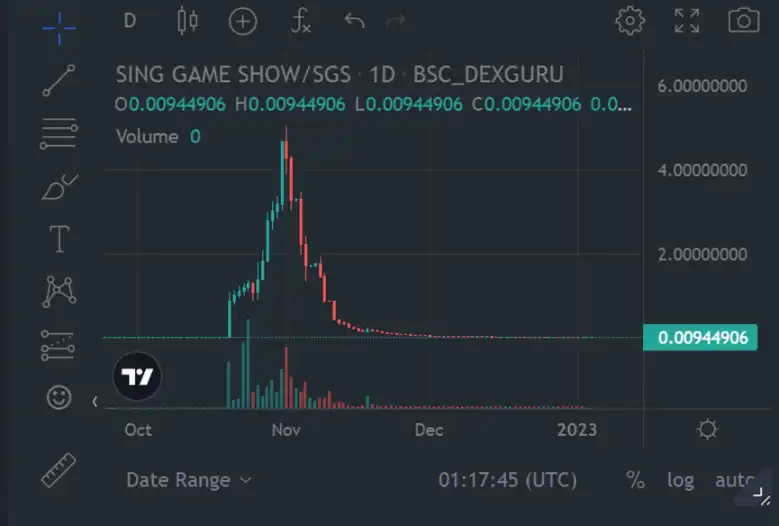
Melody: Started selling mystery boxes in July 2022, launched governance token SNS and game token SGS in October, triggering massive hype and FOMO, primarily driven by Chinese users. By December, the governance token had dropped 95%, the game token over 99.5% (as of early 2023). The NFT floor price fell to 0.16 BNB, compared to 3 BNB during the third batch sale of 3,000 boxes in November 2022. Verdict: The project has effectively died.
MMMM: Launched slowly from Japanese and Korean communities in October 2022. The first 4,000 NFTs were freeminted on November 11, 2022, reaching a peak floor price of 0.2 ETH, now at 0.075 ETH. Closed beta started November 25, with open beta launching by year-end. Community engagement and user count are steadily rising. No token has been released yet. Verdict: The team aims to build a long-term music platform.
Guatian Lab has tracked both projects closely. Their operational approaches differ drastically. Melody’s defining trait is its powerful promotion capability—able to ignite markets quickly. Its NFTs entered via paid sales (three batches: 1.5 B, 2B, 3B), and both tokens launched aggressively in October—a classic early-miner-profit model. However, this rushed approach is ill-suited for content creation X-to-Earn projects. It feels wasteful—like raising a husky only to turn it into a mutt. High-quality music hadn’t emerged before the project burned through its momentum.
Observing MMMM’s moves, the project remains in investment phase: NFTs are freeminted, tokens unlaunched. To put it in crypto slang: “the whale is still investing.” Let’s break down MMMM from several angles:
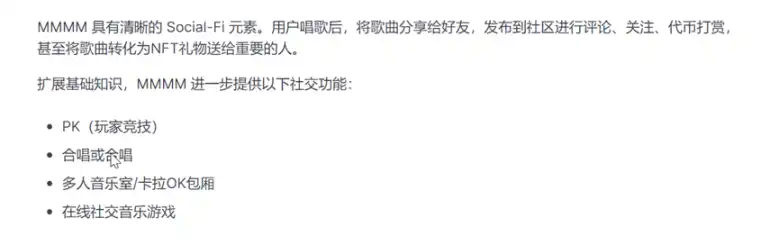
3.1 Future Potential: Social Module
Why emphasize social evolution as the key to such projects’ potential? Return to economic model analysis:
1. Both Melody and MMMM face heavy B-end burdens due to costly music licensing—the foundation cost is too high, deterring many investors. Melody remained vague about copyrights, whereas MMMM explicitly stated in AMAs that it purchased proper licenses.
2. After securing licenses, users are incentivized to sing via token rewards—similar to PVE in games, where players collectively farm the project. If the model ends here, how does the project make money? Spending on licenses and user rewards—wouldn’t the team become a charity? To profit early, they’d need constant NFT sales and pump-and-dump cycles on secondary markets.
3. Currently, MMMM offers freeminted NFTs, hasn’t launched tokens, and spent heavily on licensing. How will it monetize? Likely by advancing to Phase Two: social mode—earning sustainable cash flow through SocialFi and external revenues.
4. Imagine a NEET guy grinding songs daily on MMMM, accumulating Mess (game token), waiting for token listing to cash out. Suddenly, the project launches a “Super Girl” or “Sisters Who Make Waves” competition. The female performers are beautiful and talented, rivaling K-pop idols, potentially birthing new stars like Chen Yifa or Feng Timo. The NEET gets hooked! He tips tokens to his favorite idol! He stakes tokens in her exclusive pool to boost her ranking! Now Mess has a new use case—perfectly embodying the crypto truth: “earn in crypto, spend in crypto, not a penny taken home.”

5. Once a virtuous cycle forms between users and quality content, expansion follows—building influential fan clubs, enabling online/offline interactions between idols and fans. With enough engaged users and loyal followers, external revenue streams like advertising naturally emerge. That’s eyeball economics.
6. Why wouldn’t singers choose existing Web2 platforms? First, Web2 is saturated with low revenue-sharing ratios. Second, Web3 offers transparent, on-chain payout data—no manipulation possible. Smart contracts ensure automatic payouts to performers, eliminating backstage “rules” for withdrawals.
7. On Web2, fans give purely—time or money—for spiritual fulfillment, rarely material return. But Web3 fans—NEETs included—can stake or tip tokens to idols and potentially enjoy both emotional and financial returns! Isn’t this just redirecting DeFi’s liquidity mining strategies? Imagine an online contest: ten girls each have a staking pool. Fans stake sub-tokens to vote, and supporters of the winning pool earn 50% of event revenue—those who backed the winner actually profit.
Reviewing MMMM’s whitepaper, there’s a dedicated section on social features. We hope this project successfully evolves into a social platform.
3.2 User Experience with MMMM
Given Melody’s demise, readers can try MMMM. The ongoing second round of open beta testing (where earned MESS tokens are valid) requires an invite code—I’ve been testing it recently. Not a singing enthusiast myself—I rarely go karaoke, mostly listen while driving. Using MMMM turned it into a great work-break tool. Singing exercises my lungs and makes me sweat. Thought I hit an “S” grade and was elite—only to learn from fellow testers that SS and even SSS grades are common. Turns out “S” might just be passing level. Utterly humiliated.
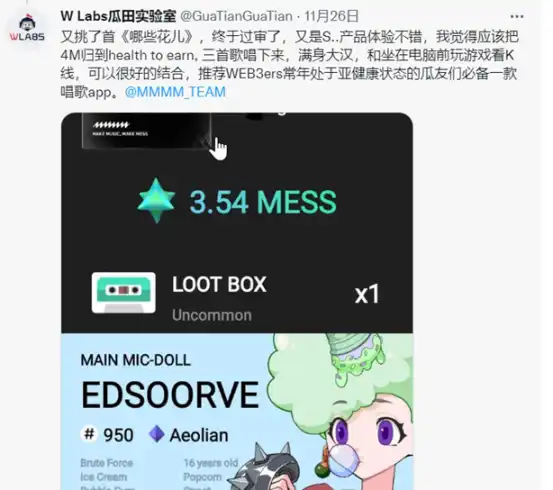
Currently, MMMM’s functions are simple: sing, get scored, receive MESS. I actually hope development proceeds slowly—given past mistakes, sometimes slow is faster.
3.3 Mitigating Structural Risks
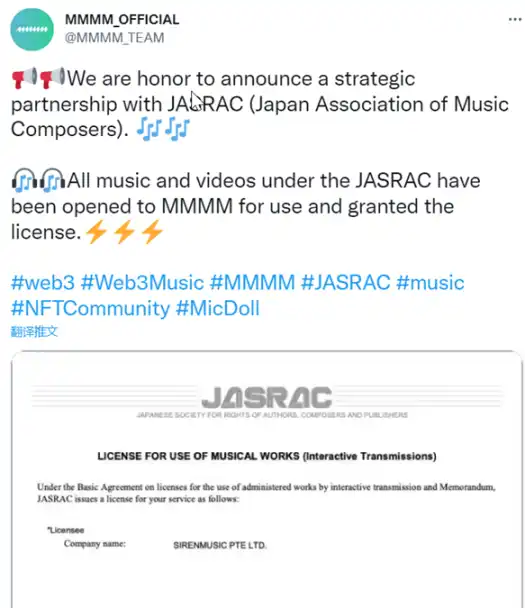
The first structural risk for such projects is copyright. As noted, MMMM confirmed in AMAs that it properly licensed music. Observing partner explanations about acquiring Japanese and Korean rights, the process was detailed and specific. Songs in-app often appear in both Chinese and Korean. We also saw official tweets showing collaboration with Japan’s composers association and legendary producer Tetsuya Komuro. Thus, we conclude MMMM has addressed copyright risks and can operate sustainably.
The second structural risk is cheating. Bots and cheaters are fatal to any Web3 project, causing unfair overproduction and accelerating death spirals. For example, Hook’s quiz system allows unlimited bot farming...
Currently, MMMM prevents cheating by requiring facial video during singing. While the team assures no recording occurs, privacy-conscious Web3 users may still feel uneasy. Could they adopt StepN’s AI anti-cheat tech? Community discussions indicate plans to replace real faces with cartoon avatars later.
3.4 Web2 User Acquisition Strategy
A mature social product cannot survive on Web3 users alone. The key lies in drawing users from Web2. According to our research, MMMM plans a no-barrier approach similar to the blockchain game Skyweaver: Web2 users can register directly with built-in wallets. They can switch to self-custody anytime. Additionally, confident singers can rent NFTs to earn Mess—effectively enabling zero-cost music monetization.
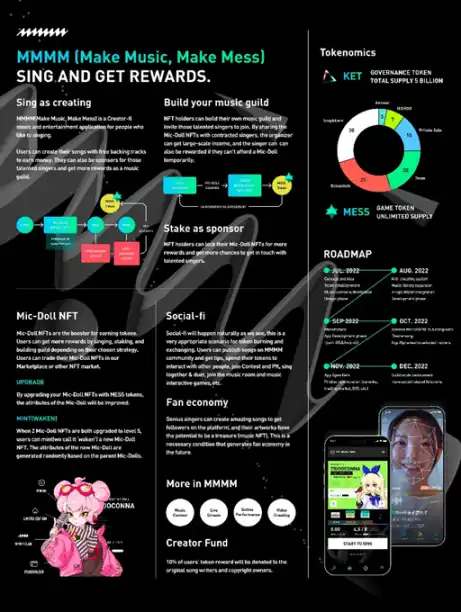
We won’t dive deeper into MMMM details here. Previously, the project shared a diagram summarizing its vision:
For Chinese readers or those seeking more detail, check out Xiao Lou’s project review: https://medium.com/@wggdao/日拱一卒-mmmm-fc1e1de8c5ef
(4) Summary of the X-to-N Sector
The X-to-Earn sector will remain a lasting hotspot. Whether you're an investor or a gamer encountering such projects, start by using our classification framework to determine whether it's a “Lifestyle Application” or a “Content Creation” project. For example, two reading apps—Readon and Read 2 N—may seem similar, but analytical focus differs, leading to different classifications: Readon uses algorithms to recommend articles you like, similar to Qutoutiao—thus categorized as “Lifestyle Application”; whereas Read 2 N focuses on being a creator platform, akin to Qidian, placing it in the “Content Creation” category.
For “Lifestyle Applications,” analyze from the C-end perspective across several dimensions: ease of user entry and scale of participation, strength of non-financial incentives, difficulty in building private traffic.
For “Content Creation” projects, shift focus to the B-end: does the team have sufficient capital to cover initial foundation costs? Do they have a long-term roadmap to evolve into a social platform? Where does their actual revenue come from?
Guatian Lab website: http://www.wlabsdao.com/
Guatian Lab Discord: https://discord.gg/wggdao
Guatian Lab Twitter: https://twitter.com/GuaTianGuaTian
Guatian Lab Long Research Articles on Mirror: https://mirror.xyz/iamwgg.eth
Guatian Lab Medium: https://guatianwgg.medium.com/
Join TechFlow official community to stay tuned
Telegram:https://t.me/TechFlowDaily
X (Twitter):https://x.com/TechFlowPost
X (Twitter) EN:https://x.com/BlockFlow_News
 瓜田实验室W Labs






