








AMA Recap: Reviewing 2022, Looking Ahead to 2023—Where Will the Bull Market Come From?
TechFlow Selected TechFlow Selected
AMA Recap: Reviewing 2022, Looking Ahead to 2023—Where Will the Bull Market Come From?
2022 is coming to an end, with institutions and individuals alike suffering through the bear market. When will this bear market end, and where will the next bull market emerge from?
 Navigating Web3 tides with focused insights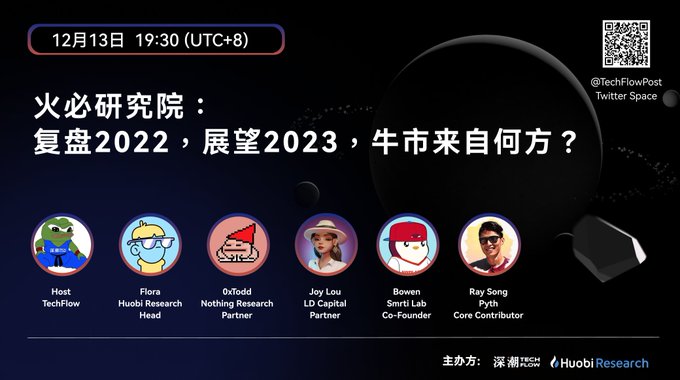
Compiled by: 0xcbk, TechFlow
As 2022 draws to a close, both institutions and individuals are enduring the bear market. When will this bear market end? And where will the next bull market come from? Coinciding with Huobi Research's release of its annual blockchain report, we invited several seasoned experts to review 2022 and preview 2023. The guests delivered sharp insights packed with valuable takeaways. So far, over 6,000 people have tuned in. Below is TechFlow’s summary of key highlights.
Guests and Introductions:
Flora, Head of Huobi Research;
Todd, Partner at Nothing Research;
Joy, Partner at LD Capital;
Bowen, Co-Founder of Smrti Lab;
Ray, Core Contributor at Pyth.
Flora: I entered the industry in 2018 and have been working on research at Huobi ever since. I'm currently leading Huobi Research. This event coincides with last week’s release of our annual report summarizing various aspects of the industry—market trends, policy developments, and future outlooks. Our team invested significant time and effort into it. Feel free to check it out, download it, and share your feedback.
0xTodd: I also started in research at Huobi Research before joining Nothing Research as a partner. We focus on early-stage investments in the primary market and conduct extensive DeFi research.
Joy: I’m Joy, Partner at LD Capital. Great to meet everyone.
Bowen: Hello everyone, I’m Bowen. Smrti Lab focuses on investment across both primary and secondary markets. Back in 2013 when I was at ZhenFund, we invested in Huobi. In 2016, I visited Huobi’s office and saw they were already publishing content about consortium chains and use cases beyond BTC, LTC, and XRP—such as ETH. Now, it feels like we're back in the winter of 2018, with many mining firms facing collapse. We should reflect on which sectors might sustainably grow next year.
Ray: Hi everyone, I’m Ray. At Jump Crypto, I handle partnerships and relationships, primarily focusing on Pyth Network—an oracle data product incubated by Jump. Jump Crypto entered crypto around 2015–2016 and now collaborates with over 100 projects including Solana, BNB, Ethereum, and Aptos, all actively using Pyth. Originally launched on Solana, Pyth has evolved into a fully cross-chain solution providing data for multiple blockchains.
TechFlow: As 2022 comes to an end, what are the most memorable events of the past year—industry-wide or personal—and how did they impact your thinking or worldview?
Flora: Huobi Research summarized the top ten events of the year. More than half were negative—such as the collapse of Three Arrows Capital, Terra’s bankruptcy, the FTX incident, and Tornado Cash regulation. On the positive side: Ethereum’s Merge, OP token launch, Layer2 momentum, Stepn driving the “X-to-Earn” trend, and regulatory clarity emerging in Europe and the U.S.
Personally, the Luna and UST crash left the deepest impression. Two months before its collapse, our team discussed Luna’s model and UST’s sustainability, concluding it was an unsustainable, self-referential scheme fueled purely by capital inflows. We even assigned someone to analyze potential fallout if UST failed. But when the collapse actually happened, its speed and scale far exceeded our expectations.
This taught us a critical lesson: trust analysis and logic over price movements. Respect risk. Moving steadily and sustainably matters more than climbing fast and high—especially in the volatile world of crypto.
Todd: The most impactful development for me was OpenAI’s release of ChatGPT. It’s not just another Siri-like assistant. Microsoft backed it and previously acquired GitHub, giving OpenAI access to vast code repositories. With nearly $1 billion invested and thousands of V100 GPUs powering training runs, this is backed by massive infrastructure.
For early startups to compete would be futile—given their access to such enormous data and computing power. If ChatGPT continues evolving, the world five years from now could look drastically different. Exciting times ahead—but also concerning, as AI may soon surpass human researchers. A mixed blessing indeed.
Joy: Institutions, exchanges, and miners who leveraged long positions at Bitcoin’s peak got trapped. By the time prices hit lows, they had no capital left to buy the dip. That’s when smart money steps in. Many lose faith in the industry during downturns. Inexperienced investors lack confidence at bottoms but panic-buy at tops due to FOMO. Some believed Bitcoin would reach $100K at the peak, then later feared years-long winters at the bottom—but these extremes can’t coexist within one cycle. Markets progress through volatility, rising spirally.
If I had to recommend the best mid-term (~6-month) investment today, it wouldn't be BTC. BTC acts as a long-tail liquidity asset—it lags in responsiveness during rallies. It only benefits after other sectors show clear recovery signals and excess liquidity flows in.
For low-risk mid-term exposure, I’d suggest gold or commodities. Relative to US equities, Chinese A-shares may offer alpha next year. However, A-shares face structural issues—their "reservoir" effect, constant IPOs and lock-up releases, and rising CPI in China post-pandemic reopening. Labor shortages could emerge similar to current conditions in the U.S.
Bowen: While traveling in Colombia this year, I attended Cosmos Works. The Cosmos ecosystem feels distant from China—it began in early 2017, driven mainly by U.S., South Korean, and European communities. It was historically undercapitalized, with few institutional investors and limited fundraising methods. Most tokens were airdropped to ATOM holders, creating a unique ecosystem dynamic. About 600 people attended—the first crypto conference I’ve ever been to—and it opened my eyes to Cosmos’ diversity. Developers there don’t obsess over token prices; while 80% leave short-term, 20% stay and build new business models.
Ray: From a trading perspective, some believe we've already hit bottom—especially as the Fed shows signs of dovishness and crypto has traded sideways for months. People speculate whether the crypto winter might be ending. But the FTX collapse severely damaged trader confidence.
From Jump Crypto’s standpoint, while trading remains core, over the past couple of years Jump Capital has increasingly shifted toward supporting builders—like Wormhole and Pyth, which we incubated.
Although many projects lost funding and cash during the FTX turmoil, those with sufficient runway continue building aggressively. Bear markets are often the best time to construct foundational industry infrastructure.
During the Luna crash and previous DeFi failures, ripple effects went beyond assets—they affected oracles too. For example, when Luna’s price dropped too quickly, oracles couldn’t update data in time, triggering cascading liquidations in large staking protocols.
Only when storms hit do you see which projects stand strong and which crumble. For builders, such moments present opportunities—projects with flawed tokenomics, weak security, or poor edge-case planning get exposed first.
TechFlow: Everyone—individuals and institutions—is suffering through this crypto bear market. Huobi Research’s annual report suggests the market will bottom out early in 2023. When do you expect the bear market to end? What macro and micro indicators are you watching? When will the next bull market begin, and what narratives and drivers will fuel it?
Flora: Huobi Research evaluates bear market bottoms and major cycles from two angles: macroeconomic and crypto-specific.
Macro:
Monitor liquidity, especially USD-based flows deeply tied to the sector. Recently, CPI and interest rate hikes dominate attention. We haven’t entered large-scale balance sheet contraction yet—still in a rapid hiking phase. Over the past month or two, the pace appears to have peaked.
Liquidity doesn’t directly signal a bottom, but it sets the foundation. To identify the next bull cycle, ample liquidity is essential.
Geopolitical factors matter too—e.g., the Russia-Ukraine war significantly impacted fund flows, transaction volumes, and demand in both regions.
In hyperinflation-hit developing countries where fiat becomes unusable, crypto adoption naturally increases.
Crypto Market:
Industry-specific metrics better pinpoint bottom ranges and timing;
Track sentiment and overall ecosystem health;
Watch infrastructure progress and whether breakthrough applications emerge that attract external users, traffic, and capital.
The market is likely already in a bottom zone. Macro-wise, the Fed’s aggressive rate hikes seem to have peaked—the pace won’t accelerate further and may slow down, entering a prolonged high-rate environment. On the crypto side, most major risks have been largely cleared. Despite dips from FTX, the depth of decline wasn’t extreme. Crypto prices are becoming less correlated with traditional markets—now driven more by internal capital flows rather than external macro swings.
Next year, Litecoin halving (scheduled for August) may spark localized rebounds. The cycle could start building momentum about six months earlier.
Todd: I distinguish between big cycles and small cycles.
Small Cycles: These are native to our industry—Bitcoin halves every four years, Litecoin does too, and Ethereum’s inflation dynamics form part of the smaller rhythm.
Big Cycles: Predicting exactly when rate cuts will begin is extremely difficult—even the Fed isn’t certain how high or long rates must go. They might give rough guidance one quarter ahead. But the actual pivot from hiking to cutting lies outside predictable ranges.
Our fund strategy: We prefer waiting for right-side signals instead of gambling on left-side bottoms. Since no one knows precisely where the hiking peak is, we’d rather miss the absolute bottom and enter once the downtrend reversal is clearly confirmed. We don’t mind sacrificing gains from the very bottom to second stage.
A favorable big cycle is a prerequisite. The follow-up trigger still depends on small cycles. Bear markets allow infrastructure to mature. Only when both big and small cycles align—and major applications emerge—will the next crypto bull market truly unfold.
Joy: Promoting specific assets during periods of negative beta is meaningless—when the whole sector declines, everything loses value regardless.
I see a current impossible trinity: CPI, monetary policy, and recession. So far, markets have priced in CPI expectations. Last week’s data reactions showed recession hasn’t been factored in yet.
These three factors influence each other sequentially: Controlling CPI below 2% is the Fed’s goal. By managing expectations, the Fed aims to stabilize inflation. CPI’s trajectory directly affects how hawkish or dovish the Fed becomes. If CPI drops faster than expected, the terminal rate gets locked in, followed by clarity on rate-cut timing and eventual QE restart.
The terminal rate is expected around Q2 2023, with rate cuts beginning December 2023, as indicated in the Fed’s dot plot. Check CME futures for consensus: terminal rate ~500–525 bps. But markets typically bottom ~6 months before easing begins—not when it starts.
Equity markets react similarly to GDP. Strong EPS growth should pick up around Q2 next year. Liquidity expansion is currently priced for December 2023—but remains sensitive to CPI shifts. CPI impacts the pace of monetary easing; tighter policy accelerates recession, dampens consumption, and hurts EPS.
Why is the Fed’s terminal rate so important?
Because U.S. equity PE median ≈ 1/(r−r₀). Higher r means lower PE. Global PE medians hover around 10 except U.S. stocks, which recently rebounded to near 20—normally around 13–14. So a retest of prior lows—S&P ~3500, Nasdaq ~18800—would be reasonable given that recession hasn’t been priced in yet. Markets are still pricing CPI expectations, not recession.
I differ slightly on two points in Huobi’s report. Internal crypto indicators make sense. First, MVRV—a measure of frothiness—equals Market Value divided by Realized Value. When MVRV < 1, it’s historically a good buying opportunity. We’re below 1 now.
Another solid metric is "realized price" and "accumulation days." Like Bollinger Bands, it has upper and lower bounds. Approaching the lower band historically precedes market bottoms. Though only validated across three cycles, it calculates based on cost basis after turnover. Similar to Wind’s indicator showing profitable A-share holders, hitting the lower band implies almost no one profits anymore—so barring black swans, a bottom is likely imminent.
Think of BTC and ETH as digital gold and treasuries; stablecoins as central bank reserves or foreign exchange liabilities; yTokens/sTokens as commercial bank liabilities; LP tokens as corporate debt. This balance sheet framework will rebuild itself identically in the next cycle. All TVL, FTV, and on-chain activity map onto it. The easiest observable proxy? Stablecoin TVL. Any significant rise in stablecoin supply—on L1, L2, or L3—signals a new narrative gaining traction. This method beats chasing individual project hype.
Bowen: The real question now isn’t which crypto to buy—it’s whether to buy risk or hold cash. Every trade is essentially a bet between bullish or bearish views. Many now favor cash to preserve purchasing power. Most expect Fed rates to peak around Q2 next year. If rates hit 4.5%, DeFi becomes unattractive. Unless real yield (net of incentives) exceeds 4.5%, no one will willingly assume contract risks or leverage to earn returns.
We’ll likely see widespread shrinkage in stablecoin liquidity pools on platforms like Compound or Curve, causing sharp declines in L1 stablecoin usage. Next year, on-chain activity metrics will likely be dismal—low unique addresses, minimal gas fees. Beyond stablecoins, I’ll watch gas fees—average growth across EVM chains—as a leading indicator for the next bull run.
Ray: Short-term, DeFi faces challenges. Lesser-known projects face dwindling liquidity. Market makers focused solely on DeFi are gradually withdrawing liquidity from DEXs. Overall trading volume is falling, and liquidity is exiting.
Long-term, decentralized finance is just getting started. Order book designs remain primitive, though innovative architectures are slowly emerging.
TechFlow: Under shifting macro conditions, regional dynamics in crypto have changed. The U.S. lost dominance after setbacks, Singapore benefited passively, Hong Kong is catching up, Southeast Asia thrives—share your observations or outlook on regional developments. Which region do you see leading future growth?
Flora: Crypto users reached 320 million this year—4.3% of global population—with Asia accounting for 40%. Centralized exchange website traffic ranks highest in the U.S., South Korea, Russia, Turkey, and Japan.
The U.S. leads in user base, application innovation, and institutional participation;
Russia’s surge stems from the Ukraine war, boosting user numbers and trading volume;
Turkey sees increased adoption due to regional tensions and domestic inflation.
Japan introduced crypto regulations early. Their community operates differently—with its own ecosystem. Users skew older, median age ~45, unlike our predominantly Gen Y/Z demographic.
Japan’s operations differ greatly. Exchanges and media are tightly controlled. Listing requires lengthy approval processes, making it hard for projects to get listed—fewer projects make it onto exchanges.
Yet Japan hosts many local projects, promoted offline. Local law prohibits unregistered projects from forming Japanese communities. Without navigating complex procedures, online operations are impossible.
Many Japanese users didn’t even know about Luna’s collapse—there’s no dedicated crypto media, information is siloed. It’s a niche market, but precisely because of its uniqueness, it holds untapped potential.
Last year’s keyword search analysis (BTC, DeFi, Crypto, NFT) revealed NFTs had the broadest global reach—indicating strong mainstream spillover, concentrated in North America, Asia, and Europe. Africa lags behind, showing higher interest in BTC and DeFi infrastructure.
We’ve conducted detailed regional analyses—feel free to explore Huobi Research’s annual report for deeper insights.
Todd: With uncertainty around how long high interest rates will last and when inflation stabilizes below 2%, teams with tighter budgets should consider low-cost regions like Thailand to survive the winter.
Joy: Hong Kong will play a pivotal role in crypto’s future—potentially surpassing Singapore. Singapore appears open but is inwardly restrictive—it wants crypto capital, not the industry itself.
Singapore faces several issues:
No structured, tiered financial market;
No retail market;
Only eight companies listed on SGX—all raise capital via bonds, not equity financing based on future cash flow discounted at high PEs.
Hong Kong has a vibrant retail market. Though political headwinds and mainland influences have weakened its capital markets recently, I believe it’s currently at a cyclical bottom. Moreover, Hong Kong regulators—including officials at Cyberport—have deep understanding of crypto. Their policies genuinely aim to attract and nurture the crypto industry.
Be cautious establishing family offices in Singapore—crypto income isn’t tax-exempt. When opening USD or SGD accounts, applicants often hide crypto-related work history. Later, when applying for PR after 3–5 years, you face a dilemma: admit falsified documents or pay back taxes (e.g., 40%) to qualify.
Mainland China offers little room for Web3 survival. Going overseas is better—recommend Southeast Asia, like Kuala Lumpur or Chiang Mai.
Drive from KL to Singapore takes ~1 hour. KL’s costs are roughly one-fifth of Singapore’s. With many university students—many studying Chinese—KL offers ready talent pools for exchange or wallet marketing teams. Facebook remains a key communication tool, deeply influencing youth.
Chiang Mai has a thriving NFT culture, excelling in native NFT creation, community vibrancy, and even AIGC artist collectives—benefiting from open climate and cultural attitudes.
Europe remains too laid-back—it’ll likely maintain current relevance. The U.S. is moving toward stricter regulation. Recently, CFTC stated only BTC qualifies as a commodity, while SEC confirmed ETH will be regulated as a security. I believe most PoS tokens with value accrual mechanisms will eventually fall under SEC oversight. The U.S. will become a heavily regulated market. The downside: conflict with crypto-native culture. Upside: potential to attract larger institutional capital.
Bowen: Latin America is fascinating. Mexico has high birth rates and proximity to the U.S. Once, in a supermarket, I saw they accepted BTC, ETH, and Solana payments. I asked why Solana—they said transactions are fast and confirmations instant.
Many U.S. founders have moved to Canada or Lisbon. No sovereign currency nation will ease regulation or taxation. Hong Kong vs. Singapore is sibling rivalry—one rises as the other falls—but ultimately they’ll mirror each other’s development paths.
I see massive potential in the Middle East. They don’t fully trust the dollar—some even hold RMB as reserves. The region may evolve into a hub with resource-backed monetary influence despite lacking formal currency sovereignty.
Nigeria has 300 million people and a 7% birth rate. Many exchanges notice bot farmers originate from Nigeria—their English proficiency rivals Vietnam’s.
Ray: I’m based in Miami, USA. Miami has a strong crypto community. Jump and Pyth initially focused on Europe and the U.S. We were pleasantly surprised by the strong Asian response at Token2049, prompting greater focus on Asia. A few months ago, we partnered with BNB and discovered many Asian projects—like Wombat on BNB, founded by Alex, who frequently moves between Hong Kong and Singapore. APAC will remain a key focus area going forward.
Most of Pyth’s team lives in Portugal, where HQ is located. Portugal is gradually becoming a crypto city, with looser regulation. Easy cross-regional mobility is a plus—only downside is it can get boring.
TechFlow: In the last cycle, there was an unrealized meme: Will Ethereum surpass Bitcoin? What’s your view? Among Ethereum’s Layer2 solutions, which specific approach do you favor?
Ray: From Jump’s perspective, two visions exist for Ethereum:
Multichain: Build diverse L2s atop Ethereum to achieve scalability—making Ethereum faster and cheaper in gas fees.
Crosschain: Which Jump actively pursues via Wormhole Bridge. Each chain has unique use cases—we aim to interconnect them so each can focus on its strengths.
Each path has trade-offs. Multichain leverages Ethereum’s existing user base and foundation. Crosschain is idealistic but technically challenging.
I don’t strongly favor either, but monitor Ethereum closely. After Solana’s setback due to FTX, multichain seems more favored now.
Bowen: Ethereum has consistently avoided a single point of failure. This issue arises in areas like RPC nodes and censorship resistance.
Ethereum became deflationary this year—network revenue exceeding issuance—driven largely by MEV (miner extractable value), effectively accelerated transaction fees. This is partly why the SEC seeks to regulate it.
I’m bullish on EVM’s future. Users want three things: fast chains, cheap gas, and no centralized single points of failure.
Todd: Agree with Bowen. Avoiding single-point failure alone puts Ethereum ahead of most chains. Even major ones—EVM-compatible or not—have suffered outages: BSC recently inflated BNB supply, Solana faced repeated crashes.
Bitcoin and Ethereum are effectively the two largest DAOs in crypto. I’m an Ethereum maxi—our fund’s investment thesis revolves entirely around Ethereum.
Back in 2018, EIP-1153 proposed temporary memory for Ethereum but never passed. Uniswap strongly supported it—it would reduce transaction fees. But the Ethereum community rejected it over potential attack vectors, still wary after gas token exploits.
Despite Uniswap’s efforts, EIP-1153 wasn’t included in the Shanghai upgrade. The process resembles U.S. legislation—proposals require intense lobbying to gain support. Other chains simply push changes without such friction.
Historically, many built on Ethereum without enriching it much. EIP-1559 came too late—near the end of the bull run. Now, every action on Ethereum—whether positive innovation or Ponzi schemes—burns ETH.
Ethereum’s current challenge—network congestion—can be solved by L2s. Delivering Polygon-like speed while maintaining Ethereum-equivalent security and decentralization. As modularity advances, anyone might launch their own L2 on Ethereum.
Flora: Ethereum’s position in the industry is undeniable. Many projects are evolving toward DAO structures. The future belongs to interconnected ecosystems and value networks.
Cosmos offers superior openness and scalability—its architecture supports unlimited chains, unlike Ethereum, which may struggle with throughput even with sharding if hosting tens of thousands of apps.
Though Ethereum is advancing rapidly, it will eventually hit bottlenecks. Growth can’t continue indefinitely along current lines.
In contrast, distributed, scalable networks offer infinite extensibility. Application-layer development may shift toward app-specific chains, enabling better customization for complex future applications—far beyond today’s simplicity.
Two trends will be crucial:
Scalable cross-chain networks capable of supporting complex app chains;
Modular design. While Ethereum is embracing modularity, it’s becoming a broader trend—components will become interchangeable, composable, and mutually supportive.
Ethereum will thrive in the next cycle—but may be replaced in the one after.
Twitter Space Links:
Join TechFlow official community to stay tuned
Telegram:https://t.me/TechFlowDaily
X (Twitter):https://x.com/TechFlowPost
X (Twitter) EN:https://x.com/BlockFlow_News






