








Interpreting Whether Modular Blockchains Can Bring the Future for Web3 Users
TechFlow Selected TechFlow Selected
Interpreting Whether Modular Blockchains Can Bring the Future for Web3 Users
As Volt Capital noted, just as web infrastructure evolved from on-premise servers to cloud servers, decentralized web is transitioning from monolithic blockchains and isolated consensus layers to modular, application-specific chains with shared consensus layers. Modular zones
 Navigating Web3 tides with focused insights
As the blockchain industry flourishes and major public chains stand in competition, beyond battles over ecosystems and users, different blockchains are offering distinct approaches to addressing the blockchain "impossible triangle"—the notion that it's impossible to simultaneously achieve scalability, decentralization, and security, hence termed the "impossible triangle."
Multichain architectures and sharding represent attempts to move away from monolithic blockchains. The emergence of rollups, validiums, and data availability chains has disrupted the decades-long status quo of single, monolithic blockchains. New terms such as Layer 1 and Layer 2 blockchains have emerged alongside innovative blockchain design techniques.
In terms of scalability, modular blockchains represent the latest paradigm in blockchain design. The concept of modularity was pioneered by the Layer 1 blockchain Celestia. When discussing scaling blockchains by orders of magnitude, modularity is rapidly becoming a defining narrative. In our article "Five Layer 1 Blockchains to Watch in 2022," we analyzed the modular blockchain Celestia—whose architecture aims to scale the scope and speed of Web3 innovation over the next decade, enabling developers to easily deploy their own blockchains at minimal cost.
Despite slogans like "modular blockchains will define the next decade of Web3 innovation," this article seeks to explore with fellow developer friends what modular blockchains truly are, what problems they solve, and what kind of future they might bring us.
Modular vs. Monolithic Blockchains
Opposite the concept of "modular blockchain" stands the monolithic blockchain, with clear functional differences between the two. First, it's essential to clarify the four core functions of a blockchain:
Execution – Transaction processing and computation.
Settlement – Dispute resolution and bridging (optional).
Consensus – Transaction ordering.
Data Availability – Ensuring data is accessible.
A monolithic blockchain is a chain that handles all four functions. In contrast, while a modular stack splits components into multiple layers, a monolithic blockchain performs all operations on a single layer.
However, a modular blockchain refers to any chain that is part of a modular blockchain stack, achieved by making blockchains modular and splitting the four functions into specialized layers. A modular blockchain stack consists of multiple layers of modular blockchains that depend on each other to form a complete system with all the above components.
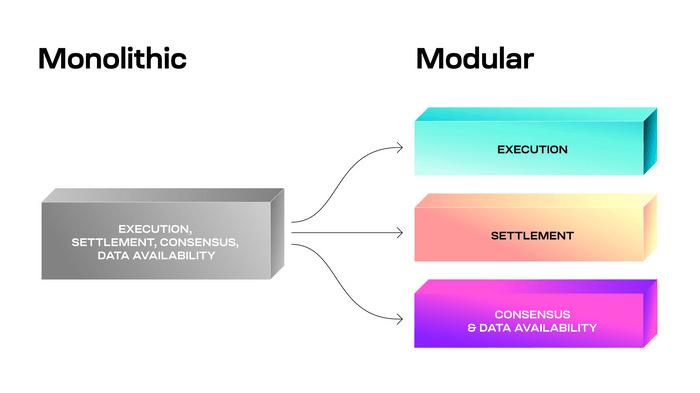
The reason for the innovation and development toward modularity lies in the inherent limitations caused by how monolithic blockchains operate. Some key limitations of monolithic blockchains include:
Inefficient transaction validation: Nodes must re-execute transactions to verify validity.
Resource constraints: Blockchains are limited by the resource capacity of their nodes.
Scalability: To increase throughput, some trade-off must be made in either security or decentralization.
Modular blockchains, on the other hand, are designed to specialize in one or more functions, thereby avoiding the flaws that arise when all four functions—execution, data availability, consensus, and settlement—are handled within the same layer. Because modular blockchains are arranged in a stack, these layers work together to deliver the same overall functionality as a monolithic chain. In other words, while achieving equivalent functionality, modular blockchains avoid existing limitations and defects.
Let’s now examine the specific advantages of modular blockchains.
Advantages of Modular Blockchains
Sovereignty Assurance
Despite leveraging other layers, new modular blockchains can maintain sovereignty similar to Layer 1 chains. This allows blockchains to respond to hacks and push upgrades without requiring permission from an underlying base layer. Essentially, sovereign blockchains retain the ability to make critical decisions through social consensus—an important aspect of blockchains as coordination mechanisms.
Efficient and Low-Cost Launch of New Blockchains
Since modular blockchains don't need to handle all functions independently, new blockchains can simply use existing modular blockchains for components they wish to outsource. This enables efficient bootstrapping of new chains, reducing deployment time and minimizing costs. For example, combining rollup "SDKs" like Optimint with the Cosmos SDK could facilitate the creation of new blockchains without needing to bootstrap a secure validator set.
Scalability
Returning to the fundamental challenge, solving scalability without sacrificing the other two corners of the triangle is a major driver behind the evolution toward modular blockchains. Modular blockchains are not constrained by having to perform all functions. By separating them into multiple layers, scaling becomes possible without compromising security or decentralization. This enables sustainable blockchain scalability compatible with a decentralized, multichain environment.
Current State of Modularity
According to an analysis by Volt Capital on modular blockchains: in a modular future, users are the ultimate winners. Celestia also expresses a vision of modular blockchains empowering Web3 user growth and community sovereignty. As we explore this path toward modularity, how can we realize a better future for users? Before answering that, let’s first focus on the current progress across various blockchains.
On the road to modularity, blockchains have converged on different modular implementations, emphasizing different aspects of execution, settlement, consensus, and data availability.
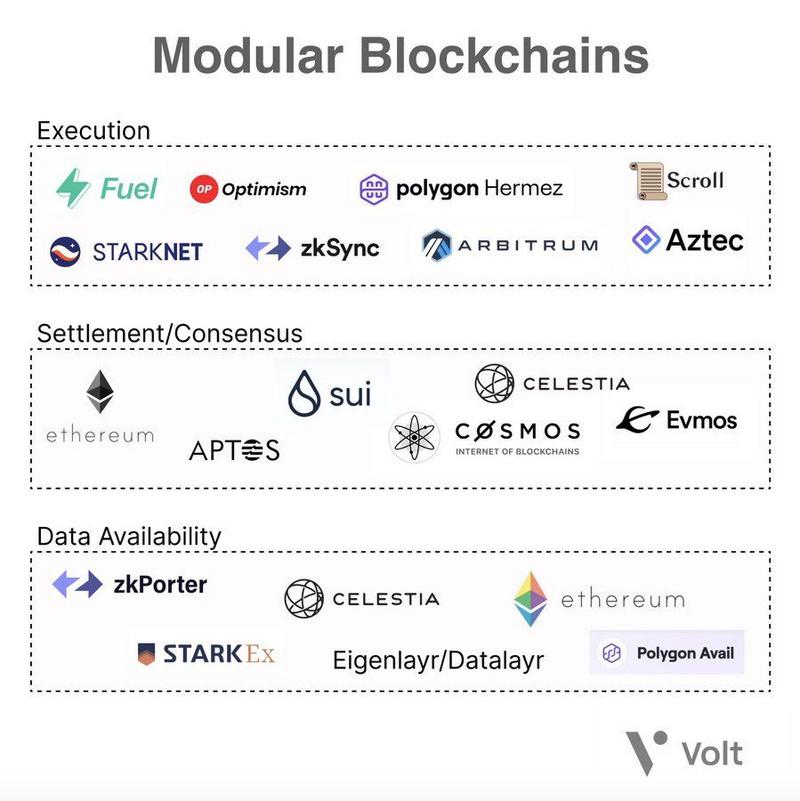
Represented by Fuel Labs, projects such as Polygon Hermez and Arbitrum are pursuing modularity by building execution layers for modular stacks. Meanwhile, the Optimism team is researching sharding, incentivized validation, and decentralized sequencers. Fuel Labs, an Ethereum Layer 2 scaling provider, is developing a decentralized scaling solution called Fuel Optimistic Rollup. Rollups not shown in the image are also a form of modular blockchain, focusing on execution while offloading settlement, consensus, and data availability to separate layers.
Teams like Celestia are working on dedicated data availability and consensus layers. Celestia allows a wide range of execution layers to use it as a data availability layer, laying the groundwork for alternative non-EVM virtual machines such as WASM, Starknet, and FuelVM. This shared data availability, compatible with various execution solutions, enables developers to build trust-minimized bridges between Celestia clusters, unlocking composability and interoperability across chains and ecosystems—similar to possibilities between Ethereum and its rollups.
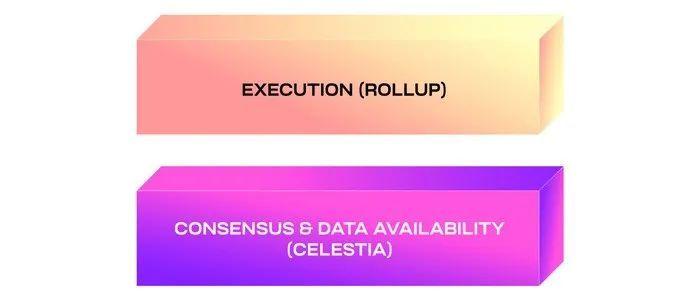
As the first true blockchain explicitly branded as "modular," Celestia naturally draws significant attention in this discussion. Celestia’s modular technology, in a way, reveals the latest stage of progress in the blockchain world. Unlike traditional blockchain designs centered on execution, Celestia leverages modularity to enable blockchains purpose-built for specific uses. This approach fundamentally alleviates the biggest bottlenecks associated with monolithic chains: transaction execution and state bloat.
New modular blockchain systems like Celestia are built from the ground up to overcome scalability barriers. Rather than building atop outdated technologies, they learn from suboptimal elements of previous generations of blockchain tech to create a completely new paradigm that optimizes scalability and decentralization while maintaining security.
The Future of Modularity
The blockchain "island effect" has long been recognized by developers and efforts are underway to break it down. However, beyond technical factors, deeper industry mindsets contribute to these "islands."
Consider a very intuitive example: most effort in building blockchains today goes into creating new Layer 1 chains, each trying to build its own ecosystem and attract users into it. No matter how mature the applications and communities within an ecosystem may be, they essentially remain closed systems.
Modular blockchains, by contrast, create a collaborative environment where many chains are interconnected. Every new user brought in by a modular blockchain creates value for the entire modular ecosystem, not just a single chain. While standalone Layer 1 chains compete against each other, modular chains collaborate. Another benefit of modular collaboration is that developers can reuse and build upon existing modular blockchains, allowing them to mix and match needed components rather than building entirely new Layer 1 chains with technology confined to a single chain. More efficient and lower-cost development will drive rapid growth and prosperity across the entire modular blockchain ecosystem.
As Volt Capital puts it, just as web infrastructure evolved from on-premise servers to cloud computing, decentralized web infrastructure is evolving from monolithic blockchains and isolated consensus layers toward modular, application-specific chains with shared consensus layers. The future of modular blockchains is the future of users—and the future of developers.
Join TechFlow official community to stay tuned
Telegram:https://t.me/TechFlowDaily
X (Twitter):https://x.com/TechFlowPost
X (Twitter) EN:https://x.com/BlockFlow_News
 @OurTinTinLand






