WGGDAO Melon Field Community Atypical Web3 Gaming Economic Model Hackathon, First Session On-Site Transcript Summary, December 10, 2022
TechFlow Selected TechFlow Selected
WGGDAO Melon Field Community Atypical Web3 Gaming Economic Model Hackathon, First Session On-Site Transcript Summary, December 10, 2022
Chain game economic model design—true experts are among the people!
 Navigating Web3 tides with focused insights
Gualord's reflections after attending the first session:
I often interact with fellow melon enthusiasts and project teams who have their own ideas about game economic design—though sometimes immature, they do contain bright spots. That’s why we organized three atypical economic model hackathons. Surprisingly, nearly thirty friends stayed on Tencent Meeting for over two hours from start to finish during our first event. I personally learned a lot—I even chased down participant Gavin the next day for another hour-long discussion, gaining tremendous insights. So, we’ve整理ed the live transcript and are sharing it here with all you melon fans. For additional slides and materials, please visit this post in the DC community.
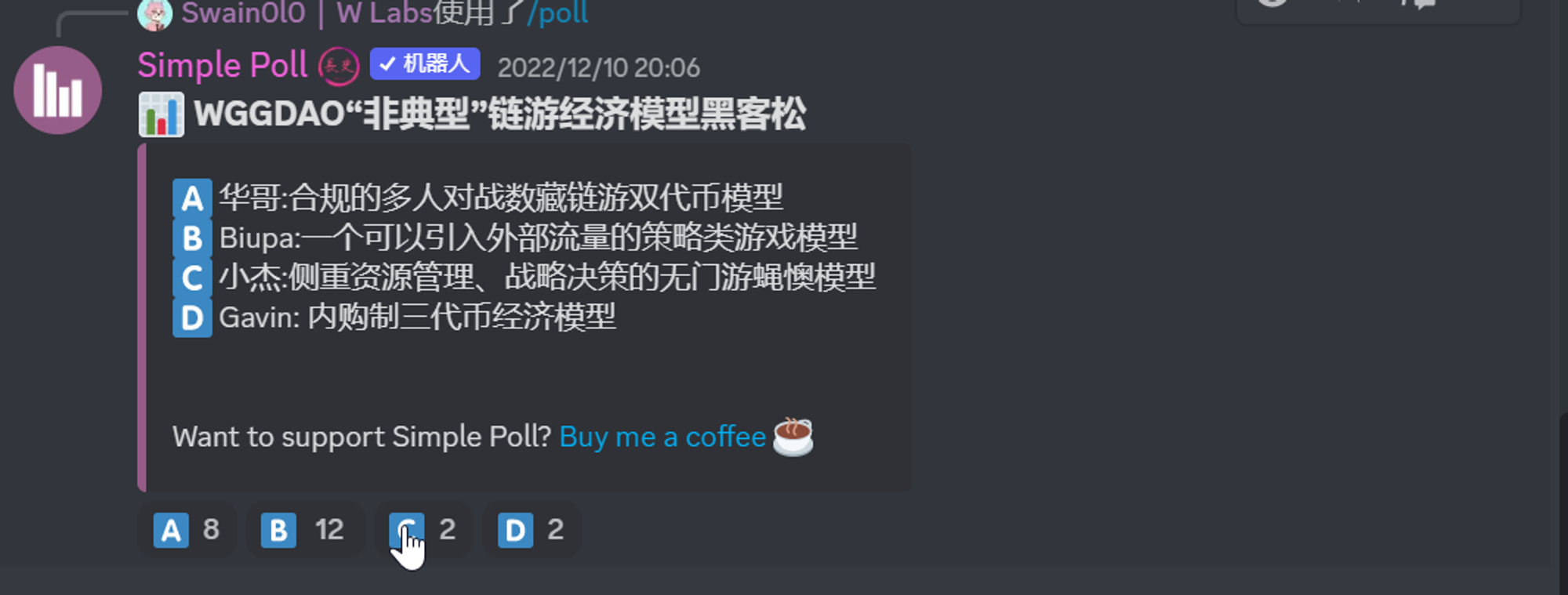
This Saturday, December 17th at 8 PM, we’ll continue with our second session! Also, voting for the best model from the first round is still ongoing. Melon fans who want to support any of the four participants can head to the “Come Vote” channel in the DC community to cast your vote—those who correctly predict the winner three times in a row will be rewarded:
Transcript:
Judges: Gualord (Founder of W Labs), Timothy (Partner at GMA), Dacheng (Head of Big Time Chinese Region). Host: Brian
First Participant: Hua, DC: Hua#2206
Hua presented a dual-token model designed for compliant multiplayer battle NFT games, similar to Web2 titles like ZhenTu. In short, the game operates entirely on a dual-token system centered around heroes, generating multiple types of NFTs.
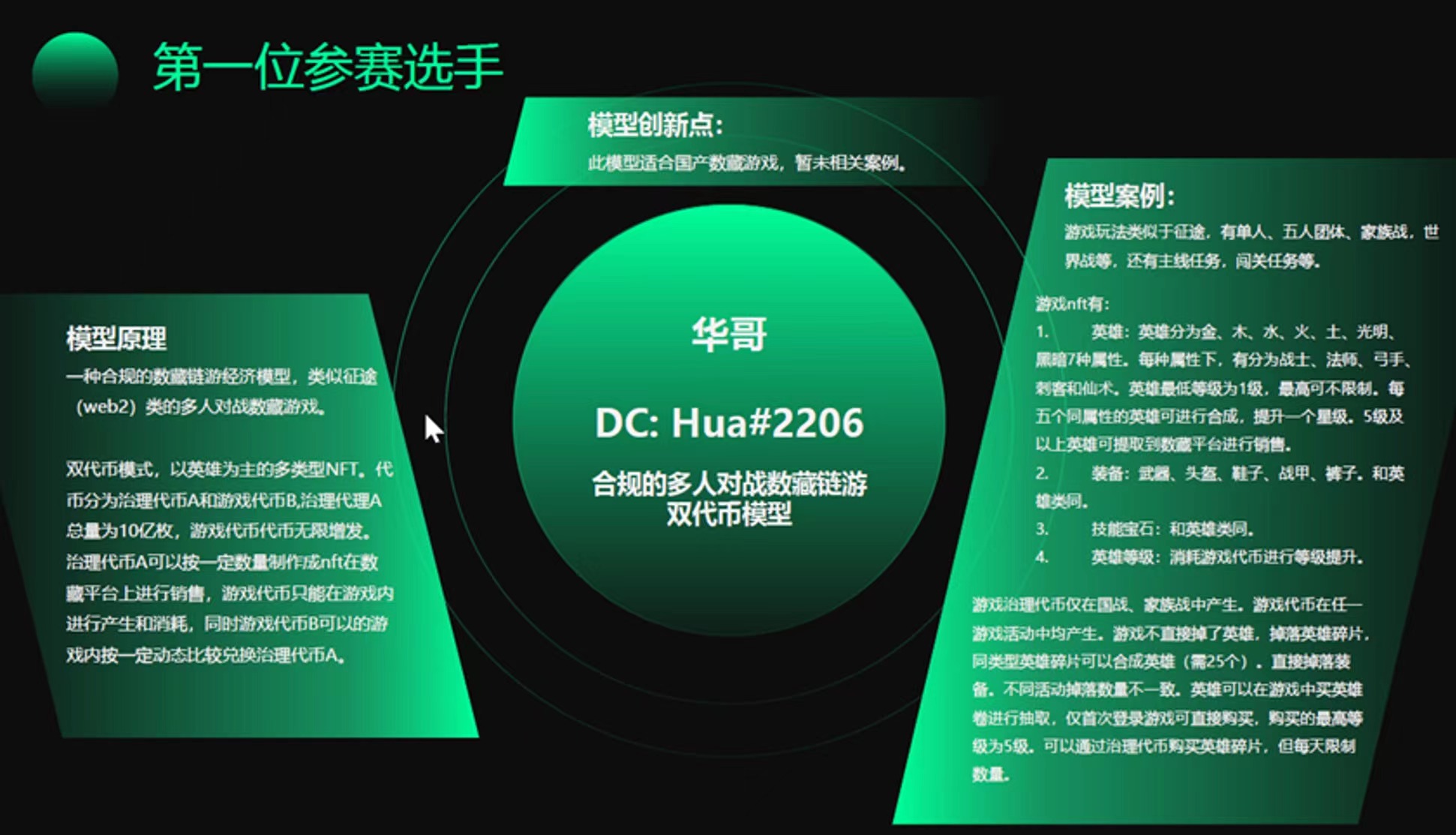
The two tokens are governance token A and in-game currency B. Governance token A has a fixed total supply of 1 billion, while in-game token B is infinitely mintable.
From a utility perspective, governance token A can be converted into a certain number of NFTs and sold on digital collectible platforms. In-game token B can only be generated and consumed within the game. Token B can also be dynamically exchanged for governance token A inside the game.
Let’s look at a case study:
In a game similar to ZhenTu, player modes include solo play, five-player teams, clan battles, and world wars, incorporating main quests and level-up challenges. Game NFTs feature heroes, equipment, skill gems, and hero levels. This dual-token model is applied as follows:
In terms of token generation difficulty, governance token A is only obtainable during national or clan wars, whereas in-game token B can be earned through any in-game activity. Thus, governance token A has fewer earning opportunities, enhancing its scarcity.
Now let’s examine hero design. Heroes can be obtained through two methods:
First, by synthesizing hero fragments, which can be acquired either by playing the game or by spending governance token A to purchase them. Dropping fragments instead of full heroes directly increases gameplay complexity and depth.
The second method is purchasing hero scrolls within the game.
Notably, hero leveling consumes in-game token B, adding another use case for token B.
Judge Highlights:
- Hua’s model is practical for domestic use—reminiscent of a digital collectible version of "Legend 2," where the parent token becomes 1 billion digital collectibles and the child token functions as in-game gold. Gold can be used to purchase collectibles.
- Turning off in-game cash top-ups is correct; otherwise, Web3 users would find it strange that money is being charged everywhere.
- The hero collection mechanic introduces a secondary gameplay layer based on card collecting.
Second Participant: Biupa, DC: Biupa#0068
Biupa has always been a creative melon friend, and for this competition wrote an extensive design document.
Biupa shared a comprehensive and well-structured concept for a strategy-based blockchain mobile game, similar to Romance of the Three Kingdoms Strategy Edition. The game features an open-world map divided into multiple plots, with randomly generated resources and terrain. Players who purchase an initial Pass are given a main city plot and a hero upon entry.
The game uses a dual-token model. EGD serves as the governance token, earned primarily through top-tier dungeons and controlling neutral cities. Key consumption models for EGD include breeding costs, staking mining (which yields EGD), and ve-model mechanics (where staked EGD in neutral cities generates yield). If a neutral city is captured by another guild, 50% of the staked EGD is lost—15% goes to the public treasury, and 35% is claimed by the attacking guild (and can be restaked).
EMD is the in-game currency, mainly earned through grinding, and serves as the primary spending token. The main city acts as the player’s base, initially spawned on a random plot, and can be relocated once every 24 hours using EMD. Heroes exist as NFTs with various attributes such as name, appearance, quality, strength, agility, governance, and resilience, and can be passed down across generations. Dungeons spawn on certain plots and can be challenged. Players must explore the map, form guilds, capture neutral cities to gain victory points, and ultimately win the season.
Judge Highlights:
- This is a cultivation + strategic combat game that encourages PvP and intensifies player conflict—making it highly monetizable. If it evolves into a social experience akin to Romance of the Three Kingdoms’ alliance warfare, it could become truly exciting.
- The idea of neutral cities is particularly compelling. Capturing one grants staking rights for the parent token, allowing players to earn via staking. Another alliance can attack and seize it—part goes to the public fund, the rest remains private. This mechanism greatly amplifies player rivalry.
- All three judges praised the neutral city design and suggested focusing more deeply on the competition for these cities.
- The parent-child token model could be improved. Judges advised against sticking to traditional models—ask whether token issuance aligns with actual player numbers.
Third Participant: Xiao Jie, DC: busy#8423
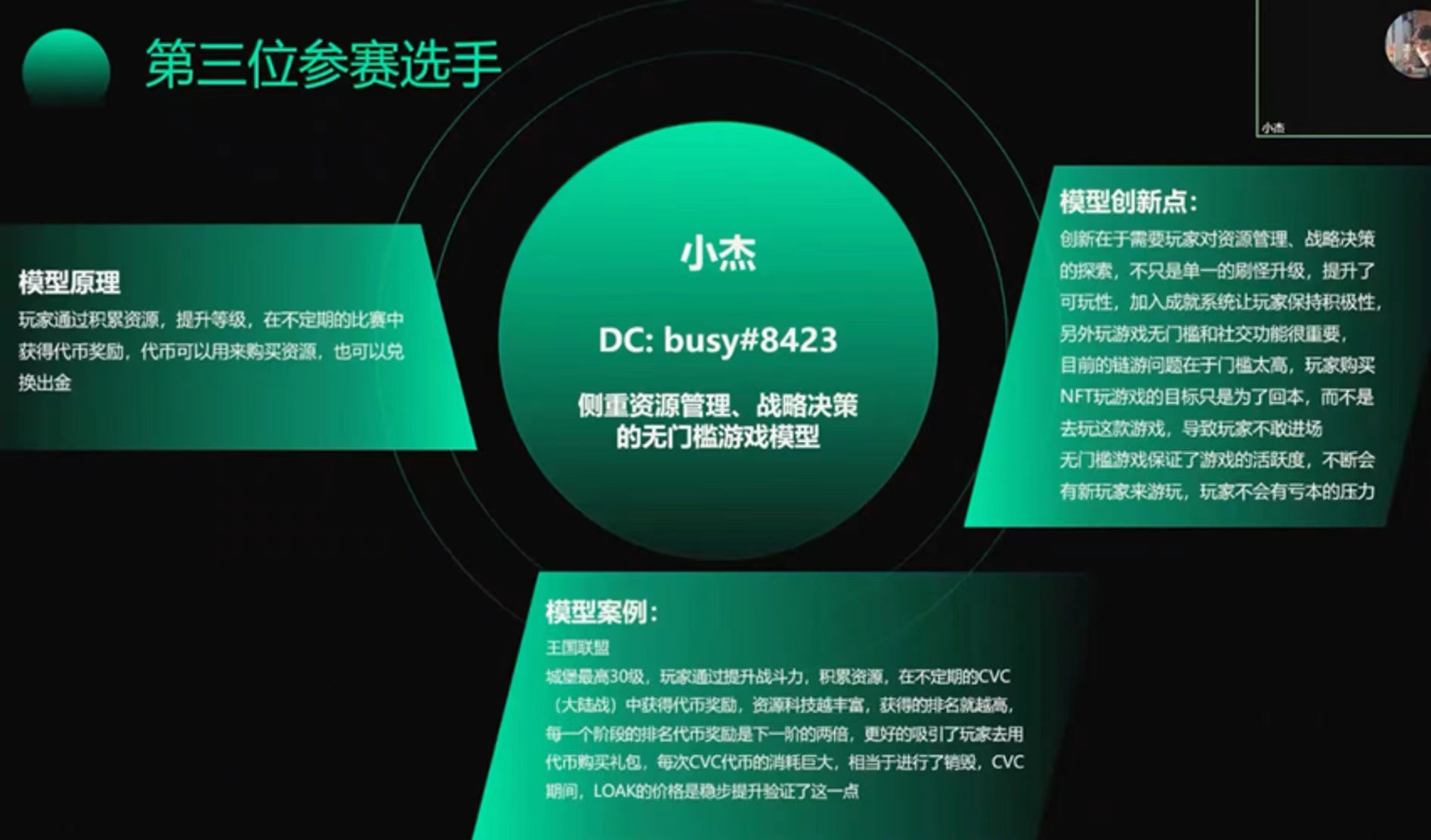
Xiao Jie introduced a no-barrier game model emphasizing resource management and strategic decision-making, using LOKA as an example. Core principle: players accumulate resources and level up, earning token rewards in periodic competitions. These tokens can be used to buy more resources or cashed out.
The innovation lies in encouraging exploration of resource management and strategic planning—not just repetitive monster grinding—and incorporating an achievement system to maintain engagement. Importantly, low barriers to entry and strong social features are emphasized. Current blockchain games suffer from high entry thresholds; players buy NFTs solely to recoup costs rather than to enjoy the gameplay, deterring new entrants.
A no-barrier model ensures sustained activity, attracting continuous new players without fear of financial loss.
Case Study: In Kingdom Alliance LOKA, castle levels go up to 30. Players boost combat power using two types of NFTs: castle skins and attribute dragons, both purchasable with LOKA tokens. Three troop types—infantry, engineers, and cavalry—can upgrade technologies by consuming tokens. Periodic CVC (Continental Wars) events consume large amounts of tokens but also offer substantial rewards. The richer a player’s tech and resources, the higher their ranking, with each phase’s reward being double the previous. This incentivizes buying token packs. Massive token burn occurs during CVC events, and the steady rise in LOKA price during these periods confirms the deflationary effect.
Judge Highlights:
- Kingdom Alliance is a classic pay-to-win game where attackers and defenders fight over cities, burning massive amounts of tokens.
- The guild-based CVC battles deeply integrate social elements, effectively building community momentum.
- Judges were surprised—assuming LOKA was dead given its death spiral on the price chart. Yet over a year later, it cultivated a loyal fanbase, with hardcore spenders battling each other monthly, consistently earning dozens of dollars. Perhaps this is the magic of nation-vs-nation combat combined with social dynamics?
Fourth Participant: Gavin, DC: thelmahermina.eth#5194
Gavin is a highly professional game industry practitioner. He proposed a三代币 model with in-app purchases, designed to create a sustainable in-game economy. The three tokens are: farming token, premium currency, and governance token.
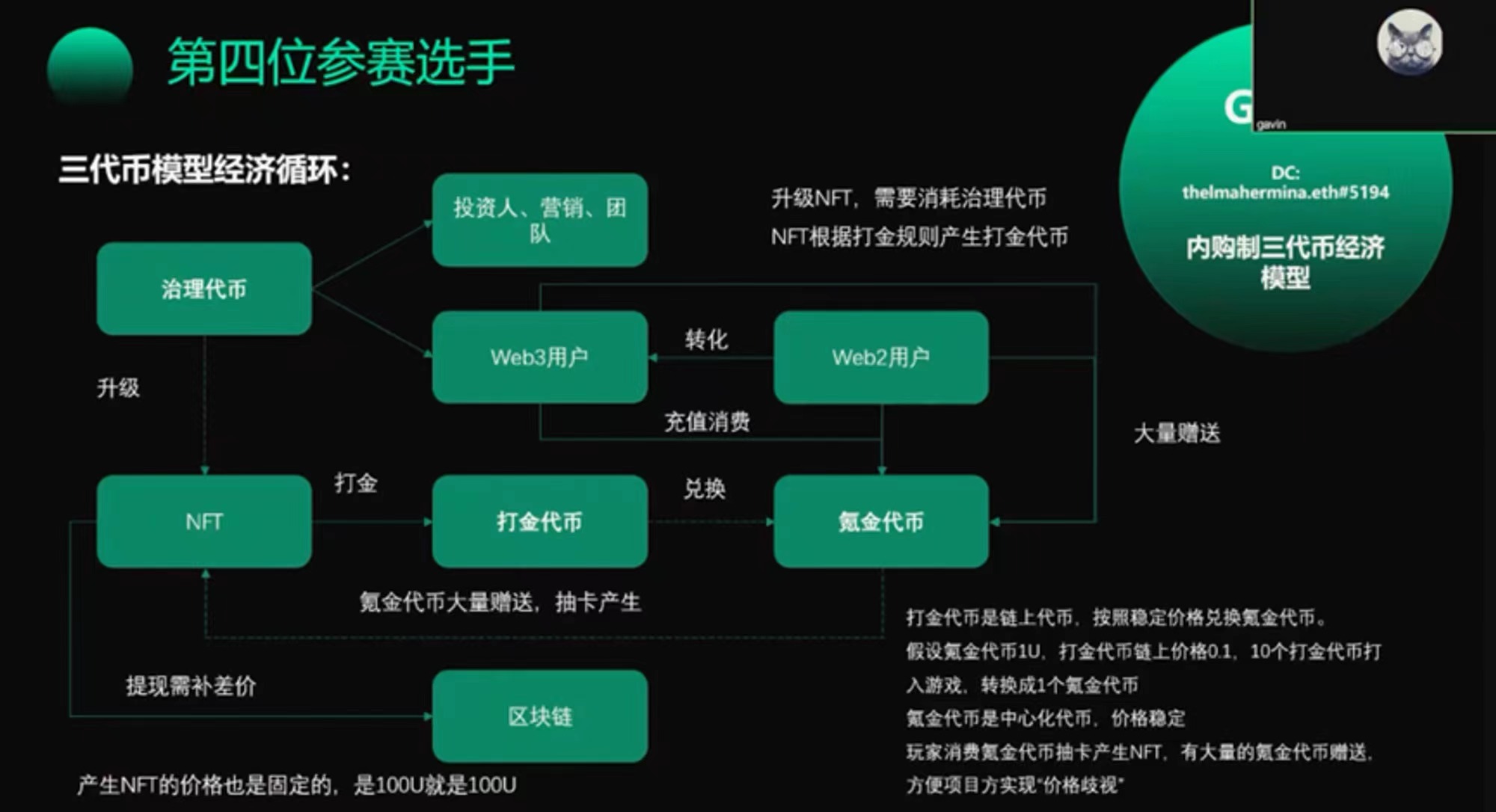
The farming token is a blockchain-native token, convertible into the premium currency at a stable rate. For instance, if the premium currency is priced at $1, and the farming token trades at $0.1 on-chain, depositing 10 farming tokens into the game converts to 1 premium currency unit.
Second, the premium currency is centralized and price-stable. It is used by players to make gacha pulls for NFTs. This process includes generous bonus rewards for premium currency spending, clearly differentiating between farming and premium currencies to enable “price discrimination” for the project team.
Third, governance tokens are consumed during NFT upgrades. Higher-tier NFT holders earn more farming tokens.
Project NFTs can be cashed out, but only if the player covers the original NFT cost and mints a Pass NFT. Without spending money, players cannot withdraw assets, but can still enjoy the gameplay. This resembles China’s shared-equity housing model—only by paying the difference can ownership be fully transferred.
Judge Highlights:
- Gavin’s model reflects traditional gaming “price discrimination”: both whales and casual players can access cards at their preferred price point—the latter simply requiring more grind. The premium currency, acting as a stable reference, enables this pricing flexibility.
- Two systems exist: free-to-play users earn farming tokens and NFTs in-game, but cannot withdraw them to chain unless they cover the equivalent USD value spent. Additionally, a Pass NFT is required for withdrawal—likely a centralized control mechanism.
- Heroes are obtained via gacha, with probabilities determining high-tier pulls or lower-tier consolation prizes, introducing luck-based variance.
- The三代币 model shows great potential but requires further refinement. Judges suggest: could farming token output correlate positively with premium currency reserves?
Join TechFlow official community to stay tuned
Telegram:https://t.me/TechFlowDaily
X (Twitter):https://x.com/TechFlowPost
X (Twitter) EN:https://x.com/BlockFlow_News
 瓜田实验室W Labs