









Plunged 80%! WEMIX Token's South Korean Game Company—Webzen
TechFlow Selected TechFlow Selected
Plunged 80%! WEMIX Token's South Korean Game Company—Webzen
Last year, Wemade, the South Korean gaming company behind the viral blockchain game Legend of Mir 4, saw its token Wemix plummet by 80%.
 Navigating Web3 tides with focused insights
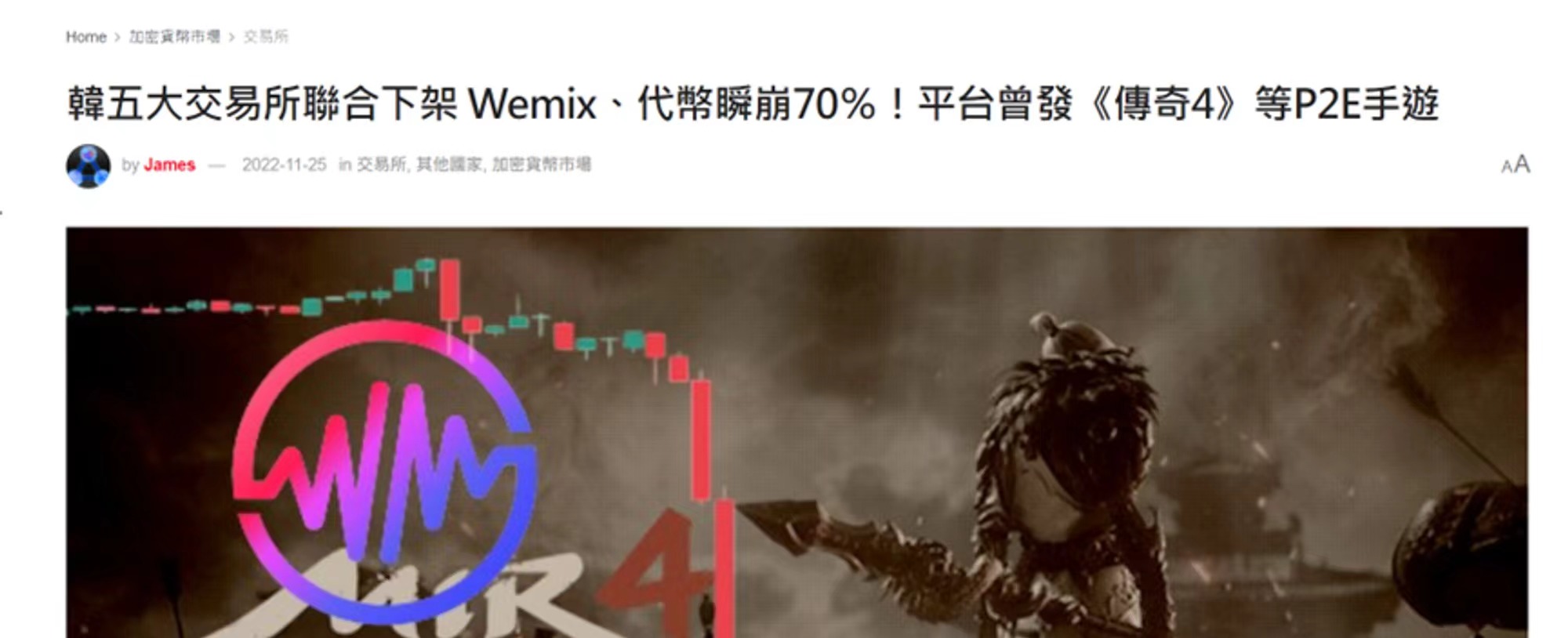
A few days ago, South Korea's crypto community, already reeling from the FTX collapse, was shaken once again: Wemade, the Korean game developer behind the popular blockchain game Legend of Mir 4, saw its token WEMIX plummet by 80%. Naturally, this is a story worth diving into. After some research, I found that the main reason was that WEMIX was jointly delisted by South Korea’s top five exchanges last Thursday, November 24:
Check out WEMIX’s price chart on CoinMarketCap—it looks even more catastrophic than Luna post-crash:
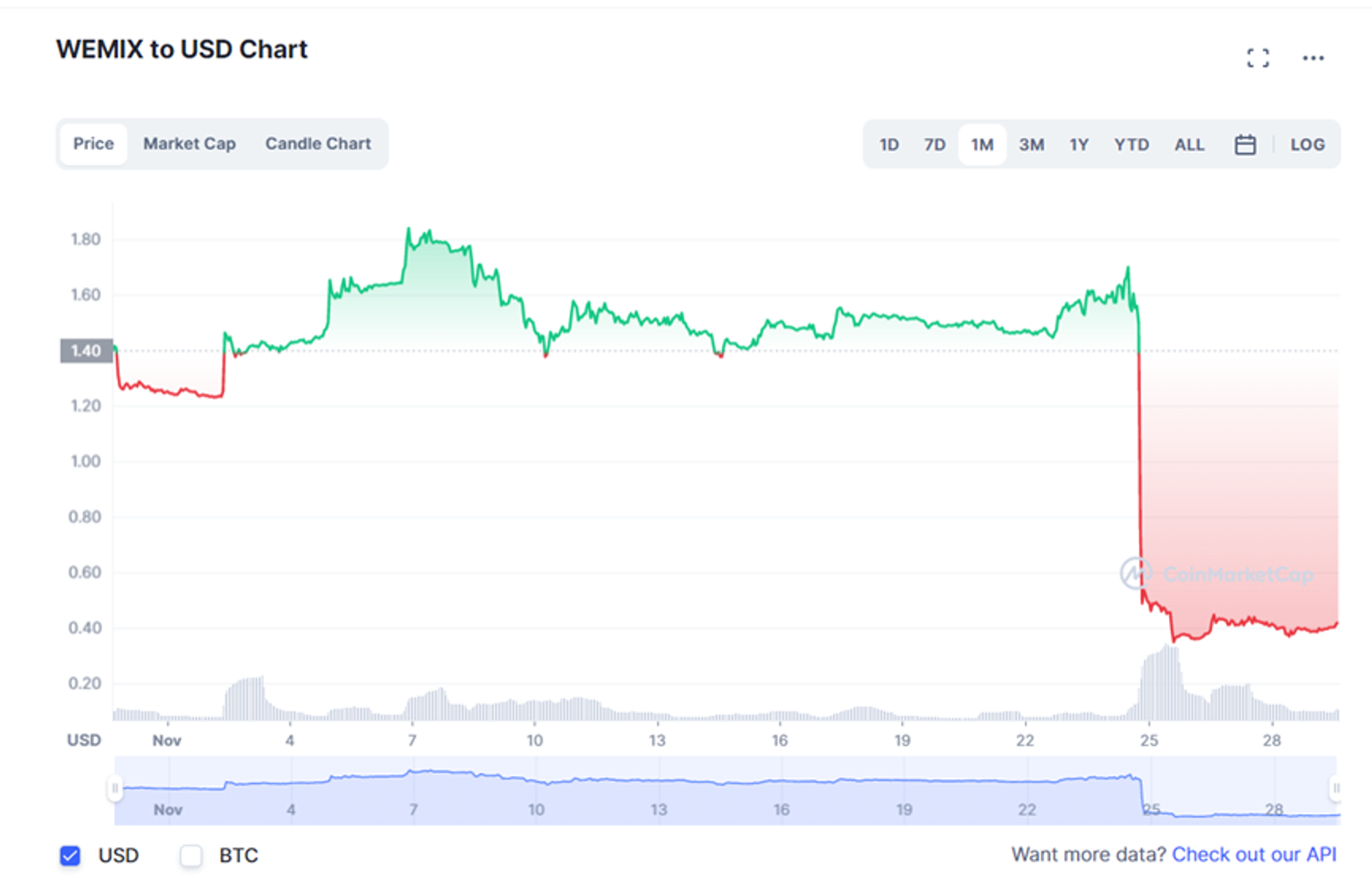
Meanwhile, Wemade’s stock price also plunged 30% on the 25th—the maximum daily drop allowed in the Korean stock market. Words fail to describe how brutal this is. Fortunately, our melon patch community doesn’t have many fans of Korean blockchain games; otherwise, after Luna, then FTX, now WEMIX—no matter how strong your mental resilience, you can't keep getting ripped off like this as a retail investor.
Today’s article won’t dive into specific projects or models. Instead, let’s explore what exactly Wemade did to provoke such a coordinated exchange backlash, and reflect on the industry outlook going forward. This still fits our series’ theme: pain points and opportunities.
(1) Digging Into the Wemade Incident
Let’s first look at what went wrong with Wemade that led to its collective blacklisting by five major Korean exchanges. After digging through various sources, here’s roughly how it unfolded:
-
Wemade had prior misconduct: Back in early this year, Wemade secretly dumped 50 million WEMIX tokens, pocketing around $250 million. When news broke, panic selling ensued among retail investors, causing WEMIX to crash from 7,000 KRW to 4,000 KRW. Since it was likely their first offense, exchanges and investors couldn’t pin down clear evidence and could only watch closely. Selling vested team tokens isn’t inherently wrong, but South Korean media later uncovered that Wemade may have sold tokens reserved for ecosystem development (out of 1 billion total WEMIX, 74% were supposed to support long-term ecosystem growth). That’s clearly unethical.
-
On October 28, Korea’s five major exchanges discovered that WEMIX’s actual circulating supply significantly exceeded what had been disclosed. They issued an “investment warning” and gave Wemade a deadline to submit clarifying documents. At that time, Wemade remained defiant: “No way! It’s just malicious rumors!”
-
By November 24, after two extensions, the five exchanges finally lost patience and simultaneously delisted WEMIX due to serious misrepresentation of circulating supply, providing inadequate or false information to investors, submitting incorrect data during the clarification period, and damaging market trust. As a result, WEMIX crashed to just 20% of its former value.
-
Even more absurdly, Wemade’s CEO held an emergency press conference that day, tearfully claiming this was a case of “extreme bullying” by the exchanges! Unfair! Injustice! He threatened legal action against the exchanges, seeking injunctions to reverse the delisting—blah blah blah! Yet he never explained why the actual circulation was so much higher than reported! Did you secretly dump more tokens again?! That’s the real issue!
Of course, I don’t read Korean, so my information might be incomplete. But English and Chinese reports generally align with this narrative. If all this is true, Wemade deserves to go to zero. Repeat offenders earn no sympathy. The real victims are the investors who trusted them. Now, hurt retail investors are fighting back—media report that affected users are filing criminal lawsuits, and South Korean police have officially opened investigations into Wemade executives for alleged fraud.
(2) Who Actually Owns the "Legend" IP?
In a previous article, we touched upon the bitter rivalry between Shengqu Games (China) and Wemade (Korea), rooted in the ownership dispute over the “Legend” IP. I used to be confused about the messy rights battle between Shengqu and various Korean companies over “Legend.” After reviewing extensive materials, I’ve finally pieced it together. Here’s a simplified timeline:
-
In 2001, Chen Tianqiao’s Shanda Games acquired the distribution rights to *The Legend* from Korean developer ACTOZ for $300,000, launching it successfully in China.
-
After Shanda acquired ACTOZ, key developers from the original *Legend* team left and founded Wemade.
-
In 2002, ACTOZ, Wemade, and Shanda reached an agreement: Wemade and Yedo (Actoz) were co-copyright holders of *Mir 2 (Legend II)*. However, Wemade delegated its rights to ACTOZ, which in turn granted Shanda exclusive rights to *Mir 2* in mainland China. Wemade retained profit-sharing rights.
-
This should’ve settled things—Wemade just collects royalties. But they weren’t satisfied. They secretly licensed the “Legend” IP to several Chinese game companies for profit. Legal battles erupted and dragged on for years. Singapore International Arbitration ruled against Wemade—they ignored it. Then, last year, China’s Supreme Court delivered a final judgment (Civil Judgment No. 395), again ruling Wemade lost the case.
Now we see Wemade’s modus operandi: classic deadbeat + reckless attitude! So secretly dumping tokens fits perfectly with their pattern—disregarding laws and regulations. Where do they get the audacity? Did Korean Liang Jingru give them courage?
(3) Is There Still Hope for This Industry?
Back to crypto. After FTX collapsed, countless media outlets and institutions published reflections: Do we only realize who’s naked when the tide goes out? Before its implosion, FTX ranked among the world’s top three digital asset exchanges. Sam Bankman-Fried, with his spiky hair, was hailed as a Wall Street prodigy and crypto wunderkind—FTX was riding high. Then, one Coindesk report followed by a few tweets from CZ brought FTX down in three days. Hundreds of billions in assets vanished overnight. Countless users who kept funds on FTX lost everything. Now the lid’s off—we see FTX was essentially a black box with virtually no internal controls. Sam and his inner circle could do whatever they wanted. From afar, he looked like a visionary leader. Up close, it was pure arrogance.
I don’t mean to sound harsh, but FTX truly devastated many friends around me. One guy didn’t sleep for two nights straight, constantly checking the FTX interface, hoping his withdrawal request would go through. We ended up voice-chatting about life, the future, and lost friends—mostly just seeking emotional support.
I recall attending a Twitter Space hosted by YouTuber “Brothers of Retail Investing,” where many said they’d quit the space entirely. The mood was heavy. One point discussed was that in any emerging industry, all kinds of chaos happen early on. Norms and transparency only emerge after several black swan events and multiple bull-bear cycles. I only hope industry participants, within their capacity, take risk and control seriously—perhaps then the industry can evolve more steadily.
This reminds me of *Reminiscences of a Stock Operator*, a classic finance book I read when starting my career. It tells the story of Jesse Livermore in the 1920s—an early pioneer of technical analysis who dominated the unregulated U.S. stock market. At his peak, he reportedly controlled 15% of America’s wealth. His greatest trade was shorting the 1929 global financial crisis. After multiple rises and falls, Livermore eventually went bankrupt and died by suicide. Only afterward did the U.S. government begin implementing securities regulations, paving the way for value investing legends like Warren Buffett. Without regulation ensuring data accuracy and transparency, how could Buffett analyze fundamentally sound companies? All the data would be fake.
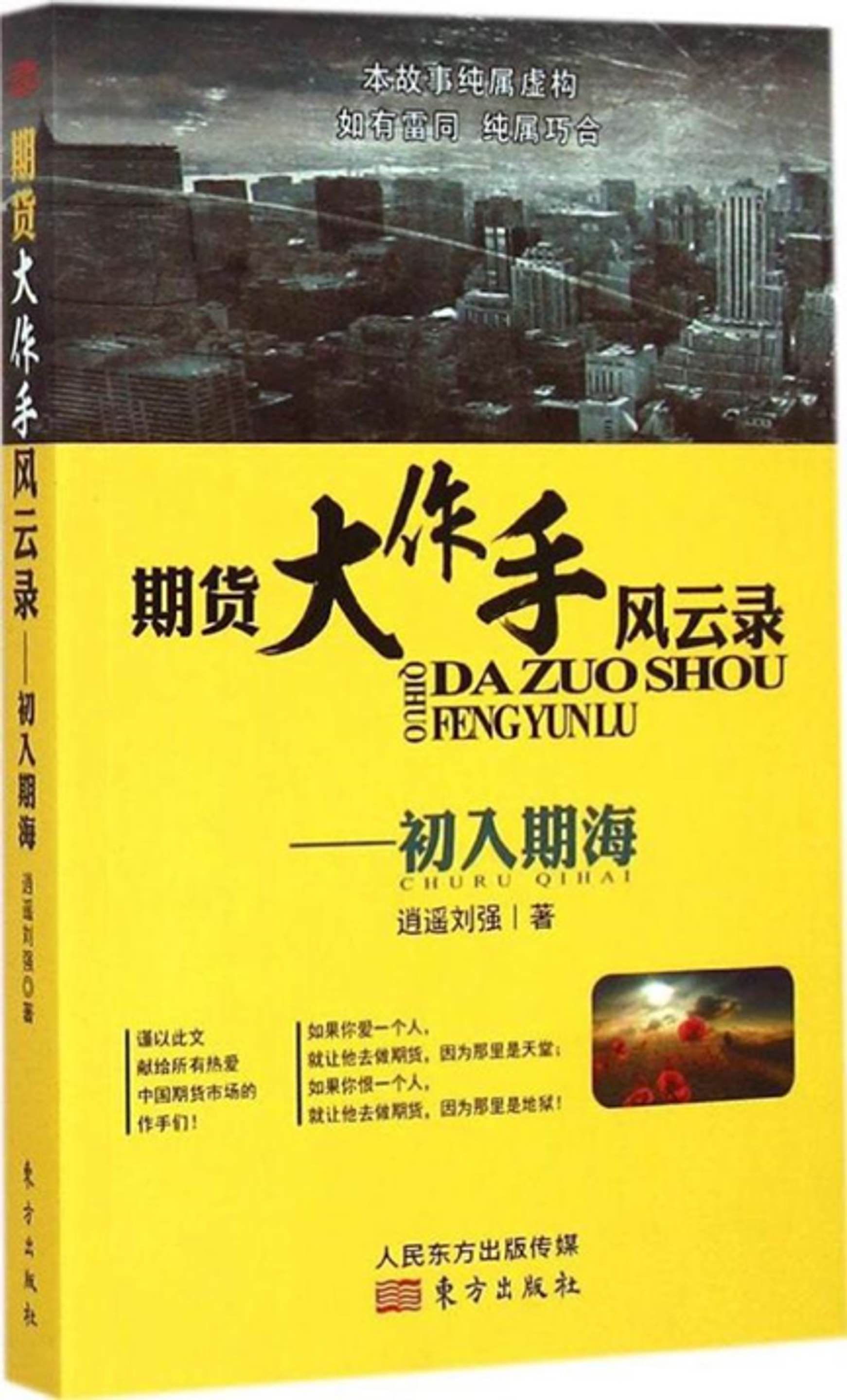
Similarly, seven years ago, Liu Qiang, author of *Chronicles of a Futures Trading Master*, couldn’t survive the 2015 stock market crash and jumped from a high-rise building in Beijing. Only afterward did regulators start cleaning up and establishing rules for futures firms.
Today’s crypto space mirrors the early days of finance—full of get-rich-quick tales, but also risks beyond most people’s psychological tolerance. I firmly believe that while blockchain’s decentralization seems at odds with centralized regulatory oversight, the crypto industry desperately needs rules and supervision. A blood-soaked market rife with fraud and opaque operations will never attract mainstream investors and users.
Every crisis contains opportunity. The joint delisting of WEMIX and the ongoing lawsuits against it send a clear message to bad actors: Deceptive practices like secretly dumping tokens—especially on a transparent, traceable blockchain—will eventually be exposed. Bad players like Wemade deserve to be purged. But over time, better blockchain gaming projects will emerge and thrive under stronger regulation. Let’s wait and see.

Reposting welcome. Original content is hard—please credit “Watermelon Patch Lab W Labs”
Watermelon Patch Lab website: http://www.wlabsdao.com/
Watermelon Patch Lab Discord: https://discord.gg/wggdao
Watermelon Patch Lab Twitter: https://twitter.com/GuaTianGuaTian
Watermelon Patch Lab long-form research on Mirror: https://mirror.xyz/iamwgg.eth
Watermelon Patch Lab on Medium: https://guatianwgg.medium.com/
Join TechFlow official community to stay tuned
Telegram:https://t.me/TechFlowDaily
X (Twitter):https://x.com/TechFlowPost
X (Twitter) EN:https://x.com/BlockFlow_News
 瓜田实验室W Labs






