Scroll: The quiet challenger in the zkEVM race, standing at the midpoint between equivalence and performance
TechFlow Selected TechFlow Selected
Scroll: The quiet challenger in the zkEVM race, standing at the midpoint between equivalence and performance
Scroll is building a 2.5 zkEVM.
 Navigating Web3 tides with focused insights
Author: Blockworks Research, Westie
Translation: TechFlow
Given the popularity of EVM among developers, there has been a strong desire to combine the scalability of zk Rollup technology with the developer experience of EVM. This has led to an arms race in zkEVM systems, with major players including Scroll, zkSync, and Polygon—among which Scroll has remained relatively low-key.
Due to EVM's limitations, zkEVMs face a necessary trade-off between compatibility/equivalence and performance. Vitalik Buterin defined a grading system from 1 to 4 to clarify the differences among various zkEVM design choices:
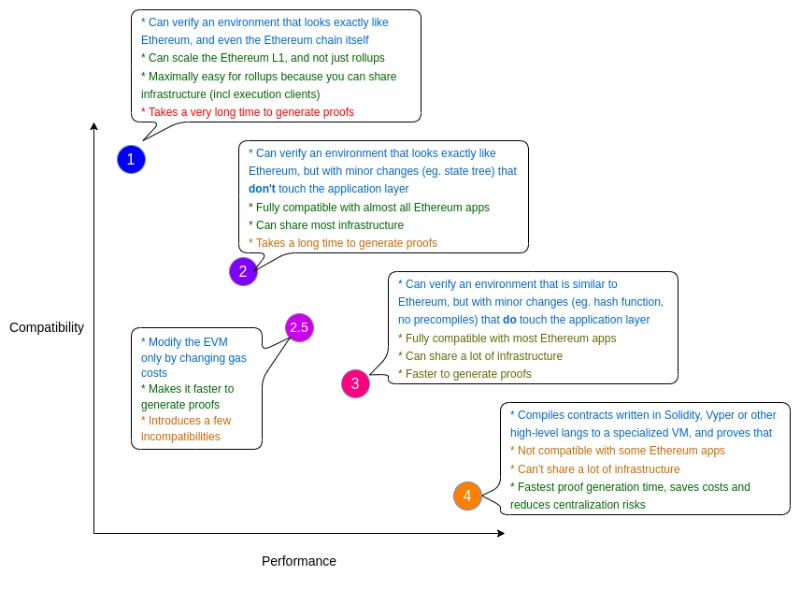
Scroll sits in the middle of this trade-off: they are building a type-2.5 zkEVM.
This means they are EVM-equivalent, with only very minor modifications to the gas cost structure.
What Sets Scroll Apart
By maintaining EVM equivalence, builders can directly migrate their applications from Ethereum L1 to Scroll without making any changes to their code. They are also fully open-source, allowing anyone to use and verify their code.
Scroll also uses a fork of Geth for its sequencer, inheriting battle-tested systems while achieving optimal compatibility with Ethereum.
This also means they can easily apply any new upgrades from Geth; other zkEVMs might need to increase code complexity to implement upgrades.
Scroll’s Architecture
Scroll’s architecture consists of three main components: the Scroll Node, the Roller Network, and the Verification Bridge.
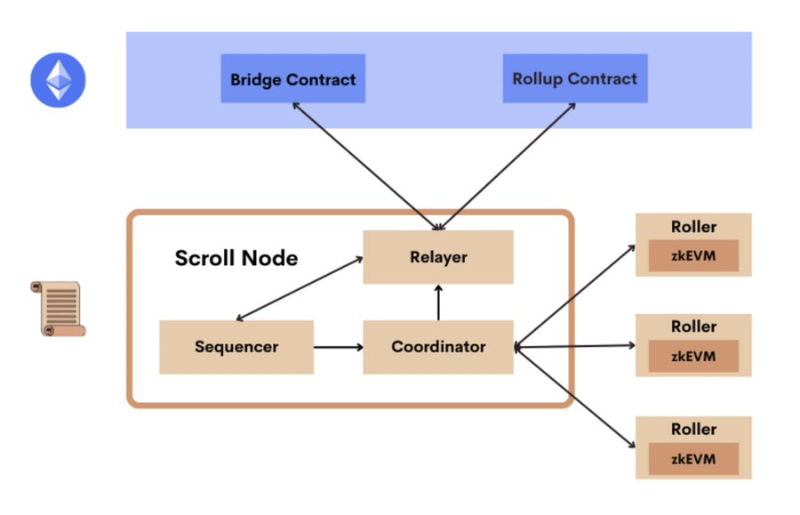
The purpose of the Scroll Node is to build blocks from user transactions and submit them to L1, as well as receive messages from L1.
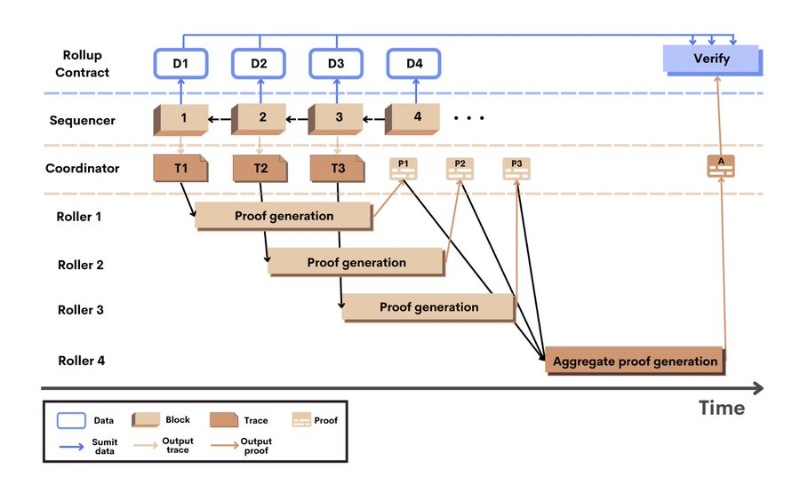
The Scroll Node has three main components: the Sequencer, Coordinator, and Relayer.
-
The sequencer receives a batch of transactions from the L2 mempool, executes them, and generates a new L2 block.
-
The execution trace of this block is then sent to the coordinator, which forwards it to a randomly selected Roller to generate a proof.
-
The relayer monitors the state of L2 blocks, their data availability, validity proofs from the rollup contract, and deposit/withdrawal events from the bridge contract to ensure everything is verifiable.
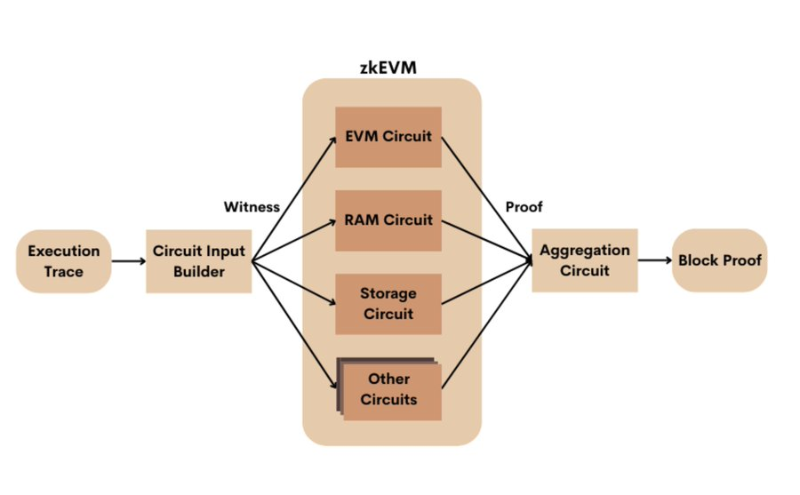
The Roller Network is responsible for generating validity proofs. It receives execution traces from the coordinator, routes them through seven different proving circuits, aggregates them into a final circuit, and sends the final block proof back to the coordinator.
The verification bridge consists of two contracts: the Rollup Contract and the Cross-chain Bridge Contract.
-
The Cross-chain Bridge Contract handles message passing between L1 and L2, including bridging transactions for ERC-20 tokens.
-
The Rollup Contract receives and stores state roots and block data as part of Ethereum's state and calldata. Once a block proof is verified by the rollup contract, the block is considered finalized.
Overall, after the sequencer creates a sequence of blocks and generates their proofs, multiple block proofs are aggregated into a single proof and sent via the coordinator to the rollup contract, where blocks are verified and finalized.
Roadmap
Over the past three months, Scroll has been in a pre-alpha testing phase, featuring permissioned smart contract deployments and whitelisted user access.
The next stage will be the Alpha testnet, where they will allow permissionless smart contract deployment accessible to anyone.
Scroll’s mainnet launch will occur in two phases.
-
Phase one will operate with a centralized sequencer and decentralized provers;
-
The primary goal of phase two is to decentralize the sequencer.
While phase two is still under active research, the current plan includes a PBS model for MEV extraction, an on-chain challenge mechanism, and a sequencer committee to enable finality before transaction completion on Ethereum L1.
Join TechFlow official community to stay tuned
Telegram:https://t.me/TechFlowDaily
X (Twitter):https://x.com/TechFlowPost
X (Twitter) EN:https://x.com/BlockFlow_News
 @blockworksres